President Trump & His Admin Allies Brutally Roast The Fake News | Drew Hernandez

During a recent press conference, President Donald Trump targeted CNN’s Kaitlan Collins, calling CNN “fake news” and mocking her question about U.S. airstrikes on Iran’s nuclear facilities, prompting laughter from his delegation. Trump dismissed a so called leaked Defense Intelligence Agency report cited by CNN, which suggested the strikes only set back Iran’s nuclear program by months which Trump vehemently denies is true. Trump insisted the sites were “obliterated” and slammed Collins for ignoring positive military achievements.

At a subsequent Pentagon briefing, Defense Secretary Pete Hegseth was questioned about not mentioning women involved in the Iran strikes, to which he emphasized the mission’s success and the bravery of all personnel, including both male and female crew members. Hegseth slammed the media for spinning the narrative to undermine Trump and the military, also grilling the “reporter” for worrying about political correctness over things that actually matter.

Sponsor | https://www.purgestore.com | Use promo code DREW for 20% off and support The Gateway Pundit today!

Follow Drew on X: https://x.com/DrewHLive
Follow Drew on Rumble: https://rumble.com/DrewHernandez

The post President Trump & His Admin Allies Brutally Roast The Fake News | Drew Hernandez appeared first on The Gateway Pundit.

Tesla’s Robotaxis Are Here

8-x---teslas-robotaxis-are-here---frame-at-0m11s

8-x---teslas-robotaxis-are-here---frame-at-0m11s

Tesla’s Robotaxis Are Here: Technological breakthrough or disguised control?

Austin, Texas has been chosen as the launchpad for what many are calling the dawn of a new transportation era: Tesla has officially introduced its self-driving taxi service, with autonomous vehicles set to revolutionize urban mobility. Elon Musk, CEO of the company, celebrated the moment as “the culmination of a decade of hard work,” hailing the project as an unprecedented technological milestone. But behind the excitement lies a deeper concern—this shift could redefine not just the auto industry, but our personal freedom and privacy as well.

The pilot program features ten robotaxis operating within a limited area of Austin. While each vehicle currently includes a human monitor in the front seat, Tesla’s ultimate goal is to remove that safety layer entirely, handing over complete control to artificial intelligence. According to Musk, this would mark a giant leap toward a “safer, more efficient, and sustainable” future. What remains unsaid, however, is that every step toward full automation is also a step toward full surveillance and control.

On paper, an autonomous transport service sounds convenient: fewer accidents, reduced traffic, and lower emissions. But in practice, this kind of technology demands constant surveillance, mass data collection, and—most disturbingly—total dependency on centralized systems managed by giant tech corporations. What happens when the AI driving you also knows where you’re going, how long you stay, who you meet, and when you leave? What if an algorithm deems your destination “problematic” or flags your profile as a “security risk”? The same logic that now censors political speech online could easily be applied to your physical movements tomorrow.

This isn’t just about the transportation market—it’s about individual freedom in a world increasingly digitized and governed by ideological and corporate powers. If the same tech giants that censor dissent, promote woke ideology, and cooperate with governments to enforce narratives are now managing your mobility, we are surrendering control of our cities—and our choices—to hands that do not answer to the people, but to technocratic design.

Moreover, this project aligns suspiciously well with the globalist agenda of the “Great Reset,” which aims to replace private ownership with shared services controlled from the top down. If you no longer own your vehicle and depend on a robotaxi to move around, you are fully vulnerable to the system. A simple digital restriction or profile suspension, and suddenly you can’t go to work, church, or visit family. The issue isn’t the technology—it’s who controls it, and why.

The launch of Tesla’s robotaxis isn’t just a story of innovation—it’s a warning. It shows how the tech utopia of tomorrow can quickly morph into a dystopia of surveillance, obedience, and control. As free citizens, we must demand transparency, safeguards, and alternatives—before automation becomes a tool of invisible chains.

#TeslaRobotaxis #TechControl #GreatReset #FreedomlessMobility #ElonMusk #DigitalSovereignty #SurveillanceTransport

The post Tesla’s Robotaxis Are Here appeared first on The Gateway Pundit.

A Weakened and Tired Looking Ayatollah Khamenei Declares Victory Over US and Israel in Thursday Speech (VIDEO)

Ayatollah Khamenei congratulated Iran for their victory over the US and Zionist regime on Thursday.

Ayatollah Khamenei came out from his hidden bunker on Thursday to deliver a sermon and make threats against America and Israel.

During his talk, Khamenei congratulated Iran for their victory(?) over the US and Zionist regime.

Khamenei was absent for several days before today’s public sermon. He obviously was petrified of the targeted attacks that took out several leaders close to him.

There was no audience sound during this video production.

Here is part of his sermon:

Via MEMRI.

Supreme Leader Khamenei: “I should congratulate the people. First, I would like to congratulate them on the victory over the fake Zionist regime. With all its clamor and pretension, the Zionist regime was almost annihilated and crushed under the blows of the Islamic Republic…

…”Nevertheless, they have achieved nothing in this war. They attacked our nuclear facilities – and this, by itself, warrants punishment by the international courts – but they failed to achieve anything significant. The U.S. President has disproportionately exaggerated in describing what happened. It turns out that he needed such exaggerations.”…

…”On the other hand, the Islamic Republic landed a resounding slap in America’s face. It attacked Al-Udeid Base, one of the most important U.S. based in the region, and inflicted damage on it. The same people who exaggerated about [the damage to Iran’s nuclear site] have tried to belittle what happened in this case. They said that nothing happened, while a great thing did happen.”

Video via MEMRI and ALX:

The post A Weakened and Tired Looking Ayatollah Khamenei Declares Victory Over US and Israel in Thursday Speech (VIDEO) appeared first on The Gateway Pundit.

Former Rep. Jamaal Bowman Says N-Word Is to Blame for Blacks Suffering from Obesity, Cancer, and Heart Disease (VIDEO)

Jamaal Bowman / CNN

Former Congressman Jamaal Bowman has claimed that black people are suffering from serious medical conditions because they are called the N-word so regularly.

Appearing on a CNN panel on Thursday, Bowman outlined his theory that rates of cancer, obesity, and heart disease are higher among black Americans because of people allegedly using the N-word.

“I’m a black man in America,” Bowman explained.

“The reason why heart disease and cancer and obesity and diabetes are bigger in the black community is because of the stress we carry from having to deal with being called the n-word directly or indirectly every day.”

Bowman’s rhetoric was so bizarre and extreme that even the Democratic Party ultimately rejected him.

In last year’s Congressional primary, Bowman lost to former New York State Assemblyman George Latimer by over 20 points.

In the wake of President Trump’s landslide election victory, Bowman openly attacked white people for not supporting his political ideas and claimed that some are simply “too far gone.”

“Dear White People,” he wrote at the time. “I don’t know why I feel the need to keep talking to you. I don’t know why part of me still has hope for you and for us.

“Some of you are too far gone. But maybe enough of you aren’t and will join us in fighting to end white supremacy.”

“I just wanna call out the hypocrisy and evil of it all and just continue to hope.

”I won’t rely completely on you because I know what’s most important is to work with my community and other like minded allies in the fight for justice.”

The post Former Rep. Jamaal Bowman Says N-Word Is to Blame for Blacks Suffering from Obesity, Cancer, and Heart Disease (VIDEO) appeared first on The Gateway Pundit.

Supreme Court Greenlights States to Cut Off Medicaid Funding for Planned Parenthood in Major Win for Pro-Life Advocates

Credit: Robin Marty / Flickr

The U.S. Supreme Court on Thursday paved the way for states to block Medicaid funding from going to abortion giant Planned Parenthood.

The high court’s decision, which comes after years of legal wrangling, affirms the authority of individual states to determine how taxpayer dollars are allocated — and who gets excluded.

In a landmark 6-3 ruling, the U.S. Supreme Court has ruled in Medina v. Planned Parenthood South Atlantic that individual Medicaid recipients do not have the right to sue states under federal law for excluding abortion providers like Planned Parenthood from their Medicaid programs.

The Court’s decision, authored by Justice Neil Gorsuch, reversed a ruling from the Fourth Circuit and solidified the state of South Carolina’s authority to remove Planned Parenthood from its Medicaid network—without fear of federal lawsuits from individual patients or abortion activists cloaking themselves in civil rights statutes.

This case arose after South Carolina decided in 2018 to terminate Planned Parenthood’s participation in its Medicaid program, citing a state law that bans the use of public funds for abortion.

Abortion advocates predictably sued under 42 U.S.C. §1983, claiming the state violated a supposed “right” under the Medicaid Act’s “any-qualified-provider” provision.

Justice Gorsuch clarified that this provision does not confer individually enforceable federal rights. It is a directive to states, not a free pass for left-wing groups to weaponize the courts every time a state takes a stand for life.

“The decision whether to let private plaintiffs enforce a new statutory right poses delicate questions of public policy. New rights for some mean new duties for others. And private enforcement actions, meritorious or not, can force governments to direct money away from public services and spend it instead on litigation,” Gorsuch wrote.

He continued, “The job of resolving how best to weigh those competing costs and benefits belongs to the people’s elected representatives, not unelected judges charged with applying the law as they find it.” 

Read the ruling below:

The post Supreme Court Greenlights States to Cut Off Medicaid Funding for Planned Parenthood in Major Win for Pro-Life Advocates appeared first on The Gateway Pundit.

Suspicious “Crucifixion” Murder – Suspect Admits He Planned to Kill 14 More Christian Leaders

Adam Christopher Sheafe, 51 (Credit: Coconino County Sheriffs Office)

Disturbing revelations have emerged from a jailhouse confession by 51‑year‑old Adam Christopher Sheafe, accused of the grotesque crucifixion-style murder of Pastor William “Pastor Bill” Schonemann, 76, who led the New River Bible Chapel in Arizona.

Sheafe told True Crime Arizona that he deliberately targeted Schonemann, stating he drove from Phoenix “around two in the morning on a Sunday night,” found the pastor mid‑Bible‑study, and executed him—pinning him to the wall in a haunting reenactment of the crucifixion. He even placed a crown of thorns from nearby woods on Schonemann’s head.

Sheafe framed his actions as a self‑declared “divine mission” under what he called “Operation First Commandment”, arguing that Christian leaders were “leading their flock astray” by following “a false God.”

ABC15 reported, “According to Sheafe’s own words, his motive was fueled by his religious beliefs, claiming that Christianity is wrong and that the Bible should only be the Old Testament.”

“Because what I’m saying is, what you’re preaching is not what God said. It’s the opposite of what God said,” Sheafe said.

Sheafe admitted that 14 other clergy members across ten states were on his hit list—including priests and pastors in cities such as:

  • Phoenix, AZ
  • Sedona, AZ
  • Las Vegas, NV
  • Portland, OR
  • Seattle WA
  • Billings MT
  • Detroit, MI
  • New York, NY
  • Charlotte NC
  • Mobile AL
  • Beaumont, TX
  • El Paso, TX
  • Phoenix AZ

Authorities say Sheafe currently faces first‑degree murder charges in Maricopa County, with the possibility of a death-penalty prosecution.

“Put me on death row, set the execution date for right now,” Sheafe said. “The victims want it. The victim’s families want it. I want it, and the taxpayers want it.”

ABC15 reported:

He told ABC15 he loves God and is “protective” of him. Sheafe also denied being part of any group with his beliefs.

Sheafe was ultimately arrested with the help of multiple agencies, including Sedona police. The string of alleged felonies he’s now charged with in Coconino County helped lead law enforcement to the now self-proclaimed killer.

Sheafe said that, days after his arrest, he wrote to the FBI, confessing, sharing details that would only be known by the person who was at that crime scene.

Sheafe has a lengthy criminal history that already spans multiple states.

At a recent press conference, Maricopa County Sheriff Jerry Sheridan described this as the most “bizarre” case he’s seen in his decades with the agency.

[…]

“Will God forgive me?” said Sheafe. “Of course, he will forgive me. He’s a loving God. He’s a forgiving God.”

The post Suspicious “Crucifixion” Murder – Suspect Admits He Planned to Kill 14 More Christian Leaders appeared first on The Gateway Pundit.

Mexico Joins the List of US Adversaries: AG Bondi Says Trump Will Not Be Intimidated

captura-de-pantalla-2025-06-26-150743

captura-de-pantalla-2025-06-26-150743

In a statement that has captured national attention, former Florida Attorney General Pam Bondi issued a stark warning: the United States will not be intimidated by any foreign actor threatening its security — including Iran, Russia, China… and Mexico.

“We will not be intimidated, and we will keep America safe thanks to President Trump’s leadership — not just against Iran, but also against Russia, against China, and against Mexico, against any foreign adversary,” Bondi declared on national media.

These words not only reaffirm the Republican commitment to national security, but also, for the first time in years, explicitly place Mexico on the list of strategic threats to the United States. The statement sent shockwaves through diplomatic circles, but for millions of Americans, it simply reflects a truth that can no longer be ignored: the southern border is now one of the main threats to American life, health, and stability.

Mexico: From Troubled Neighbor to Strategic Threat
For years, the official narrative portrayed Mexico as a “necessary partner” in the region. However, data and lived experience in border communities have shattered that illusion. Far from being a strategic ally, Mexico has become a launchpad for drug trafficking, human smuggling, weapons distribution, and illegal migration.

The fentanyl crisis has been the catalyst for this change in discourse. According to DEA reports, most of this deadly drug enters the U.S. through the southern border, distributed by Mexican cartels with impunity. The Trump administration — both in its first and second terms — has made it clear that this will no longer be tolerated.

“Whether they try to kill us physically or overdose our children with drugs, we will do everything in our power, thanks to President Trump’s leadership, to keep America safe,” Bondi said.

Trump’s Leadership: Unapologetic and Firm
Under President Donald J. Trump, national security policy no longer hides behind vague language. The definition of an adversary has been expanded: it’s not limited to military powers or economic rivals — it also includes governments that allow criminal organizations to operate freely from their soil.

Mexico has consistently failed to contain its cartels. Worse still, it has often enabled or turned a blind eye to their activity. Mexican criminal networks don’t just traffic drugs; they traffic people — including thousands of women, children, and migrants who are exploited or killed every year, often within full view of authorities.

President Trump has called this what it is: an invasion. Waves of uncontrolled migration — aided by criminal enterprises — are crippling the health, education, and security systems of American cities. Under his leadership, border protection has become national policy, not just diplomatic rhetoric.

Israel, Iran, and the Moral Duty to Protect Our Allies
While much of Bondi’s message focused on the growing threat posed by Mexico, she also reaffirmed America’s unwavering support for Israel, especially as tensions with Iran escalate.

Pam Bondi reminded Americans that under Trump, the U.S. regained global respect by acting with clarity — whether it meant ordering the strike on Iranian General Qasem Soleimani or moving the U.S. embassy to Jerusalem despite international backlash.

This clear doctrine — support your allies, confront your enemies — is now stronger than ever in Trump’s second term. Bondi’s warning is simple: the U.S. will not hesitate to act against those who threaten its safety or that of its allies — whether with bombs or with poison pills.

The Border Is the Soul of the Nation
The southern border is no longer a matter of immigration policy. It is a national fault line — a clash between two worldviews: one that tolerates chaos under the guise of “compassion,” and another that defends order, sovereignty, and American values.

Pam Bondi, by naming Mexico among America’s adversaries, shattered a long-standing political taboo and did so with the backing of an administration that has put American citizens first once again.

Conclusion: No Apologies for Defending EE.UU.
In a world that’s increasingly hostile and unstable, security is not optional. Under President Trump’s leadership, the doctrine is clear: zero tolerance for those who threaten the life and liberty of Americans.

Pam Bondi gave voice to what millions already know: the threat doesn’t always come from across the ocean. It’s crossing our border every single day.

And this time, EE.UU. will not look the other way.

The post Mexico Joins the List of US Adversaries: AG Bondi Says Trump Will Not Be Intimidated appeared first on The Gateway Pundit.

Massive Fireball Spotted Streaking Across Southeastern U.S. Skies (VIDEO)

Screenshot of fireball via Collin Rugg on X


This isn’t something you see every day!

Residents in the southeastern part of the United States spotted a massive fireball streak through the skies on Thursday afternoon.

The American Meteor Society reported receiving over 140 reports from residents of Georgia, Alabama, Florida, North Carolina, and South Carolina who had spotted a fireball.

Residents in Georgia reported feeling an earthquake as the fireball crossed the sky.

The National Weather Service assured residents in Georgia that the earthquake they felt was “the result of the sonic boom from the meteor or space junk.”

WATCH:

Another angle:

Per Fox 5 Atlanta:

Officials across the Southeast say they are investigating reports of a “fireball” seen in the sky Thursday afternoon.

According to the National Weather Service, radar could not fully track the object due to its altitude and speed, and satellite imagery—which updates only every few minutes—missed it. However, the Global Lightning Mapper (GLM), an instrument designed to detect lightning flashes in the upper atmosphere, registered the event. The object’s entry into the atmosphere created a flash similar to lightning, allowing the GLM to capture data showing the event over eastern metro Atlanta.

Meteorologists with the National Weather Service report a radar imagery revealed distinct signatures typically associated with falling meteorites.

Witnesses from as far south as Macon and as far north as Upstate South Carolina reported a bright flash in the sky. Moments later, many said they felt what appeared to be an earthquake — though officials have since attributed the shaking to a sonic boom.

ABC News revealed that one resident in Henry County, Georgia, reported a “rock” went through their ceiling around the time the fireball was spotted in the skies.

LOOK:

Here was a nice shot of the fireball:

The post Massive Fireball Spotted Streaking Across Southeastern U.S. Skies (VIDEO) appeared first on The Gateway Pundit.

Battle Hymn of the Technological Republic

Battle Hymn of the Technological Republic

Tech tycoons are reflecting on the common good—but that doesn’t mean their plans would be good for our nation.

Corporate CEO's Speak At The Hill & Valley Forum On Capitol Hill
(Kevin Dietsch/Getty Images)

The Technological Republic: Hard Power, Soft Belief, and the Future of the West. Alexander Karp and Nicholas Zamiska. Crown Currency, 2025. 295 pages.

It is a striking fact of the British experience in the First World War that, in proportional terms, the upper classes paid the heaviest price. “The sons of the ‘best’ families rushed to the colors in 1914,” one historian of the war relates, “and the death rolls of the aristocratic public schools were far in excess of the general average.” The ruling class filled out the officer corps, and officers—the first to go “over the top”—were nearly one and a half times as likely to be killed as ordinary soldiers. 

Looking back, there is something about this that beggars belief, especially for a country as unequal as pre-1914 UK. But it was noblesse oblige, no less than a remarkably self-confident culture, that built Britain into a globe-spanning empire. Nor was this situation unique. Throughout history, elites with skin in the game have been a hallmark of the most successful states. Conversely, societies whose leading citizens lose their sense of duty—one thinks of imperial Rome in her twilight centuries, or France just before the Revolution—are not long for this world.

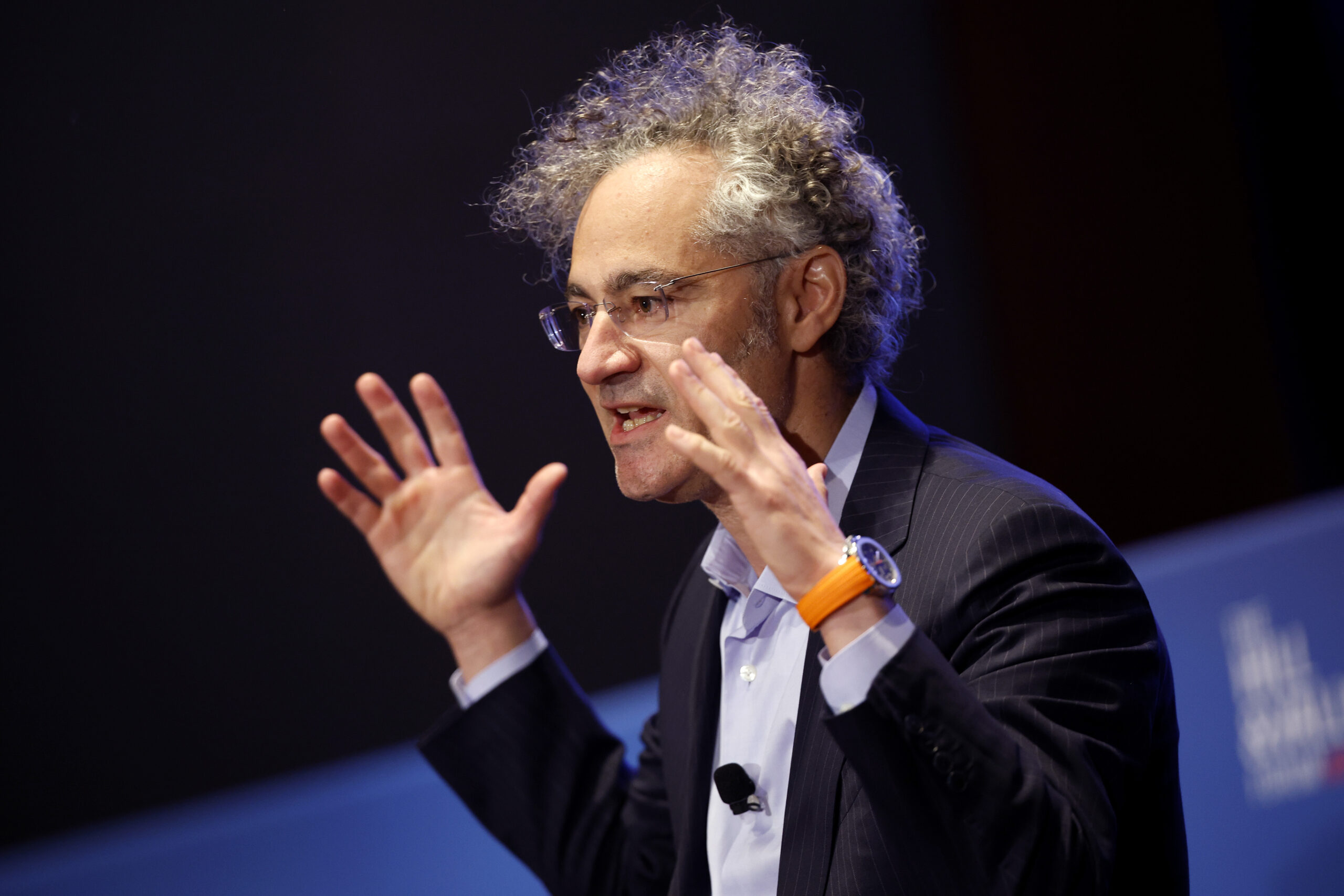
Alexander Karp and Nicholas Zamiska, the authors of The Technological Republic, have clearly taken this lesson to heart. They warn that America’s own elites have become unmoored from any sense of broader purpose: Aimless drift afflicts the best and the brightest, who fritter away their talents on ephemera and trivialities. The problem is particularly acute in the tech sector, that crown jewel of the U.S. economy. “The grandiose rallying cry of generations of founders in Silicon Valley was simply to build,” the authors observe. “Few asked what needed to be built, or why.” The result has been a withdrawal from truly challenging or useful work, and a corresponding tendency to pursue self-enrichment and avoid making waves. Instead of curing cancer or colonizing space, we have created Uber and Instagram.

Although this abandonment of collective ambition would be bad enough under normal circumstances, for Karp and Zamiska (who are, respectively, the CEO and corporate affairs director of the defense contractor Palantir) the timing could not be worse. The wolves are at the door; geopolitical rivals stand ready to eat the West’s collective lunch. What is called for is nothing less than “a reassertion of national culture and values” that will inspire America’s most brilliant scientific and engineering minds to contribute to her defense.

Integrating Silicon Valley into the military–industrial complex is, of course, Palantir’s raison d’être, and as a business model it has proven astonishingly successful. Since the company’s founding in 2003, it has grown into a force to be reckoned with: a major publicly traded firm with thousands of employees, an impressive government order book, and a market cap hovering around $200 billion. Its mainstay is software and analytics (“products for human-driven analysis of real-world data,” as the corporate website has it), and a record of delivering for clients in the shadowy worlds of intelligence and defense has imbued the brand with a mysterious, vaguely sinister aura. 

Palantir’s performance has also had a lasting impact on the broader defense industry, turning what had been the province of a few lumbering companies (the so-called “legacy primes,” like Lockheed Martin or Boeing) into an attractive field for start-ups. According to the Financial Times, the value of defense-focused venture capital deals has increased 18-fold over the past decade, fueling the rise of a new breed of contractor epitomized by companies like Anduril, Shield AI, and Epirus.

Not content merely to inspire imitators, Palantir has increasingly sought to influence its ecosystem more directly. Its CTO, Shyam Sankar, is a fixture on Capitol Hill, and last year he caused a mild stir in the defense world with the publication of “The Defense Reformation,” a collection of 18 “theses” on acquisition reform meant to evoke Luther at Wittenberg. The company has also set up the Palantir Foundation, a “nonpartisan organization dedicated to advancing national security” by publishing a magazine, hosting conferences, and sponsoring fellowships. And Karp himself has been a constant media presence of late, carefully cultivating the image of a quirky philosopher-executive bent on disrupting the status quo.

Disruption, in the Silicon Valley sense of the word, is a central theme of The Technological Republic. The dust jacket promises an “iconoclastic” argument, though the degree to which the work echoes the conventional wisdom of both Washington and Palo Alto—not to mention the fact that it carries blurbs from such pillars of the establishment as Jamie Dimon, Walter Isaacson, James Mattis, and David Ignatius—belies this claim. 

But if this is a knock against the book, it also speaks to the success of Karp’s broader project. Things appear to be going his way. With the aforementioned raft of new contractors, tech knowhow and money are flowing into the defense sector at record levels. Under the second Trump administration, the Pentagon has moved quickly to make weapons-buying faster, more cost-effective, and more flexible. Big changes to acquisition are also likely to come out of this year’s National Defense Authorization Act, many provisions of which have been crafted with an eye toward shifting the MIC’s cultural lodestar from the Beltway to the Bay Area. We may, in fact, be in the middle of the most profound shift the defense industry has undergone since the “Last Supper” of the early ’90s, thanks in no small part to the pathfinding work of Palantir. 

Another of the book’s signature ideas, the launch of a “new Manhattan Project” for AI, is also arguably under way. January saw the announcement of the Stargate Initiative, a government-backed venture that will dramatically expand America’s AI infrastructure—and at $500 billion, the price tag of this project is more than ten times the inflation-adjusted cost of the actual Manhattan Project. 

And although Elon Musk’s tenure at DOGE has come to an end, the broader push for government efficiency can be read as an attempt to implement Karp and Zamiska’s recommendation that “the public sector… incorporate the most effective features of Silicon Valley’s culture to remake itself.” 

Defter pens might have better camouflaged the hollowness of this contrarian self-presentation. But considered as literature, The Technological Republic is a bit of a disappointment. It is marred by clunky and repetitive prose, with arguments that often veer into cliché. And although the authors pull in an impressive range of historical anecdotes, data, and case studies, they don’t quite manage to fit it all together. The impression left is one of mildly interesting eclecticism rather than brilliant theoretical synthesis.

But what of the central contention—that a partnership between Big Tech and the Pentagon can save the country?

Karp and Zamiska’s argument is premised on their view of the international system. They believe, rightly, that the world is an enduringly dangerous and anarchic place, and that civilization, though infinitely preferable to barbarism, can also be more fragile. The order necessary for it to thrive must, in the final instance, be upheld by force. And this, in the Year of Our Lord 2025, inevitably implicates the U.S. military.

So far, so good. But where the authors overshoot is in their omnivorous appetite for enemies. It’s not just Beijing we need to worry about—there are repeated references to various adversaries who maddeningly go unspecified (though last year, Karp told the New York Times he found the prospect of simultaneously fighting Russia, Iran, and China “very likely”). One gets the sense that the “moment of reckoning” the authors see us inhabiting is meant to encompass a confrontation with the entire membership of the so-called “Axis of Upheaval” everywhere, all at once. 

In the spring of 2025, however, the prospect of such a Götterdämmerung appears a little remote. The read of China is of course accurate—more on this in a moment—but the United States today is engaged in intensive, plausible efforts to end by diplomacy both the Russia-Ukraine war and the Iranian nuclear program. (It’s perhaps unfair to expect a book written before the election to have anticipated Trump’s foreign policy, but here we are.) Far from World War III, the present administration has a shot at delivering the most stable international environment in a generation.

The major threat—indeed, the only one to rise to the level of the truly existential—is China. Karp and Zamiska, quite correctly, identify Xi Jinping as a ruthless, steely-eyed realist who understands the supreme importance of hard power. And then they stop. In the book’s 200-odd pages, we get less than a single page addressing the actual nature of the challenge that the United States must dedicate itself to containing, deterring, and, if necessary, defeating. This is a shame, because we are sorely in need of outside-the-box and technologically-savvy thinking on the geopolitical rivalry that will define this century.

Nevertheless, the book’s case for techno-rearmament doesn’t rest solely on the purportedly grim state of world affairs. Silicon Valley represents one of the most remarkable assemblages of brainpower in human history; there is indeed something shabby about all this talent working to make social media apps slightly more addicting. National defense offers a grander purpose. (And it doesn’t hurt that it can also be quite lucrative, as Palantir’s trajectory shows.) Moreover, the authors point out that their industry’s origins are inextricably tied to government investment during the Second World War and the Cold War. The tech sector, therefore, “has an affirmative obligation to support the state that made its rise possible.”

On a deeper level, there is also the idea that coercion can impart legitimacy and unity to the society that employs it. In a recent speaking appearance, Karp observed that a healthy culture should take “pride in occasionally using violence.” The enterprise of defense appears uniquely rejuvenating, perhaps because it strips away the frivolity and timidity and endless compromises that characterize our present elite. War is a force that gives us meaning, to filch from Chris Hedges.

The great irony, of course, is that few things have done more to undermine faith in the American project than the pursuit of a blinkered vision of national security. The War on Terror saw the sacrifice of thousands of lives and trillions of dollars to achieve what were plainly fantastical goals, even as the United States’ only real rival was allowed—even encouraged—to gather its strength. The squandering of the post–Cold War moment in favor of nation-building and military adventurism; the mendacity and hubris that got us into Iraq and kept us in Afghanistan; the sudden and ignominious end of the affair: All these took a grievous toll on America’s influence, power, and national self-image. 

Yet the book never accounts for this fact. One searches the text in vain for any meaningful critique of the U.S. foreign policy establishment, any recognition of its blunders over the past three decades. Far from provoking reflection, the widespread skepticism of our undisciplined national security state is attributed to a kind of senseless nihilism (the “soft belief” of the book’s subtitle). Principled rejection of America as the world’s policeman appears ipso facto impossible. It is explainable only as a cop-out, a way to evade hard choices in a fallen world. 

This is not to say that tech companies should avoid working with the Pentagon—far from it. Our creaking industrial base is in dire need of the rejuvenation such firms can bring. But it does suggest they should pay attention to policy ends as well as means. Any partnership should leverage Silicon Valley’s outsider thinking, not just to build better weapons, but to drive better strategy. In fact, the most compelling portions of The Technological Republic are those devoted to Palantir’s management and organizational culture. Karp and his lieutenants draw inspiration from sources as diverse as the behavior of bees (who, they inform us, succeed by “distributing autonomy to as great a degree as possible to the fringes”) and a 1979 guide to improvisational comedy. This approach—unorthodox for arms makers, normal(ish) for tech companies—has clearly delivered, and the U.S. government could stand to learn a thing or two from it. 

Just as importantly, the U.S. government will need to scrutinize the motives and operations of tech firms seeking lucrative defense contracts, especially given the documented patterns of monopolistic behavior, censorship and political bias, and—in the worst cases—active cooperation with the PRC that characterize some of Silicon Valley’s biggest players.

Karp obtained his doctorate from Goethe University in Frankfurt, and has been deeply influenced by the German philosophical tradition (indeed, he has stated elsewhere that The Technological Republic is “quite Germanic under the hood”). So it is a safe bet that he has read Heidegger’s “The Question Concerning Technology,” in which the greatest philosopher of the 20th century observes that technology is not a neutral instrument that can be suited to any task. “It is technology itself that makes the demand on us to think in another way,” he cautions, and if we are not careful, it will subsume and choke out other modes of being. The universe would then be turned into a vast machine, with nature and even man himself reduced to nothing more than a pool of regimented inputs (what Heidegger refers to as a “standing reserve”).

It is in this light that the book’s title must be considered. What is a “technological republic”? Curiously, the authors give this question little attention. For them, the phrase seems to signify only that America’s “place in the world has been made possible and advanced by its capacity for innovation,” and that the tech sector must accept a larger role in civic life (elsewhere, they submit it also reflects the dependence of American legitimacy on “technical outperformance”). But this is not the whole story. To say that we are a technological republic is to say that the imperatives so penetratingly identified by Heidegger as inherent to technology—the homogenization and flattening-out of experience, the utter rejection of limits, the transformation of subjects into objects—are also inherent to America. 

Nowhere is this dynamic more observable than in the book’s discussion of AI. As the authors frame it: 

The choice we face is whether to rein in or even halt the development of the most advanced forms of artificial intelligence, which may threaten or someday supersede humanity, or to allow more unfettered experimentation with a technology that has the potential to shape the international politics of this century in the way nuclear arms shaped the last one.

It will come as no surprise which option they recommend. If we are skeptical of anything, they go on to claim, it should be those “elites of Silicon Valley, who for years recoiled at the suggestion that software was anything but our salvation…[and] now tell us we must pause vital research that has the potential to revolutionize everything from military operations to medicine.” And in any case, it is not really a choice at all, because if we don’t, the Chinese will. In other words, the mere fact that the thing can be done means it must be done. Technology itself forces our hand.

There are other implications as well. The ethos of technology is globalist. It cannot abide constraint, and it cannot stand still. A technological republic must therefore project itself ceaselessly into the world—hence the imperative for foreign policy interventionism.

Aspects of what might be called “technologism” have been with us since the Founding, as the authors rightly note. And not even Heidegger believed we should (or could) somehow put the genie of modern technology back in the bottle. But this ethos has always coexisted with, and been held in check by, another vision of America. From Andrew Jackson to Christopher Lasch, a diverse array of doers and thinkers have striven to define the country differently—not as a universalizing engine, driven by the logic of science hitched to the incentives of the cash nexus, but as a particular and unique society, rooted in place, culture, and the recognition of limits. 

The most committed agents of technologism have been elites; too often, their victims have been everybody else. This is one way to explain the current political moment, since the developments that have fueled Trump’s electoral successes—deindustrialization, mass immigration, foreign policy adventurism—can be chalked up to the technologist ethos run amok. The promise of his movement has been to control and even reverse it. (Of course, the case should not be overstated; Trumpism contains multitudes, and another of its strands is the techno-utopianism represented by, for example, Elon Musk.)

In fairness, Karp and Zamiska do recognize some of this. “What we need is more cultural specificity,” they write, together with “a re-embrace of collective experience, of shared purpose and identity, of civic rituals that are capable of binding us together.” But they don’t seem to have fully grappled with the contradictions implicit in their aims. How, for example, is the unrestricted development of AI, which has the potential to utterly remake our economy and even our self-understanding as a species, compatible with preserving the country’s existing “cultural specificity”?  

Whatever unresolved tensions exist in the text, a clarion call to Silicon Valley is long overdue, and Karp and Zamiska deserve credit for issuing one. The future of the United States indeed depends on its most talented citizens working for something greater than themselves. But it is not enough merely to have a national project. What that project is, and how it is accomplished, count for just as much.

Consider again the case of the First World War. British elites threw themselves into the war, committing body and soul to the greatest collective effort in their history up to that point. But no amount of sacrifice could make up for the sheer folly of the enterprise. Britain involved herself in an epochal and entirely avoidable catastrophe, one that—in addition to senselessly killing off the leading lights of an entire generation—irreversibly weakened the foundations of her power. Channeled wrongly, an excess of national purpose can be just as dangerous as its absence.

The post Battle Hymn of the Technological Republic appeared first on The American Conservative.

The Burgeoning Fight Between MAHA and the Tech Right

The Burgeoning Fight Between MAHA and the Tech Right

The big business of medicine is trying to coopt the MAHA moment in the administration.

Independent,Presidential,Candidate,Robert,F.,Kennedy,Jr.,Announced,'no,Spoiler'

Credit: image via Shutterstock

President Donald Trump proclaimed victory in 2024 thanks in part due to his success at forging a broad coalition across both the country and political spectrum. Trump’s traditional MAGA base was joined by economic moderates, business opportunists, foreign favor-seekers, and anti-interventionists. Perhaps most notably, the Democrat-turned-independent presidential candidate Robert F. Kennedy’s Make America Healthy Again movement rallied around Trump to help push him over the victory line against Vice President Kamala Harris.

Health-conscious and “expert”-skeptical, the Make America Healthy Again movement, or MAHA for short, was the result of an ideological split in the left-wing, environmentalist green movement. 

Once upon a time, activists of the tree-hugging, organic food–purchasing, anti-establishment, hippie variety who had nothing but distrust for Big Pharma and the institutional status quo were widely considered to be as far from the Republican Party as humanly possible.

But in the early 2000s, activists in the green and alternative movement found themselves joined—and soon essentially replaced—by a new breed of suit-and-tie, Trust the Science environmentalist. Epitomized by Al Gore and his documentary An Inconvenient Truth, these new activists were men and women of white coats, bar charts, and peer-reviewed studies with an almost religious devotion to “Science,” “Institutions,” and “The Data.”

When Covid-19 hit in 2020, their mantra “trust the science” quickly morphed into “trust Big Pharma” and “do as you’re told,” and it became apparent that a split with the anti-authoritarian, pharma-skeptics who built the movement was inevitable.

This group (for the most part) rallied around Kennedy’s 2024 presidential campaign, and many of them stood by his side when, in August, Kennedy dropped out of the race to endorse Trump, attaching MAHA to the Republican MAGA coalition. With Trump’s electoral victory, and Kennedy’s elevation to the position of secretary of health, it is clear who won the battle in the end—the Trust the Science faction having been effectively decimated in the backlash which took place against the illogical authoritarianism of the Covid-19 pandemic.

Nevertheless, as old opponents lick their wounds, a new one looms on the horizon—an faction that has wormed its way, and continues to worm its way, into the Trump administration at an alarming rate: the ever-opportunistic tech-right.

Fresh off Trump’s 2024 election victory (which was in part made possible thanks to donations from Silicon Valley allies, including Elon Musk), former adversaries of the America First movement were given passage into the new administration. Musk was appointed head of DOGE, giving him considerable power in government despite the fact this his “department” was officially nothing more than an advisory committee; senior executives from Facebook parent company Meta, OpenAI, and Palantir were appointed lieutenant colonels in the U.S. Army as part of a new detachment specifically formed for Big Tech; and Silicon Valley–backed health startups were also able to take advantage of the new political environment.

Casey Means, an advocate of alternative medicine and the co-founder of the health company Levels, was nominated by Trump to serve as surgeon general after the president withdrew his previous nomination of Janette Nesheiwat. Her brother, Calley Means—a former NeverTrump conservative, lobbyist, and the co-founder of health tech company Truemed—was also made a special government employee.

After Trump announced Casey Means’ nomination in May, praising her “impeccable ‘MAHA’ credentials,” Kennedy’s former running mate Nicole Shanahan publicly criticized the move.

“It’s very strange. Doesn’t make any sense,” said Shanahan, who wrote that there was “something very artificial and aggressive” about the siblings, “almost like they were bred and raised Manchurian assets.”

“I was promised that if I supported RFK Jr. in his Senate confirmation that neither of these siblings would be working under HHS or in an appointment (and that people much more qualified would be),” she continued, before suggesting that somebody seemed to be “controlling” Kennedy’s decisions in the Trump administration.

And it wasn’t just Shanahan who had concerns. The appointment of the Means siblings to positions of power within the Trump administration has sparked an all-out war in the MAHA movement, with several prominent activists raising alarms over their controversial business ties.

“The Means siblings, I maintain, are representing Silicon Valley’s interests, and not ours,” wrote MAHA author and activist Naomi Wolf in an article last month. “I said — and again, I stand by every word — that they both appear to be tasked with representing Big Tech’s interests in the rush to exploit the gold mine that is the pristine, valuable data — especially our private medical data — that is currently held behind secure doors by the United States Government.”

Wolf warned that “the Trump administration was facing a catastrophic security risk,” pointing to Musk’s unprecedented access to data under DOGE and the Trump administration’s already poor track record with cybersecurity, before suggesting that Casey Means had been tasked with “plundering our government data, and of rerouting US health policy, to align with the interests of Big Tech; especially in the booming realm of biometrics.”

The Americans For Health Freedom founder Mary Talley Bowden also raised concerns about “conflicts of interest” within the MAHA movement—and Truemed in particular—while a six-month Vanity Fair investigation accused Calley Means of embellishing his history.

Truemed’s business model takes letters of medical necessity—the sort of things that used to have to be written down with a pen and paper by a doctor—and automates the process. By filling out an online form, it’s possible to write off a huge array of expensive lifestyle products as tax-free health expenses, including indoor saunas, specialty mattresses, and, in the case of Truemed-partnered merchant White Oak Pastures, organic beef testicles. 

From Peloton bikes to ergonomic mattresses—items which would usually cost thousands of dollars—Truemed’s website advertises a range of high-end, high-tech products which can now effectively be obtained for free (or at least as a tax write-off subsidized by the taxpayer).

For its part, Truemed maintains they aren’t up to any funny business. Responding to an Associated Press investigation earlier this month, the CEO and co-founder Justin Mares said the company is “in full alignment” with IRS guidelines on tax write-offs.

“Truemed enables patients to work with providers to use medical funds for root cause interventions like exercise and vitamin D to reverse disease under current law,” Mares said.

Undoubtedly there are far worse abuses of taxpayer’s money, including the recently gutted USAID, which spent eye-watering sums on boondoggles such as sex changes in Guatemala, puppet shows in Iraq, and condoms for the Taliban. But it’s easy to see why MAHA enthusiasts aren’t happy about the rewards of their hard-earned victory being seized by well-connected Silicon Valley types.

These tensions between MAHA and the Trump administration’s new Big Tech–aligned stakeholders mirror similar tensions between the populist base and the tech faction in the MAGA movement at large, which is probably one of the reasons why Wolf was invited to make her case against Truemed and Levels on Steve Bannon’s War Room– a show which has become the go-to media launchpad for skeptics of the tech-right in Trump’s coalition.

“I do see that Silicon Valley is gonna kind of align, or has aligned with MAGA and MAHA, not because they share MAGA or MAHA’s policy goals at all, but because they can use those as cover for what they really want,” said Wolf. “Which is our data and a bunch of favorable legislation and policies out of the president and RFK Jr.”

From the pre-inauguration spat over H1B visas, to Musk’s legendary crashout over Trump’s Big Beautiful Bill, a burgeoning MAHA civil war can now be added to the growing list of fault lines between the tech-right and other parts of the MAGA coalition.  

Just as the green movement was hijacked by Democratic Party operatives and Net Zero plutocrats in Davos, MAHA once again faces the prospect of having to fight for the spoils of the political victory it helped to create.

The post The Burgeoning Fight Between MAHA and the Tech Right appeared first on The American Conservative.