This story originally appeared on vigilantfox.com and was republished with permission.
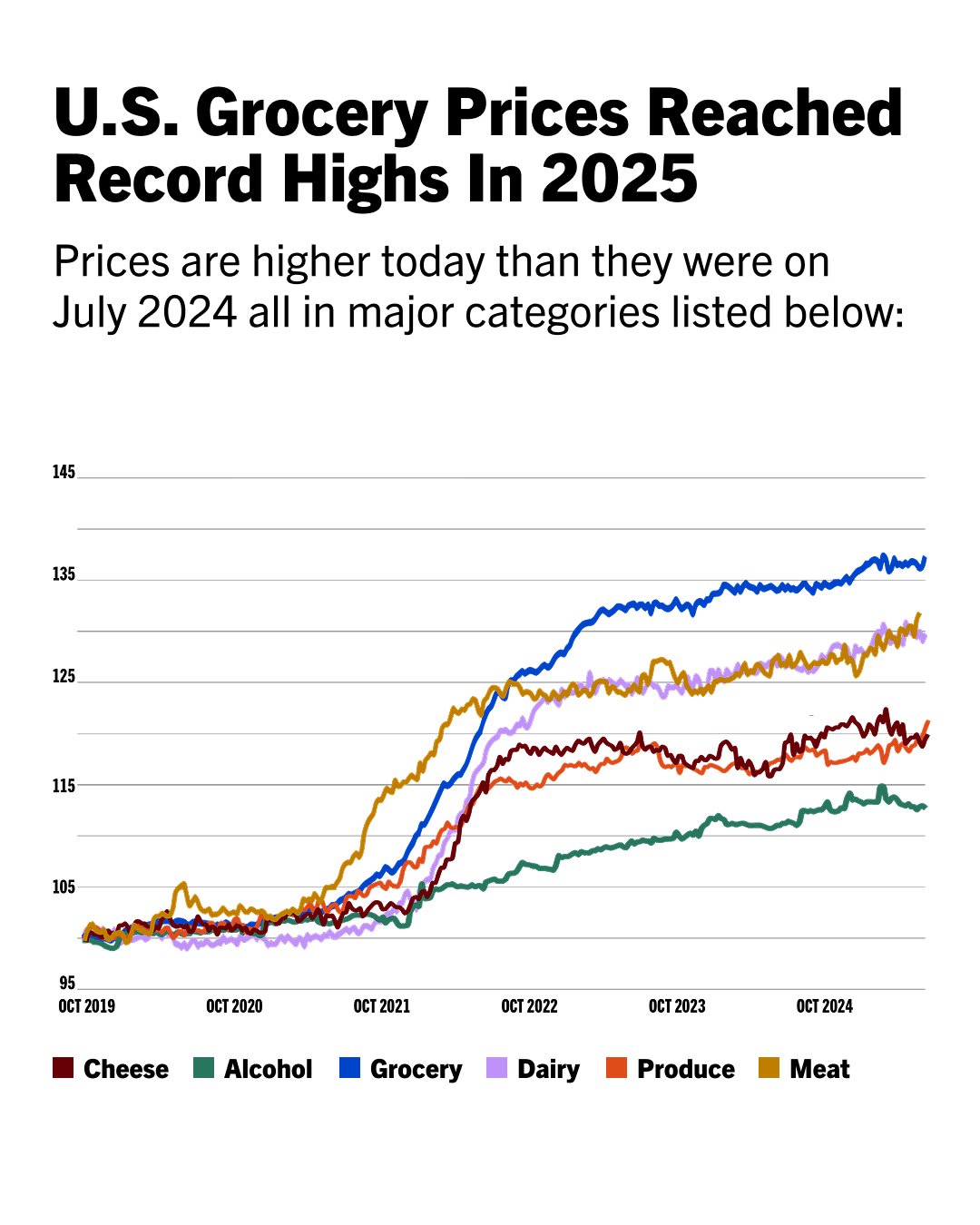
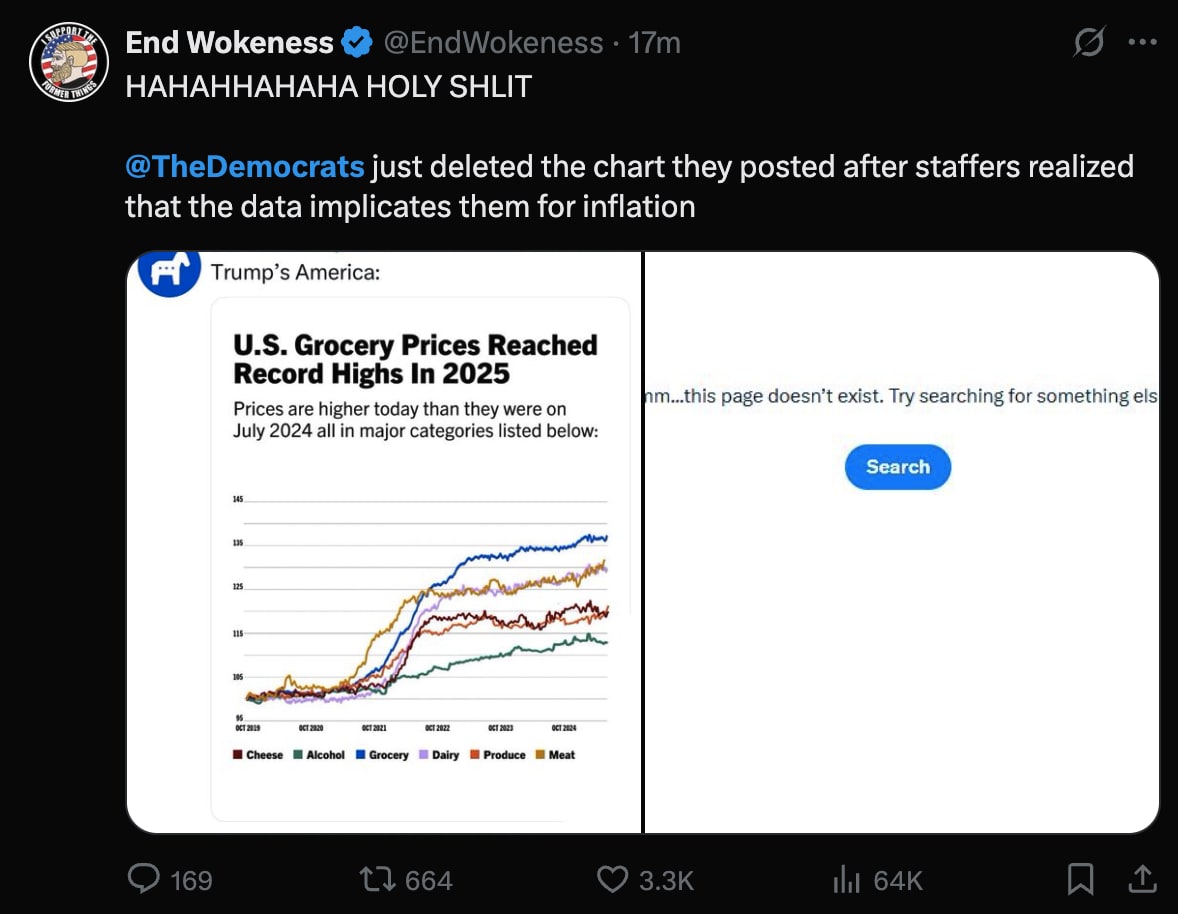
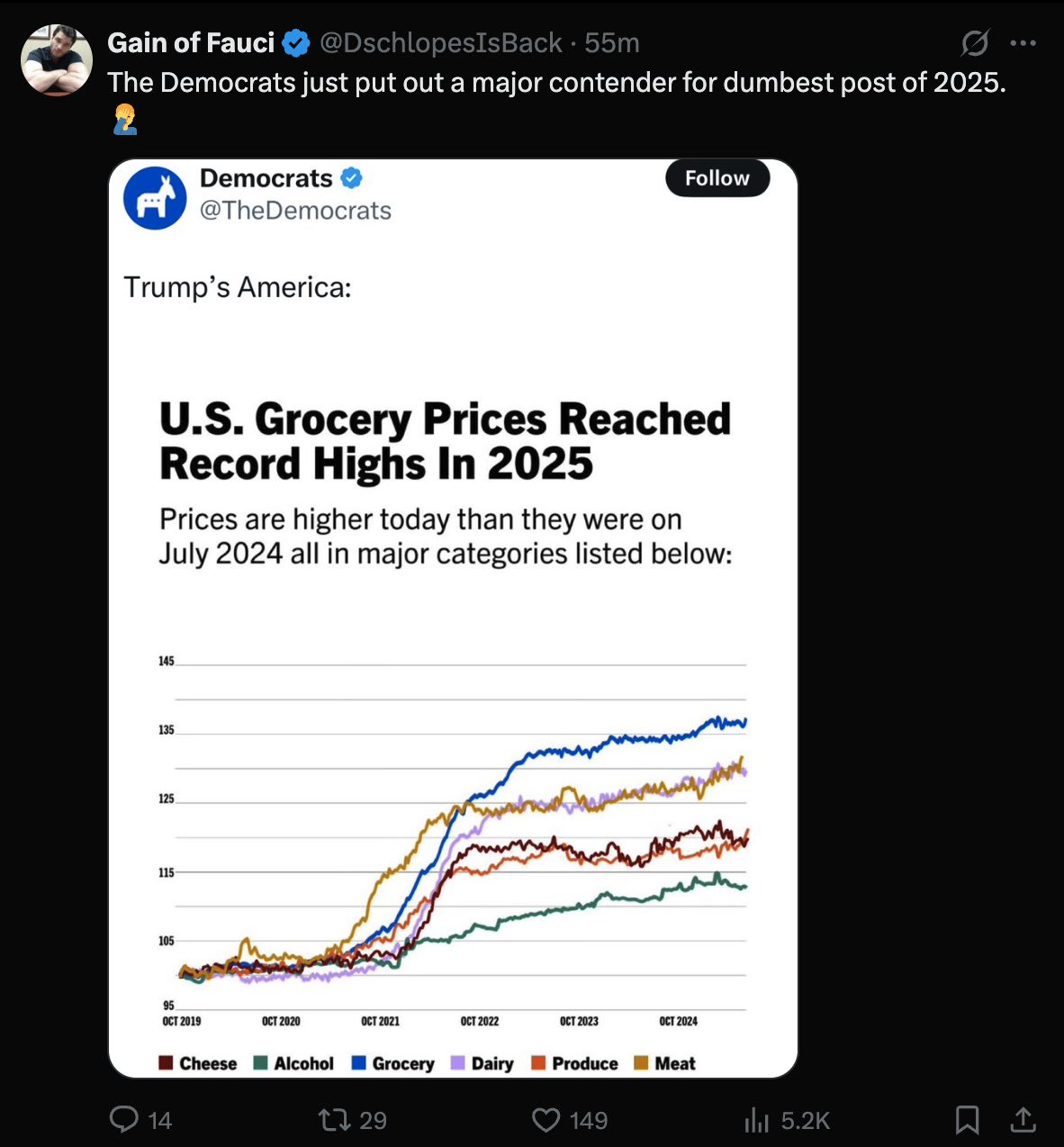
The @TheDemocrats account on X thought they had a slam dunk, posting “Trump’s America” alongside this chart.
But look closely… because what it actually shows completely destroys what they were trying to prove.
It backfired spectacularly.
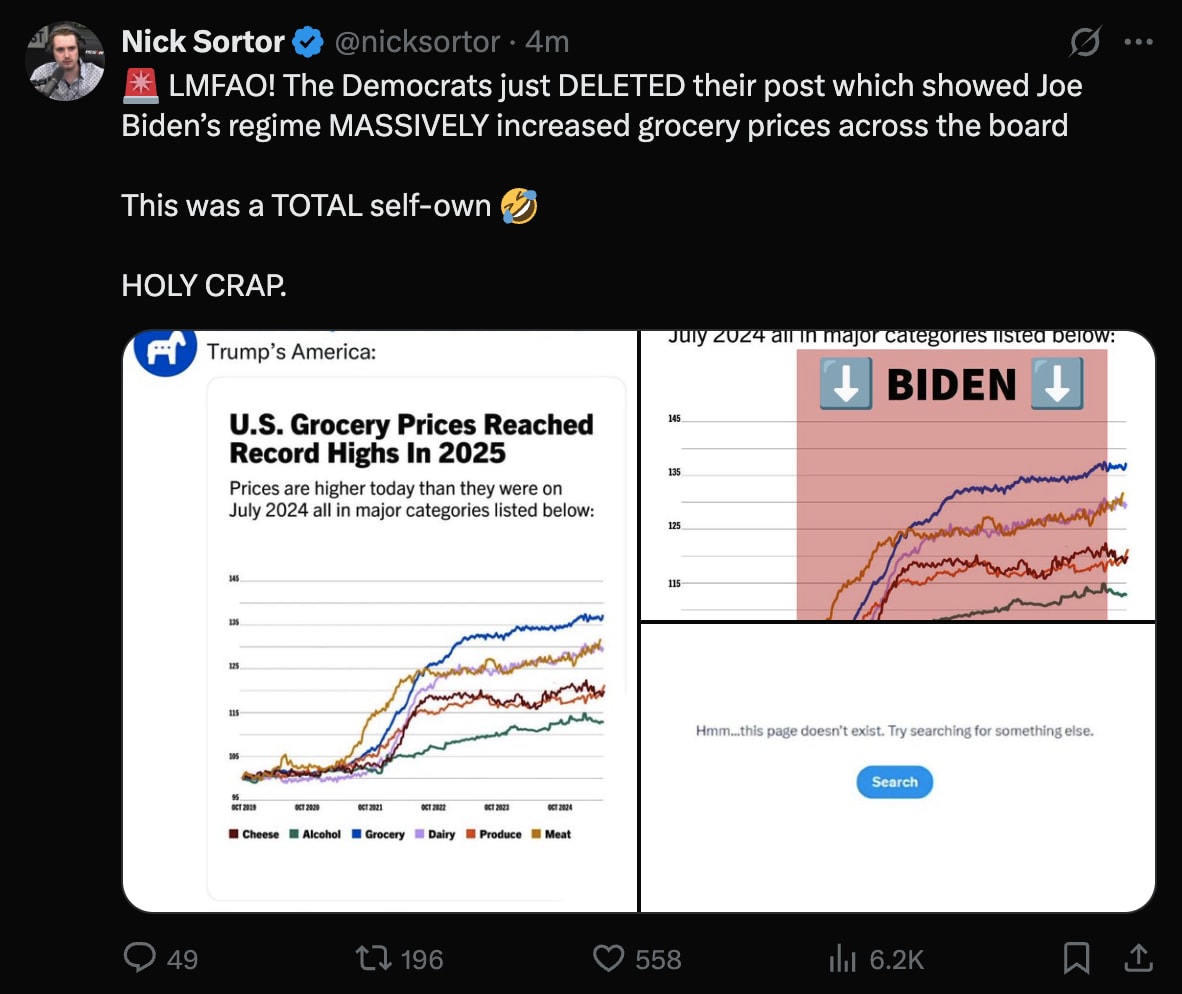
In a now-deleted post, the @TheDemocrats account on X posted the caption “Trump’s America” alongside a chart that read, “U.S. Grocery Prices Reached Record Highs in 2025.”
They really thought they scored a win, believing it showed Trump was responsible.
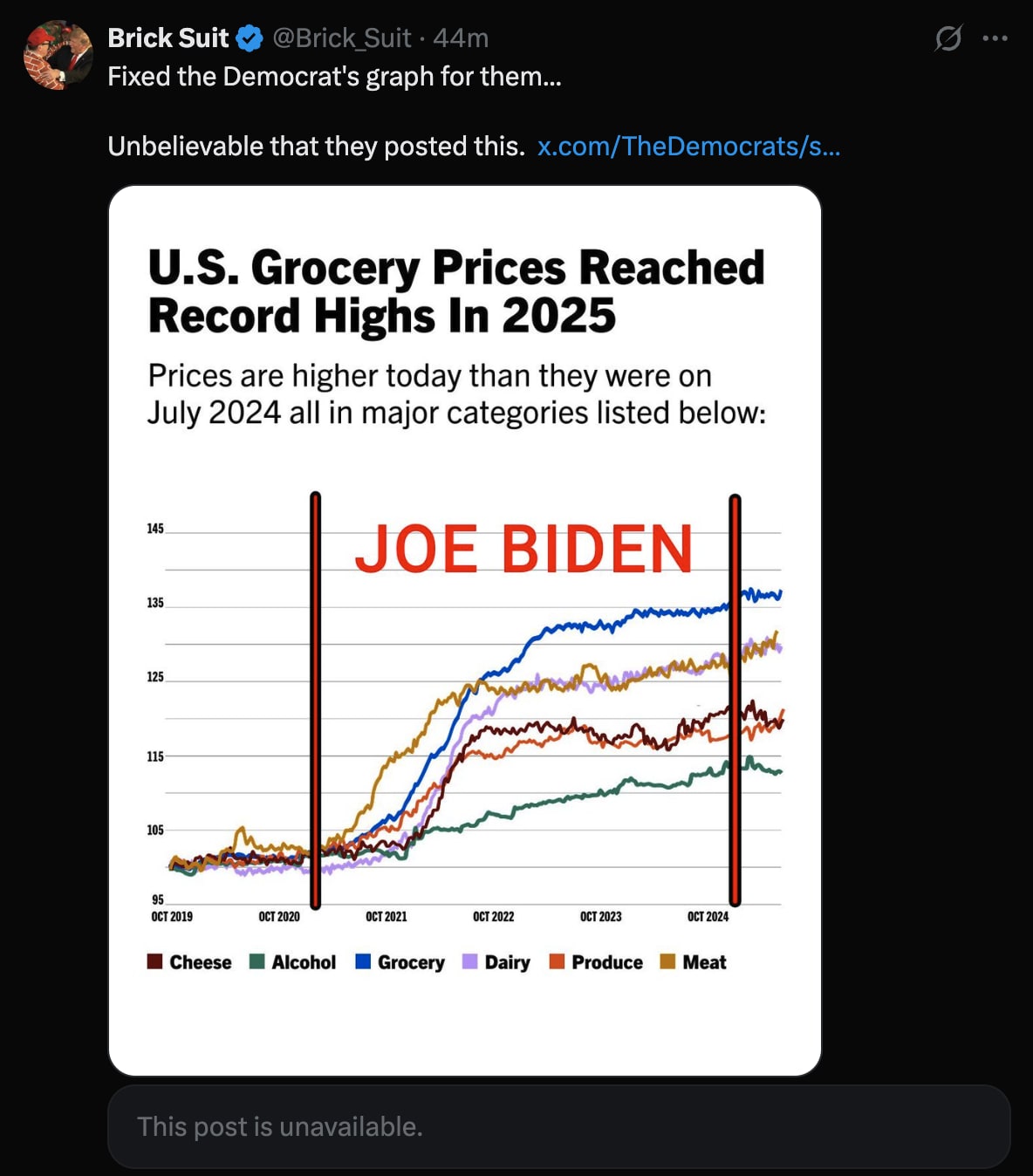
But X users quickly noticed something hilarious: almost all of those grocery price hikes happened under Biden, not Trump. Oops.
X user Jim Verdi wrote, “Do you dipshits realize what you just posted here?” followed by a stream of laughing and clown emojis.
His post racked up 2.1 million views in no time. The self-own was too good not to share.
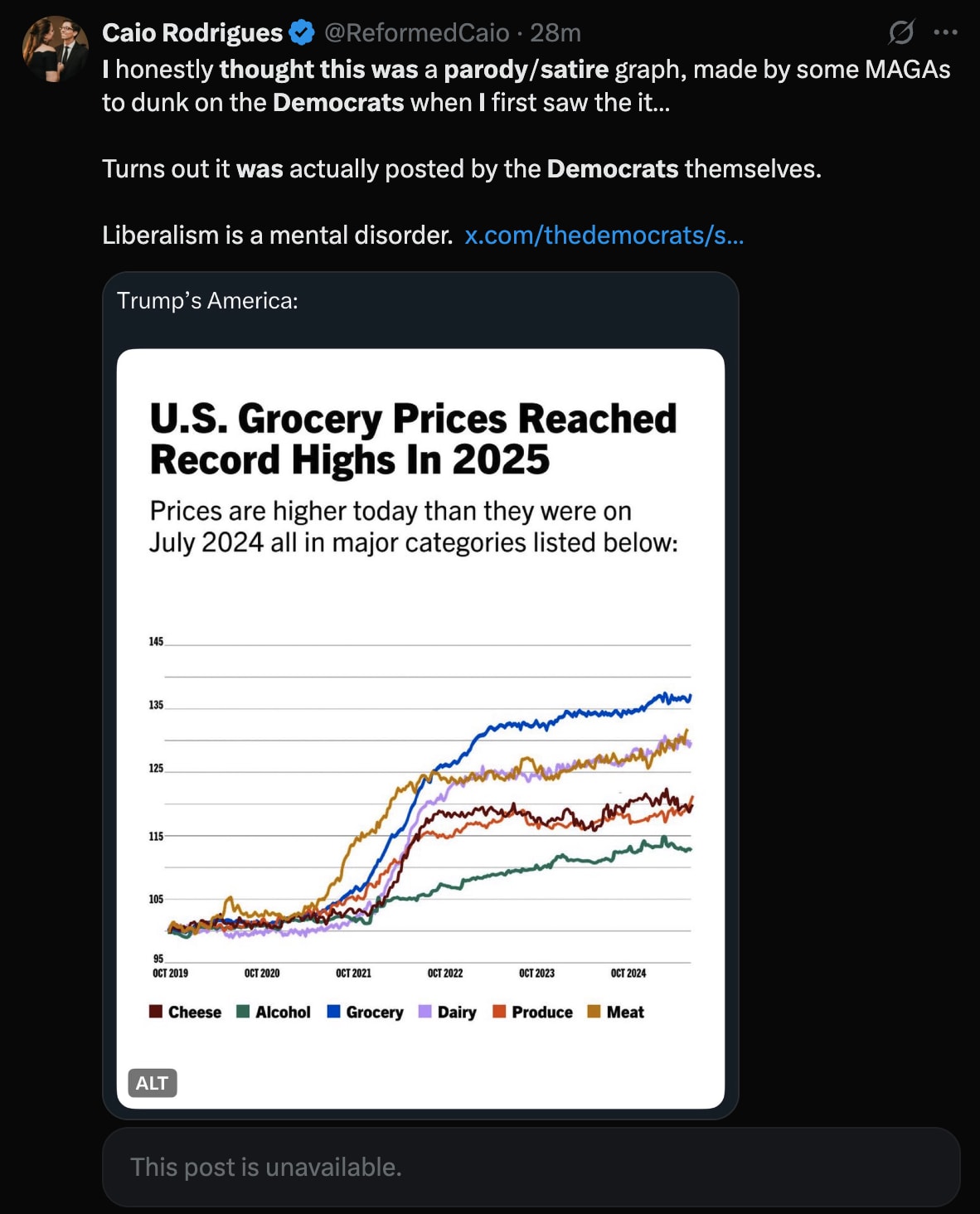
It was so bad, people thought it had to be satire. But no—it came straight from the real Democrats.org account with 2.3 million followers. How embarrassing.
“Are Democrats really this dumb?” Gunther Eagleman asked. We now have the answer: yes. Yes, they are.
The self-own didn’t stop there. Then they DELETED the post to stop the bleeding.
Oops—cue the Streisand effect.
@DschlopesIsBack is right. This might be the dumbest post of 2025, and that’s saying something.
This one’s going in the internet hall of shame—forever.
Thanks for reading. I usually cover more serious topics, but this train wreck was too good to pass up. For more stories the mainstream media won’t touch, follow me on X and subscribe on Substack. They hide it. I report it.
My name is Travis McMichael. I have been in prison in solitary protective custody since my arrest on May 7, 2020 for the self-defense shooting of Ahmaud Arbery in Brunswick, Georgia. Like the January 6 defendants, I was a victim of the “Woke Justice” system under Joe Biden.
For the first 27 months, I was confined in “the hole” on 23-hour lockdown at the Glynn County jail, with only one hour per day out of my cell for a shower, exercise, and to use the phone. I was finally transferred to Hays State Prison in Trion, Georgia in January 2023.
Since my arrival at Hays State Prison, I have been in protective custody on permanent lockdown in a 10’ x 8′ cell due to the constant threats on my life. The only exceptions are being escorted to the shower across from my cell on Mondays, Wednesdays, and Fridays.
With the exception of a court hearing this past October, I have not seen the sun in 5 years. I was informed recently by the Commissioner of the Department of Corrections that I will never be allowed to leave my cell during my imprisonment, which is life without parole plus 20 years.
I have an occasional visit from my mother, and very limited contact with staff and officers. The only interaction I have with prisoners is with the Trustees, former killers who have been vetted and are trusted to work where I am housed.
Provided to The Gateway Pundit
Despite my conditions, I am being treated professionally and fairly by the staff and trustees that I interact with through my cell door, and I am never harassed. My days consist of reading, studying the Bible, responding to letters, and sketching.
I know that my Lord and Savior sees all and knows what is in our hearts, and that keeps me in peace and in joyful spirits.
I was born in Brunswick, Georgia and raised in a loving, joyful household along with my younger sister. We had a normal middle-class upbringing. My father was in law enforcement before retiring in 2019. My mother was and still is a registered nurse.
Being raised in a home where community service and helping others was the norm, I found myself wanting to do the same. I worked as a lifeguard during the summers on the beach and as a driving instructor until joining the Coast Guard at age 21.
I served as a Boarding Officer in maritime law enforcement operations and as a crewman on search and rescue operations and patrols for 9 years. I left with an Honorable Discharge to help raise my newborn son and to start a fishing business.
February 23, 2020 was the worst day of my life. After the shooting incident, I was interviewed at the police station by investigators and immediately released because my actions were deemed to be justified in self-defense.
Months later, the “woke justice” system came after me, willing to misconstrue and manipulate what had actually happened in order to benefit a political narrative.
Because my appeal is pending, I best not explain what happened that day, but please read all the facts as recently covered by Joel Gilbert in The Gateway Pundit, and also read more at my family website here: WWW.MCMICHAELTRIAL.COM.
The days and weeks following the shooting were tough. I began having nightmares and flashbacks. I spoke with a counselor on how to process the trauma in a healthy manner, and I tried to carry on like everything was normal for the sake of my 3-year-old son and family.
After a month had passed, I began to see an uptick of visitors on my business page on Facebook for my charter service and new followers on my business Instagram account.
My LinkedIn page began sending notifications of views from people described as lawyers and social justice coordinators. Within 48 hours, I was getting tagged in Instagram posts from Attorney Lee Merritt, Shaun King with Black Lives Matter, a group called “The Justice League,” and the “Huey P. Lewis Gun Club.”
All the posts were falsely claiming that I had shot a man because he was black and jogging in my neighborhood. I didn’t think much of the posts because that narrative was so ridiculous, and the facts overwhelmingly proved otherwise. I didn’t yet understand how powerful the woke mob was.
Later that evening, The New York Times published an article with the new narrative. They claimed there was a “cover-up” and that Ahmaud Arbery was doing nothing but enjoying a jog.
Suddenly, my business accounts were flooded with negative reviews and threats, my personal Instagram account was bombarded with negative and vile messages, and my email account was flooded with subscriptions and spam.
It was instantaneous and seemed planned. Looking out my living room window, cars were circling by my house at all hours. My friends and relatives started getting doxed and harassed as well.
Previous clients who had placed positive reviews on my business pages were threatened and harassed relentlessly.
At first, I wasn’t concerned about the online harassment, but it became more organized by the day as the false narrative grew and the media picked it up.
Soon, people were appearing in front of my house with signs. Groups like BLM, the New Black Panthers, and civil rights lawyers including Lee Merritt and Ben Crump were calling for protests in my neighborhood, and telling mobs to come to my house and make a citizens arrest of me and my father. Things were beginning to get out of control and dangerous.
It had now been 74 days after the tragedy and no new evidence had emerged to change the facts.
Despite this, the Georgia Bureau of Investigation (GBI) took over the case under the direction of Georgia Governor Brian Kemp.
My father and I were arrested at our home within 36 hours. During our bond hearing, those who testified on our behalf had their pictures taken by Lee Merritt while they testified.
The photos were published by Shaun King of BLM with their addresses and work info in an attempt to intimidate others not to speak out on our behalf.
Like many others during the Biden presidency, I believe myself, my father, and also my neighbor Roddy Bryan, were arrested and ultimately convicted because of a political narrative, known as “woke justice,” and not based on the facts which easily proved it was a cut and dry case of self-defense.
I am currently appealing my conviction.
For more information on my case, please visit WWW.MCMICHAELTRIAL.COM. There is a link to my GiveSendGo account if you would like to support us in legal funding.
Travis James McMichael (born January 18, 1986) is a former U.S. Coast Guard member from Brunswick, Georgia, who came to national public attention after he and his father, Gregory McMichael, followed 25‑year‑old Ahmaud Arbery who attacked Travis and tried to take his shotgun from him. Arbery was shot in the struggle over the weapon. In November 2021, McMichael and his father were convicted of malice murder and sentenced to life imprisonment without parole.
chuttersnap chuttersnap, CC0, via Wikimedia Commons
President Trump’s tariff policy is delivering measurable results, generating $113 billion in revenue and pushing key trading partners to the negotiating table. A new trade agreement with China is being fleshed out, and a deal with the European Union is reportedly close.
Since January 2025, President Trump has enacted sweeping tariff increases under his reciprocal trade policy, aimed at countries with significantly higher tariff rates than the U.S., which maintains a 3.3% average MFN rate. India averages 17%, Brazil 11.2%, and China 7.5%, though China’s rate is misleadingly low, as it imposes much higher tariffs on specific goods, often 25%, 40%, or more. These disparities have fueled the $1.2 trillion U.S. goods trade deficit and undermined domestic manufacturing and national security.
Launched on April 2, declared “Liberation Day” by the White House, revenue from tariffs will help fund tax cuts and reduce the deficit, while also countering foreign value-added tax systems that disproportionately affect U.S. firms.
Since President Trump modified U.S. tariff rates approximately 90 days ago, dozens of countries have expressed willingness to lower tariffs and eliminate non-tariff barriers to achieve more balanced trade with the United States. As of July 2025, 4 to 7 formal agreements have been completed, resulting in reduced tariffs from Trump’s initial “reciprocal tariff” rates. Under the U.S.-China deal, tariffs on Chinese goods dropped from 145% to 30%, and U.S. exports to China now face only 10%, down from 125%.
Trump maintained a 10% baseline tariff on U.K. imports. Japan secured a deal lowering its tariffs from 25% to 15%, while Vietnam’s rate was reduced to 20%, with double that for Chinese transshipped goods. Indonesia’s rate was cut from 32% to 19%, and Cambodia’s from 49% to 36%. The Philippines also reached an agreement with the U.S. on July 22. These deals reflect early progress in Trump’s effort to renegotiate global trade on more reciprocal terms.
Many major U.S. trading partners, including Canada, the European Union, and South Korea, face steep tariffs starting August 1, 2025, after President Trump extended the original July 9 deadline. Canada, facing a 35% tariff, is the most economically dependent on the U.S. and stands to suffer the most if a deal isn’t reached.
Over 75% of Canadian exports go to the U.S., accounting for up to 34% of provincial GDP and supporting more than two million jobs, particularly in provinces like Ontario, Alberta, and New Brunswick. Canada’s economy is further tied to the U.S. through deeply integrated supply chains and daily trade flows totaling $2.7 billion.
Canada’s economy depends not only on exports to the U.S. but also on foreign direct investment (FDI) driven by tariff-free access under CUSMA. In 2024, Canada attracted a record $85.5 billion in FDI, much of it tied to access to the U.S. market, as firms from Europe, China, and elsewhere established manufacturing operations in Canada to bypass U.S. tariffs ahead of President Trump’s second term.
New tariffs now threaten over $430 billion in exports and risk triggering an investor pullout if U.S. access is no longer assured. With such deep exposure, Canada is uniquely vulnerable in a Trump-era trade standoff. Reaching an agreement with President Trump is in Canada’s best interest, or the average citizen will see a decline in their standard of living.
Now that a trade deal with China is close, the European Union remains the most significant U.S. trading partner yet to reach an agreement. The EU faces a 30% tariff starting August 1, 2025, but negotiations are actively ongoing. President Trump has signaled openness to a deal, and EU officials confirmed continued high-level discussions. Meanwhile, at the June 2025 NATO summit in The Hague, Trump secured a landmark agreement: all NATO allies committed to raising defense spending to 5% of GDP by 2035, up from the longstanding 2% target.
This includes 3.5% in direct defense spending by 2032 and 1.5% on broader security. The agreement is expected to reduce the U.S. defense burden, previously nearly 69% of NATO’s total spending, and boost revenue for American defense firms as European nations procure U.S. weapons to meet the new goals. This dual-track strategy, leveraging trade negotiations while rebalancing NATO spending, represents a major political and economic win for the Trump administration.
China threatens Taiwan. Runs another round of live ammo drills across the straight from Taiwan. – Chinese Army video
China practiced another round of live-fire amphibious drills across the strait from Taiwan this week.
According to Intel Slava – In the waters off southern Fujian, an amphibious armored unit from a brigade under the People’s Liberation Army (PLA) Eastern Theater Command conducted a comprehensive tactical exercise and landing operation, focused on command and control, assault wave formation training, obstacle crossing and breaching, infantry coordination, and air defense capabilities.
Another round of Chinese live-fire amphibious drills across the strait from Taiwan.
In the littoral waters off southern Fujian, an amphibious armored unit from a brigade under PLA Eastern Theater Command conducted a comprehensive tactical exercise and landing operation,… pic.twitter.com/hUF2CTjDdt
JD Vance: Interestingly, some criticize us from the right because they want the pace of deportations to be higher. Frankly, I understand that, and I share that frustration. The counterargument is that the courts are trying to stop us at every step of the way. And up until a month ago, we didn’t have the resources for ICE to deal with this massive invasion that Joe Biden led into our country. We didn’t have the necessary resources to truly process many of those people.
That has changed thanks to the big, beautiful bill. We’ve also won some court cases, so I expect the pace of deportations to pick up a bit.
But the important thing is that when we’re criticized — and I sometimes hear this critique — “well, the deportation rate under the Trump administration is actually lower than it was under the Biden administration,” that’s actually a completely false statistic. It’s based on the idea that if you enter the country illegally and the Biden administration processes and expels you, it counts as a deportation. It counts as illegal immigration and then it counts as a deportation.
So you have to look at the net number, right? If you do +1 and then -1… I’m no math expert, but I’m pretty sure that equals zero. The net number is what really matters.
And where the Trump administration has been most successful is that we — I believe in 2025 — will have the first net negative immigration number in about 50 or 60 years in the United States. So there has been a really, really significant shift in immigration policy.
At least three fired Justice Department officials involved in January 6 prosecutions and Trump witch hunts are suing AG Bondi and the DOJ over their terminations.
Former January 6 prosecutor Michael Gordon, press aide Patty Hartman and DOJ ethics official Joseph Tirrell filed a lawsuit against Trump’s DOJ on Thursday – and they hired Deep State lawyers Norm Eisen (key architect behind color revolution and 180 lawsuits against Trump), Abbe Lowell (Hunter Biden’s lawyer), Mark Zaid (lawyer who defended Ukraine impeachment leaker Eric Ciaramella) to represent them.
Earlier this month US Attorney General Pam Bondi fired 20 DOJ officials tied to January 6 and Trump docs probe.
Top DOJ ethics official Joseph Tirrell was fired along with the other swept up in Bondi’s terminations.
Tirrell released a statement on his LinkedIn account:
Until Friday evening, I was the senior ethics attorney at the Department of Justice responsible for advising the Attorney General and Deputy Attorney General directly on federal employee ethics. I was also responsible for the day-to-day operations of the ethics program across the Department. I led a small, dedicated team of professionals and coordinated the work of some 30 other full-time ethics officials, attorneys, paralegals and other specialists across the Department of Justice, ensuring that the 117,000 Department employees were properly advised on and supported in how to follow the Federal employee ethics rules.
My career in public service has so far spanned a quarter of a century. I started as a United States Naval Officer, graduating from the ROTC program at the University of Michigan. After a 6-year military career, I earned a law Degree from the Detroit School of Law at Michigan State University. I started at the FBI in 2006 in the Presidential Management Fellows Program. At the FBI, I worked in a variety of offices thanks to the PMF program and eventually I went to work for the FBI’s Office of Integrity and Compliance. From there, I moved to the Departmental Ethics Office at Main Justice as Deputy Director. Finally, in 2023, I was promoted to the Senior Executive Service and the Position of Director of the Ethics Office.
My public service is not over, and my career as a Federal civil servant is not finished. I took the oath at 18 as a Midshipman to “support and defend the Constitution of the United States.” I have taken that oath at least five more times since then. That oath did not come with the caveat that I need only support the Constitution when it is easy or convenient. I look forward to finding ways to continue in my personal calling of service to my country. I encouraged anyone who is reading this to do the same. I believe in the words of Dr. Martin Luther King Jr. – “the arc of the moral universe is long, but it bends toward justice.” I also believe that Edmund Burke is right and that “the only thing necessary for the triumph of evil is for good people to do nothing.”
I received a number of calls and messages of support in the last few days. Thank you to everyone who has reached out. Be well.
The lawsuit alleges the plaintiffs were fired without cause and without advance written notice. They also accuse the Trump DOJ of violating the Fifth Amendment.
“Disregarding long-standing statutory and regulatory protections that govern how and when members of the civil service can be terminated, and the limits thereof, Attorney General Pamela Bondi individually informed Plaintiffs by one-page memoranda that they were summarily removed from federal service “[p]ursuant to Article II of the United States Constitution and the laws of the United States.” No cause, let alone a proper merit-based one, or required due process was provided to Plaintiffs with respect to their termination and removal,” the plaintiffs argued according to the complaint reviewed by The Gateway Pundit.
The plaintiffs demanded a jury trial.
JUST IN: Former Jan. 6 prosecutor Michael Gordon (prosecuted Riley Williams, Ray Epps, Bigo Barnett, among others) and press aide Patty Hartman have sued Pam Bondi over their terminations from DOJ.
Palestinian Christian communities face systemic violence and oppression.
The recent attack by Israel’s military on Gaza’s only Catholic Church has been met with global outrage. The shell fired from an Israeli tank not only damaged the Holy Family Church compound that hundreds of Palestinians had been using as shelter, but also killed three people and wounded at least 10 more, including the parish priest. But this attack on Palestinian Christians is unfortunately not new, nor should it be surprising.
Living in Jerusalem for four years as a U.S. diplomat, I learned that we Christians in the West hold many misconceptions about Christianity in the Holy Land. Some are small, such as every Nativity scene in the United States showing a wooden stable, when in likelihood, the stable in which Jesus was born was a cave, like all stables in historic Palestine.
Some misconceptions, however, carry larger consequences, such as the idea that being a good Christian means supporting the Israeli government without question. Given the rising civilian death toll in Palestine and ongoing Israeli government actions targeting Christians, such unwavering support is problematic.
Nearly all Christians in the Holy Land are Palestinians, including Palestinian citizens of Israel. Christianity is foundationally tied to Palestinian culture and history, in the land where it all began.
Since October 2023, Presidents Biden and Trump have given Israel’s military close to $30 billion in military aid, and Israel has killed at least 59,000 Palestinians in Gaza—including over 19,000 children—in 21 months. Hundreds more have been killed in the other Palestinian territories Israel occupies, the West Bank and East Jerusalem. Numerous well-respected human rights organizations, international humanitarian aid groups, and other experts—including famed Israeli genocide scholar Omer Bartov—assess these actions to be genocide. Meanwhile, Israeli Prime Minister Benjamin Netanyahu’s government continues to destroy Palestinian homes in the West Bank and East Jerusalem to make room for illegal Israeli settlements. This seeming disregard for Palestinian lives runs in clear contradiction to Christian values. But the problem is much deeper than that.
During my years of service in Jerusalem, when we hosted members of Congress and other U.S. government representatives, we regularly arranged tours of Christian sites for them. But these same visitors mostly refused to meet with the leaders of Christian churches and communities, as though a meeting might force a factual, moral, and theological reckoning that these communities are both Christian and Palestinian.
Palestinian Christian communities face systemic violence and oppression at the hands of the Israeli government, which receives billions of dollars in U.S. aid each year, and from violent Israeli settler groups. Palestinian cities within Israel are chronically neglected and face rising crime rates, and their residents face an unequal system which an ever-growing number of human rights groups and international bodies, including the world’s top court, the International Court of Justice, have labeled as apartheid. In Jerusalem, church leaders describe Israeli government policies as designed to remove the Christian, and by extension Palestinian, character from the city.
Christian clergy in Jerusalem are regularly spat on, harassed, and assaulted by right-wing Israelis, often under the watchful eye—and sometimes direct participation—of Israeli police. Church properties are vandalized with little, if any, consequences. Violent Israeli settlers, backed by the police, have illegally occupied church properties in the Old City and evicted the Palestinian Christian tenants. Palestinian Christian homes outside of the Old City are often bulldozed, without due process, to make way for excavations designed to draw in tourists, and Palestinian Christians living in the West Bank are often prevented from visiting Bethlehem due to Israeli-imposed military checkpoints and road closures. Attacks on Palestinian Christians and churches in the West Bank are also common.
In Gaza, the Christian community is small but influential. Numbering no more than a few thousand, the community provides education and health services to thousands of Gazans, both Christians and Muslims. Even before October 2023 the size of the community had decreased significantly as many chose to leave Gaza because of the inhumane, illegal 18-year-long blockade imposed by the Israeli government. Some church leaders worried that the community had shrunk below a sustainable number and was destined to continue declining.
Holy Family Church is not the only church in Gaza. The Church of St. Porphyrius, a Greek Orthodox church in Gaza City, is believed to be the third oldest in the world, built in 425 AD. Despite being well-known as both a Christian church and a shelter for civilians, the Israeli military dropped a bomb in its vicinity on October 19, 2023, killing 18 civilians. A few days later, Israeli snipers shot and killed two women in its courtyard.
As Israel’s assault on Palestinians continues, I would encourage our government leaders—including President Donald Trump, Secretary of State Marco Rubio, and Ambassador to Israel Mike Huckabee—as well as Christians everywhere, to recall Jesus, his origins, and his teachings, and to think deeply about whether supporting an Israeli government which is committing these attacks on Christians in the Holy Land is the best expression of our faith.
The Ukrainian president may have just alienated Western supporters.
Even before Vladimir Putin’s invasion in 2022, Washington poured billions into Ukraine with two goals: arming it against Russia and reforming its corrupt institutions. Kiev’s parliament dealt a blow to the latter project on Tuesday. Lawmakers placed Ukraine’s National Anti-Corruption Bureau (NABU) and Specialized Anti-Corruption Prosecutor’s Office (SAPO) under the direct control of the Prosecutor General’s Office, itself a political instrument of President Volodymyr Zelensky. The same day, Zelensky duly signed the bill into law.
Amid public outcry, Zelensky seemed to reverse course. In a video address, the Ukrainian leader said on Wednesday that he’d submit a new bill to the parliament that would restore the independence of the agencies. But as Christopher Miller of the Financial Times notes, “It remains unclear how far the new bill will go towards restoring full independence.”
Whatever happens next, this week’s events should set off alarms for Ukraine’s Western backers. For MAGA Republicans, long skeptical of blank checks for Kiev, Zelensky’s move on Tuesday was vindication, exposing the fiction that Ukraine has “transformed” into a liberal democracy. Whether or not you agree, the episode raises urgent questions: Will the U.S.-led West keep funding a government that seeks to dismantle anti-corruption oversight? And what does Ukraine’s apparent democratic backsliding, if it continues, mean for Ukraine’s pro-Western aspirations—or for its failing frontline?
NABU and SAPO were the crown jewels of reforms implemented after the Maidan Revolution in 2014. They were staffed with Western-vetted prosecutors and designed to insulate anti-graft efforts from political meddling. Their work became a key justification for U.S. aid. Yet on Tuesday, Zelensky folded them into the state apparatus, effectively ending their independence.
His government claimed this was a wartime necessity, a temporary consolidation to streamline governance and stamp out alleged Russian moles. Skeptics saw a power grab. Hundreds protested in Kiev, Odessa, and Lviv—the first large-scale demonstrations since Russia’s 2022 invasion. The Russian dissident journalist Leonid Ragozin (no Kremlin ally) noted on X, with bitter irony, “the complete Russian-styled takeover of Ukraine’s power vertical.” Ragozin traces this shift all the way back to 2014, when the revolution’s anti-corruption agenda was hijacked by security elites and radical ethnic nationalists single-mindedly focused on confronting Russia, creating an ideal environment for graft. Ukraine’s Prime Minister Yulia Svyrydenko dismissed the protests as the work of “some social groups” who exaggerate corruption.
The European Union saw things differently. Its enlargement commissioner, Marta Kos, warned that independent anti-corruption bodies are essential for Ukraine’s membership bid —calling their dismantling a “[serious] concern.” G7 ambassadors echoed the sentiment.
The Tuesday move, if it isn’t fully reversed, is likely to erect more hurdles on Ukraine’s path to EU accession—which was already riddled with obstacles. Germany’s Chancellor Friedrich Merz said last week that Ukraine won’t join the EU before the war with Russia is over, and even after that, it will have to rebuild to integrate into the bloc, which will take many more years.
But will harsh EU words translate into punitive action? Zelensky seems to feel pressure from street protests and some European leaders, but he may believe that the EU won’t cut financial aid, restrict weapons supplies, or introduce personal sanctions against Ukraine’s top leadership for fear it would weaken Ukraine militarily and embolden critics of continued support. In line with this thinking, statements from ambassadors, media, or individual officials can simply be ignored. Kiev can also try to placate Brussels with promises to “restore everything after the war.”
The situation could prove very different with the U.S., however. President Donald Trump may care little about the fate of NABU or SAPO. But many in his circle and among MAGA Republicans despise Zelensky and believe the U.S. should distance itself from the war—keeping it “Biden’s war” rather than letting it become “Trump’s war.” They will use the corruption-related concerns and protests against Zelensky as a leverage to push for the U.S. decoupling from Ukraine.
Indeed, some MAGA voices are already doing just that. Rep. Marjorie Taylor-Greene (R-GA), who has emerged as a principled Republican voice against endless wars, praised the protests in Kiev against the “dictator” Zelensky and called for an end to American funding.
Simultaneously, Zelensky’s move may have alienated key allies in Washington, such as the hawkish Senator Lindsey Graham (R-SC), author of a plan to hit Russia and its trade partners with massive new sanctions. Incidentally, the Ukraine corruption story broke just as the EU’s commissioner for defense and space, Andrius Kubilius (another notable Russia hawk) was in Washington making the case for more American support for Ukraine and meeting with Graham, among others. Defending more aid for Ukraine must have been a lot more awkward than usual as a result.
If Trump concludes that U.S. aid has been embezzled, the backlash could be swift and severe. He may yet push Zelensky to accept Russian terms for peace negotiations. The timing couldn’t be worse. As Ukraine’s forces retreat under slow but relentless Russian pressure, the political fallout in Washington may be perilous for Zelensky. With many Republicans already opposed to Ukraine aid, the attempt to erode anti-corruption safeguards may give them fresh ammunition, which pro-Ukraine Republicans and Democrats could find difficult to counter.
Zelensky has taken a huge gamble. If it backfires, he may have further undermined his country’s already precarious position at the frontlines—and his own political future. Even worse, from Ukraine’s perspective, is that Zelensky’s Tuesday move may shift the conversation from “how to save Ukraine” to whether it’s worth saving in its current form at all. He would be wise to restore full independence to the anti-corruption agencies and put the episode behind him.
Perhaps President Donald Trump said it best at the signing ceremony for the One Big, Beautiful Bill: “The largest spending cut, $1.7 trillion, and yet, you won’t even notice it.”
The president signed the One Big, Beautiful Bill Act into law at the White House on July 4. Par for the course, Congress nearly ran out the clock on their deadline. But, unlike other deadlines Congress faces (the debt limit, government funding, etc.), the July 4 deadline for the Big, Beautiful Bill was arbitrary and self-imposed. Nevertheless, in the final days of the bill’s negotiations, Congressional leadership exhibited a fervent resolve to stick to the July 4 deadline, which Trump firmly latched onto not only because he wanted the policy wins but also because of the optics. Trump’s understanding of good optics was on full display at the signing celebration—complete with a flyover of B-2 bombers.
Trump’s signature sealed what was probably the most hectic few days on Capitol Hill that I’ve covered in my career.
After the Senate advanced the bill on June 28, Senate Minority Leader Chuck Schumer ordered a full reading of the bill—nearly 1,000 pages long—on the Senate floor, followed by a 24-hour vote-a-rama. Meanwhile, Senate Majority Leader John Thune (R-SD) and Senate GOP leaders were wrangling the potential holdouts: Sens. Rand Paul (R-KY), Susan Collins (R-ME), Thom Tillis (R-NC), and Lisa Murkowski (R-AK). In the early morning hours of July 1, it became clear that the final passage was riding on Murkowski’s support. The Alaska senator made GOP leadership and the press well aware she was no fan of the legislation, but she did not let the opportunity go to waste. The final version of the bill had a number of handouts and carve outs for the Last Frontier. My personal favorite: a measure that provides a larger tax deduction for business meals for certain Alaskan fishing and processing ventures. Murkowski’s vote made it a 50–50 tie in the Senate. Vice President J.D. Vance broke the tie, which sent the legislation back to the House.
The House wanted to move quickly. To the dismay of both House GOP conservatives and moderates, they were getting shoved the Senate version despite about four months of House negotiations before the legislation even made it to the upper chamber. Moderates were angry because the Senate made more Medicaid changes, increasing the government’s savings on the program from $800 million to about $1 trillion over the 10-year budget window. House conservatives, namely the House Freedom Caucus and allies, were upset that the Senate version of the bill did not adhere to the ratio of tax cuts to spending cuts agreed to in the budget resolution by the House.
House leadership wanted to move so quickly that potential GOP holdouts complained they wouldn’t even have enough time to read the final version of the Senate bill before voting. On a special episode of my Daily Signal show, the Signal Sitdown, Rep. Ralph Norman of South Carolina told me the House was being forced to “take it up something that is 980 pages, and nobody’s even read [it].”
“We shouldn’t be trying to pass something we know nothing about,” Norman added.
Concerns like Norman’s forced House leadership to slow down the process and discuss the Senate changes—well, that, and a mistake in the rule produced by the House Rules Committee that governed debate on the bill. It was 48 hours of non-stop whipping, and Trump was Johnson’s ace in the hole. On July 2, the president hosted a group of potential moderate holdouts at the White House in the morning and a group of House conservatives later in the afternoon.
The moderates turned out to be easier to win over than the conservatives.
Rep. Dusty Johnson of South Dakota, chair of the GOP Main Street Caucus, emerged from the White House meeting and said, “Donald Trump is the best closer in the business, and we’re going to get it done.”
“The president, I think, closed out just about everybody,” the South Dakota Congressman added.
House conservatives were willing to push harder. “The sense is the White House needs to deliver the Freedom Caucus — that’s the project of the day,” an unnamed source from House leadership told POLITICO. “The White House, the thinking goes, is better situated to discuss executive orders and potential future legislation that could address their concerns.”
Rep. Tim Burchett of Tennessee has a penchant for telling it how it is. He told reporters that conservatives had “reached a critical mass” of holdouts and that “it’s going to be a jailbreak,” either against or in favor of the bill.
In my conversations with conservative House members since the July 2 meeting, the White House meeting was not about feel-good face time with the president. The president’s team and House conservatives went through a long list of conservative concerns, and the White House addressed how each of these concerns would be addressed by the executive branch in the coming months. That did not stop the House Freedom Caucus from publishing a three-page memo tearing the Senate version apart for failing to go further on spending cuts and sunsetting Biden-era environmental subsidies. Rep. Andy Harris of Maryland, the House Freedom Caucus chair, did not attend the White House meeting.
What plans were exactly cooked up in that White House meeting remains unknown. Members have remained tight-lipped on the issue. It’s speculation, but the rescissions package currently in the Senate’s hands and future rescissions packages seem to be the White House’s way to address conservatives’ desire to further cut government spending.
Enter OMB Director Russ Vought. Vought’s conservative bona fides made him one of Trump’s most effective messengers for working over conservatives behind the scenes. He spent much of July 2 on the Hill assuring conservatives that the executive branch would use its authority to further curb government spending. In the dead of night on July 2, the House had the votes. One “magic minute” and vote later, and the bill was on the way to the president’s desk.
Did things have to transpire the way they did? Probably not. The July 4 deadline was completely self-imposed. The real deadline was the X date for the debt limit, which was inching backwards toward the fall. And House members have just about had enough of swallowing Senate products full of handouts for Murkowski or Collins. Such is the nature of narrow majorities.
Nevertheless, the wins are real: Over $150 billion for border security and deportations and a massive tax hike averted. The alternative looks something like what transpired in Trump’s first term when Republicans, led by anti-Trump leaders in both chambers, got a tax cut but failed to deliver on Trump’s other campaign promises: Obamacare repeal and the border wall. This time, things were different.
The budget reconciliation process was always going to be a hot mess, but a mess worth having. I believe the kids have a term for that these days: “brat.”







 …