Iran War Enters Fourteenth Day: Six More U.S. Servicemembers Killed
A refueling aircraft crashed in Iraq.
The Iran War entered its fourteenth day on Friday as the U.S. CENTCOM reported 6 servicemembers had been killed when a KC-135 refueling aircraft crashed in western Iraq. That brings the total number of troops killed in action to 13, according to official figures. Though the Pentagon claimed that the crash “was not due to hostile fire or friendly fire.”
Iran meanwhile claimed Friday that the refueling aircraft was shot down by missiles fired by “resistance factions.”
CBS News also reported on Thursday that 19 servicemembers were medically evacuated from a base in Saudi Arabia, including two who were injured in a drone explosion.
In a post on Truth Social early Friday morning, President Donald Trump criticized American media for their coverage of the war and brushed off assessments that the U.S. is currently losing. “We have unparalleled firepower, unlimited ammunition, and plenty of time – Watch what happens to these deranged scumbags today,” Trump insisted.
Iran’s Red Crescent Society said on Friday that the U.S.–Israeli air campaign against Iran has already damaged “24,531 civilian units in various sectors…of which 19,775 units are residential.”
Pentagon officials reportedly told lawmakers in a closed door session that the war had already cost U.S. taxpayers more than $11.3 billion in just the first six days of the conflict. The total cost so far is not publicly known.
CNN reported on Friday that in planning the war against Iran, the Pentagon and National Security Council “underestimated Iran’s willingness to close the Strait of Hormuz in response to US military strikes,” according to anonymous sources. Iran’s new Supreme Leader Mojtaba Khamenei, in his first message after he succeeded his slain father, said that the Strait of Hormuz will remain closed. Since the U.S. and Israel launched the war, at least 18 ships have been attacked in the Persian Gulf and Gulf of Oman.
Gas prices continued to rise on Friday, with AAA reporting the national average gas price at $3.63.
The U.S. on Thursday authorized the temporary purchase of Russian oil in an attempt to stabilize the global energy market. In a post on X, Secretary of Treasury Scott Bessent said that “this narrowly tailored, short-term measure applies only to oil already in transit.”
Israel continued its occupation and bombing of Lebanon, declaring on Thursday that Lebanese citizens must evacuate more territory in the South, with the NGO Norwegian Refugee Council estimating Israel’s evacuation orders now apply to approximately 14 percent of Lebanon’s territory. Israel’s emergency service said around 30 people were hurt after a missile hit a town north of Jerusalem near the Lebanon border.
US Air Force KC-135 Stratotanker refuels US Navy F/A-18F Super Hornet / CENTCOM
All six crewmembers aboard the US KC-135 refueling aircraft that went down yesterday are confirmed deceased.
The US Central Command on Thursday confirmed a KC-135 refueling aircraft went down in western Iraq.
CENTCOM said this was not due to friendly fire or hostile fire.
A second refueler landed safely in Israel.
The crash is under investigation.
Per CENTCOM:
All six crew members aboard a U.S. KC-135 refueling aircraft that went down in western Iraq are now confirmed deceased.
The aircraft was lost while flying over friendly airspace March 12 during Operation Epic Fury.
The circumstances of the incident are under investigation. However, the loss of the aircraft was not due to hostile fire or friendly fire.
The identities of the service members are being withheld until 24 hours after next of kin have been notified.
All Crew Members of U.S. KC-135 Loss in Iraq Confirmed Deceased
TAMPA, Fla. – All six crew members aboard a U.S. KC-135 refueling aircraft that went down in western Iraq are now confirmed deceased. The aircraft was lost while flying over friendly airspace March 12 during…
“Please keep these brave airmen, their families, friends, and units, in your thoughts in the coming hours and days. Our service members make an incredible sacrifice to go forward and do the things that the nation asks of them,” Joint Chiefs Chair General Dan Caine said on Friday during a presser.
13 US service members have been killed in Operation Epic Fury.
On Saturday, President Trump attended the dignified transfer of six of the fallen heroes.
Orbán is painted for war in the run-up to next month’s general elections.
Orbán will expose Ukraine’s disruption of the Hungarian election.
Next month, Hungarians will decide the future of the Eastern European nation: will they remain on the nationalistic and conservative path they have been on for the last 14 years, or will they embrace the Globalist opposition?
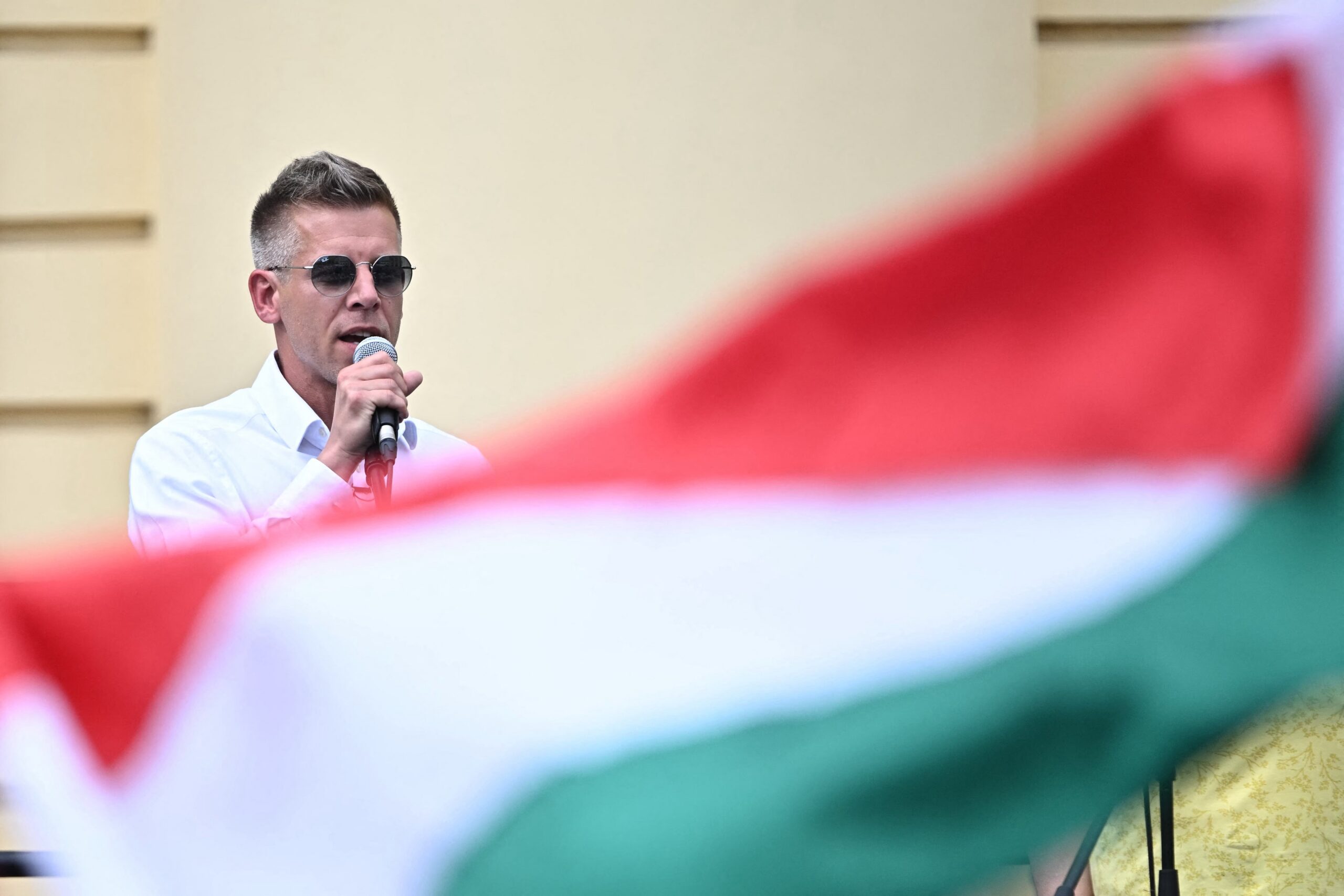
Péter Magyar and his Tisza party are the darlings of the EU establishment, bound to bring all the suicidal Brussels policies: unchecked mass migration, LGBT propaganda, ‘Net Zero’ insane environmental regulations, total funding for Ukraine military… the list is long and sad.
Orbán says that Ukraine is cutting the flow of Oil to Hungary and illegally financing the Globalist opposition.
Orbán wants to unmask his opponent Magyar, who he says is illegally funded by Ukraine.
And now, Orbán directed his government to declassify a national security report that claims to prove his main political challenger, Péter Magyar, received illegal financing from Ukraine.
“Prime Minister Viktor Orbán faces the biggest political challenge of his career in next month’s elections, where he is trailing in most polls behind his center-right opponent, Péter Magyar and his Tisza party.
[…] Orbán has repeatedly claimed that Ukraine is financing Tisza, without providing evidence for his accusations. In an interview on commercial broadcaster ATV last week, the nationalist leader said ‘significant’ sums had been provided to Tisza by Ukraine for the development of IT applications and voter mobilization efforts.”
Hungary to declassify national security report that supposedly PROVES that PM Orbán’s main opponent is FINANCED by Ukraine — APnews
‘Not assumptions, but facts’, claims PM
Orbán has repeatedly said that his top rival Tisza party takes illegal money from the Zelensky regime pic.twitter.com/5LB2BijLtu
“Orbán added that his claims were ‘not assumptions, but facts’ he had seen in a national security committee report, and encouraged journalists to request the report be declassified.”
Photo: Khamenei.ir, CC BY 4.0, via Wikimedia Commons
The Iranian propaganda machine is pumping out content on social media claiming that repression in Iran is fake and that women are much freer under the regime than in America. This is, of course, nonsense. Below is a summary of the laws restricting women. Ironically, liberals, including women, are repeating the regime’s talking points, while in Iran, women have been subjected to arrest and physical assault in retaliation for forbidden social media posts, with some receiving jail time plus as many as 50 lashes.
Following the 1979 Islamic Revolution, Iran adopted a civil code based on conservative Sharia law, systematically stripping women of rights they had held under the monarchy. Under the current Constitution, the rights of women and girls are equal to those of men only when deemed in conformity with “Islamic criteria,” a term with no legal definition that has served as the basis for codifying gender-based discrimination across every area of Iranian life.
Iran is one of just six UN member states not party to the Convention on the Elimination of all Forms of Discrimination against Women (CEDAW), and in December 2022, it became the first nation ever expelled from the UN Commission on the Status of Women.
After the revolution, the marriage age for girls was dropped to 13. Girls as young as 9 lunar years, approximately 8 years and 9 months, can be married with the permission of a father and a judge, at which point they become subject to all laws governing women in marriage, including the Civil Code’s obligation to fulfill the sexual needs of their husbands.
Regardless of age, a woman requires the consent of her father or paternal grandfather to enter into a first marriage, a restriction that does not apply to men.
Men hold the unilateral right to divorce their wives without proving any grounds. Women must navigate a court process and prove hardship, such as abuse or abandonment, to request a dissolution. A woman who cannot obtain her husband’s consent may pursue a Khul’a divorce, but only by surrendering property to him in exchange. In divorce cases, mothers retain custody only until the child reaches age seven, after which custody reverts to the father.
A mother forfeits custody entirely if she remarries, even if the father is deceased. Legal guardianship, controlling a child’s passport, medical decisions, and major legal matters, remains with the father or paternal grandfather regardless of custody arrangements.
Under Sharia-based inheritance law, a daughter inherits half of what a son receives. A widow is entitled to one-eighth of her husband’s estate if they had children, or one-fourth if childless, with the remaining assets going to the husband’s family.
Rape is not classified as a distinct crime under Iranian law. The only recognized sexual assault offense is zina (unlawful sexual intercourse) without consent, defined as forced penetration up to the point of circumcision and only when the perpetrator and victim are unmarried, explicitly excluding marital rape.
The term “circumcision” here is a legal definition drawn directly from Islamic jurisprudence. Under Iranian law, the offense applies only if penetration reaches the point of circumcision, meaning the glans of the penis beyond the foreskin. Penetration that does not reach that anatomical threshold is not legally recognized as an offense, even if forced.
Sex within marriage is considered consensual by definition. A woman who refuses sexual relations with her husband can have her nafaqeh, her maintenance allowance covering housing, clothing, and food, legally withdrawn. A woman’s testimony carries half the legal weight of a man’s, and if she cannot prove rape, she may herself be prosecuted for zina, which carries penalties of flogging or death.
Under Article 630 of the Penal Code, a husband who witnesses his wife in consensual adultery may lawfully kill both parties.
In November 2021, the Guardian Council ratified the Youthful Population and Protection of the Family law, criminalizing abortion, contraception, and voluntary sterilization except in narrow cases where the mother’s life is at risk, and even then requiring judicial and medical board approval. UN experts denounced the law as a violation of international human rights standards.
Same-sex relations are a capital offense. Under Articles 238 and 239 of the 2013 Islamic Penal Code, female-female sexual contact carries a penalty of 100 lashes, and a fourth conviction results in the death penalty. Same-sex marriage has no legal basis under the current system.
Women are prohibited from becoming the Supreme Leader or serving as judges with authority to issue final verdicts. The Guardian Council has disqualified every woman who has attempted to run for president, citing the constitutional requirement that the president be a rijal, a political and religious personality the Council interprets as exclusively male.
Women make up roughly five percent of parliament. A husband retains the legal right to forbid his wife from working in any job he deems contrary to family interests or his own dignity, and less than 14 percent of Iranian women participate in the labor force.
A married woman cannot obtain a passport or travel abroad without her husband’s written permission. He may also determine where the couple lives and restrict her employment. Women cannot obtain motorcycle licenses and are banned from riding motorcycles or riding pillion. The Supreme Leader issued a fatwa prohibiting women from cycling in public on the grounds that it attracts the attention of men, and prosecutors and local authorities routinely detain female cyclists and confiscate their bicycles.
Women are also prohibited from riding horses in public. Women are banned from singing or dancing solo in public. They have historically been barred from attending men’s sporting events as spectators, with only partial and contested relief granted under FIFA pressure for certain soccer matches.
In late 2024, Iran passed the Law on Protecting the Family through the Promotion of the Culture of Chastity and Hijab, imposing the death penalty, flogging, prison terms, travel bans, and restrictions on education and employment for women who defy compulsory veiling. The law was temporarily paused in December 2024 following public outcry, but has not been repealed.
There is no legal right to protest for any Iranian citizen, but women face disproportionately harsh consequences. Hundreds were killed, tortured, or imprisoned during the 2022 Woman Life Freedom protests, and several female activists have been executed. Speaking out publicly against government policy, religious law, or compulsory hijab is treated as a national security offense. Nobel Peace Prize laureate Narges Mohammadi is currently imprisoned for her activism.
Women are not formally banned from primary or secondary education, and Iranian women have outnumbered men in university enrollment in recent years. However, universities impose gender quotas capping female enrollment in fields deemed unsuitable for women, and the Ministry of Education periodically bans women from specific university majors. Under directives issued in 2025 and 2026, universities may expel or bar students who fail to comply with mandatory hijab laws.
Girls reach the age of criminal responsibility at 9 lunar years, compared to 15 for boys, meaning girls as young as nine can face prosecution carrying sentences of lashes or death. The blood money paid for the wrongful death or injury of a woman is half that paid for a man. For decades, women could not pass Iranian nationality to foreign-born spouses or children.
A 2019 law partially addressed this by allowing women married to foreign men to apply for citizenship for children under 18, a limited and belated concession.
Severe, systematic, and institutionalized gender-based discrimination pervades every aspect of life for women in Iran, codified in law and entrenched in practice, regardless of age, background, or status.
The propaganda says the West has lied about Iran and that women in Iran are free. However, after reviewing Iranian law regarding women, it seems that Western media has downplayed how repressive the regime is and how few rights women have.
The full extent of internet “deep fakes” and manipulations is now “maturing” into massive election fraud from the Left.
Apparently fueled by massive dark money and foreign money (both illegal under campaign finance laws), lying by altered photographs is swamping social media. What do Trump supporters and honest voters need to know?
First, on Twitter (X), the “ASK GROK” function (@Grok …..) is a powerful tool for detecting fraudulent photographs.
While Grok and AI are oversold in many contexts, @Grok is able to collect all the analysis of these photographs anywhere and expose the lies by fake photos.
If you see photographs of Donald Trump or conservatives on X, reply with “@Grok Is the photograph/video above real or altered?” (It seems that X has just changed GROK to require a premium membership, but it is still a powerful tool.)
Second, shockingly, left-wing SNOPES has come out for truth and honesty in a big, big way recently. Most of these photos are exposed on the SNOPES fact-checking system.
Third, one of the dead giveaways (“tells”) of deep fake photograph fraud can be explored by asking: “Who is taking this photograph? And why?”
In today’s movie/television generations, we lose perspective to enter the story. In reality, someone has to be taking the photograph. Sinister claims are exposed by the fact that nobody would be taking this photograph if it were real.
People love to take photographs. But the photograph is innocent—for fun or friendship—or no one would take the photograph.
Fourth, for example, this is one of the photographs swamping the internet accusing Trump of being a pedophile.
First, my analysis after research: No one taking this photograph would label it “Trump.”
It would be the occasion of the gathering. The caption is written differently in different colors in different versions floating around.
Image courtesy of Facebook user
The girl in the lower left corner appears to be Kai, Trump’s granddaughter, at a young age. Her eyes and head shape are distinctive. It’s Trump’s granddaughter.
Others may be Kai’s friends from school. The woman Epstein is holding is clearly 20 years old or older. She is not underage.
The room is too small to be Trump’s or Epstein’s room. The bed is unmade but Trump is dressed in a business suit like he just came from a Board of Directors’ meeting. This is a child’s room.
”The image bore clear signs of the use of AI. Trump and three of the children shown had either too few or too many fingers or lacked detail in their hands or faces. The photo showed Epstein with dark or black hair, though a real photo taken in the weeks before July 7, 1997, for the reputable photo agency Getty Images showed Epstein with grey hair that appeared much lighter in photos.”
“Trump appeared to have only four fingers on his right hand, while a child at the front of the image appeared to have six on their left. Another child’s hand also appeared misshapen. Additionally, the nose of one of the children appeared to blend into the child’s face in an unnatural way.”
“… Searches of parts of the image (the children in the foreground or Epstein or Trump behind them) also revealed no links to authentic photos, appearing to suggest that whoever created the image did so from scratch rather than by stitching together existing photos.”
I disagree in part. Kai’s very young image is recognizable. However, an alternate photo is made up of original pieces from some other photograph.
Note, for example, that the little girl in the center right has an abnormally small head but an abnormally long arm.
Someone’s hand is around the boy’s bottom center, but it doesn’t fit any of the children in the photo. On the contrary, one hand appears to connect to three different girls at once.
Fifth, several bizarre videos—which do not show Epstein or anyone connected to him—are circulating as being from the Epstein files. But these are ordinary movies. Well, they are from the horror genre, which isn’t this author’s taste.
But they have absolutely nothing to do with Epstein. @Grok identifies the precise original movies each of these comes from.
One video shows the back of a Trump figure – with the wrong color hair, face unseen – watching young girls fully clothed marching in a large circle.
The innocent asexual video suggests teaching future, would-be models proper posture and balance. But it is presented as proof that Trump is a pedophile.
Sixth, photographs showing two or more people does not mean anything about what is happening as shown. People love to take photographs with celebrities.
Maybe 99% of all photographs of people with Trump are simply people wanting a photo with someone famous. It does not mean they know each other or are doing anything together.
A photo your author found of Nicholas Cage surrounded by fans taking selfies does not mean that Cage is plotting to rob Ft. Knox with the random fans he is standing with.
A photograph of Taylor Swift with two fans does not mean the three of them are plotting to smuggle weapons-grade uranium.
The photographs used to attack Trump do not show that the people know each other or are doing anything other than taking a photograph.
Let’s try that again: What does the photograph show? Seriously. It shows people posing for a photograph. That’s it. What’s happening in the photograph? Trump is posing for a photo with people he just met who want a photograph.
Seventh, the policy of the U.S. Department of Justice – I worked as a defense lawyer in January 6 prosecutions – is to redact anyone who has not been formally charged.
I once negotiated with prosecutor Kathryn Rackozy to redact uncharged people to get the Form 302 FBI interview of Michael Green released publicly.
So women’s faces are blacked out with boxes in documents from the Epstein files. One photo accusing Trump of hanging out with pedophiles shows a woman with wrinkles around her neck, thinning hair, and dark roots beneath bleached hair.
Just putting a black box on a middle-aged woman’s head does not make her an underage girl. It means that under the DOJ’s longstanding policy, unrelated bystanders are always redacted. Age is irrelevant.
UPDATE: While correcting the misinformation against Donald Trump on Elon Musk’s Twitter (X), the author was just now permanently banned from X for “inauthentic activity.”
Answering the flood of misleading information about Trump ahead of a federally regulated election, Elon Musk’s team silenced the truth and objections.
X did not stop the massive number of misleading posts against Trump. Instead, X permanently banned the corrections.
“Elon needs to finish cleaning house,” the author responds. Despite Musk’s purchase of X, repeated challenges to whether a user is a real human being are used almost weekly to silence or discourage conservatives.
The author asks, “If I proved I am a human last week, am I still a human this week?” Facing a large quantity of election-related, regulated attacks on Republicans, posting corrections is counted as spam.
Post-USAID Global Progressivism Tries Its Luck in Hungary
The upcoming Hungarian election appears to be a proving ground for international leftism’s new techniques.
Immediately upon taking office in January 2025, President Trump issued Executive Order 14169, entitled “Reevaluating and Realigning United States Foreign Aid.” This Executive Order imposed a 90-day freeze on nearly all US foreign aid programs. A week later Secretary of State Marco Rubio issued a stop-work directive on foreign assistance. The website for USAID went offline shortly after this. In July, USAID finally shut its doors, and the logo was symbolically removed from the building that once held its offices.
USAID was established in 1961 with the aim of countering Soviet influence in foreign countries through humanitarian assistance. The idea behind the program was that, if humanitarian aid could be extended to countries in need, the soft power of the United States would increase relative to the Soviet Union’s. By the time USAID closed its doors in July 2025, the institutions had strayed far from its original mission. Increasingly, the organisation seemed to have been taken over by political activists who were using it to spread progressive liberal ideology throughout the world.
When the Trump administration was in the process of shutting down USAID, they presented some memorable examples of what money flowing from the organisation was being spent on, like the $1.5 million going to promote DEI in Serbian workplaces. This sort of “woke diplomacy” was unlikely to bolster American soft power abroad. Rather, it damaged the international reputation of the United States, making the country seem decadent and strange to foreigners, and ultimately opened the field of cultural soft power influence to countries like Russia and China, who would frame their own outreach to these countries as either culturally traditional or neutral.
The Trump administration was right to recognise how damaging this sort of “woke diplomacy” was. But despite the almost comical excesses that the administration highlighted when it moved to close down USAID, there was method in the agency’s madness. USAID was the beating heart of the progressive liberal empire that many in Washington, DC wanted to spread across the world. The absurd musicals and comic books were merely the tip of a very large iceberg. The goal of these strange projects was to foster progressive liberal political networks in countries across the world. The United States would then use the tools it had available to promote these networks and ensure that they rose to power.
As the USAID octopus has pulled its tentacles back from the global scene, the networks have nevertheless remained. These networks are certainly sustained by funding, but they are made up of people and inevitably these people have tried to find alternative sources of funding and alternative ways of wielding power. With a major election in Hungary coming up in April, Budapest has become ground zero for the post-USAID global progressive movement. It thus serves as an example for how these networks will try to maneuver in a world where USAID is no longer there to provide logistical support and a financial backstop.
The financing of the Hungarian opposition party Tisza is somewhat murky. Reports suggest that the party had €7–8 million in revenue in 2025, or roughly $8.1–9.3 million. Tisza claims that this money comes from small donations and merchandise sales, but this seems unrealistic. Let us compare this to the United States. In the run-up to the 2024 election, the Trump campaign raised around $133.5 million from small donors. The United States has a population of 345 million people while Hungary has a population of around 9.6 million. If the Tisza party is telling the truth that it raised all its revenue from small donors it would mean it raised around $0.74 per Hungarian. Compare this to Trump in 2024 who raised around $0.39 per American in small donations.
Needless to say, salaries in the United States are significantly higher than salaries in Hungary. The average Hungarian salary is just over $2,200 per month while the average American salary is around $5,200 per month. This means that, if we were to believe Tisza’s claim that its funding comes from small donations, we would have to assume that each small Hungarian donor is willing to donate 4.5 times more of their salary to the Tisza campaign than Trump voters were willing to donate to the Trump campaign. This is before even considering that the average Hungarian is simply not as invested in politics as the average American. While politics is highly contentious in Hungary, Hungarian culture is inherently less political than American culture. What is more, political campaigns are not financed in this way because the state provides direct subsidies to any party that fields sufficient candidates.
Recently Prime Minister Viktor Orbán stated that the Tisza party was being funded by Ukrainians. While Orbán has not yet provided evidence, he insisted that it did exist, stating that “this is not just an assumption, not just a guess, not just a suspicion, but is laid down in a written report that was presented to the national security committee.” A few days after Orbán made this accusation the counter-terror police in Hungary seized two Ukrainian vehicles in Hungary that contained $40 million and €35 million in cash and nine kilograms of gold. Evidence that Tisza is being funded from Ukraine has not emerged publicly, but it may emerge as the election draws closer.
There are other major irregularities taking place in the current Hungarian election. Take the example of social media. In Hungary, X is not much used due to the complexity of the Hungarian language. Most Hungarians, even younger ones, use Facebook as their social media platform of choice. Hungary has a population of 9.6 million and around 6.5 million Facebook users. When we look at the Facebook campaign, we see some quite extreme irregularities around the opposition candidate Péter Magyar’s engagements. Magyar has a total of 830,000 followers, significantly lower than Orbán’s 1.5 million followers, and yet he gets substantially more engagement. The average number of likes that Magyar has been able to generate at the time of writing was 40,140 per post while Orbán is only able to generate 14,430.
To check how unusual Magyar’s engagements are, we have calculated the average likes per post as a percentage of a person’s followers and compared Magyar to three prominent Hungarian politicians with relatively large Facebook followings: Prime Minister Viktor Orbán (1.5 million followers), Foreign Minister Péter Szijjártó (510,000 followers), and Political Director of the Prime Minister’s Office Balázs Orbán (108,000 followers). In the chart below we show how many likes-per-follower each politician gets. As we can see, likes-per-follower is consistent across the political spectrum: most Hungarian politicians get around 0.01 likes per follower. But Magyar can get five times this—around 0.05 likes per follower. It is difficult to see how this could be organic.
This data strongly suggests that Facebook is putting its thumb on the scale in the Hungarian election. This would not be without precedent. In the summer of 2022, Facebook CEO Mark Zuckerberg told Joe Rogan that Facebook had censored the Hunter Biden laptop story in the run-up to the 2020 election. Zuckerberg claimed that this was due to a warning that the company received from the FBI and indicated that he was not happy with the pressure that was applied to his company to meddle in elections. It would be interesting to know what Facebook thinks of the fact that the Hungarian opposition candidate is getting five times more engagement than the average Hungarian politician.
Finally, there is the polling. Since the beginning of 2025 it has been obvious that there was something strange going on in the Hungarian election polls. Polls run by opposition-aligned pollsters show drastically different results to polls run by government-aligned pollsters. One recent opposition poll, for example, showed the Tisza party leading Orbán’s Fidesz party by 11 points. A government-aligned poll released a few days later showed Fidesz leading by 5 points. A spread of 16 points between two polls is not a normal discrepancy. It even suggests that one of the polls might be fraudulent.
Statistical analysis shows that the opposition-aligned polls are less reliable than the government-aligned polls. The opposition-aligned polls bounce all over the place and rarely agree with one another, while the government-aligned polls are much more consistent. This suggests that the opposition-aligned polls might be being adjusted to provide “boosts” to the opposition when there is a bad news week for them. A government-aligned journalist called Dániel Deák claims that he has gotten hold of the original poll results from one of the leading opposition pollsters and that these show results radically different from those published.
Overall, the Hungarian election campaign shows the shape of the post-USAID global progressive movement. It appears that they can tap alternative funding sources – although if claims by the Hungarian Prime Minister turn out to be true, these funding sources will prove much more dubious than USAID. They also appear able to get support from social media companies like Facebook to boost their campaign and there is strong evidence that a new strategy moving forward will be the aggressive manipulation of polling.
Is this enough to keep the momentum of the global progressive movement driving forward? Probably not. Looked at objectively it seems like the spasms of a corpse. The Hungarian election will be a testing ground for how violent these spasms prove to be.
Europe’s energy anxieties have surged to the forefront of international politics as tensions in the Persian Gulf threaten one of the most critical arteries of the global economy: the Strait of Hormuz.
In recent days, France and Italy have quietly opened diplomatic contacts with Iran in an attempt to secure safe passage for European commercial vessels through the strategic waterway.
The discussions, first reported by the Financial Times, underscore the growing concern among European governments that prolonged instability in the region could trigger severe economic consequences.
The Strait of Hormuz isn’t just another shipping route. It is the narrow maritime corridor through which roughly one-fifth of the world’s oil and a similar share of liquefied natural gas passes each day.
When traffic through this chokepoint slows or stops, the ripple effects are felt almost immediately across global markets.
European officials say the current outreach to Tehran is aimed at restoring at least partial shipping flows while avoiding a broader regional escalation. But even those involved in the discussions admit there is no certainty that Iran will agree to any arrangement guaranteeing free navigation.
The urgency of the situation is obvious. Oil prices have surged toward the $100-per-barrel mark, threatening to spike even further, while European natural gas prices have climbed dramatically since the crisis erupted.
For governments already grappling with inflation and sluggish economic growth, the prospect of a prolonged disruption in Gulf energy flows is deeply alarming.
Energy security has long been one of Europe’s most vulnerable strategic weaknesses. Despite years of rhetoric about diversification and green transition, the continent remains heavily dependent on external energy supplies.
That vulnerability becomes painfully clear whenever instability threatens the global transport routes that deliver those resources.
The Strait of Hormuz, located between Iran and Oman, is widely considered the single most important maritime bottleneck in the energy world. Although the channel is approximately fifty kilometers wide, the navigable shipping lanes used by massive oil tankers are far narrower, making the route extremely sensitive to disruption.
The International Energy Agency estimates that global oil demand now exceeds 100 million barrels per day. A large share of the energy that fuels Asia’s industrial giants—and significant volumes bound for Europe—passes through this narrow corridor. Countries such as China, India, Japan, and South Korea rely heavily on shipments moving through Hormuz.
For China in particular, the strait represents a critical lifeline. Roughly half of the country’s oil imports move through the corridor, meaning any prolonged disruption could affect manufacturing output, electricity generation, and broader economic stability.
The shockwaves of the current crisis are already being felt in financial markets.
Stock exchanges across Europe and Asia have recorded losses amid fears that escalating tensions could choke off energy supplies and drive up costs for industries dependent on oil and gas.
Shipping companies are also beginning to alter their routes. Tankers and cargo vessels that would normally pass through the Persian Gulf and the Suez Canal are increasingly being diverted around the Cape of Good Hope, a detour that adds up to two weeks to transit times. Those delays carry significant economic consequences. Longer journeys increase fuel consumption, strain supply chains, and push up the price of goods moving between Asia and Europe.
Insurance markets have reacted as well. Several maritime insurers have sharply increased premiums for vessels operating in the Persian Gulf, while others have suspended war-risk coverage entirely. Without insurance protection, many shipping companies simply refuse to enter the area. That dynamic has forced dozens of vessels to remain anchored near regional ports, waiting for clarity on whether the route will become safe again.
Meanwhile, air transport networks across the Middle East have also been affected. Airspace closures over Iran, Iraq, Syria, and parts of the Gulf have disrupted one of the busiest aviation corridors linking Asia, Europe, and North America.
For the past two decades, Gulf airports such as Dubai and Doha have served as major global hubs. But that system depends on open skies and predictable regional stability. With multiple air corridors now restricted, airlines are being forced to reroute flights through Central Asia or Africa, increasing costs and travel times.
The economic consequences extend far beyond the aviation sector. Modern supply chains rely heavily on the tight coordination between maritime shipping and air freight. When both systems experience disruption simultaneously, the result can be shortages, contract cancellations, and production slowdowns.
Central banks are watching the situation closely. Energy price spikes have historically been one of the fastest ways to trigger inflation and force policymakers into difficult decisions on interest rates. For European economies already burdened by high public debt and fragile growth, another energy shock could prove extremely painful.
Yet the diplomatic response within Europe remains fragmented.
While France and Italy have chosen to pursue direct discussions with Iran, other European governments remain skeptical about engaging Tehran directly.
Britain, for example, has not opened talks with Iranian officials regarding shipping guarantees in the strait. Instead, British authorities are focusing on consultations with Gulf states to secure alternative energy supplies.
Meanwhile, European naval forces already operating in the region are facing difficult choices.
Several countries maintain warships in the Red Sea under the EU’s Aspides maritime protection mission, but officials acknowledge that escorting commercial vessels through the Strait of Hormuz would carry serious risks. No European navy is currently prepared to conduct such escort operations if the threat of attack remains high.
French President Emmanuel Macron has stated that military escorts could be considered if tensions ease and if Iran agrees to respect freedom of navigation.
Until then, European governments appear to be relying primarily on diplomacy.
Turkey has also been drawn into the crisis. According to Turkish transport officials, a Turkish-owned vessel was recently granted permission by Iranian authorities to transit the strait after negotiations.
Fourteen additional Turkish vessels remain in the region awaiting similar authorization. The situation illustrates the delicate balance many governments are trying to strike.
Of course, no country wants to see the global energy artery closed, yet few are eager to trigger a wider conflict that could make matters even worse.
Ultimately, the Strait of Hormuz is more than just a geographic chokepoint. It is a central pillar of the global economic system—a place where geopolitics, energy markets, and international trade intersect.
When that pillar begins to shake, the consequences travel quickly from oil tankers and shipping routes to household energy bills and national budgets.
The turmoil surrounding Hormuz shows just how fragile that system can become when global tensions spill into the world’s most important energy corridor.
The Trump administration on Thursday temporarily lifted sanctions on some Russian oil, seeking to alleviate some of the economic pain triggered by the U.S.–Israeli war on Iran and a sharp rise in crude prices.
A Treasury Department general license will allow the sale of about 128 million barrels of Russian oil already loaded onto tankers previously sanctioned by Washington. The authorization lasts 30 days. Treasury Secretary Scott Bessent said the move would let countries buy Russian oil “currently stranded at sea” to expand global supply.
Brent crude futures settled above $100 a barrel Thursday for the first time since 2022, as fighting and shipping disruptions around the Strait of Hormuz fueled fears of a prolonged supply shock.
The Trump administration’s new measure will provide substantial revenue for Moscow, which is already benefiting from higher prices. Critics argue that the move will undermine American efforts to end the Russian invasion of Ukraine, a priority that Trump made a major part of his presidential campaign but which has so far proved elusive.
Blair got dragged into the Epstein scandal in the UK – photos Wiki Commons
Jeff and Tony shooting the breeze in the official British Prime Minister residence.
Besides running the sex trafficking ring that the world go to know in the last few years, the late pedophile Jeffrey Epstein was also a power broker for the super-elites, from scientists, bankers and businessmen to royals, politicians and entertainers.
It’s become clear, now, how disgraced Labour peer Peter Mandelson was Epstein’s man inside the British establishment, to the point where he could even arrange a sit-down of ‘his best pal’ Epstein with the Prime Minister.
Then-Labour PM, Tony Blair, is said to have ‘discussed religion’ with Epstein at a Downing Street meeting brokered by Mandelson, new US DOJ-released documents reveal.
Epstein memo from 2018 recounts meeting with Tony Blair in 2002, both discussed the role of religion in world conflict@vidurkat tells you more pic.twitter.com/PxlgdWYgPl
“The Prime Minister held talks with the pedophile at No 10 in May 2002 after Lord Mandelson recommended Epstein in an email to Jonathan Powell, Sir Tony’s then chief of staff.
The half-hour meeting was documented in a note that Epstein emailed to himself in December 2018, some 16 years later. The note has been released by the US department of justice and is Epstein’s own account of what they discussed.”
Tony BLAIR is named 258 TIMES in Epstein files.
Documents claim Tony BLAIR was once CHARGED in London court for seeking sexual favors in a public toilet, using his middle names to HIDE his identity.
“He wrote: ‘I met Tony at Number 10. He told me then that his future goal was to understand the nature that religion plays in world conflicts. He told me that he had a wise religious man in Australia that he would consult when he needed personal advice. Btw [by the way] I am very happy to be called your friend’.”
TONY BLAIR ALLEDGED TO HAVE BLOCKED NAMES OF FAMOUS PAEDOPHILES ACCORDING TO EPSTEIN FILES
It was already public knowledge that Blair met Epstein, but this note from the disgraced financier is the first alleged summary of the discussion.
“The meeting happened just over a month after Sir Tony and George Bush, the then US president, reportedly discussed the possibility of invading Iraq at a meeting in Texas.”
Jeffrey Epstein was trying to make Tony Blair the absolute monarch of the Middle East as early as 2009. pic.twitter.com/evh981Ng0N
Investigative journalist John Solomon joined Benny Johnson this week to deliver a chilling update on the state of our Republic.
According to Solomon, the American people are about to learn the horrifying truth: Communist China has successfully penetrated state voter ID databases to conduct influence operations during U.S. elections.
According to Solomon, the investigation involves senior leadership from the CIA, FBI, and the Office of the Director of National Intelligenceand could have massive implications for ongoing debates in Washington over election security legislation.
During the interview, Johnson asked Solomon about the situation unfolding in Maricopa County, Arizona, where investigators recently seized election-related materials through a grand jury subpoena.
Solomon clarified that the operation was not technically a “raid,” but part of a larger legal effort examining whether election officials properly followed state law while administering federal elections.
But the Maricopa investigation may only be the tip of the iceberg.
Solomon revealed that CIA Director John Ratcliffe, FBI Director Kash Patel, and Director of National Intelligence Tulsi Gabbardare reportedly conducting an extraordinary intelligence reviewrelated to election systems.
According to Solomon, the review centers on a newly discovered body of documents that could raise serious concerns about foreign interference.
Solomon told Johnson that investigators are examining whether Chinese actors penetrated voter identification systemsand used the data for influence operations targeting American elections.
Solomon believes the intelligence findings may dramatically influence the Senate debate over the SAVE America Act, a measure aimed at strengthening voter verification requirements.
Benny Johnson: But your take on Maricopa County — you’re saying that what’s going to happen is we’re going to find out the Chinese had a major heavy hand in rigging the election? What’s your take on the raid yesterday in Maricopa?
John Solomon: Yeah, it wasn’t really a raid. It was a grand jury subpoena, but they grabbed the stuff. There will be some search warrants executed in the coming days based on my reporting.
They’re looking at — in Maricopa County — a very technical thing, just like it was in Georgia: Did you follow state law? Because if you didn’t administer a federal election the way it was supposed to be administered under state law, you can be charged federally.
It’s just about doing the right thing and following the law. But above that — not in Maricopa County, not in Fulton County — there is an extraordinary review going on by the CIA director, the FBI director, and the Director of National Intelligence. So, Tulsi Gabbard, John Ratcliffe, and Kash Patel.
They have found a body of documents that I think will trouble all of us and probably will have a profound effect on the Senate debate over the SAVE America Act.
A lot of senators are sitting up there saying, “I don’t know if I need to vote for this. I don’t know what the politics are.” Wait a second — when they find out that maybe voter identities in their state databases were penetrated by China and used in influence operations, that may change their mind. I think the debate in the Senate could be informed by what comes out in the next few weeks.




 Tony BLAIR is named 258 TIMES in Epstein files.


