HIDDEN IN SAFES!… Pentagon Uncovers Classified Documents on 5th Anniversary of Kabul Airport Massacre

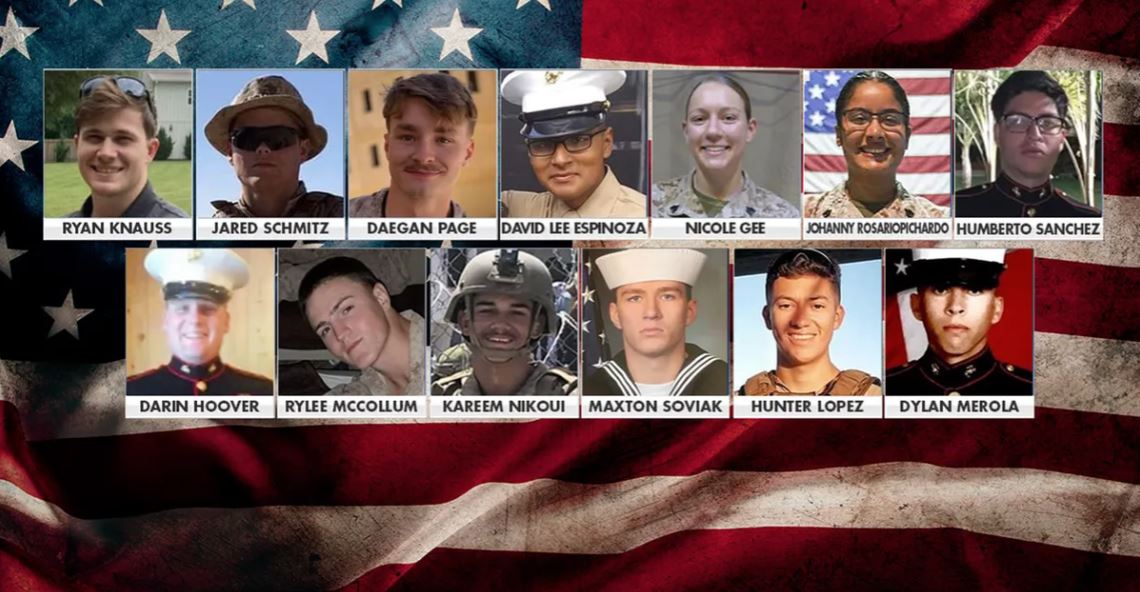
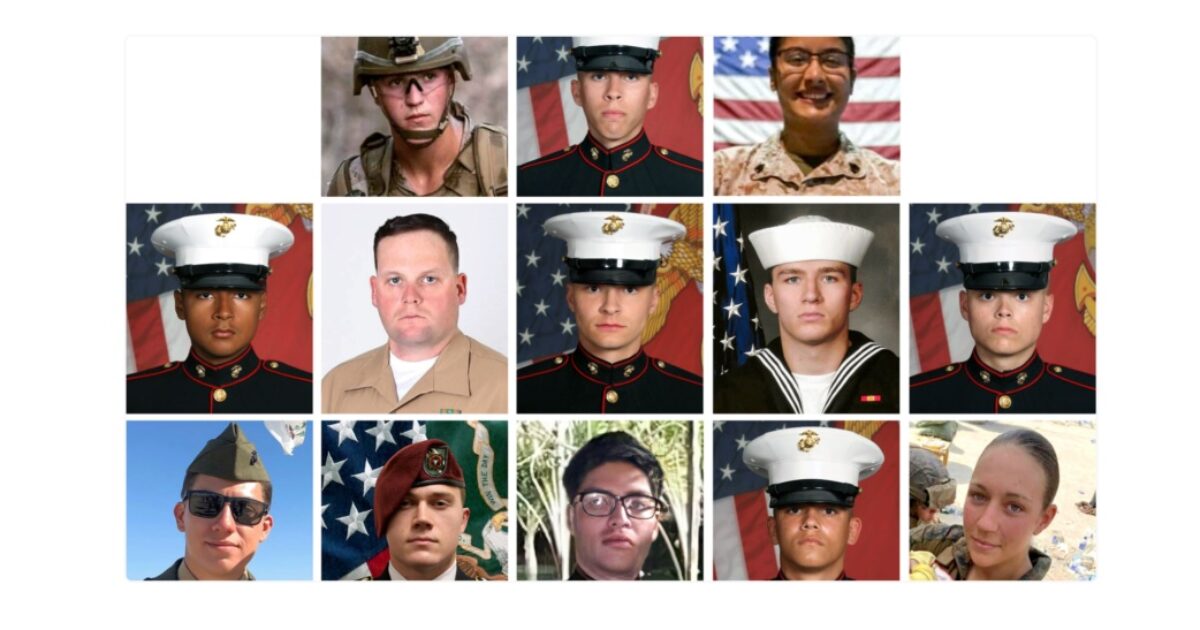
13 US servicemen and women were killed on August 26, 2021 by a suicide bomber during Joe Biden’s disastrous withdrawal from Afghanistan. – Fox-Grok image

This week was the five-year anniversary of the Kabul Airport bombing attack that killed 13 US servicemen and women and over 170 civilians.

The 13 U.S. service members killed in the ISIS-K suicide bombing at Abbey Gate (Hamid Karzai International Airport, Kabul) on August 26, 2021, were 11 Marines, one Navy hospital corpsman, and one Army soldier.

They are:

  • Marine Corps Staff Sgt. Darin T. Hoover (also listed as Darin Taylor Hoover), 31, of Salt Lake City/Midvale, Utah
  • Marine Corps Sgt. Johanny Rosario Pichardo (also listed as Johanny Rosariopichardo or Johanny Rosario), 25, of Lawrence, Massachusetts
  • Marine Corps Sgt. Nicole L. Gee, 23, of Sacramento/Roseville, California
  • Marine Corps Cpl. Hunter Lopez, 22, of Indio, California
  • Marine Corps Cpl. Daegan W. Page (also listed with middle names William-Tyeler), 23, of Omaha, Nebraska
  • Marine Corps Cpl. Humberto A. Sanchez, 22, of Logansport, Indiana
  • Marine Corps Lance Cpl. David L. Espinoza, 20, of Rio Bravo/Laredo, Texas
  • Marine Corps Lance Cpl. Jared M. Schmitz, 20, of St. Charles/Wentzville, Missouri
  • Marine Corps Lance Cpl. Rylee J. McCollum, 20, of Jackson/Bondurant, Wyoming
  • Marine Corps Lance Cpl. Dylan R. Merola, 20, of Rancho Cucamonga, California
  • Marine Corps Lance Cpl. Kareem M. Nikoui, 20, of Norco, California
  • Navy Hospitalman (Petty Officer Third Class) Maxton W. Soviak (also Max Soviak), 22, of Berlin Heights, Ohio
  • Army Staff Sgt. Ryan C. Knauss, 23, of Corryton/Knoxville, Tennessee

NEVER FORGET — Defense Secretary Lloyd Austin, Joint Chief Chairman Mark Milley, and CentCom Commander General Kenneth McKenzie all knew about the Kabul Airport planned  bombing at the Abbey Gate hours in advance.

The top US Military leaders knew that the Abbey Gate Soldiers were at the greatest risk.

Commanders calling in from Kabul reported that the Abbey Gate, where American citizens had been told to gather to gain entry to the airport, was the “highest risk” and detailed their plans to protect the airport.

A photo taken outside the Kabul Airport prior to the Islamist bombing that killed 13 US servicemen and women.

Previously, American heroes confirmed to The Gateway Pundit that US brass knew the suicide bomber was in the area of the Kabul Airport but military brass would not let them take him out.A 

US Marine sniper later testified that this was true.  He was not allowed to take out the bomber.

Now, according to the Armed Forces Press the Pentagon uncovered classified documents hidden in a safe on the 5th year anniversary of the Kabul Airport massacre.

Sean Parnell, Chairman of the Afghanistan Withdrawal Special Review Panel and Senior Advisor to Secretary of War Pete Hegseth, dropped a bombshell on the fifth anniversary of the August 26, 2021 attack. His team uncovered classified documents on the withdrawal that were deliberately hidden inside safes at the Pentagon.

Armed Forces Press reported on Parnell’s announcement:

His team has uncovered classified documents that had been deliberately hidden — “stashed and hidden away in safes where they would not be found.” After reviewing them, Parnell said it “became clear why someone tried to hide them” — but he declined to release the contents publicly until the investigation is complete.

Someone stashed classified Abbey Gate documents in safes where investigators would never find them.

So will the government take any action?

Secretary of War Pete Hegseth participated in a Pentagon ceremony on Tuesday to upgrade valor awards for service members who defended Abbey Gate — correcting what Parnell described as the “inappropriate downgrading” of those honors under the previous administration.

These were Americans who ran toward the bomb and saved lives. The Biden administration downgraded their valor awards.

They are finally getting the recognition they deserve.

Thirteen service members were killed in Kabul during the Biden administration during his disastrous withdrawal from Afghanistan.

The post HIDDEN IN SAFES!… Pentagon Uncovers Classified Documents on 5th Anniversary of Kabul Airport Massacre appeared first on The Gateway Pundit.

TRUTH: Sen. Lee Says If Thune Calls Back the Senate Early and Passes SAVE Act Republicans Would Win in a Landslide – So Where Is Thune?

Too bad, Senate Majority Leader John Thune does not give a rat’s a$$!

Who is Thune reporting to, anyway?

* * * * * * * * * *

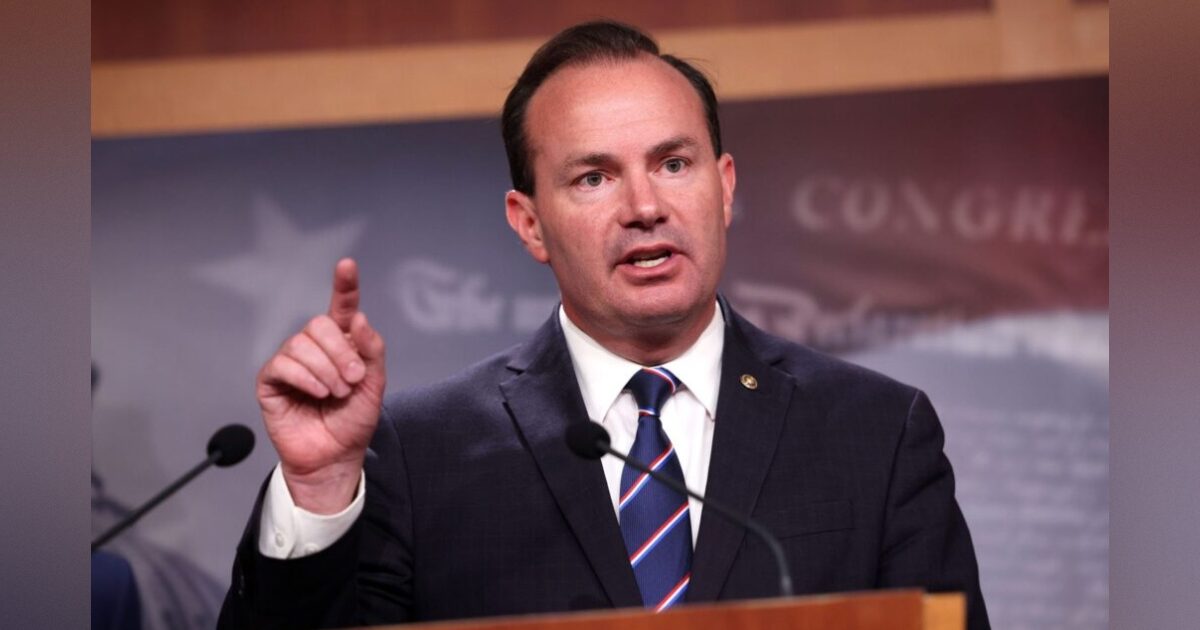
Sen. Mike Lee (R-UT) speaks on the bipartisan infrastructure bill during a press conference at U.S. Capitol on August 04, 2021 in Washington, DC. The group of Senators criticized the bill for being too expensive and claim it will increase the debt, inflation and taxes. (Photo by Kevin Dietsch/Getty Images)

Senator Mike Lee (R-UT) on Thursday tweeted that, “We’d increase our odds of keeping the Senate GOP majority if @LeaderJohnThune called us back into session immediately, announced his intention to keep us in continuous session until it passed, and required filibustering senators to speak.”

Lee followed up in the comments, with, “It’d work. It shouldn’t be this hard.”

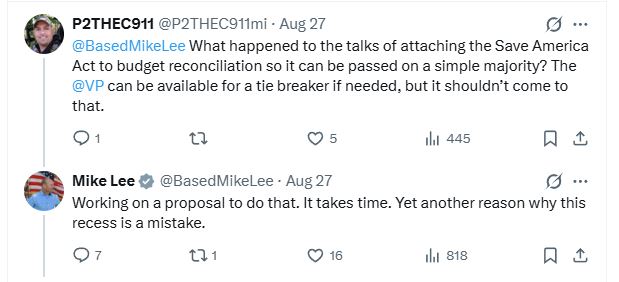
Senator Lee also said he is working on a proposal to attach the SAVE America Act to budget reconciliation so it can be passed on a simple majority. Vice President Vance can be available for a tie breaker if needed.

Mike Lee is one of the good ones. He means well.

Unfortunately, we have John Thune leading the US Senate. Thune believes he knows better than the 85% of Americans, both Republican and Democrat, who want Voter ID laws.

But, John Thune doesn’t care.

We are in a historic moment in time when the country sits on a brink. Democrats and communists are openly threatening to destroy the America that we love. Of course, the Democrat brass are against Voter ID. They depend on fake votes to win elections.

John Thune may be the man who gives these crazy b*stards a majority.

God help us!

We must all vote to give Trump the majority. It has to happen!

The post TRUTH: Sen. Lee Says If Thune Calls Back the Senate Early and Passes SAVE Act Republicans Would Win in a Landslide – So Where Is Thune? appeared first on The Gateway Pundit.

Sick Liberal Women Attack Usha Vance After She Posts Sweet Comment on Dolly Parton’s Passing – And Their Talking Points Are Complete BS!

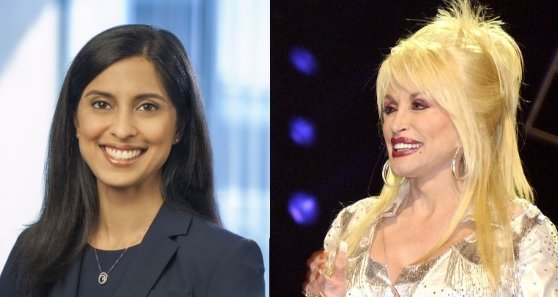
Second Lady of the United States and singer Dolly Parton – wiki commons

The media received their assignment on Usha Vance, the impressive attorney and mother of Vice President Vance’s three children.

They need to destroy this lovely woman and mother of three at all costs.

Usha, the attractive, brilliant, professional, has an elite resume.

She graduated from Yale Law School in 2013, where she was executive development editor of the Yale Law Journal (a senior role) and managing editor of the Yale Journal of Law & Technology. She also participated in the Supreme Court Advocacy Clinic and other clinics. Before that she earned a B.A. summa cum laude in history from Yale and an MPhil from Cambridge as a Gates Scholar.
Earlier this week, like so many Americans, Usha mourned the passing of Dolly Parton. Usha posted this lovely message on X.
Usha Vance (SLOTUS): “As four-time subscribers to Dolly Parton’s Imagination Library and lifelong fans of her music, our family knows that Dolly Parton loved a good story. I hope that you’ll pick up a book and celebrate the magic of storytelling in her honor today.”
Here is the tweet.

This inflamed the radical white liberal women mob.

They accused her husband JD Vance of defunding Dolly Parton’s Imagination Library!

Here are a couple responses on X from the liberal mob…

“ST*U Usha”

“Your husband cut funding…”

“wtf R U doing…”

The story made headlines at these far left publications: The Irish Star and She Finds on Yahoo,

But JD Vance had NOTHING to do with any cuts to Dolly’s Imagination Library.

The $4 million figure appears in recent state-level budget stories, not in connection with JD Vance who had no role in the state budgets.

Missouri reduced its state allocation from about $6 million to $2 million for fiscal year 2027—a $4 million cut that froze new enrollments starting July 1, 2026. Indiana had allocated $4 million for one year of a prior biennial budget before eliminating the state match entirely. Other states (Washington, Maine, parts of Kentucky and Nevada) also reduced or ended matching funds. These were decisions by state legislatures and governors.

The left is hateful as usual. Such loud, offensive and dumb people.

The post Sick Liberal Women Attack Usha Vance After She Posts Sweet Comment on Dolly Parton’s Passing – And Their Talking Points Are Complete BS! appeared first on The Gateway Pundit.

How the Other Half Homeschools

How the Other Half Homeschools

A record number of American parents are finding that the most affordable “good school” is in their own home.

Pamphlets and literature collected at a homeschool convention photographed on June 21 in Washington, DC.
Photo by Bill O’Leary/The Washington Post via Getty Images

Earlier this summer, while reading Skipping School: A History of American Homeschooling and How It Went Mainstream by historian Dixie Dillon Lane, I wrote the following note in the margins: “Will opposition to homeschooling become a luxury belief domiciled among elites?” At the time, the note was just a hasty thought scribbled down with no particular examples of elite opposition sticking out in my mind. Then, on July 14, I’ve Had It podcast hosts Jennifer Welch and Angie Sullivan handed me such an example on a silver platter. 

“What I have absolutely f—ing had it with is watching some of the stupidest people I went to school with decide they’re qualified to homeschool their children,” a caller identified only as Ellie from Minnesota told Welch and Sullivan. “I can’t stand these morons attempting to homeschool their children when they probably shouldn’t have even had children to start with.”

Welch and Sullivan reacted with laughter and grins. 

“I just think homeschooling is a bad idea from soup to nuts. I don’t care if you’re a nuclear physicist. I think it’s just f—ing weird as f— that you want your kids around you all day, every day,” Sullivan said.

“America has a crazy Christian problem…. I’m talking about the freaks of the megachurch,” Welch said. “I’m talking about the ones that have schools that are these crazy indoctrination factories, hate academies, and then when that hit isn’t strong enough, then they go to homeschooling.”

Welch and Sullivan rightly faced backlash for their comments. Although the progressive podcasters are from the heartland (Oklahoma City, to be exact), their views on homeschooling, rather than on, say, health care or transgenderism, may be what really separates them from normal Americans. They are elites. Welch appeared on The New Yorker Radio Hour with David Remnick in January. Welch and Sullivan donned evening gowns to receive a GLAAD Media Award from Laverne Cox in March. Middle-class Americans increasingly approve of and practice homeschooling, while laptop liberals like Welch and Sullivan are turning it into a punchline, falling out of step with normal people’s experiences.

Who are today’s homeschoolers, and how did the practice become so widespread? (More than 5 percent of American children are now homeschooled.) Lane’s Skipping School answers those questions and many others. Lane, herself a homeschooling mother, reports from inside the movement but doesn’t let that color her conclusions. In some ways, Skipping School is a response to “irresponsible research and reporting” on homeschooling post-2020, but Lane doesn’t present a one-sided case. She carefully sifts through survey data, legal cases, and personal stories to present a portrait of homeschooling that shows its growing place in the American mainstream. Lane writes of early homeschoolers in the mid-20th century, when education experts’ influence was waxing and parental control was waning, that in “taking the shocking step of removing their children from school, [parents] were in fact acting in a characteristically American manner, privileging independence over state authority. These innovators foreshadowed a new American paradox: a nation plagued by distrust yet booming with consolidation.”

Welch and Sullivan might be surprised to learn that homeschooling is a racially diverse movement (in 2016, less than 60 percent of homeschoolers reported as white). Parents choose to homeschool for a variety of overlapping reasons, with religious motivation being just one factor. “We can say with some confidence that… the overall motivation of homeschoolers as a group was almost certainly not primarily religious and has grown to be less so over time,” Lane concludes after digging into survey data from the National Household Education Surveys Program. 

Lane begins Skipping School with accounts of homeschooling’s early days in the 1950s, when the California mother Mary Turner was questioned in court for homeschooling her children. Mary and William Turner were middle-class, educated, and patriotic, yet a judge ordered their children to return to the schoolhouse. Homeschoolers in many states remained under the radar until roughly 1990, when “the playgroups and associations that families had initiated… transformed into a publicly recognized social movement.” Homeschoolers now had groups like the Home School Legal Defense Association, founded in 1983, to back them up. By 2010, homeschooling was part of the mainstream. Lane writes, “It is both practiced by enough Americans and accepted by enough Americans to be considered a minor norm within the larger American landscape.”

Woven throughout the book but never pushed to the forefront is the importance of socioeconomic factors in families’ education decisions. Moms often discuss online whether it’s a privilege or a sacrifice to be a stay-at-home mother. Homeschoolers are caught up in a similar debate. Lane reports that “the income levels of homeschooling families were spread across the socioeconomic spectrum, on average only slightly less wealthy than the national average.” She doesn’t dig into why homeschoolers are less wealthy on average—could it be that mothers are doing unpaid work as their children’s teachers rather than earning income? Perhaps that’s only one piece of the puzzle. But it surely undercuts the narrative that all homeschool mothers (and mothers who don’t earn income) sit on a pedestal of privilege. 

Some homeschool families would probably opt for private schools if it were within their means. Lane, who has taught at Christendom College, traces the roots of Catholic homeschooling to the Second Vatican Council of the 1960s. Parochial school tuition became more expensive, pricing out many Catholic families, and some of those same families also became concerned about the “Catholicity” of Catholic schools. By the 2024–25 academic year, there were roughly twice as many homeschool students as Catholic school students, according to a February study from the National Home Education Research Institute. 

Lane says that it was never inevitable that the nascent homeschooling movement would survive its under-the-radar days. Yet many Americans today know homeschooling families or even are themselves homeschoolers. Could economics play more of a role in this phenomenon than we realize? In a viral Substack article titled “Young Adults Are Poor Despite Every Metric Which Suggests Otherwise,” the self-identified legacy advisor Johann Kurtz writes that young Americans now need “extraordinary income” to obtain what previous generations took for granted, namely a spouse, house, children, good school, and good neighbors. A record number of American parents are finding that the most affordable “good school” is in their own home. 

Parents are continuing to homeschool because it works academically. Looking at homeschoolers’ ACT scores, Lane describes 21st century homeschooling as “academically promising (at a minimum, as effective as public schooling).” Meanwhile, data on public school students’ performance are a mixed bag, if even that. But the era of the tiger mom is over; the MAHA mom is ascendant. And the MAHA mom and homeschool mom are merging, as one Idaho mother demonstrated in a video declaring “WE HOMESCHOOL FOR HEALTH,” adding, “7-8 hours indoors in a typical school environment is detrimental to my kids’ health and development. That’s my why. What’s yours?” She’s not alone. “A majority of parents place less of a premium on their children’s academic success than their mental well-being,” reads a 2023 report from EducationWeek. 

But can homeschooling maintain out-group approval without high test scores to make the case for its existence? Americans like numbers, the bigger the better. But aggregate data will never be able to tell stories like that of a homeschool student with learning disabilities who, through special parent attention, achieves academic success that won’t show up as an outlier on any chart but represents great individual improvement. Perhaps the MAHA homeschool mom can shift the terms of the debate, especially as researchers uncover just how backwards traditional schooling practices are when it comes to the health and success of our kids.

It’s wonderful that parents with few options to effectively educate their children can turn to homeschooling. But what does it say about our society that so many have to? Lane described midcentury America as “a nation plagued by distrust yet booming with consolidation,” and that description still holds true today. One word that comes up over and over again in Skipping School is “postinstitutional,” which Lane associates with a public that is “highly individualized but also increasingly integrated with institutions and wider communities.” Homeschooling has developed “from an anti-institutional movement into a postinstitutional one,” she writes. 

Countless conservative scholars have written about institutional failure regarding everything from elite universities to Congress. The failure of so many public schools to provide a safe environment and decent education for future citizens may be the greatest failure of all, and one that costs not just parents but society at large. A few decades ago, sending your child to the local public school for kindergarten was a frictionless decision. Now, parents concerned about everything from AI reading apps to cross-dressing teachers are diverting time away from other pursuits just to find an adequate place for their children to learn the ABCs. Sometimes inefficiency is worth it, but it’s mighty inefficient for so many conservative families to have to figure out how to run their own personal elementary schools.

That’s why so many homeschooling families seem to be reinventing the one-room schoolhouse from first principles. (Of course, one-room schoolhouse sounds too Little House on the Prairie, so “microschool” is the preferred term.) Modernity has revealed that many institutions are fake at best and evil at worst. Families can just band together to reinvent schooling. Such self-sufficiency is a characteristically American trait, and one that I hope will help education in America get back on track.

The post How the Other Half Homeschools appeared first on The American Conservative.

What Vance Sees in Huey Long

What Vance Sees in Huey Long

The Kingfish is a worthy model for right-wing populists.

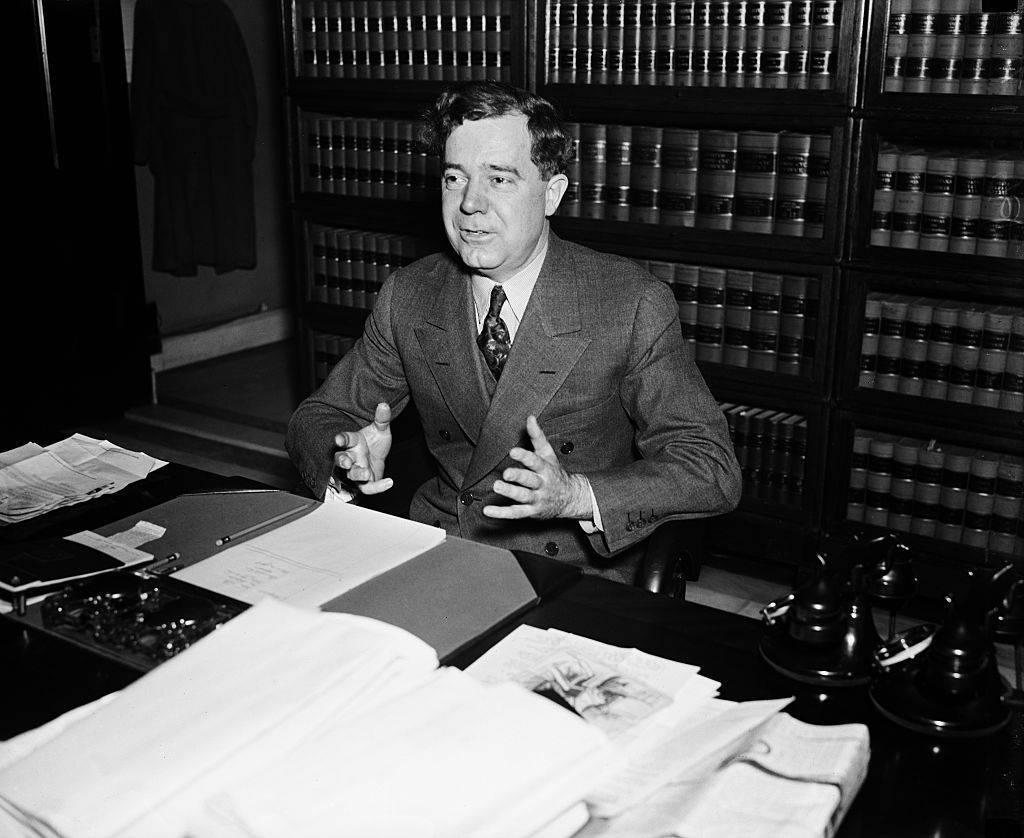
U.S. Senator Huey P. Long, Portrait, circa 1935

At a steel plant in his hometown of Middletown, Ohio last week, J.D. Vance invoked the memory of a “great Southern populist.” 

“His name was Huey Long,” the vice president said, “and he once said ‘Every Man a King’ was the goal of his political program.” 

Noting that Long—the Depression-era Louisiana governor and U.S. senator popularly known as the Kingfish—was “an interesting guy, kind of a crazy guy,” Vance connected his program with the Trump administration’s agenda:

But no man is a king if their castle is under siege by criminals. No man is a king if they can’t take their family out to dinner without being mugged or having their car jacked. And of course, ending the Biden border invasion was a big part of why we have changed that over the last 18 months.

Now, this wasn’t a full-throated endorsement of Long on Vance’s part; nor did the vice president precisely describe what Long’s famous slogan actually entailed. (That would be wealth redistribution.) But even a passing, non-condemnatory mention of Long set off alarm bells for some bien pensants of both the right- and left-wing varieties, whose preference for neoliberalism at home and neoconservatism abroad is starkly at odds with what the Kingfish represented. 

As the Democratic governor of Louisiana from 1928 to 1932, Long imposed a far-reaching, profoundly populist vision on what had heretofore been a state beset by extreme poverty and inequality. When he took office, Baton Rouge basically belonged to Standard Oil, and Louisiana politics was the province of the scions of the state’s small moneyed establishment. Wealth was hyper-concentrated, and politics was a means of preserving and increasing this concentration. This explains why a place honeycombed with rivers and bayous had only three state-built bridges prior to Long, and why Louisianians of the era had the country’s second-lowest literacy rate.

During his subsequent stint as a U.S. senator (1932–35), Long maintained de facto control of Louisiana through his allies and a puppet who occupied the governor’s mansion in his absence, all while challenging FDR from the left. Long had supported Roosevelt during the 1932 presidential election, but he eventually broke with him, and in 1934 proposed his “Share Our Wealth” plan as a substitute for the New Deal. While Long frequently changed the specifics, in essence this program would have capped extreme personal wealth, guaranteed family incomes, provided allowances for families to purchase homes, enacted free public education for many students, and limited the work week to 30 hours and the work year to 11 months. 

Though the prudence and feasibility of these policies are open to question, what is beyond dispute is that Long was on the side of the working man, insofar as it can be said that any American politician ever was. 

And indeed, Long’s “Share Our Wealth” agenda may have helped tilt Roosevelt in a more pro-worker direction. The Second New Deal, implemented from 1935 to 1936, was considerably more radical than the first iteration. It enshrined Social Security into law, guaranteed the right to unionization and collective bargaining, and jumpstarted rural electrification. It’s hard not to see another product of Roosevelt’s program, the Works Progress Administration—which employed more than 8.5 million to build 650,000 miles of road, 125,000 public buildings, 8,000 public parks, and 800 airports, and was responsible for countless American landmarks that remain to this day—as having cribbed a bit from Long’s Louisiana model, which saw the construction of 9,700 miles of road and 111 toll-free bridges.

Long was also a magnificent orator, electrifying, edifying, and endlessly amusing his listeners. He delighted in skewering elites of all stripes: “The only difference that I have found between the Democratic leadership and the Republican leadership,” he once said, “was that one of them was skinning from the ankle up, and the other one from the ear down, when I got to Congress.” 

Ultimately, though, Long wouldn’t live long enough to challenge Roosevelt and the uniparty of his day. He was shot dead on September 8, 1935, in the Louisiana State Capitol—a grand, Art Deco skyscraper Long had built as the shining monument to his political project (and, well, himself) that had opened only three years prior. The son-in-law of a political opponent was the assassin, and all throughout Long’s reign, the New Orleans establishment and their allies would routinely muse about when someone would kill Long. As an old, Southern-aristocratic-cadenced journalist of the era recounted in Ken Burns’s 1985 documentary Huey Long, one of the fairer mass-media depictions of the Louisiana Kingfish, “I can’t remember any Saturday night that I went anywhere that we didn’t talk about killing Huey Long,” though she said it “didn’t mean you meant to do it,” only that you wanted the “incubus” gone. 

Long deserves recognition for other things as well: Louisiana State University, for example, which he massively expanded, tripling its student population and establishing its medical center; the free textbooks that he provided to schoolchildren throughout the state; adult literacy programs to educate the masses; numerous low-income-serving hospitals; and his elimination of the poll tax to encourage voter turnout. On this latter move, it redounds enormously to Long’s credit that he largely eschewed the racism that was too often entwined in southern populism (indeed, he counted the KKK among his political enemies).

Despite all this, Long’s legacy and standing with America’s liberal class is incredibly poor. This raises the question: With Long responsible for so many remarkable achievements in Louisiana, and through his national political influence some of the best of the post–New Deal order, why has he been castigated as a “dictator”? And curiously, why are many of the same critiques of Long so seldom applied to Roosevelt’s own “dictatorial” tendencies, of which there is certainly much material: his threats to pack the Supreme Court, his internment of American citizens of Japanese ancestry, his breaking of the two-term presidential tradition? It’s not only socialists and populists who celebrate Roosevelt—though there’s certainly a lot of that—but also mainstream liberals, perhaps barring the Reagan-worshiping right. 

The answer might come down to the fact that Long was inclined toward what we might charitably call executive overreach. He started his own propaganda newspaper, threatened judges, forced state employees to pay up to 10 percent of their salaries into his campaign slush fund, took over New Orleans and Baton Rouge from their municipal governments, and once even briefly kidnapped two men so they couldn’t testify about his affair.

These are, obviously, fair matters for critique. But it is also true that Long largely worked within the confines of the law, and wielded his power in the service of (mostly) public-spirited ends. There were certainly no massacres on the streets of Long-administered New Orleans and Baton Rouge, nor did the state witness any of the other horrors that characterize societies run by genuine tyrants (dictators also don’t tend to increase voting access, as Long did). If Long was a dictator, so was FDR—and Trump. But no serious person would call Roosevelt or Trump a dictator, and that is precisely the point. 

Which brings us back to those who took umbrage with the current vice president’s reference to Long. 

On the neocon right, the Fox News host Mark Levin satirically remarked of Vance’s recent speech, “Huey Long. That’s the ticket,” and, “I notice the Buchananites don’t care for Reagan. He’s no Huey Long, that’s for sure.” Joel Berry, the producer of Jeremy Boreing’s  show and the former managing editor of the Babylon Bee, tweeted, “Ronald Reagan and Milton Friedman did infinitely more to make ‘every man a king’ than Huey Long ever did.” Dana Loesch opined, “Absolutely bizarre that [Long] would be recast as some example for the GOP today.” And James Lindsay, finally, had to say: “The scope of this Huey Long stuff from the Vanceguard skanks shows that they’ve been cooking on this for a while just outside of general notice. Very few people are all that aware of Long or his ideas or legacy, but the whole Vanceguard seems to be very aware and enamored. Sus.” 

The libertarians, who are at least more ideologically consistent, were not happy either. Reason ran an op-ed: “J.D. Vance’s Interest in Huey Long Should Be a Red Flag for Conservatives.”

Meanwhile, on the mainstream liberal left, Bill Scher, the politics editor of the Washington Monthly, quote-tweeted Vance’s remarks, “Uh, Huey Long was an authoritarian socialist and ‘Every Man a King’ was a redistribution program that placed 99% tax on wealth above $8M.”

That program, as it turns out, won a lot of people over. As Rod Dreher, conservative intellectual and former senior editor of The American Conservative, told me of his childhood in the Louisiana of the ’70s and ’80s, “I remember my father, born in 1934, taking up for Huey. He was very right-wing, my dad, but he told me that if it hadn’t been for Huey, people like him and his family—working-class rural folks—would not have had good roads or schoolbooks. I didn’t want to hear it at the time, because I was one of those poli sci majors who was all in for good government.” 

“But now I can see that my late father had a good point,” Dreher continued. “Louisiana politics were quite corrupt before Huey came along. The state was controlled by planters, New Orleans oligarchs, and then by oil companies. Huey, born in rural north Louisiana, was something like Donald Trump, in that he came in, all theatrical bluster, and won power. But unlike Trump, Huey was not only intelligent, but cunning.” 

Perhaps a more trenchant critique of Vance’s reference is that his boss has all the downside of the Kingfish and none of the upside: cronyist corruption on an unprecedented scale; a crude and blustering rhetorical style; little to no respect for constraints on his personal power. With Long, there was a real point to it all, and he indisputably elevated his constituents out of poverty and provided them with clear, visible, positive material outcomes. With Trump, as has become clear especially in this second term, it really is only about himself—and if somehow it’s not, the president has been incredibly ineffective by any non-MAGA-cultish measure. But this is not the liberal critique. The liberal critique is that Long was terrible, period, and nobody should ever say anything positive about him. (It’s probably no coincidence that, to further displease America’s liberal class, on foreign policy, Long was a staunch opponent of American imperialism from the Philippines to Latin America, and wanted the United States to stay out of European conflicts.)

The unfair, one-sided interpretation of Long’s legacy is not upheld only through social media posts. His treatment in the arts has also helped to darken his image. Robert Penn Warren’s book All the King’s Men and its two cinematic adaptations seem to have convinced many that Long was, at heart, a power-mad demagogue.

But as Dreher commented, “What Hollywood and mass media overlook, though, was the man’s deep intelligence, and Stakhanovite work ethic, which he had since his youth as a traveling salesman. They miss that, and they miss the fact that without Huey P. Long, most of the people of Louisiana would have been consigned to live a more feudal existence, exploited by oil companies and New Orleans elites.” 

So what, finally, should we make of Huey Long and the connection to today’s populist right? For one, he  seems somewhat popular among the younger, more engaged and online crowd; after Vance’s comments, Nalin Haley—Nikki Haley’s son, whose right-populist politics are diametrically opposed to his mother’s own—posted an image of Long in his fiery speech-pose, captioned, “We’re so back.” 

Dreher’s opinion is that, if the young right is “interested in Huey because he tenaciously battled entrenched political and corporate interests on behalf of the common good, then they have a lot to learn from his example.” And furthermore, “the only contemporary politician on the right who could plausibly claim Huey P. Long as an inspiration is J.D. Vance. I say that because if Vance becomes president, I think he truly does have the same feel for working people that Huey did. Plus, he is intelligent, and not bound by the legacy of Ronald Reagan. Trump’s populism is almost entirely a matter of style, but I anticipate President Vance’s version would be far more substantive — though the real test would be how he would treat Silicon Valley oligarchs.” 

Still, Dreher cautions Vance against associating himself too closely with Long: “Even in Louisiana, where the practical monuments to Long’s governorship—bridges, things like that—still stand, and are still used by the state’s people, Huey has gone down in popular memory as a colorful part of our past, but not one we are eager to repeat. If you have to explain to people that Huey Long is a more complex and positive figure than the received historical narrative portrays, you probably shouldn’t lean too much on him in your speeches.” 

But Adam Dohrenwend, an assistant professor at James Madison University who has studied at the place Long during his tenure saw as “his university,” LSU, has a grimmer view. “He’s the vice president. He’s in charge. So let’s see [the Long-style populism].”

If the right wants to emulate Long’s accomplishments, rather than merely his style, it still has a long way to go. But one suspects this will be easier once Donald Trump makes his exit. And if anyone could pull it off, it would be J.D. Vance and whatever remains of the New Right—perhaps aided by the so-called “Tucker wing,” or something like it.

For much of Tucker Carlson’s own rhetoric could have come straight from Long’s mouth. An August 17 Instagram clip of his, cut from one of his monologues, shows Carlson intoning precisely as Long would have: “Both parties have colluded against the population to make their lives better and our lives worse. And unfortunately they have been extremely successful.” 

Though one would still be wise to question the right’s capacity for any Longism beyond mere rhetorical signaling. Long, ultimately, was of the left, even if modern Democrats have largely abandoned it. As Dohrenwend believes, “The left should absolutely reclaim Huey Long. He’s not their guy, the right’s.”

Whether the vice president, or anyone on the right, will really seek to make “Every Man a King” remains to be seen. But whatever else happens, as Dreher told me in closing, “Vance would look like a banger in a white linen suit.”

The post What Vance Sees in Huey Long appeared first on The American Conservative.

Five Years On From Biden’s Finest Hour

Five Years On From Biden’s Finest Hour

The 46th president paid an enormous political price—the beginning of the end of his presidency—to do the right thing by leaving Afghanistan.

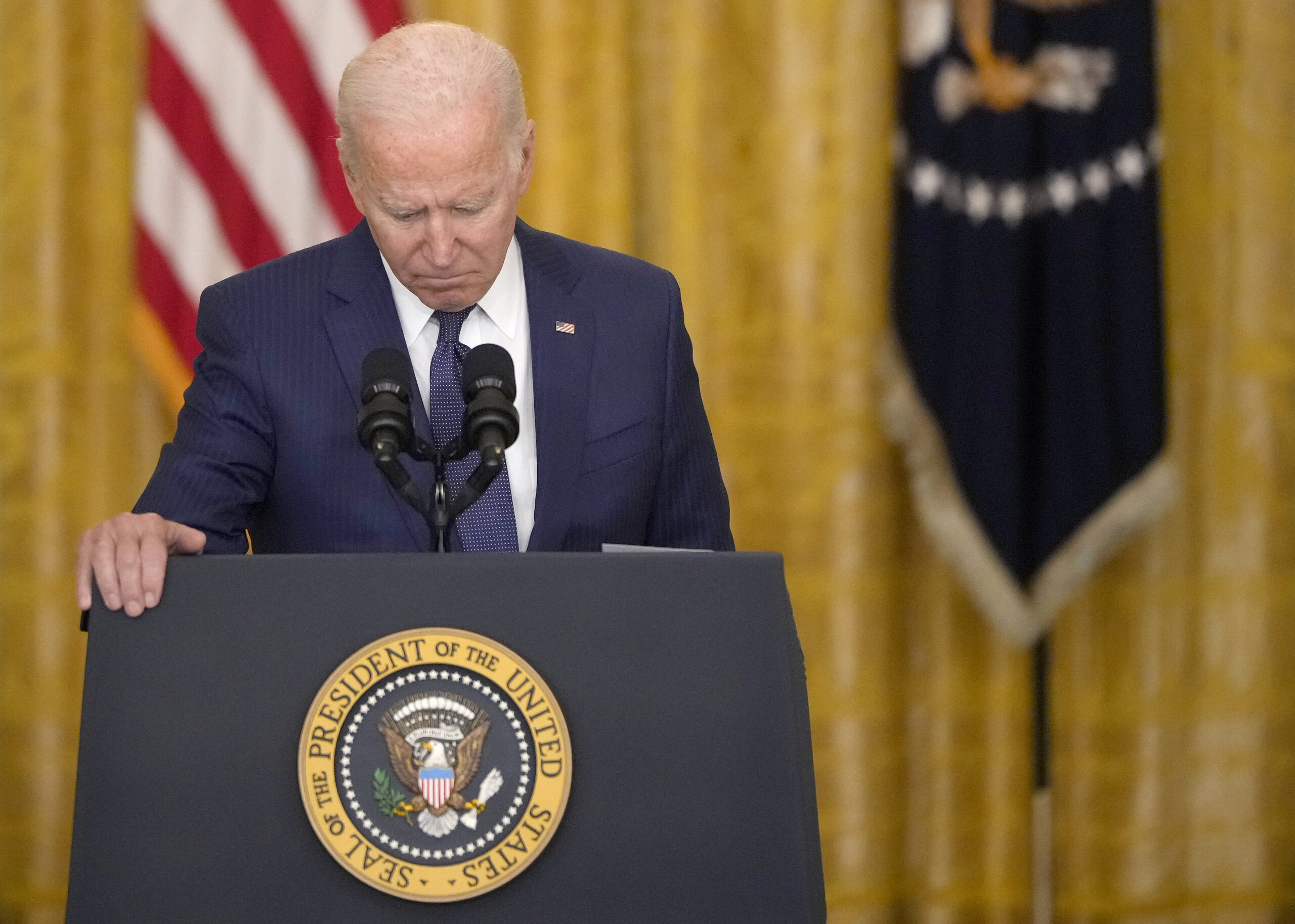
President Biden Addresses The Nation After Explosions Rock Kabul
Photo by Drew Angerer/Getty Images

At 4:53 PM, Kabul time, on August 29, 2021—while Americans were enduring a putrid summer hunkered down at home amid Covid’s “Delta wave”—a U.S. unmanned drone (then a relatively unheard-of technology) bombarded a 1996 white Toyota Corolla. United States Central Command (CENTCOM) killed 10 people, including seven children. 

It was a mistake.

That September, CENTCOM’s jefe de jefes Frank McKenzie told reporters in Washington, “We now assess that it is unlikely that the vehicle and those who died were associated with [Islamic State – Khorasan Province] or were a direct threat to U.S. forces.”

McKenzie continued, “I offer my profound condolences to the family and friends of those who were killed. This strike was taken in the earnest belief that it would prevent an imminent threat to our forces and the evacuees at [Hamid Karzai International Airport].” 

He did not equivocate: “But it was a mistake and I offer my sincere apology. As the combatant commander, I am fully responsible for this strike and its tragic outcome.” 

While perhaps mundane and riddled with military-speak, it was big of any authority figure in those years, a time when we now know a vast array of Washington officials were lying—not only about the “Global War on Terror” and the American “mission” in Afghanistan, but also the Covid “crisis”—to tell the truth and to apologize.

Though McKenzie has gone on to enjoy the post-military career of a craven hawk (that all-too-comfortable web of nebulous associations and think-tank perches for the retired brass), his political management of the situation matched the assessment of the man given by my late mentor, the military historian and Middle East advisor Mark Perry.

“McKenzie is viewed by his colleagues as one of the most politically astute officers to ever head up the US Central Command—a notable change from his sometimes controversial predecessor Army Gen. Joseph Votel,” Perry wrote in 2019. “Votel was outspoken and opinionated, and he bickered…. That won’t happen under McKenzie.… At the Pentagon, McKenzie worked to dampen the growing competition between combatant commanders.” (Perry died, maddeningly, a week before the fall of Kabul.)

McKenzie disagreed with the decision by the Americans to leave. That long-reported fact is now blared out again in a new agitprop documentary by the Wall Street Journal’s editorial board, on then-President Joe Biden’s decision to exit Afghanistan that summer. But McKenzie conducted himself, in the fog of war, as a professional, executing a strategy that was not his. 

After the U.S. made the opposite decision in 2026—to enter into a new war in a neighboring Greater Middle Eastern country—the Pentagon under Secretary Pete Hegseth and CENTCOM (helmed by Adm. Brad Cooper, who was described to me by one senior administration official as a “made man” in the “CENTCOM mafia”) has seemed notably more spiritually dishonest, and far more messianic.

While the exodus from Afghanistan was imperfect, the conduct of the boring Biden Pentagon deserves more credit.

President Biden got the strategy in Afghanistan right. He was right. He was right for years—going back over a decade, to his time as vice president, when he reportedly considered resigning over then-President Barack Obama’s gargantuan troop surge there. 

“Tomorrow [President Obama] is going to make a fateful decision regarding Afghanistan—as I sat looking out the window at the sea—thinking I should resign in protest over what will bring his administration down,” Biden wrote in an “Af/Pak” pad he put to use during National Security Council meetings in 2009, as divulged by former Special Counsel Robert Hur.

Though “nostalgia” is not the right word for 2021 (that year was not a particularly great vintage) or the Biden presidency (ditto), this episode—the choice to leave Afghanistan for real—deserves commendation from someone, anyone. And since Biden has been abandoned by his own party and remains a joke on the right, I guess the defense of his Afghanistan policy (along with a few other aspects of his presidency) is going to fall to the executive director of The American Conservative.

Biden will always be fascinating to me. He is an excellent example of someone who probably made the fullest use he could of his mental and physical gifts. Biden was and is not brilliant. But he’s smart. He works hard. He reads, in his way. 

Biden was and is not a beautiful man. He is not Jack Kennedy, on whom he modeled his life and family (with a hauntingly similar mix of true triumph and vicious tragedy). But he is physically striking, dapper, arguably the best-dressed and most well-styled president of my lifetime. 

Biden was and is a bullshitter and a blowhard. But that tendency had receded somewhat by the time he became vice president and president. That’s why I don’t necessarily buy the common argument that he would have been a better president younger. There is a classic vitality vs. wisdom tradeoff here. (Though it’s much more likely the end of his reign would have been avoided.)

I’m not sure he always was—“Biden disappoints everyone,” as a comment famously attributed to Ted Kaufman (arguably Biden’s best friend) has it—but by the time he became president, I think Biden was a fundamentally good man.

Biden was overmatched by Ukraine, where he was an orthodox liberal and not dextrous enough to develop original views or exert independent command. He was done in, eventually, by his own physical limitations. Biden was arrogant about the latter, but presidents are unavoidably a little arrogant, and he got unlucky. (What if he had never agreed to that early debate? Would he be president today?) 

His record on Gaza is ghastly, and his relative trust in Benjamin Netanyahu and the unambiguous virtue of the Israeli project—“I’m a Zionist,” Biden often declared, famously and sometimes oddly—blots his record with the biggest sin in Washington: being a sucker. He contributed to the evils of Covid and “Woke 1,” as I guess we’re calling it. (It was indeed “crazy.”)

But Biden was very plausibly the best possible Democrat to lead the country at the time. If conservatives are honest, Trump’s reelection in 2020 would have been an unfathomably dark and grinding affair. Even Trump and his aides know he is more powerful than ever by virtue of his unprecedented comeback.  

Biden got inflation wrong. But so did a lot of people, and most of “the smart set” at the turn of the decade. 

But Biden worked with, or at least didn’t massively interfere with, the Federal Reserve’s efforts to land the plane without triggering an economic recession. (We shall see if we’re about to be so fortunate this presidential term.) That is still a wild triumph. 

I’m a borderline Paulite “end/audit the Fed” guy, but honesty compels one to concede that Jerome Powell is an actual, living American statesman. I struggle to think of another one. (Perhaps James Baker?)

Still, the failure of the Biden zeal for spending was and is disquieting—no one truly authoritative really, in his heart of hearts, knows with high conviction how to handle the economy after the Covid-era spending bonanza and its consensus failure (a somewhat but not entirely fair judgment). But that’s not really Biden’s fault. It is the new, frightening human reality. 

If Biden had won, and his cancer had progressed at the same pace (an assumption—the mind’s power over the body is a mysterious thing), one wonders whether he would have resigned in office. I tend to think he would have. But it’s unknowable.

Biden’s Treaty Room address announcing the withdrawal from Afghanistan and his defenses of the fundamental policy amid the chaos in August 2021 are still, I believe, the bravest, best things a president has done in my lifetime. 

That is a sad commentary on American leadership in the 21st century, but there you have it. Biden was not great, but he was commanding and interesting, and perpetually underrated, which is inherently sympathetic. 

And, although it pains me to say it, one can no longer make an intellectually credible argument that Trump (who negotiated the original deal with the Taliban) wouldn’t have gotten rolled by the generals if reelected in 2020. This is, of course, also unknowable. But he was rolled by the generals on Afghanistan when he was elected the first time in 2016. And our present war in Iran is a mighty big counterpoint to the theory that, when push comes to shove, Trump’s true convictions matter.

Biden got it done. So: thank you, Mr. President.

The post Five Years On From Biden’s Finest Hour appeared first on The American Conservative.
Conservative Analyst Sean Davis on Immigration: There is a Difference Between Becoming an American and Just Living in America (VIDEO)

Screencap of Twitter/X video.

Sean Davis, the conservative writer and political analyst of The Federalist, recently appeared on the Charlie Kirk podcast and made an outstanding point about immigration.

While Davis said that he does not believe that we should shut down immigration altogether, he pointed out that there is a world of difference between someone who comes to America to be an American, and the people who come here to simply live in America and take advantage of all of the things that country has to offer.

He also points out, correctly, that America does not need people who come here to simply live here.

Transcript via Real Clear Politics:

SEAN DAVIS: I believe this radical thought that stems from the Constitution, the Declaration, that America exists to secure the blessings of liberty for Americans, which is to say America exists for Americans.

Now, does that mean we should never, ever let anyone in again, ever, from a foreign country? No. But it does mean that America needs to stay American.

And you reach a certain point with immigration where the numbers get so high that you have a tipping point where the people who are coming in are no longer becoming American. What they are doing is becoming people who just live in America.

And you can see this in the cultural practices they retain. You can see this in where they are sending their money via remittances.

So many — such a high percentage of people who are coming in do not see themselves as American. They see themselves still as Indian. They see their roots as Indian. They are not willing to assimilate into our culture, and that is how you destroy a culture.

So you might ask, well, who cares? You know, America’s awesome, and let them make money. Who cares about the culture?

The culture is why we are better than everyone else. That is an objective statement. If we weren’t better than everyone else, everyone else wouldn’t be trying to come here.

America invented the automobile and the airplane. We split the atom. We created the aircraft carrier. We make computers and the internet. We put rockets in space. We put a man on the moon. Other countries did not do this. Americans did this. People like Homer Hickam from West Virginia did this.

So I want everyone else to understand: We don’t actually need you here. We have been the best country in all of history without you.

Watch below:

He stated that perfectly. There’s really nothing to add.

The post Conservative Analyst Sean Davis on Immigration: There is a Difference Between Becoming an American and Just Living in America (VIDEO) appeared first on The Gateway Pundit.

FRIDAY FUN: Maine Weatherman Can’t Stop Laughing During Broadcast, Has a Total Meltdown on the Air (VIDEO)

Screencap of Twitter/X video.

A Maine weatherman named Patrick Osborn who works at WABI News recently suffered a total meltdown on the air and could not stop laughing during a live broadcast.

Have you ever been in a situation where you are not supposed to laugh, which only ends up making you want to laugh more? It looks like that’s what happened here.

Apparently, a practical joke had just happened on the set, right before Osborn went live. The result is pretty funny.

Even FOX News reported on this:

A local meteorologist is experiencing viral fame after he was caught on live television suddenly breaking into an uncontrollable fit of giggles that grew increasingly hysterical as he struggled to keep his composure.

Patrick Osborn, who was delivering a regularly scheduled weather report on Maine news station WABI, left viewers completely stunned Sunday morning as he repeatedly tried, and failed, to hold back his laughter.

In the video, Osborn was seen gasping for breath as he blurted out temperatures between chuckles, repeatedly apologizing before the laughter finally rendered his speech completely incomprehensible.

The laughing fit stretched on for about a minute, with Osborn stepping off camera before returning and eventually tossing back to a colleague.

Recalling the moment with WABI co-anchor Brian Sullivan, Osborn said, “I got a fit of laughter that I was not able to control on air, unfortunately. A lot of times, something funny happens, and I’m able to contain myself, but this one, it was just a little too overwhelming.”

He revealed that the laughter was triggered by a prank he had attempted to play on fellow anchor Josh Gabbard, only for the joke to backfire on him.

During a commercial break, Osborn said he played a short Charlie Brown video for its sound effects but failed to realize the clip was actually an hour-long compilation that periodically replayed the sound every few minutes.

The sound effect in question was the ‘Wah Wah Wah’ noise the teachers make in Charlie Brown cartoons. Either way, the result was this weatherman totally losing his composure on the air and it’s pretty funny. Watch:

There were probably a lot of laughs in the newsroom that night after this.

The post FRIDAY FUN: Maine Weatherman Can’t Stop Laughing During Broadcast, Has a Total Meltdown on the Air (VIDEO) appeared first on The Gateway Pundit.

Greg Gutfeld Hammers Jessica Tarlov for Pushing Liberal Talking Points About Anti-ICE Activist Alex Pretti (VIDEO)

Screencap of Twitter/X video.

This week on The Five, Greg Gutfeld slammed liberal co-host Jessica Tarlov for pushing the left wing talking point that Alex Pretti was ‘murdered’ by ICE agents while leaving out the fact that Pretti was agitating for trouble, kicking an ICE vehicle and the fact that he was armed with a gun.

It has been a while since we have seen a Gutfeld/Tarlov smackdown and this was a good one.

Tarlov’s description of what happened to Pretti was completely dishonest.

Townhall has details:

“Alex Pretti’s family were interviewed by George Stephanopoulos, and they’re talking about their son, sibling being murdered by ICE and that there has been no accountability for that,” Tarlov said. “And that is a tragedy and something that also changed course in the way that ICE was allowed to operate.”

“Until we saw the tape,” Gutfeld interrupted her. “Then we realized that he was agitating, kicking.”

“Oh my God,” Tarlov said.

“Didn’t he kick the … a guy comes and attacks your car and he’s holding a gun. What is a cop supposed to do? I’m just giving you the facts. You did not mention the facts of the story. I had to put in there. I am your AI. Your Grok,” Gutfeld said.

Then Tarlov turned to George Floyd.

“And I heard from you last week that George Floyd would be bopping around no problem, that he overdosed instead of the fact that Derek Chauvin had his knee on his neck,” Tarlov continued.

“He overdosed. He also overdosed a few weeks before. He was in intensive care,” Gutfeld replied. “Yeah, call me Grok 2.2.”

“He was a saint,” Kennedy jokingly said.

Watch the video below:

The left does not even really care about Alex Pretti, he is just a political pawn for them. Something that they can use to justify their hatred of ICE and what they are doing.

Greg was right to call Jessica out on this.

The post Greg Gutfeld Hammers Jessica Tarlov for Pushing Liberal Talking Points About Anti-ICE Activist Alex Pretti (VIDEO) appeared first on The Gateway Pundit.

80-Page Report Reveals New Details About Pharmacy Technicians Involved in Drug Mix-Up That Left Patients Paralyzed at Nashville Hospital

An 80-page report revealed more details about a ‘pharmacy error’ that sent multiple patients into cardiac arrest at a Nashville hospital.

At least two patients are paralyzed, and one was put on a ventilator at Ascension Saint Thomas Midtown Hospital on August 14 after they were given the wrong medication prior to surgery.

The four patients were reportedly given potassium instead of an anesthetic. The dangerous mix-up happened at the hospital’s in-house pharmacy.

Too much potassium administered too quickly can stop a person’s heart, CBS reported.

The Tennessee Bureau of Investigations is now involved in the case.

The hospital said they were “sorry” for injecting the patients with too much potassium.

“Our hearts remain entirely with the four patients and families impacted by the recent event at Ascension Saint Thomas Hospital Midtown,” the hospital said. “On behalf of our leadership and care teams, we extend our deepest apologies for the harm caused.”

According to WKRN, the Tennessee Health Facilities Commission released an 80-page report releasing its findings after conducting an investigation into the pharmacy errors that resulted in severe injury to multiple patients.

Investigators found that five syringes that were supposed to contain Mepivacaine 2% (an anesthetic) were mistakenly swapped with potassium phosphate the day before surgery. The error passed through preparation, verification, and dispensing, even though three pharmacy technicians and one pharmacist were involved in the process.

According to WKRN, Pharmacy Technician #1 retrieved one vial of the anesthetic, then returned to another storage bin and grabbed a vial of potassium phosphate instead.

The incorrect medication was transferred to the mixing room, where Technician #2 took the potassium and filled five surgical syringes. The syringes were then labeled as Mepivacaine and passed to the pharmacist shortly before 11 am on August 13.

Although the pharmacist reviewed the syringes, the medication was not physically compared with the computer record. The report revealed that the pharmacist took only 29 seconds to verify and approve the medication.

The syringes filled with the wrong medication were subsequently sent from the hospital’s in-house pharmacy to be used on the patients on August 14.

Technician #1 told investigators last week that she “could not say for sure if the vial was Mepivacaine or Potassium Phosphate” and “she wished she had looked more closely at the vials.”

Technician #2 told investigators that she was supervised by Pharmacy Technician #3 that day because she is at the end of her probationary period and had never mixed Mepivacaine 2%.

Technician #3 worked at the hospital the entire day after the surgical patients went into cardiac arrest, even though she was involved in the drug mix-up.

Pharmacy Technician #1 was placed on leave on August 14 pending investigation and said no one from the facility has reached out to him.

When he was asked about the drug mix-up, he stated he “did not know if he needed to talk to the survey team without an attorney…”

The report also details the horrific pain and suffering that the patients experienced after the wrong medication was administered.

No lawsuits have been filed against Ascension Saint Thomas Hospital Midtown; however, the victims’ families are currently consulting with attorneys.

Click here to read the full 80-page report.

The post 80-Page Report Reveals New Details About Pharmacy Technicians Involved in Drug Mix-Up That Left Patients Paralyzed at Nashville Hospital appeared first on The Gateway Pundit.