Chinese press shoves through American press in the White House briefing room (video screenshot via Iris Tao on X)
During Chinese President Xi Jinping’s visit to the White House on Thursday morning, Chinese photographers stole the show by clashing with Secret Service agents while awaiting Xi’s arrival and later shoving American reporters as they made their way through the briefing room.
President Trump and First Lady Melania Trump welcomed Xi and his wife, Madame Peng, to the White House this morning. Trump and Xi delivered remarks, exchanged gifts, and observed a military review.
The festivities included a B-2 Spirit stealth bomber and F-22 flyover.
WATCH: B-2 and F-22s just flew over the White House during a Rose Garden Military Review with President Trump, First Lady Melania Trump, Chinese President Xi Jinping, and Madame Peng pic.twitter.com/p1iZTnml8a
This follows Trump’s spectacular welcoming ceremony for the Chinese President on Wednesday at Joint Base Andrews. Trump also orchestrated a B-1 bomber demonstration during an arrival ceremony with cannons, a 21-gun salute, a presentation of colors, the US Air Force Band, platoons from each branch of the US military, and American flower presenters.
Ahead of Xi’s arrival, Chinese photographers were causing trouble for the American press and Secret Service.
AFP correspondent Danny Kemp shared footage from a confrontation at the South Portico this morning after the Chinese reporters shoved their way to the front of the crowd to get their shot.
Raised voices as Chinese photographers seek better spots for Xi’s arrival at the White House pic.twitter.com/RODKG9CF4l
Another clip from the Telegraph’s Connor Stringer shows a Chinese photographer being physically restrained and then escorted away by two female Secret Service agents.
White House print pooler Kerry Picket reported:
Following a relatively loud disagreement between Chinese photographers, a White House staff photographer and secret service over where the Chinese photographer could set up, the ceremony began.
POTUS and FLOTUS walked out on to the North Portico where a red carpet was rolled out. They were met by Chinese President Xi Jinping and his wife Madam Liyuan Peng who rolled up in a black suv.
During a later photo op, Trump joked that the Chinese had the friendliest press corps, according to the White House press pool.
Following the events this morning, NTD correspondent Iris Tao shared another video from inside the briefing room where a male Chinese photographer “shoved an American female reporter while rushing through the briefing room door to the Oval Office.”
A Chinese male photographer shoved an American female reporter while rushing through the briefing room door to the Oval Office bilateral.
This follows earlier clashes between U.S. and Chinese photographers during the arrival ceremony. pic.twitter.com/5MiQa9Arx2
Update: CNN, Politico and MSNOW reporters have regained access to the White House.
Reporters whose White House access was revoked after President Trump barred CNN, MS NOW and Politico from the grounds were allowed to enter the complex again Thursday, hours after a federal judge ordered senior Trump administration officials to restore their press credentials.…
The Trump Administration continued to block White House access to CNN, Politico and MSNOW despite a judge’s Temporary Restraining Order.
As The Gateway Pundit reported, U.S. District Judge Timothy J. Kelly ordered the Trump administration to restore White House access for journalists from CNN, MS NOW, and Politico, ruling that President Donald Trump’s ban on the outlets was likely unconstitutional.
Kelly, a Trump appointee, issued a Temporary Restraining Order in the early hours of Thursday morning.
The outlets only had to post a laughable $1 bond.
The order directs administration officials, excluding President Trump personally, and those acting with them, to return and reinstate the affected passes.
The order covers credentials revoked on or about September 18.
Reporters from POLITICO and MSNOW have revealed that they have not been allowed back into the White House.
In addition to being denied access, they had their press passes seized by the Secret Service.
BREAKING: Despite the court’s order, a POLITICO reporter was barred from entering the White House this morning and had his credentials seized.
The court order was clear about its immediate effect and applied to all WH / USSS officials.https://t.co/apJyaX2OGR
CNN’s Betsy Klein has also stated that she has not been allowed in.
At 1am ET, a judge ordered the Trump admin to restore White House access to CNN, MS NOW and Politico. As of 9am, CNN correspondent @betsy_klein has still not been allowed back to her workspace at the WH. “It appears that the White House may be in defiance of this court order…” pic.twitter.com/D0JjjiA2tY
As The Gateway Pundit reported Friday, President Trump announced the ban on these fake news outlets on Truth Social:
I am proud to announce that, effective immediately, I am banning Fake News CNN, MSNOW (who recently changed their name from MSNBC due to lack of viewership and credibility!), and Politico (The recipients of an illegal and ridiculous $8 Million Dollar subscription, an All Time Record, directly from the United States Government, under Crooked Joe Biden, in order to keep them “alive.” Seems like corruption to me!), from the White House as a result of their constant “reporting” FAKE NEWS!
Xi’s visit may yield incremental improvements, but a grand bargain is unlikely.
Photo by Wang Xin/VCG via Getty Images
Last October, the United States and China agreed to a one-year pause in the trade war set off by Trump’s “Liberation Day” tariffs. The truce stabilized economic ties, and is likely to be extended when President Xi Jinping visits the White House this week for a summit sure to be heavy on pageantry (President Donald Trump is expected to personally greet Xi at the airport). But progress in areas besides commerce will be elusive without a meeting of minds on the long-term direction of the relationship. The baseline scenario is that a narrow trade truce keeps things just above water and leaves higher-stakes issues to the future—perhaps until after Trump leaves office. Improving this precarious trajectory will require both sides to restrain their most zero-sum impulses and take steps to expand engagement beyond trade to the political issues dividing them.
The “truce era” of U.S.-China relations is pitched between visions. The first is suggested by a “constructive relationship of strategic stability,” the awkward framing bothsides adopted at the Beijing summit in May. In this view, a durable “strategic stalemate” requires a bilateral reset. Beijing and Washington must accept that the power gap between them has narrowed to such a degree that the relationship must be recast to sustainably protect each side’s redlines, particularly regarding political issues like Taiwan and the U.S. alliance system.
The second is that the truce is just what it sounds like: a useful lull for each side to get its house in order. Trump 2.0, in this read, is just a temporary exception to the hawkish impulses of official Washington, and the bilateral power gap is not guaranteed to continue narrowing in China’s favor—especially given the revolutionary promise of AI. It follows that the truce is not an opportunity to set the relationship on a more sustainable path, but rather to patch techno-economic vulnerabilities, corral allies, and prepare for a long-term resumption of confrontation and instability.
The deliverables most likely to emerge from Xi’s visit will be notionally compatible with both visions. They will sustain the truce and begin to flesh out the “constructive relationship of strategic stability,” but they will also be easily reversible in the event of a sudden downturn in the relationship. Under the October deal, both sides rolled back tariffs, the U.S. paused an expansion of export controls on Chinese firms, and China agreed to resume rare earths exports to the U.S. and pause a licensing regime that could restrict trade in any goods containing Chinese inputs.
The Chinese side reportedly wants to extend this arrangement until the end of Trump’s term, but the U.S. has offered only six months, possible because it believes China has not fulfilled its promise to restore rare earths shipments. Preparatory talks last weekend between Treasury Secretary Bessent and China’s Vice-Premier He Lifeng did not settle the issue. The truce is vague and fragile. This summer it was strained by U.S. import bans on Chinese robots and power equipment and retaliatory Chinese sanctions on American firms. Still, it is low-cost for both sides and now serves as the central ballast of the relationship. Expect it to be renewed when Trump meets Xi.
The Bessent–He talks apparently produced a tentative agreement to create a “U.S.-China AI dialogue.” According to Bessent’s remarks to reporters last Sunday, the body will help establish joint understandings of AI threats and might also include a “notification mechanism” for each side to alert the other of AI safety incidents such as the recent cases of rogue behavior by AI agents. Like the 2024 Biden–Xi agreement to keep AI out of each side’s nuclear command and control systems, a notification mechanism is not enforceable or verifiable. The best case is that it becomes a frequently used channel for both sides to develop a common vocabulary of AI policy and communicate red lines. The worst case is that it suffers the fate of previous U.S.-China hotlines: No one will pick up the phone.
Progress on military-to-military talks will be similarly incremental and reversible. This week’s meeting will reportedly build on work done to resuscitate bilateral military contacts in the wake of the Busan and Beijing summits. This might include regularized meetings between U.S. and Chinese theater commanders, as well as a resumption of the arms control talks China broke off in 2024 following U.S. arms sales to Taiwan.
The arms-control mechanism may lead to other crisis stability measures, such as a formal missile launch notification agreement (U.S. officials pushed for this late in the Biden administration). And Elbridge Colby, the head of the Pentagon’s policy office, may finally get the green light to visit Beijing, reportedly a longstanding goal of his. These would all be valuable measures, but they will make flimsy scaffolding absent efforts to address the political sources of the U.S.–China rivalry.
First among those is Taiwan. Trump’s decision to pause a $14 billion arms sale to the island has probably been vital to sustaining the truce. After the Beijing summit he told Fox News the sale is a “good negotiating chip” and that he is “not looking” for Taiwan to go independent. With each passing summit, Washington’s China-watching community holds its breath, concerned that Trump may assent to China’s wishes and significantly weaken the US commitment to Taiwan. A U.S. policy shift such as formally “opposing” Taiwan independence given in exchange for commensurate Chinese concessions would signal both sides are willing to reconcile their interests to sustain “constructive strategic stability” in the long run.
But despite many China-watchers’ fears (and some restrainers’ hopes), a grand bargain is unlikely. Trump disciplines his rhetoric about precious few topics, and one of those topics is Taiwan. Unlike his predecessor, who said four times the U.S. would definitely defend Taiwan, Trump consistently hews to the traditional US policy of “dual deterrence,” which sustains the status quo by keeping both Taiwan and China guessing about US intentions.
An overture to Kim Jong Un is a more promising avenue for political cooperation. Xi and Trump will recall that their coordination in 2017–18 helped end the Korean missile crisis. It also served as a stabilizing force for the broader U.S.–China relationship, which at that time was strained by Trump’s first tariff war. Since then, North Korea has tripled its nuclear arsenal and entered into an expansive security alliance with Russia. Its neighbors, including China and South Korea, increasinglyaccept that denuclearization is no longer a viable basis for relations with the Kim regime; still, they continue to see engagement as in their national interests. In August President Trump renewed his diplomatic push on the issue and said he wants to meet with Kim “this year.”
The North has rebuffed Trump so far, likely because it sees no evidence Washington is modifying its insistence that U.S.–DPRK relations can only improve if denuclearization occurs. China reportedly offered to help broker a potential new round of Trump–Kim talks, and this week’s summit could bring those into being. The White House readout from the Beijing summit contained the stock reaffirmation of the goal of denuclearizing North Korea. New joint language this time—perhaps explicitly elevating stable engagement over denuclearization—would signal to the North that the U.S. is serious about talks. It would also provide an opportunity for U.S.-China cooperation on a regional security challenge that touches both sides’ vital interests.
This week’s summit will mostly be an exercise in marking time, yielding smiles and incremental agreements. That is better than many alternatives. It was easy to imagine that the second Trump administration would pick up China policy where the first one left off and resume the Covid-era hardline. Instead, Trump kept the China hawks in his administration at bay. Neither Trump nor Xi is allergic to confrontation, but each ultimately sees the other as a powerful peer he must work with to secure his own country’s interests. This week, and in the two further meetings to come in 2026, both sides need to begin to give political expression to “constructive strategic stability.” Otherwise, the truce will wither, and the relationship will remain at the mercies of accident and force.
Reps. Brandon Gill (R-TX) and Delia Ramirez (D-IL). Credit: Official House Portraits/Public Domain
Rep. Brandon Gill (R-TX) proved once again why he is one of the GOP’s most effective communicators yesterday after burying a self-described anchor baby Democrat congressman who wants to destroy immigration enforcement completely.
As CBS reported, Rep. Delia Ramirez (D-Ill.) boasted on Wednesday that she is introducing legislation that will abolish U.S. Immigration and Customs Enforcement and dismantle the Department of Homeland Security.
The funds will be redirected to more social services.
Gill, understandably, was not pleased to hear this. But he took the opportunity to promote his commonsense piece of legislation, which would bring an end to birthright citizenship for the children of illegals once and for all.
.@RepDeliaRamirez shows exactly why it’s time to end birthright citizenship for the children of illegal aliens: it can empower those with no loyalty to America to dismantle it from within.
Ramierez, whose parents crossed the border illegally from Guatemala while her mom was pregnant with her, responded by mocking Gill on X, him that his bill was “unconstitutional,” and proclaiming “Latina power.”
Gill refused to let that disgusting remark slide and delivered an absolutely epic reply. He first made clear that the only thing that matters is AMERICAN power, not “Latina Power.”
Gill then RIPPED Ramirez’s parents for breaking immigration law and correctly pointed out how ungrateful she was for not appreciating the fact that she is a U.S. citizen thanks to a legal loophole.
“I believe in American Power— which means being able to control who comes into our country and that the golden ticket of citizenship should belong to Americans first and Americans only,” Gill wrote on X.
“Your parents were illegal aliens who showed no regard for our nation or its laws when they came here,” he wrote. “You should be beyond grateful that a legal loophole allowed you to enjoy the fruits of a first-world nation.”
“Instead, you’re working to end immigration enforcement– telling actual Americans that their birthright doesn’t belong to them and that our nation and its culture have no meaning or value to you,” he continued.
“You have no love or appreciation for America because, at the end of the day, you still proudly consider yourself a Guatemalan before you are a citizen of America.”
I believe in American Power— which means being able to control who comes into our country and that the golden ticket of citizenship should belong to Americans first and Americans only.
Your parents were illegal aliens who showed no regard for our nation or its laws when they… https://t.co/HcGngXR37w
Florida Attorney General James Uthmeier has told Sarasota County Schools to fire Pine View history teacher Liz Ballard and revoke her educator certificate over reports that she harassed an eighth-grade boy over conservative views, used him as the class punching bag after his parents told her to stop, called him a “misogynist,” spread rumors around campus, and disparaged his father.
Pine View is the public magnet for gifted students in Osprey.
Uthmeier’s Office of Parental Rights wrote in a letter on Monday that Ballard “routinely discusses political topics” and that the student told her his parents “expressly forbid” him from those debates.
The letter states Ballard “harassed, disparaged and deliberately tried to ‘cancel’ an eighth-grade student for his conservative views.”
I sent a letter to Sarasota Schools after a Pine View teacher allegedly labeled an 8th grader a “misogynist” based on his political affiliation, ignored his parents’ wishes, and disparaged the child’s father.
Despite the parents’ request, Ballard allegedly kept putting him up as “the conservative perspective in the classroom,” the letter says, and “pressured him to defend political positions on demand in front of his classmates.”
Uthmeier says that Ballard called the boy a misogynist, “spread this label around the school, and openly questioned the suitability and influence of the student’s father.”
He called the targeted harassment “the reputational destruction of a child” and said it would violate Florida law, board policy, and at least six principles of professional conduct.
Multiple parents had already opened HR files on her, Uthmeier wrote.
“If true, she should be fired and never teach in Florida again,” he posted.
The district has until Oct. 1 to tell him what it has done or will do.
Jason Means, president of the Sarasota Classified Teachers Association, is defending the leftist teacher in the media but has not confirmed whether the union will formally defend her during the investigation.
“She’s a great teacher at a great school; Pine View’s a great school,” Means told WFLA. “He might have, you know, overstepped his bounds a little bit. I mean, obviously it’s within the laws of the state of Florida, and I can see where he would say that he would have the right to send such a letter. I feel like he might have bigger fish to fry.”
Romania’s right-wing, anti-globalist AUR party George Simion has turned the detention of Călin Georgescu into the centerpiece of AUR’s confrontation with President Nicușor Dan, demanding the president’s suspension and portraying the episode as evidence that Romania’s corrupt political establishment is increasingly using state power against the increasingly popular sovereigntist opposition.
The clash comes less than two years after the annulment of the presidential election Georgescu had unexpectedly led, an intervention that continues to haunt the legitimacy debate surrounding Romania’s post-2024 political order.
“Nicușor Dan must be suspended!” Simion declared Thursday, accusing Dan of treating snap elections elections as something harmful to citizens and alleging that the president personally ordered Georgescu to be put in handcuffs.
While Simion has not publicly produced evidence showing that Dan directed DIICOT’s operational decisions, the accusation is a part of AUR’s wider argument that political and judicial power are increasingly converging against the sovereigntist camp.
President Nicușor Dan, who was elected in the 2025 rerun after Romania’s 2024 presidential vote was annulled following Georgescu’s historic, blow-out win, claimed, rather unconvincingly, in an interview with Antena 3 that snap elections would prolong Romania’s political uncertainty and would be “bad first and foremost for citizens.” He urged parliamentary parties to negotiate a government instead of sending the country immediately back to the polls.
AUR has flipped that argument on its head. Simion’s party presents a return to the ballot box not as dangerous instability but as the most direct way to restore political authority to voters after months of coalition bargaining and institutional deadlock.
The suspension campaign was already gathering steam before Georgescu’s latest detention. AUR launched the suspeND.ro platform to track parliamentary support, publish lawmakers’ positions and mobilize citizens around an effort to remove Dan through the constitutional suspension process.
Earlier this month, AUR said 119 parliamentarians and more than 390,000 members of the public had registered support through the initiative. The party was seeking 155 parliamentary signatures as it tried to transform popular anger into a formal constitutional challenge.
The legal threshold remains substantial. Under Romania’s Constitution, at least one-third of parliamentarians must initiate suspension, Parliament must then approve it by majority vote after consulting the Constitutional Court, and the final decision on removing the president goes to voters in a national referendum.
Georgescu’s detention has handed AUR a far more powerful symbol than any petition website could provide. DIICOT officers stopped the former presidential candidate in traffic Monday morning and took him to his Mogoșoaia home while investigators carried out five searches in Bucharest and surrounding areas
The operation lasted nearly nine hours before Georgescu was taken to DIICOT headquarters. Prosecutors detained him for 24 hours, and he was subsequently photographed leaving the building in handcuffs as supporters gathered outside.
DIICOT says Georgescu is being investigated alongside others for aggravated fraud and participation in an organized criminal group. Prosecutors allege that businessmen were promised access to major foreign credit facilities in exchange for financial guarantees, resulting in alleged losses exceeding €1.1 million.
In ordinary circumstances, the case might remain primarily a criminal matter. Georgescu’s political history makes that impossible: he is the outsider who stunned Romania’s governing class by finishing first in the opening round of the 2024 presidential election before the state cancelled the contest altogether.
The Constitutional Court annulled that election after intelligence services alleged, without providing any evidence, Russian-linked online interference, campaign irregularities and manipulation favoring Georgescu. To this day they have failed to provide evidence supporting their extraordinary claim, which effectively ended Romanian democracy. US Vice President JD Vance, Elon Musk, and US State Department have all slammed the decision to annul the presidential election and effectively suspend democracy.
Romania’s establishment institutions, for their part, have maintained that the intervention protected electoral integrity. AUR, Georgescu and much of the sovereigntist electorate have drawn the opposite lesson: when voters produced an outcome outside the established Euro-Atlantic globalist consensus, institutions stepped in and erased it.
That interpretation remains contested, but its political consequences are undeniable. The annulment created a lasting reservoir of distrust among voters who believe the state nullified their electoral choice and then prevented Georgescu from returning to the rerun, leaving every subsequent investigation of him vulnerable to accusations of political retaliation.
Dan later won the separately organized 2025 presidential election, giving his presidency a recognized constitutional basis. But for AUR’s electorate, legal validation has not erased the deeper legitimacy dispute created by the extraordinary cancellation that preceded his rise to office.
Simion has increasingly stopped speaking about that dispute in cautious parliamentary language. After Georgescu’s detention, he warned that “any of us could be next,” framing the police operation as a warning to anyone challenging Romania’s established political system.
That argument now gives AUR a much broader story to tell than one criminal investigation. The party points to the cancelled presidential election, Georgescu’s exclusion from the rerun, repeated criminal proceedings, searches by masked officers and his public appearance in handcuffs as evidence of what it describes as escalating institutional pressure on the sovereigntist movement.
The wider sovereigntist critique goes further still. AUR increasingly portrays Romania’s governing architecture as a closed, left-liberal Euro-Atlantic establishment—growing more authoritarian in method—in which Brussels-oriented parties, security institutions, and traditional political networks keep control of the country’s strategic direction while nationalist challengers remain outside the governing perimeter.
That is why Simion’s demand for snap elections carries more weight inside AUR than a normal tactical maneuver. The party presents another national vote as a way to return political authority to Romanians themselves rather than allowing yet another government to emerge from negotiations among parties whose public support and governing coalitions have repeatedly fractured.
Suspending Dan has therefore become part of AUR’s larger attempt to convert widespread distrust of Romania’s institutions into a constitutional struggle over popular sovereignty. Whether Simion can assemble the necessary parliamentary numbers remains uncertain.
Romania’s increasingly unpopular, globalist establishment—widely seen as illegitimate in the eyes of the people—now faces a problem that arrests, coalition deals and procedural arguments cannot solve on their own. After an annulled presidential election, the exclusion of its first-round winner, renewed criminal proceedings and another dramatic detention, AUR is betting that an expanding share of the electorate will see the central issue not as Georgescu alone, but as a more fundamental question: whether sovereignty still rests with Romanian voters or with the institutions claiming the power to decide when their choices can be allowed to stand.
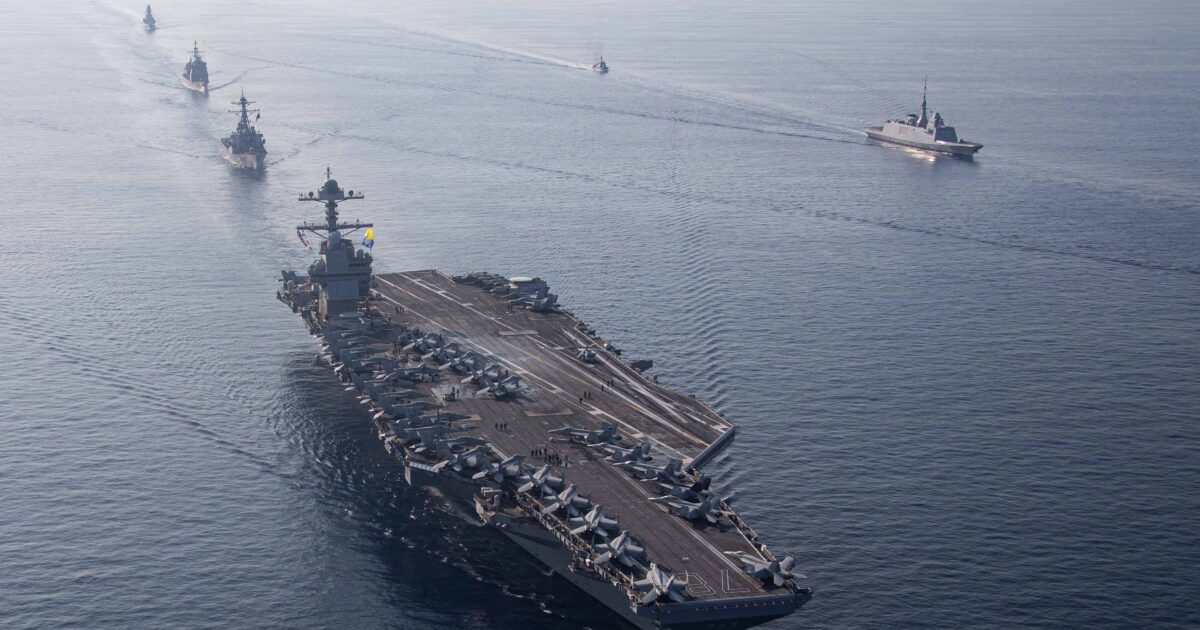
The Gerald R. Ford Carrier Strike Group sails with NATO allied ships during Neptune Strike on July 11, 2023. The formation includes the aircraft carrier USS Gerald R. Ford, French frigate FS Languedoc, destroyers USS Ramage and USS Thomas Hudner, cruiser USS Normandy, and Italian frigate ITS Carabiniere.
Since President Trump took office in January 2025, the United States has improved its strategic position in the world, despite media framing to the contrary. The United States captured Venezuela’s Nicolás Maduro and now controls much of the oil exported from Venezuela. In the Iran conflict, U.S. strikes killed Iranian Supreme Leader Ali Khamenei, curtailed China’s supply of cheap oil, and collapsed the economy on which the Islamic regime depends.
Washington signed a defense agreement with Denmark, achieving crucial U.S. policy objectives without having to buy Greenland. The United States maintained its ban on exporting the most advanced AI chips to China and expanded military cooperation with Australia and the Philippines to counter the People’s Liberation Army.
Most of these achievements cost little or no taxpayer money. Fewer than 20 U.S. soldiers have been killed, and the U.S. mainland has not been attacked.
On September 22, 2026, the United States, Denmark, and Greenland signed an agreement granting the U.S. permanent military access to Greenland while affirming Danish sovereignty. The agreement allows the U.S. to expand Pituffik Space Base, establish additional defense areas, and use Greenland’s airspace and territorial waters.
It also restricts countries outside NATO from establishing a military presence or gaining control over mining and critical infrastructure, protecting Greenland’s rare earth reserves from Chinese influence. The agreement strengthens U.S. missile defense and control of the strategically important GIUK gap without requiring the United States to purchase Greenland or make any payment to Denmark or Greenland.
In Venezuela, Delta Force captured Nicolás Maduro at Miraflores Palace on January 3, 2026, during Operation Absolute Resolve. He was flown to the USS Iwo Jima and later transferred to New York. On January 5, he pleaded not guilty in Manhattan federal court to narco-terrorism charges.
Before the raid, more than half of Venezuela’s daily oil exports of 768,000 barrels went to China, much of it at discounted prices. China had also lent Venezuela about $60 billion. Energy Secretary Chris Wright said the United States would control oil sales, redirecting barrels from China to the United States. Venezuela’s oil exports now go primarily to the United States and India.
U.S.-controlled oil sales raised more than $13 billion by July 30, with the money held in U.S. Treasury accounts. About $3 billion had been released to Venezuela. Trump said the proceeds “paid for that war many times over.” Oil exports reached 1.2 million barrels a day, a seven-year high.
Investment has focused on expanding production. On September 2, Chevron announced a $7 billion investment to double its Venezuelan output. The country’s refineries remain below capacity and would require at least $20 billion to restore. JPMorgan projects production could reach 2.5 million barrels a day within a decade, while Goldman Sachs estimates that output of 2 million barrels a day would lower oil prices by about $4 per barrel by 2030.
In Iran, a joint U.S.-Israeli operation killed Supreme Leader Ayatollah Ali Khamenei early on February 28, 2026, in his leadership compound in central Tehran. About 40 senior officials were killed with him, including armed forces chief of staff Abdolrahim Mousavi, IRGC commander Mohammad Pakpour, Defense Minister Aziz Nasirzadeh, and adviser Ali Shamkhani. National security chief Ali Larijani was killed on March 17.
Before the war, China bought an estimated 1.4 million barrels of discounted Iranian oil per day. The conflict and U.S. restrictions sharply curtailed those shipments, cutting Chinese refiners off from much of their cheap Iranian crude. The loss of oil revenue and intensified U.S. sanctions helped drive Iran’s foreign trade down 35 percent while inflation reached 66 percent, leaving the regime’s economy in crisis.
Mojtaba Khamenei, Ali Khamenei’s son and successor, was injured on the first day of the war. CNN reported that he suffered a fractured foot and facial lacerations. Secretary of War Pete Hegseth said he was “wounded and likely disfigured”, while a source familiar with U.S. intelligence assessments told Reuters that he may have lost a leg. The details remain unclear because Mojtaba has made no public appearance in more than six months. He did not attend his father’s public funeral ceremonies in July, although his three brothers did. He governs through written statements, and Iranian authorities attribute his absence to security concerns.
On China chip policy, Nvidia’s Blackwell GPUs, its most advanced chips, remain banned from export to China. On May 13, 2025, the Commerce Department warned that using Huawei Ascend chips could carry legal risks. It also issued guidance against allowing U.S. chips to train Chinese AI models or be diverted to China.
On January 13, 2026, Commerce began reviewing export license applications for the older Nvidia H200 and AMD MI325X chips case by case. On June 1, it clarified that licensing requirements cover all China-headquartered companies, including their overseas subsidiaries.
The United States also strengthened military and economic cooperation with Australia. A Pentagon review completed in December 2025 kept the AUKUS pact in place. In April 2026, the U.S. Navy awarded Electric Boat a $197 million contract, with options worth up to $930 million, to support the transfer of submarines to Australia. U.S. submarines are scheduled to begin rotating through HMAS Stirling, near Perth, in 2027. Australia will receive three used Virginia-class submarines, with the first arriving in 2032.
In October 2025, the two countries signed a critical-minerals framework providing at least $1 billion in joint financing and pledged to restrict Chinese purchases of new mining assets. Australia is also moving to reclaim Darwin Port, where about 2,500 U.S. Marines rotate each year, from Chinese-owned Landbridge. The company has held a 99-year lease since 2015 and filed an arbitration claim against Australia in April 2026.
The United States and the Philippines have been treaty allies since 1951 and have expanded military cooperation since 2025 to deter China. In April 2025, the U.S. deployed NMESIS missiles to the Philippines during the Balikatan exercises. On October 31, Secretary of War Pete Hegseth and Philippine Defense Secretary Gilbert Teodoro announced Task Force Philippines to counter Chinese coercion in the South China Sea.
The FY2026 U.S. defense bill authorized $500 million annually in military financing for the Philippines through FY2030, totaling $2.5 billion. The United States has also proposed an ammunition facility at Subic Bay. In August 2026, U.S. defense officials called the Philippines a “model ally.”
Japan has joined this expanding regional cooperation. Its Reciprocal Access Agreement with the Philippines took effect in September 2025, becoming Japan’s first with an Asian country. A logistics-sharing agreement followed in January 2026, and the two governments elevated relations to a Comprehensive Strategic Partnership in May.
On February 25, 2026, Philippine, U.S., and Japanese forces conducted a joint patrol in the Luzon Strait, about 120 miles south of Taiwan. It was the first Philippine-led patrol of its kind that far north. Balikatan 2026, held from April 20 to May 8, involved 17,000 troops from seven countries, making it the largest Balikatan exercise to date. The drills included counter-landing operations in the Batanes Islands, which sit in the Luzon Strait between the Philippines and Taiwan. Japan deployed about 1,400 personnel, marking the first deployment of Japanese combat troops to Philippine soil since World War II.
The Philippines has also increased contact with Taiwan. In April 2025, Manila eased restrictions on official visits to Taiwan. The Philippine and Taiwanese coast guards met in December 2025 to discuss intelligence sharing, and Taiwan’s coast guard is planning its first ship visit to the Philippines since 1974. Stronger ties among Japan, the Philippines, and Taiwan have reinforced the U.S. position in the region to a level not achieved under any previous president.
(Note: Thank you for supporting businesses like those presenting a sponsored message below and ordering through the links below, which benefits Gateway Pundit. We appreciate your support!)
In a world of high interest rates, credit cards are playing a long game you might not see coming. That “sneaky interest trap”? It’s the 20-30% APR lurking behind your rewards points and cashback perks – silently compounding on unpaid balances, turning a $5,000 holiday splurge into a $1,000+ annual fee just for existing.
Now, with rates still hovering high amid economic headwinds, savvy cardholders aren’t just paying bills – they’re outsmarting the system.
Picture this: You charge $10,000 across cards for home, travel, or that emergency fund gap. At a typical 22% APR, you’re not just repaying debt – you’re gifting the bank $2,200 a year in interest alone. Minimum payments? They barely touch the principal, letting the balance grow like a burden on your shoulders.
But flip the script with a 0% balance transfer: Interest? Frozen solid. That $10,000 costs you exactly $0 in interest until 2028 – giving you over a year of pure principal payback.
Every dollar counts. Your payments rocket straight to the debt, not the bank’s profit margins. Pay it off faster, or redirect savings to build an emergency buffer.
No sneaky fees here. Seamless transfers, no hidden gotchas – just breathing room in a squeeze economy.
It’s like hacking the matrix: While average borrowers lose 20% of their earnings to interest vampires, you’re the one calling the shots.
Who Gets to Outsmart the Trap?
This isn’t for everyone – it’s for the select few:
Savvy people with scores of 670-850, who’ve built solid habits but feel the pinch from rising costs.
People carrying balances and tired of watching debt grow unchecked, whether from big-ticket buys or life’s curveballs.
Strategic resetters eyeing a debt-free 2027, minus the chaos of high-rate loans or consolidation pitfalls.
White House App Hits No. 1 in News and Cracks App Store Top 20 as Americans Tune Out Fake News
The following is from the Trump team.
As of September 22, 2026, the official White House mobile app reached No. 1 in the News category on the App Store and climbed into the Top 20 among all apps. The app previously hit No. 1 in News and, at launch, soared as high as No. 4 across the entire App Store. More and more Americans are gravitating to the app because they want the news straight from the source, not filtered through networks that have spent years distorting the record of President Donald J. Trump.
That demand is rising as legacy networks fall in line behind CNN, MS NOW, and Politico, outlets whose White House credentials were pulled after a long record of false reporting. Other networks have now withheld pool coverage in solidarity. The American people are not waiting on those cameras; they are going straight to the Presidency.
Americans are choosing the source over the spin.
Launched in March 2026, the official White House app carries a 4.9 out of 5 average rating on the App store and more than two million downloads across the App Store and Google Play. It has now reclaimed the No. 1 News ranking in the country and broken into the overall Top 20. That is proof the American people want unfiltered access to the Presidency.
With the official White House app, Americans can:
Get news direct from the source: policy initiatives, key victories, and major developments with no filter and no spin, plus official social feeds, photos, and videos in one place.
Receive real-time updates and instant push notifications from the President, press briefings, and breaking White House news the moment they happen.
Watch live events and the full daily schedule, including speeches, bill signings, state visits, and historic moments as they unfold.
Dive into a dynamic media library of highlights and stay connected on the latest policy breakthroughs.
Send their voice and feedback directly to the Administration.
TrumpTV: the Administration’s biggest moments, 24/7.
The ranking surge overlapped with the launch of TrumpTV, a major success. Americans can now watch the Trump Administration’s biggest moments all in one place. Top videos, major remarks, and must-see highlights are streaming 24/7 and updated in real time. Stay informed and stay up to date. TrumpTV is available on WhiteHouse.gov, YouTube, and the official White House app.
From the Oval Office straight to your phone, the official White House app is the fastest, most powerful way to stay informed and engaged with the Trump Administration.
Download the official White House app today at app.gov. Available now on iOS and Android.
For one month, Tout-Paris treated Thélyson Orélien like a prophet. Goncourt list. Fnac prize. Grasset. Foreign deals before the book was even on the table. A Haitian migrant odyssey, dignity, gangs, the road north — the exact relic the literary church wanted to kiss.
Thélyson Orélien, born in 1988 in Gonaïves, Haiti, is a Haitian-Canadian poet and first-time novelist who left the island after the 2010 earthquake and settled in Quebec, later Ottawa. Until this year he was little known. Then came C’était ça ou mourir, published by Boréal in Quebec and Grasset in France: the first-person odyssey of Jonas Dorléon, a history teacher from Port-au-Prince’s Carrefour-Feuilles who flees gang terror with almost nothing — a diploma, a book of Depestre, a photo of his mother — and walks the migrant road through the Dominican Republic, Brazil, the Darién Gap, Mexico, the United States and the Roxham crossing into Canada. The novel is sold as fiction fed by a thousand anonymous crossings, not a straight memoir. Paris sold it as scripture.
Then people ran the new Gospel through the machines.
Pangram did not whisper. It screamed. Excerpt after excerpt at or near 100 percent AI. La Presse put the whole novel through the same tool and got 94 percent. Other detectors pile on the same stench.
Prompt: Literature and Suffering, please
His answer, delivered with a straight face: zero AI
Never. Would not use a machine. He writes with his guts.
That defense is not brave. It is stupid.
You do not beat a wall of detectors by stomping your foot. You beat it with drafts, dates, files, versions. Monsieur Orélien offered a slogan. The slogan died on contact. A child can see the seam: the smooth fake lyricism, the moral sticker on every page, the migrant-as-sermon cadence that never breaks into a human voice. The book is not “powerful.” It is moralizing, thin, indigestible, unreadable — the house style of a prompt that was told to sound like Literature and Suffering at the same time.
And this is not his first trick. Years before the coronation, La Presse and Le Point caught him lifting columns and even prize-winning passages from other writers — a Philippine article translated and signed, lines stolen from Le Matin des magiciens. A copyist who now swears the masterpiece came from the soul. Sure.
Tout est faux
The genius. The guts. The “zero AI.”
What remains is a bad text, a worse alibi, and a Tout-Paris that clapped for the costume until the costume started talking.
The new Jason Arday
Cambridge needed a miracle résumé; Paris needed a sacred migrant novel. Both men were rushed onto the altar before anyone seriously checked the sentences. Both were wrapped in identity until scrutiny itself could be called an attack. Both were protected by institutions that loved the symbol and were bored by the footnotes.
Then the record came out — copied passages, a story that would not sit still — and the same hands that had crowned them began to ease away. Arday resigned. Weeks later, he was found dead in London.
Unexpected, police said. Not suspicious. The people now manufacturing Orélien’s legend, and the people already preparing to drop him when the stink gets expensive, do not get to pretend they have never seen this movie. They built a mask, sold it as a soul, and left a man standing in public with nothing behind it. That is not courage. That is how the last mascot was used up.
Left-wing racism kills
It does not kill with a slur. It kills with a pedestal. It picks a man for his skin and his story, forbids anyone to read the sentences, calls the audit “hate,” then steps back when the mask splits. Jason Arday was that product. Paris is running the same product again with Thélyson Orélien. The cruelty is not the question. The cruelty is the coronation.


(@ConradsonJordan) September 24, 2026