A Non-Nuclear NATO–Russia War Would Still Be Disastrous

A Non-Nuclear NATO–Russia War Would Still Be Disastrous

Americans have little direct experience with conflict on U.S. soil.

2026 NATO Leaders Summit In Ankara
(Photo by Win McNamee/Getty Images)

NATO partisans in both Europe and the United States remain determined to continue the alliance’s proxy war against Russia, despite growing risks that the confrontation currently playing out in Ukraine could spiral out of control. Even as some Western officials warn that the Kremlin is planning a war against NATO, most implicitly assume that the alliance’s military superiority will ultimately deter Vladimir Putin’s government from launching a full-scale attack. NATO leaders appear confident that the alliance can deter Moscow from attacking its members’ territory directly, despite the continued provision of military assistance to Ukraine.

Thus far, the principal worry of Western hawks has been the Kremlin’s low-intensity hostile initiatives—hard-to-prove “hybrid” or “gray zone” actions by Moscow.  Cyberattacks, incursions by aircraft and drones, and episodes of infrastructure sabotage are becoming more frequent and worrisome. Still, pro-NATO analyses hold that major Russian military actions are unlikely as long as the democratic West remains vigilant and united to repel Russian aggression. However, the story goes, insufficient Western (especially U.S.) support for Ukraine and insufficient demonstrations of determined hostility toward Moscow will weaken that deterrence.

Such arrogance is unwarranted. Moscow’s anger and frustration is rising, as indicated by the mounting number of incidents in the gray zone category in recent months. Yet policymakers on both sides of the Atlantic appear to have given little thought to the likely consequences of even a sustained, limited war in their countries. The ugly reality is that the impact would be highly disruptive at best—and catastrophic at worst.

To the extent that experts examine the issue at all, they usually focus on the least likely scenario: a full-scale nuclear war between Russia and NATO. Analysts then typically dismiss that nightmare scenario by emphasizing that the doctrine of mutually assured destruction worked during the Cold War and will continue to work in our own era, since the same logic of deterrence still applies. 

But what if Russian or NATO leaders conclude that it’s possible to wage a limited war without either side resorting to the thermonuclear option? Military planners on both sides apparently have run simulations of limited-war scenarios. They don’t believe that such a conflict is so horrid as to be unthinkable.  Independent analysts also contend that Western publics should no longer ignore the possibility of world war. Concerned citizens in all relevant countries, including the United States, need to ponder these possibilities.

Except for immigrants from war-torn foreign countries, the vast majority of people residing today in America or Europe have no experience with, or concept of, the scale of destruction that even a limited, non-nuclear war between NATO and Russia would create. Television viewers around the world on 9/11 did receive a glimpse of the probable nightmare. But the direct effects of that attack were confined to three sites, and there were fewer than 3,000 fatalities. To be sure, air travel was shut down for days, shipments of goods by trucks and railroads were disrupted, and the attack inflicted a severe psychological shock on the nation and the world. Nevertheless, life largely returned to normal within weeks.

The outcome would almost certainly be far worse if a major NATO–Russia war erupted. Americans should contemplate the probable societal impact if a near-9/11-scale military incident took place in the West and Russia every month or so. In war zones around the world, such destruction (or even worse) is the norm. Are American or European civilians prepared to confront the prospect, much less absorb the actual impact, of such blows? 

In a NATO–Russia conventional war, the kind of destruction, chaos, and bloodshed seen in the Ukraine War the past few years could become part of the normal experience of Americans and Europeans. Except for isolated incidents, Americans haven’t experienced the direct, horrid effects of warfare on civilians since the end of the Civil War in 1865. A NATO war against Russia would bring that exceptionally long period to an end.

The U.S. has waged numerous wars against foreign adversaries throughout the 20th and 21st centuries.  But in all those conflicts, the American homeland has remained immune to any serious attack, except for Pearl Harbor and 9/11. Americans even remained distant from the world wars of the 20th century. And the third-tier adversaries we have fought more recently—North Korea, North Vietnam, Serbia, Afghanistan, Iraq, and now Iran—have all lacked the capability to launch a major attack on the U.S., much less sustain a long-term offensive on American soil.

Russia, however, has the military wherewithal to do exactly that, and NATO’s growing involvement in Ukraine’s attacks on targets inside Russia may give Moscow sufficient incentives to respond in kind. The European members of the alliance, especially the Baltic states, are especially vulnerable, but even NATO’s larger, more significant European players are not immune from retaliation.  Nor is the United States, especially as the two sides traveled up the escalation ladder.  

The American people need to ask themselves if continuing to use Ukraine to wage a proxy war against Russia is worth risking the safety and well-being of the U.S. homeland—and thus the lives of their own loved ones. Given the array of ominous developments in recent months, that danger is no longer a purely hypothetical concern.

The post A Non-Nuclear NATO–Russia War Would Still Be Disastrous appeared first on The American Conservative.

Voters Don’t Want the Old GOP

Voters Don’t Want the Old GOP

Some MAGA critics are right that conservatives are mad, but dead wrong about what they really want.

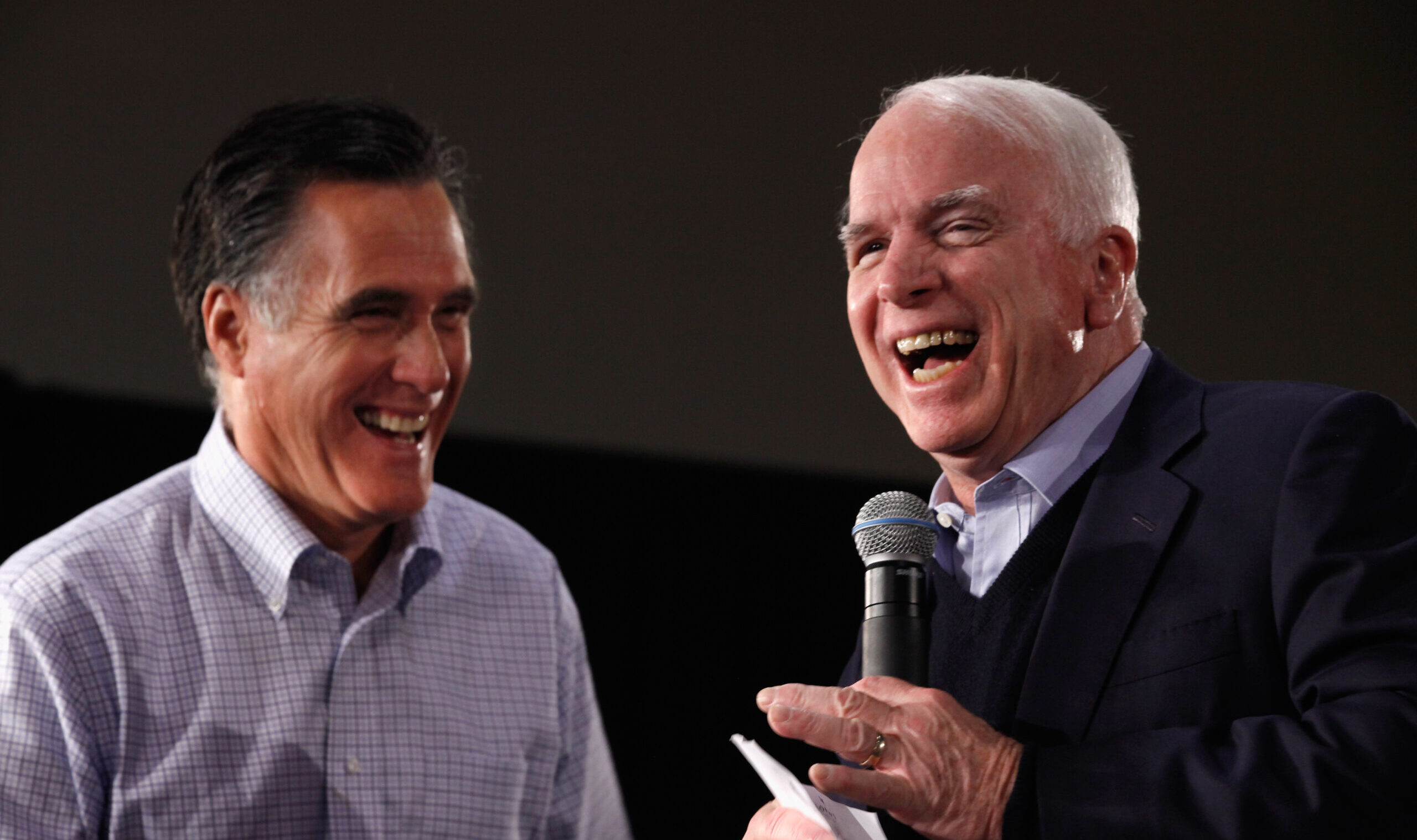
Mitt Romney with John McCain

Credit: Chip Somodevilla/Getty Images

Donald Trump and his coalition have rocked the Republican party more than any other right-wing movement this century.

So much so that some Republicans now long for the party as it was before MAGA, the ostensibly “traditional” pre-Trump GOP.

Sen. Thom Tillis (R-NC) is one of them. The senator, who decided not to run for re-election this year, is promoting a new book that presents himself as, if not a Never Trumper, then at any rate a dissident from MAGA. “What [Trump’s] done is he’s created a coalition that, in my opinion, will not stay with Republicans once we go back to traditional Republican platform priorities,” Tillis said of the GOP’s future in an interview last week. “I think a lot of the elements of the populism that Trump created to expand a base that made him successful running for president, I don’t think that stays with the party long term.”

On X, The Blaze’s Auron MacIntyre shared a clip of Tillis saying this and added, “They’re admitting out loud that they’re running out the clock on Trump so they can return the GOP to factory neocon settings.”

MacIntyre is not wrong.

Another figure who longs for the GOP before Trump is Rahm Emanuel, the former chief of staff to President Obama who is currently making a bid for the 2028 Democratic nomination. He wants Democrats to embrace what he calls “McCain-Romney Republicans” who now vote Democrat.

“The top story from the 2026 cycle will be the electoral opening Democrats seized—and will have to maintain,” Emanuel wrote for the Wall Street Journal last Wednesday. “Most important, the McCain-Romney Republicans, who are politically homeless, need to be welcomed into Democrats’ governing and electoral coalition.”

Emanuel urged his fellow Democrats to make common cause with these kinds of centrist Republicans, and to avoid embracing the hard-left socialist Democratic candidates who are faring well at the moment.

“Millions of McCain-Romney voters are redefining their political identities, and they will be most responsible for Democratic gains in November,” Emanuel explained. “These voters don’t want to be associated with MAGA, and they see themselves as free agents.”

It’s true that many Republican voters who might go for Democrats this election don’t want to be associated with MAGA. But they might not want to revert to the supposed good ol’ days of John McCain, Mitt Romney and George W. Bush either.

President Ronald Reagan’s former Office of Management and Budget Director David Stockman shared Emanuel’s op-ed and added, “McCain-Romney neocon warmongering GOP campaign loot collectors from the MIC (military-industrial complex)? You are barking up the wrong tree, Rahm.”

Stockman is on point.

Tillis and Emanuel are both right that voters, and especially Republicans, are mad at Trump and his party, and most predict this anger will be on full display in the upcoming election.

But both are wrong to dismiss populism. The establishmentarian politics that Tillis and Emanuel represent within their respective parties is what so many voters were rejecting when they embraced the current “Drain the Swamp” president.

Populism is not only not the problem, it’s not likely to be going anywhere. The upcoming midterm elections won’t mark some return to party-elite form, but another populist revolt against the apparently insincere populism Americans voted for two years ago.

This isn’t rocket science: Trump’s coalition is mad because the erstwhile “no new wars” president who promised to put America first and keep prices low instead started a brand new war at the behest of Israel and the expense of working-class Americans. The Republican establishment was also on board with the war—until recently, when even a few historically hawkish candidates in tight races have started saying it should end.

On the Iran War, the issue that seems to be defining Trump’s second term the most, this president has delivered what the neocon favorite Mitt Romney seemed to promise as the 2012 Republican presidential nominee, and what the 2008 GOP nominee and neocon favorite John McCain campaigned on. Trump is now compared to that most “traditional” of 21st century Republicans, George W. Bush. The former president’s brother, Jeb Bush, has praised Trump for starting a war with Iran. Marc Thiessen, an alumnus of the George W. Bush White House, is a big fan of Trump and his war. And the neoconservative pundits Mark Levin and Ben Shapiro now praise Trump for having a foreign policy that looks a lot like what was on offer from McCain and Romney.

On the other side of the aisle, many of the Democrats challenging Republicans in seats once thought safe are finding success with populist campaigns that focus on combatting rising prices, opposing the overwhelmingly unpopular war, and, perhaps most amusingly, putting America First. Abdul el-Sayed, the Democrat who is running against “traditional” Republican Mike Rogers for Senate in Michigan, has regularly appeared on Fox News and constantly pitches to (former?) MAGA voters.

It’s worth noting that there was a Republican party before Trump, under whose banners Tillis was first elected to the Senate in 2014. This is how POLITICO reported Tillis’s victory in the GOP primary for that seat: “Tillis Beats Tea Party in N.C.: The GOP establishment scored a victory Tuesday when its preferred candidate soundly defeated a pair of grass-roots insurgents in a North Carolina primary.” One of those insurgents was Greg Brannon, who had the endorsement of the Tea Party Republican and war skeptic Rand Paul. (Paul, of course, won his own Senate seat in 2010 by running against the pre-Trump, pro-war neoconservative-marinated Republican brass.)

There was a Republican uprising against the party’s establishment well before Trump burst on the scene, and Tillis was definitely not part of it.

In fact, there was much dissent and intra-party challenging of Republican elites in those post-Bush years. Obama’s 2008 victory was largely a rejection of the old GOP and its wars, which McCain fully embraced, and Romney’s 2012 loss was due in no small part to Americans not wanting another extension of Bush-Cheney.

The “traditional” McCain-Romney Republicans haven’t been popular enough to win a presidential election since Bush in 2004, and the first Republican to do so won by calling Dubya a liar and his war in Iraq a “big, fat mistake.”

Now Trump is making his own mistake in Iran, and many of his 2024 voters appear eager to correct their mistake this year. Not because they yearn for a return to the Republican party as it was before him, but because Donald Trump promised to beat that party and dispose of it—and has failed.

The post Voters Don’t Want the Old GOP appeared first on The American Conservative.

On Immigration, the GOP Risks Learning the Wrong Lesson

On Immigration, the GOP Risks Learning the Wrong Lesson

Here, at least, Trump’s second term has largely been a success.

President Trump Introduces Executive Orders Regarding Cattle Industry
Photo by Andrew Harnik/Getty Images

There’s a chance that Republicans will learn the right lessons from the midterm elections. Then there’s Rep. Maria Elvira Salazar (R-FL).

The Florida congresswoman made headlines last month for “breaking” with President Donald Trump on immigration. In fact, many of the headlines contained some variant of this phrase. “Mr. President,” Salazar said in an ad at the time, “some of your immigration enforcement efforts have gone too far.” She blames unnamed advisers, though we can guess whom she’s referring to.

Left unmentioned in most of these stories about Salazar’s rebellion (which would have been a much catchier headline) is that she wasn’t totally aligned with Trump on immigration even before Republican electoral fortunes took a turn for the worse. She has long been a proponent of legal status for many, if not most, illegal immigrants already in the country. She takes the Bush-era position that this is not amnesty as long as it is not instant and totally unconditional.

This position always polls well in the abstract, until it is demonstrated that the conditions are not as stringent as initially advertised, or that the not-amnesty will not apply to many people, or that it will need to take place in the context of renewed nonchalance about immigration enforcement.

If the amnesty signed into law by Ronald Reagan, which was at least generally recognized by its supporters as an amnesty, did not resolve illegal immigration, what hope is there for a surreptitious amnesty backed by his imitators 40 years later?

There will be a strong temptation among many Republicans to attribute any losses in the midterm elections exclusively to Trumpian updates to the GOP brand, while ignoring the strong parallels with the party’s loss of its congressional majorities in 2006.

If Trump didn’t explicitly promise to forgo new foreign wars to focus on affordability at home, he at least heavily implied this is what he would do if he won the 2024 election. And the record of his first term—at least, prior to the Covid pandemic—made it seem like a reasonable bet that he would prioritize the domestic economy over Mideast adventurism.

Whereas Trump did promise tougher immigration enforcement if elected, and largely delivered the same during his first term. 

That doesn’t mean Trump handled immigration perfectly, then or now. In both his terms, performative enforcement designed to deter illegal immigration often backfired by undercutting popular support for his program. Back then it was “kids in cages,” this time it was the fatal shootings of anti-ICE protesters. 

Interior enforcement is always going to be a tougher sell to many people than securing the border. There are people in Trump’s orbit, some of them influencers and others who are actually influential, who evince a certain giddiness about the deportations of gardeners and housekeepers that even many Trump voters find distasteful.

But border security is never going to be so perfect as to render interior enforcement unnecessary, and there will be powerful incentives for illegal immigration as long as major industries remain so heavily dependent on illegal labor. That’s why some people who are neither violent criminals nor members of foreign terrorist organizations need to be removed simply for violating immigration laws, as long as the number of illegal immigrants remains high.

Trump might have moved to a more employer-focused form of enforcement, but this is another area where he has allowed managing his coalition to take precedence over the greater political good. Nevertheless, he did recalibrate on immigration after last winter’s anti-ICE protests, pivoting much more quickly than on Iran and much more effectively than on tariffs (two issues that would have benefited from greater sensitivity to employer bottom lines).

Even with these adjustments, Trump has gotten real results when it comes to reducing illegal immigration. The border crisis is the problem Trump has most clearly resolved. He has also controlled legal immigration in ways that would have been unthinkable a decade ago.

If Trump had been able to make half as strong an argument for progress on affordability, Republicans would see less of an erosion of Hispanic support. That’s not to say that none of these voters feel the same way about Trump’s immigration enforcement as Salazar does. But the growth in Hispanic support for Republicans came during lockdowns and inflation, not because Trump liberalized his stance on immigration. Democrats saw a reduction in their Hispanic support precisely as immigration became their main way of wooing these voters.

Nevertheless, there will be a push among Republicans to backtrack on immigration if Democrats make their expected big congressional gains. Perhaps even Trump would be amenable to what would surely be sold to him as a legacy-enhancing bipartisan immigration deal, as was briefly floated after Democrats took Congress in the 2018 midterm elections during his first term.

It is not the most important course correction for Trump’s GOP to make.

The post On Immigration, the GOP Risks Learning the Wrong Lesson appeared first on The American Conservative.

Trump Turns Brutal Ad Into Personal Attack

President Trump turned a question about a hard‐hitting Ohio campaign ad into a personal attack on an ABC News reporter, shifting attention from the ad’s claims to a media fight.

Story Highlights

  • Ramaswamy’s campaign confirmed it produced and funded the Ohio ad using Amy Acton’s estranged mother.
  • The ad sparked bipartisan backlash, including from Ohio’s Republican governor.
  • Trump said he knew “nothing” about the ad’s backstory but still defended using it.
  • Trump insulted an ABC reporter during questions about the ad, fueling a press clash.

What The Ad Is And Who Stands Behind It

Vivek Ramaswamy’s Ohio governor campaign confirmed it produced an ad featuring Democrat Amy Acton’s estranged mother, Donna Arthur, calling Acton a liar. The campaign said it planned a $4 million statewide buy to air the spot. This places the controversy within official campaign activity, not a random online video. News reports say the mother and daughter have been apart for decades, and the message triggered strong criticism from both parties. The ad remains a flashpoint as the race grows more personal.

Coverage ties the ad to painful family history. Reports state Acton has described childhood sexual abuse by a stepfather, while her brother publicly backed her account. The Associated Press noted the mother had not seen Acton in nearly 50 years and had lost custody after the stepfather was indicted for rape when Acton was 12. That background helps explain why the spot drew broad condemnation and why some Republicans urged Ramaswamy to pull it down.

How Trump Responded And Why It Matters

President Trump told reporters he knew “nothing” about the ad’s backstory, yet he defended using it and framed it as a mother criticizing her daughter. He suggested such a message is fair game in politics. He also argued the issue did not concern the stepfather claims. These comments signaled support for the ad’s continued use, even as Trump denied deep knowledge of the underlying family history. That stance kept attention on tactics, not verification.

During a press exchange about the ad, Trump attacked an ABC News reporter and mocked her appearance. The moment turned a question about accountability into a debate over the press. Mediaite documented the clash, including Trump’s insult and his pivot to blasting the network. For readers on both the right and the left, this is a familiar pattern: a sensitive policy or ethics question becomes another fight with the media, and the public learns little more about the facts behind the ad.

Backlash, Limits, And The Open Questions

Ohio’s Republican Governor Mike DeWine called on Ramaswamy to take down the ad, underscoring that criticism crossed party lines. Yet reports do not show a formal ruling that the ad broke a law or rule. ABC News earlier said it could not verify all the video’s underlying claims when it first circulated, and no public record has resolved all disputes about Acton’s family history. The lack of adjudication leaves voters with arguments, not clear answers.

Here is what we do know: Ramaswamy’s team owns the ad; the content centers on an estranged mother’s attack; the target says it distorts her life; and bipartisan voices object. Here is what we do not know from current records: whether every allegation in the ad is true and whether any official body will review it. Meanwhile, Trump’s insults toward the press risk burying those core questions under another media brawl.

Sources:

mediaite.com, cnn.com, pbs.org, apnews.com, us.cnn.com, abcnews.com, politifact.com

Guadalupe Deluge, One Rookie Orchestrates

When a flash flood turns a children’s summer camp into a crime scene against nature, the entire apparatus of American disaster response — helicopters, hoists, incident command, triage protocols built over decades — gets compressed in the public mind into a single image: one person in a flight suit, lowered into the chaos. That compression is not wrong, exactly, but it is incomplete, and understanding why tells you something true about both the heroism and the machinery behind it.

Key Points

  • Coast Guard rescue swimmer Scott Ruskan, on his first operational mission, served as the only triage coordinator on the ground at Camp Mystic during the catastrophic July 4, 2025 Guadalupe River flooding in Kerr County, Texas
  • Congress, the U.S. Navy Memorial, and the White House have all formally credited the operation with saving 165 lives, and Ruskan has received the Pat Tillman Award, a State of the Union recognition, and the Navy Memorial’s inaugural Distinguished Service Commendation
  • Ruskan flew with a full Coast Guard air crew — two pilots and a flight mechanic — and worked alongside Army National Guard responders and camp staff, a collective effort the institutional record acknowledges even as it singles him out for the ground triage role
  • The 165 figure is the officially credited total for the mission, not a line-item ledger of individual rescues, which is typical of how search-and-rescue operations are reported and recognized

What Happened at Camp Mystic

Before dawn on July 4, 2025, torrential rain sent the Guadalupe River surging through Kerr County, Texas, catching Camp Mystic and surrounding communities with little warning. The Coast Guard scrambled air crews from Air Stations Corpus Christi, Houston, and Miami into what became one of the largest domestic search-and-rescue pushes of the year. Among the crews dispatched was a Corpus Christi helicopter carrying Aviation Survival Technician Third Class Scott Ruskan, flying into his very first rescue mission as a swimmer. The flight itself was treacherous — low visibility, violent weather, a six-hour push to reach the site — before the crew ever got near a survivor.

Once overhead, Ruskan was lowered into a scene with no established command structure and, by his own account relayed afterward, roughly 200 people needing evacuation. Rather than beginning extractions alone, he set up what amounted to an improvised triage station: assessing who needed immediate medical attention, calming frightened children and counselors, prioritizing the order of evacuation, and staging survivors for pickup as more aircraft arrived. Contemporaneous reporting from CNN placed him physically carrying survivors across hazardous terrain to the helicopter when conditions required it. A U.S. government public-information account corroborates the same sequence — dangerous weather en route, Ruskan leaving the aircraft, coordinating from the ground, administering aid, and preparing people for extraction.

The Official Record and the Number 165

The figure most attached to this story — 165 lives saved — now carries the weight of formal institutional endorsement. House Resolution 570, introduced in the 119th Congress on November 7, 2025, commends Ruskan by name, stating he “directly” saved “an astonishing 165 individuals” while serving as “the only triage coordinator on the Camp Mystic site”. The U.S. Navy Memorial’s announcement naming him the first-ever recipient of its Distinguished Service Commendation uses nearly identical language, crediting him with helping organize evacuations, assess and prioritize survivors, and secure timely transportation to safety. Those are not throwaway press-release numbers; they are the figures Congress and a national military-heritage institution chose to put their names behind.

It is worth understanding what that number represents and what it does not. It is the credited total for the mission as a whole, drawn from the kind of after-the-fact accounting that accompanies every major search-and-rescue operation — a tally of people brought out alive, not a survivor-by-survivor manifest crediting a specific set of hands to each name. That is simply how these figures have always worked, in military citations and civilian rescue awards alike: the number attaches to the mission and its lead actor, while the mechanics who kept the aircraft flying, the second pilot managing instruments in zero-visibility weather, and the National Guard teams working the ground alongside Ruskan all contributed to the same total. The congressional resolution and the Navy Memorial citation describe Ruskan’s specific, documented role — triage coordination — accurately; they are not claiming he personally hoisted all 165 people one by one.

Recognition, and Why Ruskan Keeps Redirecting It

The honors that followed were substantial and public. Ruskan was invited to a State of the Union address, where he was reunited on camera with an 11-year-old girl he had helped rescue. He was named the 2026 recipient of the Pat Tillman Award at the ESPYs, an honor built specifically around service members whose actions exemplify selflessness under pressure. He led the 2026 Houston Livestock Show and Rodeo Parade as grand marshal. And in 2026, the U.S. Navy Memorial made him the inaugural recipient of its Distinguished Service Commendation.

What stands out across nearly every account, including Ruskan’s own remarks at the Navy Memorial ceremony, is his consistent insistence that the mission belonged to a crew, not an individual. He has credited the two pilots who flew through the storm, the flight mechanic who ran the hoist, and the Army National Guard personnel who worked alongside him on the ground. Master Chief Petty Officer of the Coast Guard Phillip Waldron, introducing Ruskan at that ceremony, made the same point explicitly, emphasizing the mechanics, engineers, and logistics specialists whose work behind the scenes makes missions like this one possible at all. This is not Ruskan deflecting credit out of modesty alone — it reflects an accurate structural fact about how Coast Guard rescue aviation actually functions: no single swimmer reaches a flood zone without a cockpit crew getting the aircraft there first.

Why the Hero Frame Persists — and Why It’s Not Wrong

Disaster researchers who study how rescue narratives form note that singling out one rescuer serves a real function: it gives the public a human face for collective competence, and it tends to encourage preparedness behavior by showing individual agency can matter even inside overwhelming events. The risk, documented in the same research, is that the spotlight can obscure the wider network — pilots, mechanics, volunteers, camp staff — whose coordinated work made the rescue possible in the first place. Ruskan’s case threads that needle about as well as any recent example can: the institutional citations single him out for a specific, verifiable role — the only person physically on the ground running triage — while he, the Coast Guard’s own leadership, and the award language itself consistently point back to the full crew. The honors are earned; the operation was still a team effort.

Sources:

youtube.com, abc13.com, navymemorial.org, congress.gov, deseret.com

SAD TROMBONE: Massachusetts Lesbian Bar That Went Viral for Requiring Face Masks in 2026 is Closing Permanently

Screencap of YouTube video.

About a month ago, there was a viral news story out of Massachusetts about a lesbian bar in Greenfield, MA that required patrons to wear face masks.

The owner decided she wanted to try to bring in more people in order to make more money, so she announced that one night a week on Saturday, they would make masks optional. As a result, her patrons started accusing her of trying to kill people.

The story was instantly everywhere.

Now, it turns out that the bar is closing its doors permanently. Oh well.

FOX News reports:

Viral Massachusetts lesbian bar announces it will be ‘soft closing’ after easing mask rules

Last Ditch Bar and Arts Venue, a Massachusetts lesbian bar that went viral for its masking policy last month, announced Monday that it would be closing and seeking a buyer for the business.

“WE ARE CLOSING. We have put our lives on hold to foster networks of care, resources, and a home base for organizing. It’s time we pass it on. We’ve been fighting since the beginning to fill out the team, and we still don’t have a board/leadership to manage workers owned Co-op transfer. We are SOFT CLOSING effective immediately, all BOOKED events will CONTINUE, otherwise we are CLOSED,” the bar wrote on Instagram.

“We need new owners ASAP, we close this winter,” the bar also wrote…

Last Ditch Bar and Arts Venue went viral last month after The Boston Globe reported that it would be lifting its mask mandate for one night a week.

Some critics accused the Massachusetts bar’s owners of putting disabled people at risk and compared the policy change to a “mass disabling event” and a “eugenicist” attack while also making threats against the establishment.

What a shame. Mandatory masking in 2026 seemed like such a solid business plan.

It was such an entertaining story. Best of luck to these folks in their next business venture.

The post SAD TROMBONE: Massachusetts Lesbian Bar That Went Viral for Requiring Face Masks in 2026 is Closing Permanently appeared first on The Gateway Pundit.

AWESOME: College Student Files Official ETHICS COMPLAINT Against Senator Elissa Slotkin for Her Threats to Young People Thinking of Working for Trump (VIDEO)

Screencap of Twitter/X video.

Democrat Senator Elissa Slotkin of Michigan was in the news two weeks ago because she said that she wants to go after Trump’s inner circle in order to scare young people who might be thinking of going to work for the Trump administration.

It was clearly a threat. Go to work for Trump and you might find yourself in a world of trouble.

Now a student from the University of Chicago has filed an official ethics complaint against Slotkin. She deserves this.

The College Fix reports:

University of Chicago student files ethics complaint against Sen. Slotkin

A University of Chicago student has filed an ethics complaint against Sen. Elissa Slotkin for her recent suggestion that college graduates who work for the Trump administration might be prosecuted.

“Senator Slotkin, if you thought this was over, you’re wrong,” said student Michael Bicksel in a video he posted on X on Oct. 22 as he held up a copy of an ethics complaint he filed with the U.S. Senate.

“The complaint was submitted to the Senate Select Committee on Ethics and argues that Slotkin proposed using congressional investigations and potential prosecutions to frighten young people away from serving in a Republican administration,” Fox News reported.

“The complaint asks the committee to determine whether Slotkin’s comments amounted to ‘improper conduct which may reflect upon the Senate,’ a standard described in the Senate Ethics Manual as applying to conduct that may be unethical even if it does not violate a specific law or Senate rule,” the outlet reported.

Speaking Oct. 13 at the University of Chicago’s Institute of Politics, the Michigan Democrat said potential legal problems should be a deterrent against working for Trump…

The comments drew widespread criticism as a threat to young conservative graduates looking to work in government, as well as complaints the sentiments were akin to “Bolshevik tactics.”

See the student’s video below:

Slotkin really screwed up by making those statements.

It’s a perfect reminder that the Democrats are the actual authoritarians that they constantly accuse Trump of being.

The post AWESOME: College Student Files Official ETHICS COMPLAINT Against Senator Elissa Slotkin for Her Threats to Young People Thinking of Working for Trump (VIDEO) appeared first on The Gateway Pundit.

Multiple Counties in Illinois Now Trying to Break Off From the State to Get Away From the City of Chicago (VIDEO)

Screencap of Twitter/X video.

Multiple counties in the state of Illinois are now looking to break away from the state because they are tired of being ruled over by the corrupt Democrat city of Chicago. Who can blame them?

This is the exact same thing that has been brewing in the state of Oregon for a few years now. Voters there are tired of the insane, left wing politics of Portland ruling the state.

In this case, a group called Illinois Separation is driving the idea.

FOX News reports:

Frustrated Illinois residents seek to redraw state map in bid to break free from Chicago

Frustrated Illinois residents are pushing to break away from Chicago and form a new state, driven by what the movement’s leader calls growing resentment over the city’s influence on the rest of Illinois.

Loret Newlin, director of Illinois Separation, which is leading the push to let voters weigh in on breaking away from Cook County and forming a new state, told Fox News Digital that residents outside the Chicago area are being ignored by state government and want to change that.

“Our area is not taken into consideration when laws are being made,” Newlin said. “There’s definitely more focus on them, and the laws are centered to benefit Chicago and Cook [County].”

“There is a lot of area outside of Cook that should have been taken into consideration,” she said.

Newlin said that 11 counties and several townships in Illinois will vote on a non-binding referendum in November that asks residents if they’d be interested in separating from Cook County to form a new state.

The referendums are intended to gauge whether voters want to pursue forming a separate state made up of Illinois counties outside Cook County. The effort draws on a process outlined in Article IV, Section 3 of the U.S. Constitution, the same provision invoked when West Virginia became a state in 1863.

See the video report below:

How long before similar movements hit New York, California, or Washington State?

Average Americans are tired of blue cities and their far left politics.

The post Multiple Counties in Illinois Now Trying to Break Off From the State to Get Away From the City of Chicago (VIDEO) appeared first on The Gateway Pundit.

Black Voter in Detroit Surprises Chris Cuomo by Saying He’s Voting for Republican Mike Rogers – Then He Explains Why (VIDEO)

Screencap of Twitter/X video.

Chris Cuomo, formerly of CNN and now with NewsNation, recently ran into a black man in Detroit who is voting for Republican Mike Rogers and when he explained why it made perfect sense.

At this point, it’s probably safe to say that Abdul El-Sayed’s black voter problem in Michigan is real.

It seems like every week, there is another media interview with a black voter from Michigan saying that they are voting for Mike Rogers. And the thing is, Rogers does not even have to win all of the black vote. If he takes merely 30 percent of it, that is probably going to be enough to win the race.

From Overton News:

Chris Cuomo gets a stunning reality check after asking a Black voter in Detroit who he’s voting for in the Senate race.

The expression on Cuomo’s face was PRICELESS as Anton Daniels revealed he was voting for Republican Mike Rogers.

To add insult to injury, Daniels then dropped a brutal truth bomb about the Democrat Party and the Black voters running away from it.

CUOMO: “Do you believe people may be wrong if they assume that all Black voters will vote for El-Sayed because he’s considered another brown guy?”

DANIELS: “I think that they are. And the reason that I think that it is because it’s a lot of Black people that are waking up and realizing that voting Democrat does not necessarily mean that it aligns with your values.”

Watch the video below:

The left is pushing El-Sayed really hard. They want to win this race so badly.

They think if a candidate like El-Sayed can win in Michigan, they can push them everywhere.

The post Black Voter in Detroit Surprises Chris Cuomo by Saying He’s Voting for Republican Mike Rogers – Then He Explains Why (VIDEO) appeared first on The Gateway Pundit.

Israeli Elections: Benjamin Netanyahu Takes the Lead – But Early Results Show No Clear Winner

Prime Minister Benjamin Netanyahu at the Holocaust museum.

Elections are taking place in Israel today and results are starting to come in.

This is the first national election since the October 7, 2023 Hamas attacks.

The exit polls show no clear winner.

Benjamin Netanyahu’s bloc is projected to win 65 seats in the Knesset, leading all other candidates. 61 seats are needed for a majority in the 120 seat legislative body.

According to the Times of Israel, the Arab parties may win 16-19 seats on high Arab turnout.

Turnout was high at about 77.7% (up from 70.6% in 2022), the strongest in decades, also from the Times of Israel.

Prime Minister Benjamin Netanyahu already delivered a victory speech.

But counting continues!

The post Israeli Elections: Benjamin Netanyahu Takes the Lead – But Early Results Show No Clear Winner appeared first on The Gateway Pundit.