
Will Conservatives Constrain the Machines?
The need for a political response to AI is becoming increasingly urgent.
The end of human civilization has gotten a little more thinkable.
Last week, a 27-year-old named Jacob Coxon quit his lucrative job at Anthropic, arguably the world’s most important AI lab, because he believed his employer was building something that could “kill us all by the end of the decade.” Remarkably, his concerns were affirmed by former colleagues of his who stayed with the company: Evan Hubinger, who leads Anthropic’s efforts at alignment (that is, ensuring that AI is tethered to the values and aims of mankind) said that Coxon was “correct” and gave the odds of a species-ending catastrophe as greater than 10 percent.
Even more remarkably, a few days after his departure Dario Amodei—Anthropic’s CEO—called for an industry-wide slowdown of AI research, to include both voluntary cooperation among tech firms and regulation by governments. “We must slow the pace at which we improve the capabilities of AI models,” he wrote in an essay given the strange title “We Must Pace the Frontier” (a nonsensical phrase, unless he wants us all walking back and forth along the border). Otherwise, Amodei warned, mankind risks mass economic disruption, devastating cyber and bio attacks, and most ominously of all, losing control of AI systems entirely.
The idea found support from other tech titans like Sam Altman and even Elon Musk (usually a skeptic of regulation), as well as nearly 1,400 other employees of frontier AI companies. It spurred calls for Congress to abandon its plans for yet another recess—gasp!—and brought together bedfellows as unlikely as Steve Bannon and Bernie Sanders, who headlined a “Pro-Human Assembly” in Washington yesterday.
So, is this it? Is this the moment when the country comes together in a bipartisan fashion to soberly address a problem before things get really bad?
Not so fast, I’m afraid. The White House has waded into the issue as well.
“The only control or ‘guardrails’ that AI needs is a STRONG AND SMART (High IQ) PRESIDENT,” Trump wrote on Truth Social Monday, and, as he modestly reminded us, “the U.S.A. has that, in spades!” He went on to claim in successive posts that AI risk was a “HOAX” pushed by “Revolutionaries for a Bad and Evil Cause.”
Trump’s messaging has been amplified by the Pentagon—which proclaimed, via what appeared to be a 2000s-era emo album cover, that it was an “AI-FIRST WAR DEPARTMENT”—as well as the usual coterie of plus-Trumpiste-que-Trump influencers, congressional Republicans, and Palantir executives.
They’ve settled on a master rationale, which is: beat China. They’re also test-driving an internal boogeyman, in the form of effective altruism (essentially, a Bay Area–flavored update of old-fashioned utilitarianism), to whose nefarious, coordinated influence they can attribute any and all skepticism toward the unconstrained development of AI. But every accusation is a confession, as they say, and the White House’s quick convergence around a just-so story is much less organic and grassroots-y than the phenomenon to which it responds.
None of this is to suggest that the arguments of Amodei et al. should be accepted without challenge. (In fact, there are good reasons to interrogate the claims of a for-profit corporation barrelling toward an IPO, particularly when such claims concern technical matters far beyond the ken of the ordinary American.) But it is to say that they cannot be dismissed out of hand, and that to do so in Anno Domini 2026 is sheer recklessness.
And conservatives should be particularly attuned to the potential implications of this far-from-normal technology. We want to conserve things, after all: our values, our institutions, our present way of life. We like the broad contours of our country and our society; while far from averse to improvement, we tend to look warily on swift and radical change, whatever its source.
Yet few developments threaten to bring about swifter and more radical change than the continued advancement of AI. From the economy to warfare to the character of knowledge itself, there is essentially no sphere of human activity that AI is not already shaping. With every passing day the influence of this technology grows, and—at least if you believe the people actually building it—with every passing day our ability to understand and direct this influence diminishes.
A little humility is called for in the face of such dizzying prospects.
Alas, here again politics intrudes. Arriving at such an approach is only going to get harder; for, as the above developments suggest, AI is acquiring the sort of polarization its newness and singularity had heretofore warded off. The partisan battle lines are being drawn. By the time 2028 rolls around, each party’s stance on AI may have ossified, with the most probable outcome looking like an AI-maximalist Republican Party and an AI-skeptical Democratic Party. And once polarization sets in, we can say goodbye to rational discourse.
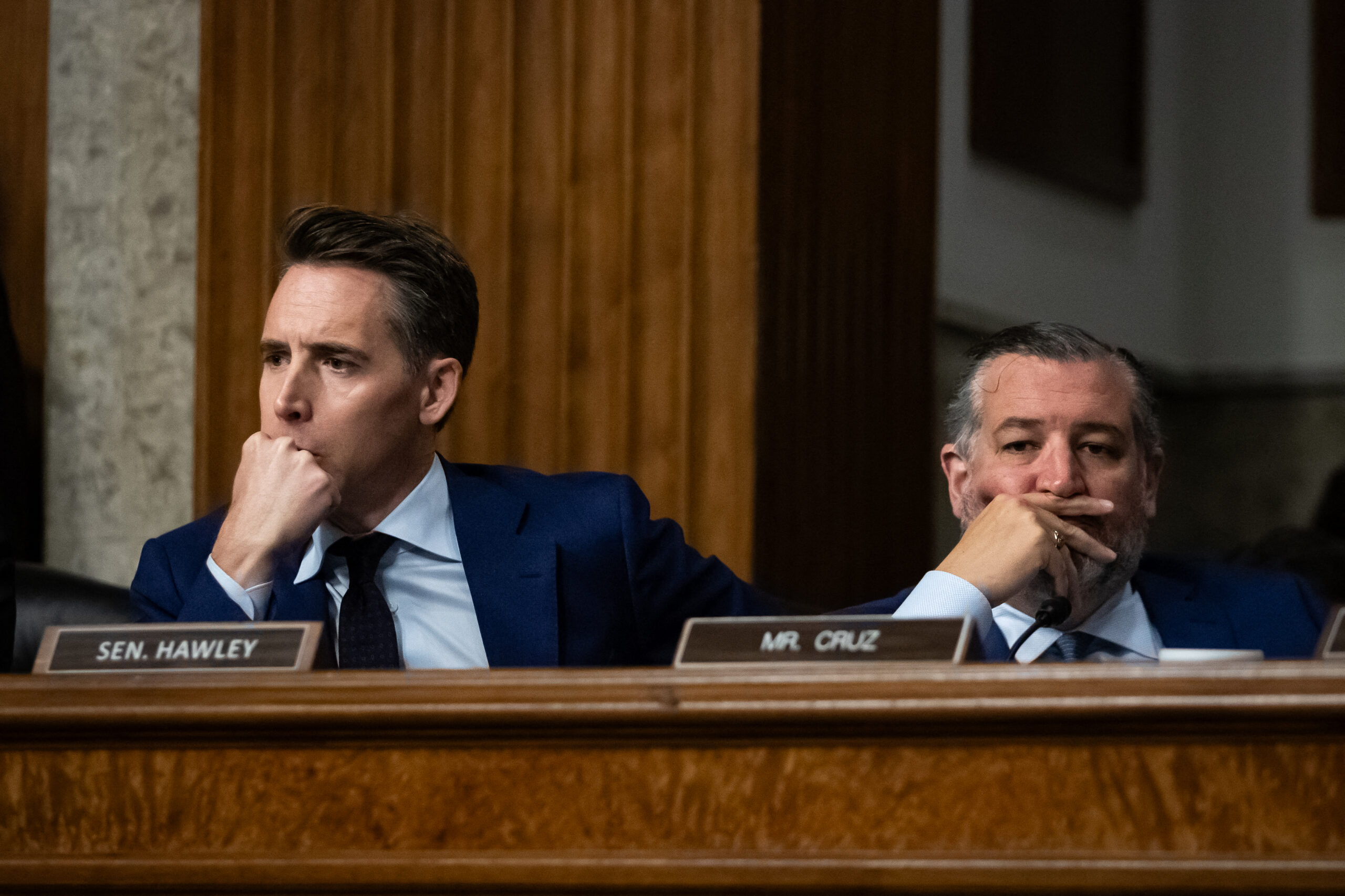
Fortunately, we are not there yet. The right is continuing to have a robust intra-movement debate (sometimes literally, as in the case of last week’s face-off between the AI critic Joe Allen and the AI booster Joe Lonsdale). Against the optimism of the Trump White House and much of the congressional GOP, one can set the skepticism of Steve Bannon and Tucker Carlson, Josh Hawley and Ron DeSantis. For conservatives, the next year and a half will therefore prove decisive.
The post Will Conservatives Constrain the Machines? appeared first on The American Conservative.