
The President’s Irresponsible Power
If Trump wants the credit, he must also take the blame.
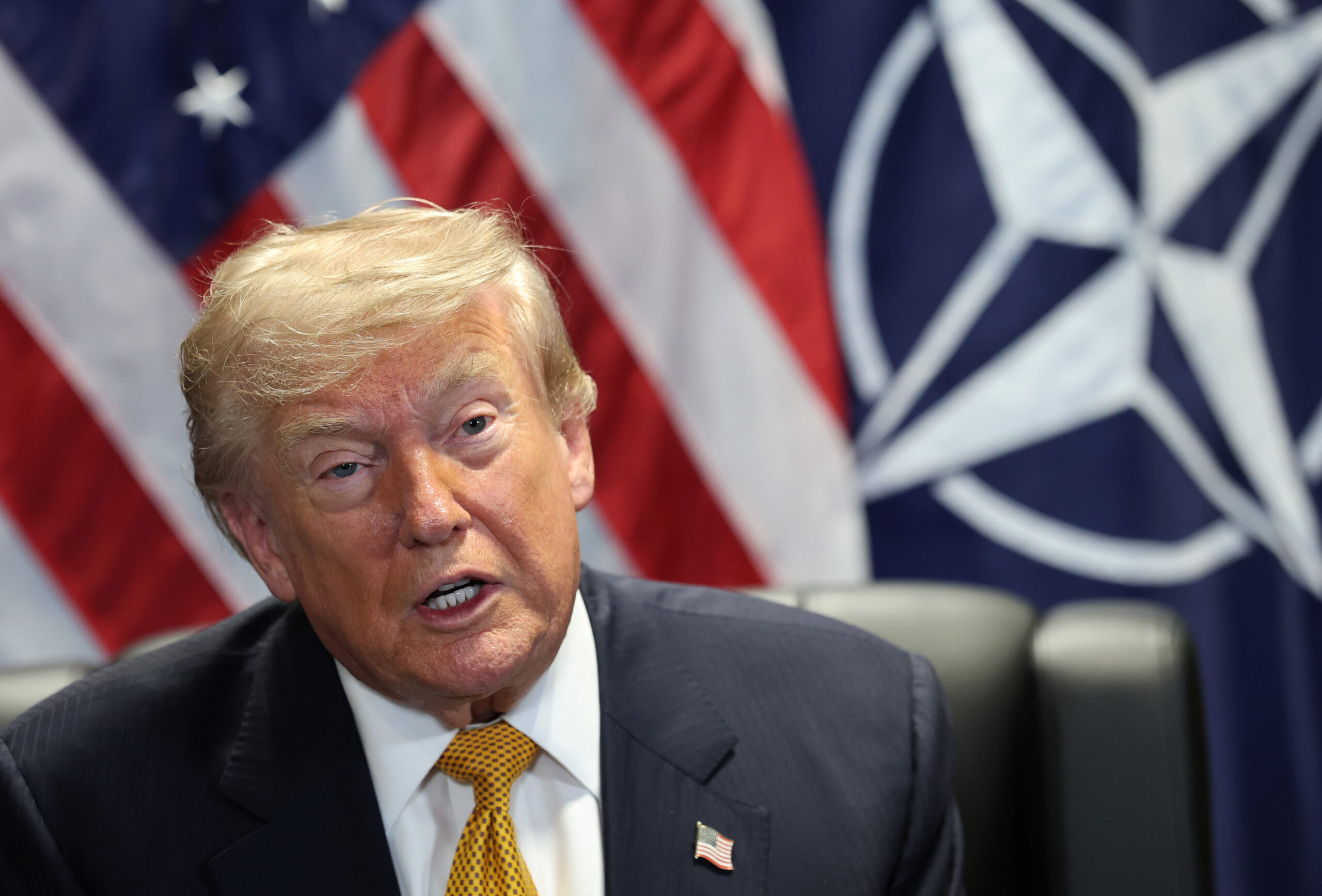
President Donald Trump’s popularity is suffering badly from another seemingly endless Mideast war. Amid rising prices, even some MAGA voters are turning against him, after supporting him due to the “affordability” crisis under the Biden administration. Since returning to the White House, Trump has dismissed the issue, claiming that prices are falling, and offered a $5,000 “dividend”—but only if Republicans retain control of Congress after the midterm elections.
Of course, politicians commonly fault their predecessors. But Trump’s excuses appear increasingly threadbare as he nears the halfway mark of his second term. He has dominated American politics for the last decade and remains firmly in charge of the GOP, which controls the House and Senate and can claim a majority of Supreme Court justices as ideological allies. He emphasizes his own influence in other ways, too, claiming to be the greatest American president and most powerful person who ever lived, while “running” the world.
Power he has in abundance, and he has used it in ways that harm Americans. To start, he, no less than Joe Biden, is responsible for Washington’s ongoing proxy war against Russia. During his first term he reversed Obama administration policy and provided lethal military aid to Kiev. Although last year he dropped Biden’s direct financial and military assistance to Ukraine, he approved the sale of U.S. weapons to European governments for transfer to Kiev. He also continued U.S. intelligence support for the Zelensky government, aiding its drone and missile attacks. He was unconcerned about the destructive impact of those attacks on Russian oil and diesel production until energy prices reached record levels.
Those prices spiked because of the Iran War, yet here too the president has sought to avoid blame, arguing that record diesel prices are somehow a result of Biden’s actions against Russia but not Trump’s surprise attack on Iran. Since March, he has routinely promised they will drop dramatically as soon as Tehran yields, which he has also repeatedly, indeed, almost constantly, predicted. Yet the war continues.
Trump has presented the conflict as one of necessity, citing Tehran’s possession of enriched uranium. There was no evidence that Tehran was pursuing a nuclear weapon when last year Trump ended negotiations and claimed to “obliterate” its nuclear program. And the only reason Tehran possessed the stockpile cited by Trump was because in 2018 he killed the Joint Comprehensive Plan of Action, i.e., the Iran nuclear deal, which had restricted Tehran’s nuclear activities. After withdrawing from the agreement, Trump imposed what he called a “maximum pressure” campaign and essentially demanded Tehran’s surrender. Instead, the Islamic Republic ultimately accelerated its nuclear activities, causing Trump to complain about its failure to accept his terms before the 2020 election.
Despite having claimed to solve the Iranian nuclear problem last year, in February he joined Israel in another military assault on Iran, contending that it was essentially nanoseconds away from developing nuclear weapons and blowing up the world. Which indicates that the 2025 operation was a failure. Or that, if it really was a success, he had no justification for making Israel’s war on Iran into America’s war.
In either case, the ill consequences were his responsibility, not Biden’s. The Pentagon had long war-gamed Iran’s closure of the Strait of Hormuz, but Trump seems to have dismissed the possibility of such an action. The Pentagon also feared Iranian attacks on its bases throughout the Persian Gulf, which he likewise dismissed. Moreover, the Iranian blockade affected the global supply of other critical products, most notably fertilizer and helium. The recent revival of conflict between the Saudi government and the Ansar Allah or Houthi movement in Yemen has further impeded oil supplies.
Trump repeatedly sought to influence energy markets by predicting a diplomatic settlement and claiming the strait was under U.S. control, while ignoring the predictable consequences of the dramatic drop in energy shipments. Indeed, it was widely recognized by most everyone other than the president that attacking Iran was almost certain to spike oil—and consequently gasoline, diesel, and jet fuel—prices. Although the impact of the war has been cushioned by unexpected mitigating factors, such as China’s reduction in oil imports, the market appears to be coming under increasing pressure.
The president’s undisciplined and arbitrary trade war against most nations on earth has also had a negative economic impact. While tariffs never would make Americans rich, as he claimed, he could have used carefully targeted levies to raise revenue—the federal government is running a $2 trillion annual deficit—and achieve foreign policy objectives. For instance, a more limited effort, conducted in cooperation with allied states, would offer a possible strategy for constraining Chinese economic influence.
But his blunderbuss campaign created malign consequences that he has consistently denied. Most importantly, American consumers, sellers, and producers pay most of the resulting cost increases. These are substantial, especially for the most basic building blocks of an industrial society. For instance, hiking the price of aluminum and steel increases costs throughout the economy. Indeed, the president has implicitly acknowledged that fact by repeatedly lifting duties on sensitive consumer goods, most recently beef, in response to complaints over rising prices. In practice, when even he could no longer maintain the fiction that taxing imports did not raise their price, Trump reduced the tariff.
Such levies also raise prices indirectly, by reducing or eliminating alternative products. A market economy is based on freedom of entry and rigorous competition. One objective of tariffs is to promote domestic production by blocking cheaper imports. Whatever the wisdom of attempting to promote “infant” American industries or revive enfeebled “sunset” enterprises, doing so depends on pushing up prices. With the federal government banning low-cost alternatives, domestic producers charge more. The president’s endlessly repeated denials do not change what Americans pay for essential goods.
Trump’s core policies—promiscuous warmaking in the Middle East and expansive mercantilist economic practices worldwide—reflect a return to an earlier age. They are mistaken, in my view, but reflect traditional if widely disputed policy paths. Facing rising popular dissatisfaction, however, the president has chosen to run away from the inevitable consequences of his actions rather than defend them. Someone styling himself as history’s most consequential person should do better.
The post The President’s Irresponsible Power appeared first on The American Conservative.