
When a Populist Becomes the Deep State
Recep Tayyip Erdoğan has been the most influential Turkish statesman in a century. Will his project survive him?
The Iran War has, for good reason, subsumed all coverage of the broader Middle East in the Anglophone media, and God knows there’s plenty there to fill the column inches. Still, one wonders: What on earth is going on in Turkey?
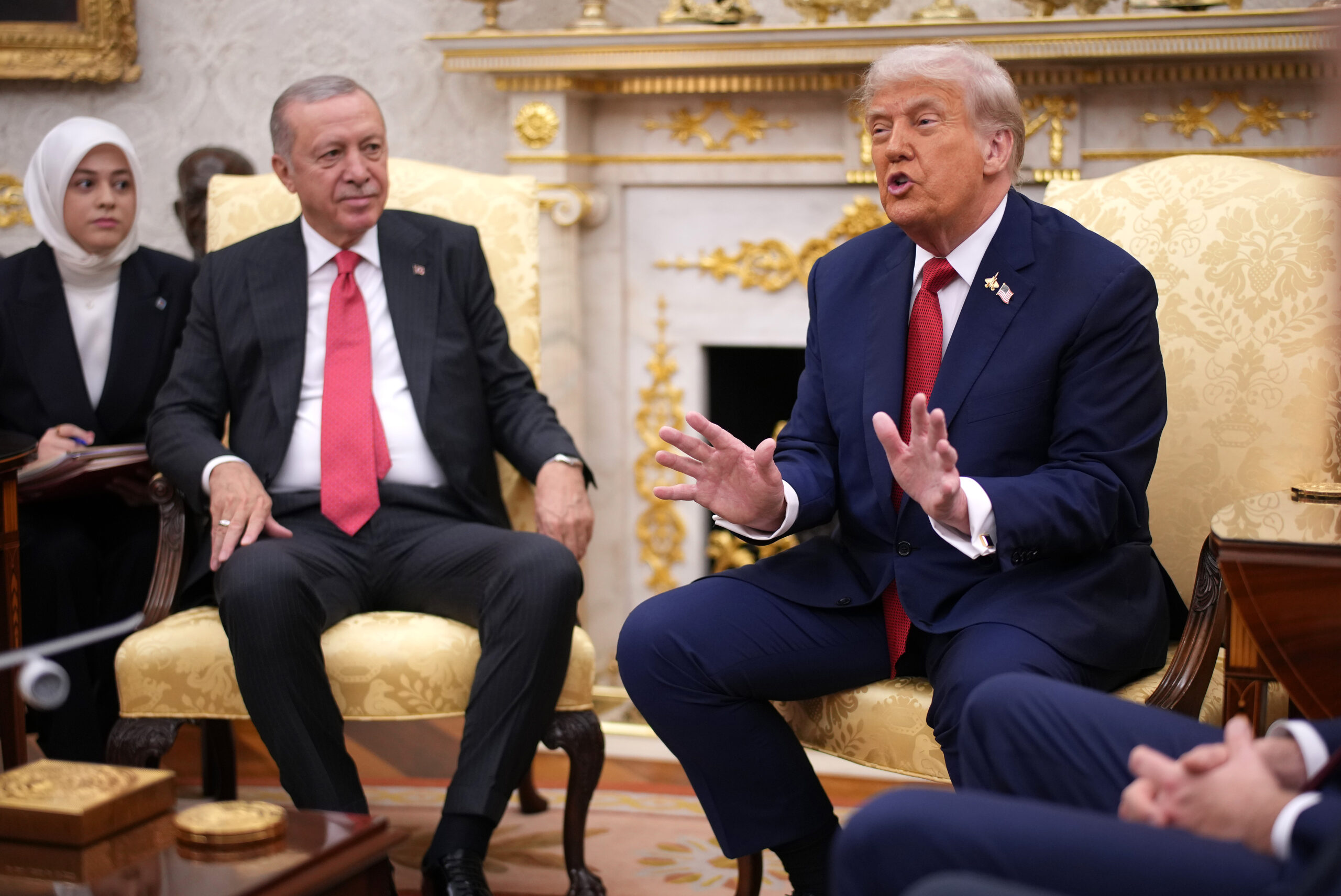
In the parlance of the craps table, President Recep Tayyip Erdoğan is on a heater. Last May, the Kurdistan Workers’ Party (PKK), a terrorist ethnic separatist group, was notionally dissolved after its imprisoned leader, Abdullah Öcalan, called for it to lay down arms. In a visit to Washington last September, the Turkish president secured a memorandum of understanding for developing a civilian nuclear program and grab-bag of defense goodies, including jet engine sales. At July’s NATO summit Ankara, President Donald Trump (who said he was attending the powwow only because of his affection for his Turkish counterpart) made favorable indications about lifting sanctions to allow Turkey to acquire American F-35 jets. European leaders praised Turkey’s role in stabilizing Syria after Assad—in whose ouster Turkish arms and support were decisive—and discussed deeper cooperation with Turkey’s defense industry. References to Erdoğan’s interference with opposition parties and his crackdown on critics in the media were negligible. Nor does his outspoken criticism of Israeli operations in Gaza seem to turn off pro-Israel leaders like Trump. In August, he signed a mutual defense agreement—the Mecca Defense Alliance—with his counterparts from Riyadh and Islamabad.
Erdoğan has contended in the top ranks of Turkish politics for 30 years, but now he is playing at the big table in the international casino—a long way from the uncertainty of the coup attempt of 2016, when he and his future were caught literally up in the air. Despite the president’s high-flying capers abroad, all is not well at home. At writing, Turkey’s inflation rate is almost 30 percent, admittedly far down from a high of about 85 percent in 2022. Growth, which has been robust through the Erdoğan years, is slowing. Even as Turkey’s hard power appears to increase, Turks are feeling less secure; in a July 2025 poll, in the immediate aftermath of the so-called 12-Day War, 71 percent of respondents said that Turkey should start developing nuclear weapons.
At the same time, Erdoğan’s political tactics are becoming more overtly repressive, engendering further public dissatisfaction. Hassling the press has become the standard way of doing business in Turkey, and barely draws international comment anymore. Most recently and spectacularly, the Erdoğan-appointed judiciary in May voided the leadership elections of the Republican People’s Party (CHP), the oldest political party in the country and the main opposition party, to instate Kemal Kılıçdaroğlu as chairman over the somewhat more dynamic Özgür Özel. What ensued can be described only as excellent television: Riot police broke into CHP headquarters physically to remove Özel from the premises. Acrimony broke out, accusations of government stoogery flew, and Özel insulted Kılıçdaroğlu’s mustache. Finally, in July,
Özel and most of the party with him broke away from the court-sanctioned CHP to form a new party, inventively christened the Yeni Parti—the New Party. Among those who endorsed the Yeni Party is the relatively young, telegenic, and popular Ekrem Imamoğlu, the jailed and suspended mayor of Istanbul, who had been expected to be CHP’s 2028 presidential candidate. In his July speech announcing the party schism, Özel accused the derin devlet—the “deep state”—of persecuting Erdoğan’s political adversaries.
This is an ironic and amusing turn of events. “Deep state” is an originally Turkish term, used to describe the elite complex that preserved the republic’s Kemalism—which is to say, in large part, preserving the preeminence of CHP, Mustafa Kemal’s party.
There’s a long and convoluted history here. Atatürk established a secular republic on the continental European model. He removed any reference to Islam from the Turkish constitution, abolished the legal office of the caliph, and launched a series of reforms to cultivate a secular Turkish nationalism and degrade traditionally powerful religious structures: banning Sufi lodges, bringing religious education under the tutelage of the state, imprisoning restive sheikhs, and “purifying” the Turkish language by purging words of Arabic and Persian origin (or finding “Turkish” etymologies for them of varying plausibility). Briefly, the Arabic call to prayer was banned and a Turkish version mandated. Unsurprisingly, much of this top-down, elite program was unpopular with the people; the Turks have been Muslims for a thousand years, and many of Turkey’s ethnic minorities have a particularly close relationship with the practice of Islam, notably the Kurds. Contrary to the impression created by Western-facing Kurdish nationalists, largely dominated by the secularist, leftist Kurdish Workers’ Party (PKK) and its affiliates, Kurdistan was the vibrant center of much of the Ottoman Empire’s religious life.
This period engendered the great antithetical poles of modern Turkish politics: secularism versus political Islam, elitism versus populism, nationalism versus pluralism. It is a testament to Atatürk’s greatness that he was able to contain these contradictions. Also to his pragmatism. (For all the work of the language reformers, Atatürk never abandoned his graceful Ottoman prose style. Evidently a single state dinner at which he haltingly delivered a speech written in “pure Turkish” was enough for him.) His successor, İsmet İnönü, was a figure of less stature, who relied more heavily on the tools of state repression to advance the Turkish project, jailing more dissidents—particularly religious dissidents—and for a time banning political parties besides the People’s Republican Party (CHP).
These things can’t go on forever. İnönü grudgingly allowed free elections in 1950, which brought the handsome, popular Adnan Menderes of the Democrat Party (DP) to the premiership. Menderes liberalized Turkish economic policies; he also eased state repression of religious institutions, most symbolically restoring the Arabic call to prayer. The secularist elite grew agitated at Menderes’s policies; in 1960, the generals couped him and hanged him. Among his last official acts was restoring the Ottoman-era name of the general staff of the military. İnönü returned as prime minister the year after.
This shocking episode became the precedent for much of Turkey’s subsequent political history. Popular politicians with more overt affinities for Islam and Turkey’s prerepublican history strove for power to be knocked back by the secularist elites in the army, the judiciary, and the CHP—that is, the derin devlet, the deep state. In this way, Turkey came early to a condition now spreading in Western democracies. The liberal mirage—the idea that structures of governments like the courts, the police, and the military are nonpolitical or extrapolitical administrators—has never really obtained in Turkey.
And, in some way, Erdoğan was also the earliest of the 21st century’s wave of successful right-wing populists. Born to a ship’s captain in a poor neighborhood of Istanbul, he worked odd jobs as a street vendor before coming of age in the ferment of the 1970s. The sometimes violent right-wing student movements of which he was a member had a revisionist nostalgia for the Ottoman Empire and argued for the centrality of Islam to Turkish identity. The poet Necip Fazıl Kısakürek, who called for the reopening of Hagia Sophia as a mosque, was a rallying point for the restless and politically disenfranchised Turkish youth. In 1974, Erdoğan won a prize for a recitation of one of Kısakürek’s poems and met the poet himself.
It was Erdoğan’s remarkable gifts as a reciter and orator that got him in trouble. In 1994, he won the mayoralty of Istanbul for a political party associated with the moderate and eccentric Islamism of Necmettin Erbakan, who, among other things, wanted to ban lending at interest and middleman professions. In 1997, in the midst of the so-called postmodern coup against Erbakan’s government, Erdoğan recited a version of a poem by the early Turkish nationalist writer Mehmet Ziya Gökalp that included militaristic references to Islam. The deep state sprang into action; in March 1999, after appeals and sentence reductions, Erdoğan began four months’ imprisonment for violating the secularism laws. The day he entered prison, he released an album of poem recitations, Bu Şarkı Burada Bitmez (“The Song Doesn’t End Here”), which became the year’s best-selling album in Turkey. There was a whiff of Mandela about him when he was released and, just short of four years later in 2003, assumed the premiership with his new electoral vehicle, the Justice and Development Party (AKP).
In another whiff of Mandela, what followed was a mix of progress, corruption, and repression. AKP was billed as a technocratic party, with old Erbakanist developmental policies given a veneer of optimistic, new-century, good-government reformism. (Significantly, the party’s logo, a light bulb, was a symbol suggested to Erdoğan by Kısakürek years before.) In the low-inflation global macroeconomic environment of the early 2000s, keeping interest rates down and opening up capital markets was what everyone was doing, under the influence of Islamist political economy or not. Early in his tenure, he sought reconciliation with ethnic minorities in the historical Turkish orbit, including both the Republic of Armenia and Turkey’s own Kurdish population, whose historical conflict with the Turkish state was so much bound up in the secularization Erdoğan’s own political tradition opposed. The War on Terror scrambled the greater Middle East and with it these early overtures; but in the following years, Erdoğan proved himself to be adaptable, some might say unprincipled, in his foreign policy, leading to the recent triumphs.
Alongside this Western-friendly suite of policies was his campaign against the deep state. Much of this, in concrete terms, came down to restaffing the government with his own counterelite, largely drawn from Turkey’s religious fraternities. This proved to be a tough row to hoe; in 2016, adherents of Fethullah Gülen’s Hizmet organization, who had replaced many of the old-line Kemalists in the police and the military, attempted to seize power in some sort of combination with Kemalist elements in July 2016. There was enough luck and happenstance in this story that some critics still insist the Gülen coup was a false-flag operation justifying the sweeping purges that followed. While the full tale will probably not be told for years, the preponderance of public evidence suggests that it was in fact a good-faith effort. But it is true that purges followed the Gülenist coup (and two other supposed conspiracies, “Sledgehammer” and “Ergenekon,” both of which are prima facie less believable). Erdoğan has been thorough; hence we return to Özel’s complaint that the deep state is after him.
Much remains to be done: a final political settlement for the Kurdish question, the consolidation of Turkey’s place in the emerging order in the Middle East, the on-again, off-again steps toward closer relations with Europe, dealing with the economy. But Erdoğan is old. He turned 72 in February; he now walks with a slight stoop, and that resonant voice is a touch hoarser than it was. As with every elderly head of state, rumors about his health occasionally swirl through the press. He is expected to run for another five-year term in 2028, but it is difficult to imagine another after that. Inevitably the question: What will happen to his project when he has left the stage?
Any political settlement based in part on repression has inherent weaknesses; these are especially pronounced in Turkey, which has never entirely successfully found a stable political outlet for popular dissatisfaction. Erdoğan’s particular project also has a particular weakness in its inability to deliver consistent economic success, a driver of disgruntlement everywhere and in all times. Yet the likeliest opposition—the old CHP—is sclerotic and now literally fragmented, and it was the hatred it engendered in a large part of the population that enabled AKP’s rise in the first place. If the Yeni Parti can shed the old baggage and function as a normal party, and get around the workings of a now-hostile state machinery, perhaps İmamoğlu will complete his own recapitulation of Erdoğan’s career. Otherwise, it is only a question of succession on the AKP side.
Hakan Fidan, the current foreign minister, is an obvious contender. He has worked with Erdoğan for a long time, and was his chief of intelligence during the Gülenist coup attempt. He has overseen the great foreign-policy successes of Erdoğan’s late career, especially the pacification of Syria. Loyalty and competence go far. And foreign policy chops specifically may be a desideratum in the near future: Israeli politicians keep making nasty noises in the direction of Ankara. Erdoğan’s second son, Bilal, has occasionally been mentioned, but has kept a relatively low profile; while he is deeply involved in his father’s network of nonprofits, he has taken little active role in politics. Selçuk Bayraktar, Erdoğan’s son-in-law, is a more impressive character. An MIT-trained engineer, he is the chairman and CTO of Baykar, the beating heart of Turkey’s conspicuously successful drone industry. The persistent challenge for AKP (and for Turkey) has been to generate growth without the distorting effects of inflationary policies or corruption; putting a successful businessman in charge has had a recurring appeal for economically disgruntled democracies going back at least to Crassus. Yet it is difficult to imagine any of these characters filling Erdoğan’s enormous role in the modern Turkish state.
Here we find the classic problem of the populist politician. To advance his agenda effectively requires becoming the establishment, at which point his operation becomes prey to all the dysfunctions that weakened the prior establishment and enabled his ascendancy; or, alternatively, he must concentrate power and command in his own person, which will leave his agenda helpless when the man himself has moved into the great political beyond. In Turkey, there has been a little bit of both.
The post When a Populist Becomes the Deep State appeared first on The American Conservative.