
How the GOP Can Win Back Latinos
Voters in South Florida shared their frustrations with The American Conservative.
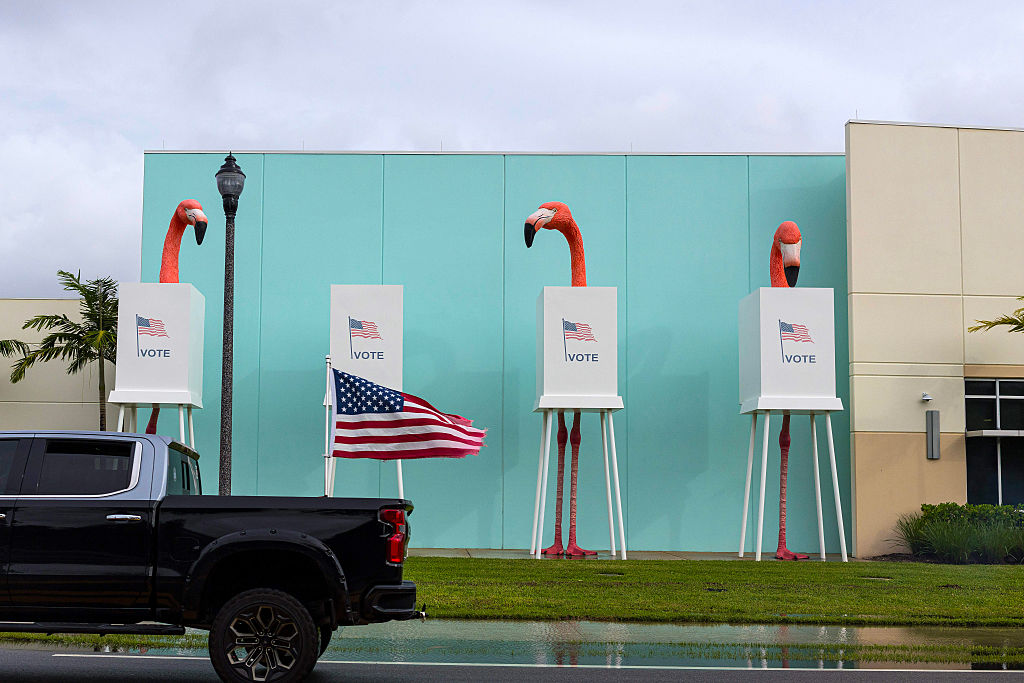
It was Election Day in neoconservative South Florida. The torrential rains briefly subsided as I made my way to the local polling station in suburban Fort Lauderdale. A handwritten sign made the following plea to voters: “We didn’t fight terrorists abroad just to come home and watch DEMOCRATS elect them into office.”
The state’s younger generations, however, see matters differently. One 20-something Latino I spoke with described himself as a socialist and said that Republicans had nothing to offer young people. Conversely, a young mother of Peruvian heritage told me she typically voted for Republicans but felt Trump needed a wake-up call over broken promises.
In the end, Republicans avoided a bloodbath in Florida despite voters—and especially Latinos—swinging hard to the Democrats. The Republican gubernatorial and senatorial candidates Byron Donalds and Ashley Moody narrowly prevailed over Democratic challengers Angie Nixon—who was endorsed by the Democratic Socialists of America (DSA)—and David Jolly. The Miami neocon trio of GOP Reps. Carlos Gimenez, Maria Elvira Salazar, and Mario Diaz-Balart also appear to have survived, though Salazar and Diaz-Balart’s races were still too close to call at the time of writing.
Elsewhere in the country, Latinos drove historic Democratic victories, including all statewide races in Texas. All told, the group swung 29 points away from Republicans after Trump’s performance in 2024. What lessons, then, should the GOP draw from this Latino backlash?
One thing to note is that there are important differences between Latinos of different backgrounds. Voters of South American and Cuban origin, for example, tend to lean neoconservative when it comes to foreign policy. And second- and third-generation Latinos are often indifferent to political developments south of the border.
In Florida, Moody won Cuban-Americans by seven points, mitigating losses among Hispanics. One Cuban-American millennial, a venue promoter in Wynwood, Miami, told me he split his vote, explaining that he couldn’t vote for Nixon due to her inability to call Cuba a dictatorship. And in the Cuban-American stronghold of Hialeah, the neoconservative faithful held firm in their support for the GOP. “We have to let Trump work”, said Marcos, a middle-aged mechanic, originally from Havana. The president “knows what he’s doing,” he added, referring to both the Iran War and the sanctions-induced crisis in Cuba.
Yet among Venezuelan-Americans in South Florida, MAGA neoconservativism has shown considerable cracks over a range of issues, including the administration’s policy towards Caracas. In the wake of the January kidnapping of Venezuelan dictator Nicolás Maduro, concern over Trump’s cozy relationship with the regime successor Delcy Rodríguez was largely confined to media and intellectual circles. Ten months later, many grassroots Venezuelan-Americans continue to give the president the benefit of the doubt. Some, however, have become frustrated with the prospect that the regime in Caracas may ultimately survive Trump’s term.
In suburban Fort Lauderdale, José—a 2024 Trump voter—told me he had been ecstatic following the Maduro raid but since then has soured on the administration. “Things are worse than ever, not just here but also for my relatives that are still in Venezuela,” he said. “They were supposed to arrest the Chavistas, not sign all these deals with them!” José added, referring to Venezuelans who subscribe to the socialist ideology of former President Hugo Chávez.
Then, of course, there’s the elephant in the room of the administration’s approach towards immigration enforcement. At a watch party close to the Trump National Doral hotel for a local Miami-Dade official, some invitees panicked at Florida Republicans’ tight margins on election night. “How could Miami vote for a socialist for senator?” said one Venezuelan-American realtor. “It’s the immigration issue,” another attendee responded. “They’ve gone too far with ICE. A lot of people are just staying home,” he added. Indeed, turnout in majority Hispanic precincts throughout the state fell to 44 percent even as overall turnout stood at 60 percent.
The remarkably accurate pollster Atlas-Intel found that 40 percent of Latinos listed “immigration policy, deportations, and ICE” as one of their top three electoral issues, putting it ahead of “combating corruption” and “economic policy and taxes.”
It’s not hard to see why Hispanics are deeply concerned about immigration enforcement. Around 60 people have died under ICE custody since Trump returned to office. Many of the voters I spoke with told stories of friends and family members—some of whom were U.S. citizens—who suffered abuse under ICE detention. Notably, Salazar has drawn ire from immigration hardliners for criticizing enforcement excesses and championing a pathway to citizenship for certain illegal immigrants.
Nonetheless, it’s foolish to presume that Democrats will dominate among Latinos for the foreseeable future, including when it comes to immigration. In a seeming paradox, Atlas-Intel also found that 45 percent of the demographic still favored mass deportation of illegal immigrants, compared to 40 percent who were opposed. The truth is that Latinos—much like the broader population—remain broadly against illegal immigration even as a slim majority also favor abolishing ICE.
Many of the Latino Trump voters I previously spoke with in 2024 expressed frustration over having migrated legally to the U.S. while millions of illegal immigrants and fraudulent asylum seekers “jumped the line” at the border under President Joe Biden. Progressives are profoundly mistaken if they think that they can avoid renewed border chaos by only deporting criminals, while also allowing anyone to claim persecution and solicit asylum inside the U.S.
If a future Democratic administration reopens the border, it’s quite likely voters—Latinos included—will swing back to the GOP in subsequent elections; as of this writing, voters continue to prefer Republicans by 13 points over Democrats on immigration. If Republicans are truly serious about delivering lasting results on the border while also avoiding endless backlash, there is a conservative but also populist path forward for the party.
In 2008, current Kansas Attorney General Kris Kobach, a Republican, made a compelling case against an ICE police state, arguing it would be both less costly and more effective to punish employers of illegal labor under a rigorous, national regime of E-Verify. That program, which verifies the immigration status of employees, has been repeatedly sabotaged at the state and national level by carveouts and selective enforcement, due mainly to employer lobbying.
Much to his credit, Vice President J.D. Vance stated in his post-election autopsy that he was open to changing enforcement “by focusing more on businesses that hire illegal labor.” At present, worksite investigations and prosecutions of employers of illegal labor sit at or near record lows. Actually deterring illegal immigration by cracking down on employers ultimately depends on achieving sufficient scale and consistency of enforcement. In Canada, hiring illegal workers is nearly impossible due to a rigorously enforced equivalent of E-Verify.
In 2023, Gov. Ron DeSantis passed a law mandating that private firms subject employees to E-Verify. The mandate, however, features a carveout for companies with fewer than 25 employees and has been poorly enforced. And even that has been too much for some: The Wall Street Journal, for example, decried the piecemeal mandate in February, claiming that it was “killing growth” (the paper also expressed panic at Republican efforts to broaden the mandate).
Given sufficient political will, Kobach estimated his proposal could be implemented at a cost of around $600 million over five years, a trivial expense (compare this to the $85 billion currently devoted to ICE). Illegal immigration by economic migrants—as in Canada—would collapse, and large numbers of recent arrivals would self-deport for lack of employment options. It remains to be seen whether the Trump administration—or Democrats for that matter—will eventually embrace such a proposal.
Foreign policy will be another tricky issue for the administration with Latinos moving forward. So long as the Iran War continues to fuel higher prices at the pump and grocery store checkout, voters of all stripes are likely to deliver another gut punch to the GOP in 2028. Latino neoconservatives—in Miami or elsewhere—will probably continue to prefer Republicans, but some may opt to stay home if they perceive limited progress on regime change in Cuba or Venezuela before Trump leaves office.
There are, however, areas where Republicans will continue to reap dividends with Latinos in the long term. Hispanics are overwhelmingly Catholic or evangelical and generally conservative on issues like crime, family, and energy abundance. In addition to backing mass deportation, Latinos approved of federal recognition of two biological genders and increased fossil fuel production under Trump by margins of 10 and 20 points, respectively; they likewise back Republicans over Democrats on crime by nearly 12 points.
For the GOP, winning back Latinos who defected to the Democratic Party or who sat out this election will remain crucial for the foreseeable future. Republicans can start by embracing the vice president’s four-point plan for reestablishing trust with voters: 1) end the war; 2) focus on cost of living/inflation; 3) put America First; and 4) change our relationship to Israel.
The post How the GOP Can Win Back Latinos appeared first on The American Conservative.