
Kushner and Witkoff’s Abu Dhabi Talks Could Change the Game in Ukraine
Engaging Russia’s own concerns is necessary for getting Moscow to cut a deal.
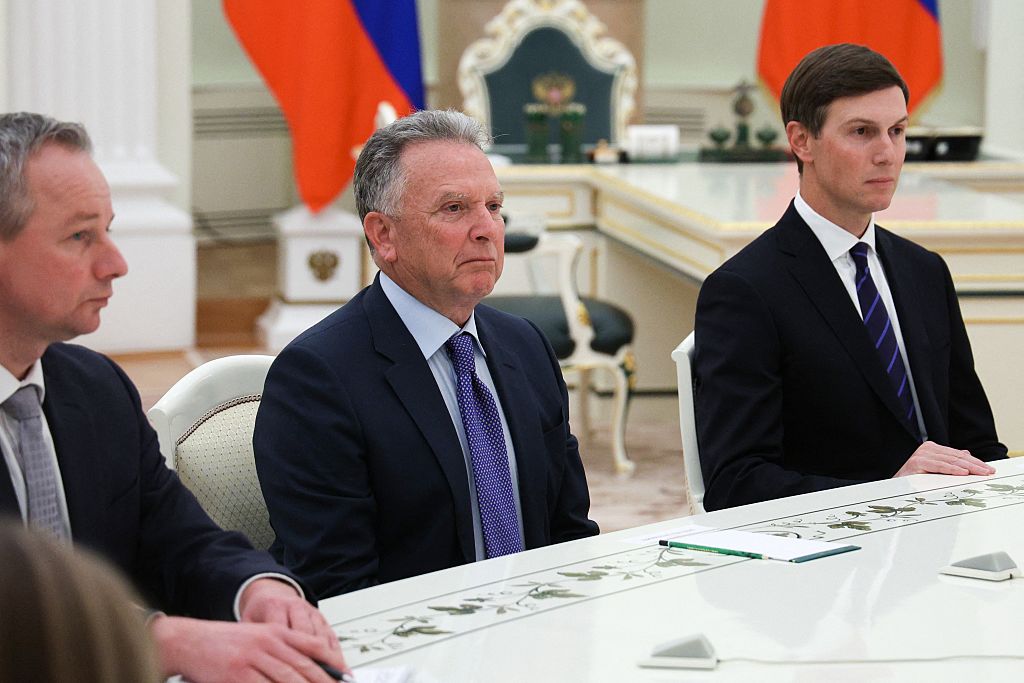
After an eight-month hiatus, talks between the United States, Russia, and Ukraine resumed last week in the Emirati capital of Abu Dhabi.
Steve Witkoff and Jared Kushner, who served as the U.S. representatives, said before the meetings kicked off that “any future agreements must… provide credible security guarantees for Ukraine.” This formulation was to be expected, echoing as it did previous statements on the topic. The surprising part came when Secretary of State Marco Rubio added, “Those security guarantees are going to be key in order for Ukraine to be able to agree to something. But it has to be something Russia agrees to as well.” Kushner then filled in the key detail by stressing “the need for a broader European security architecture that can help establish the conditions for lasting peace.”
With that, Russia came closer to achieving its main objective in this war. As laid out in its December 17, 2021 proposal on security guarantees sent to the United States and NATO before the war, Russia demanded that NATO “refrain from any further enlargement of NATO, including the accession of Ukraine.” A further request was that NATO avoid “deploy[ing] military forces and weaponry” on the territory of any country that joined NATO after the May 1997 signing of the NATO-Russia Founding Act.
Failure to engage in serious negotiations on these key points, Moscow said, would lead to a Russian response that could include unspecified “military-technical measures.” One of these turned out to be the invasion of Ukraine.
But for Russia, this war was never just about Ukraine. “The Ukraine settlement,” as one source in the Russian delegation said, “is just one aspect of this wide-ranging discussion and is subordinate to the main objective—the creation of a comprehensive and indivisible security architecture for the entire continent.”
Invasion, on this view, was an effort to revise the European security architecture by fiat, replacing the two-tiered framework imposed by NATO’s eastward expansion with a system that meaningfully included Russia.
Fast forward to last week, when President Donald Trump told reporters that “there’s going to be an agreement. It’s going to be a big agreement, and it’s going to involve more than Ukraine… and I could even say it might involve all of Europe.” The Russian goal of getting a more favorable security architecture looks to be back on the table for the first time this century.
What made this breakthrough possible, as the Russian analyst Sergey Poletaev points out, is that in Abu Dhabi, for the first time, talks about how to end the war extended beyond Ukraine to include what Russia calls “the root causes” of the conflict. As the head of the Russian delegation, Vladimir Medinsky, put it, “the whole body is sick, and Ukraine is simply where the abscess burst. So the whole body needs treatment. A simple band-aid won’t do.” In practice, these negotiations concluded by recognizing that the conflict in Ukraine will have to be resolved within the context of a broader agreement about the principles of coexistence.
This fundamental Russian demand had previously been rejected by European leaders. But while the EU and many of its member governments have continued to officially rule out the possibility of bringing Russia into the continent’s security architecture, a surprise European Council Statement put out last week seemed to concede much of Moscow’s point. It stated in no uncertain terms that the current security framework for Europe is inadequate for managing the risk of confrontation and avoiding dangerous escalation. Having admitted the problem with the current European security architecture and linked it directly to Ukraine, European leaders now face the inescapable conclusion that the only way to resolve this issue is to engage in security discussions with Moscow. On these terms, Russia has said, it is perfectly willing to sit around the table with Europe.
Abu Dhabi thus offers a small glimmer of hope that, despite the devastation and incalculable suffering caused by this horrible conflict, both Russia and Ukraine might still be able to achieve something that each has long sought. Russia can claim a win by, at last, being welcomed into a broader European security architecture and by achieving control over the Donbas. Ukraine can claim a win by assuring its sovereignty and security, while also remaining free to pursue membership in the European Union.
When Russia presented its demands for a new, inclusive security architecture in the weeks before the war, both Washington and Brussels bluntly told Moscow that they were unwilling to even discuss excluding Ukraine from NATO. Now this is on the table. The tragedy is that such an architecture, had it been seriously pursued back then, might have prevented this war from ever starting.
The post Kushner and Witkoff’s Abu Dhabi Talks Could Change the Game in Ukraine appeared first on The American Conservative.