
Iran–Contra at Forty
Once upon a time, Congress asserted itself on foreign policy.
Four decades ago, President Ronald Reagan went on TV and acknowledged that his administration had shipped what he described as “small amounts of defensive weapons and spare parts” to the Islamic Republic of Iran. The president was responding to the news—first broken by an obscure Lebanese weekly—that U.S. missiles had been transferred to the Iranian regime. In his speech, he confirmed the gist of that reporting, but adduced a noble reason: his vision of replacing the animosity then existing between the United States and Iran with a new relationship, one that might well put the Middle East on the path toward “enduring peace.”
Alas, this was not the full story. Not only was there mounting evidence that the administration had in fact seen its arms shipments as a means of sweetening a hostage release deal—contravening its public insistence on taking a hard line with terrorists—but the Iran imbroglio intersected with another news story making the rounds in DC. This was the revelation that the U.S. government, in defiance of a congressional prohibition, had been supplying military aid to the Nicaraguan Contra rebels. The connection was money: As Attorney General Edwin Meese was forced to admit on November 25, at least some of the funds from the secret arms sales to Iran had made it—no one seemed quite sure how—into the secret accounts used to support Nicaragua’s anti-communist guerillas.
Now the nation had a full-blown scandal on its hands. “By all accounts,” the New York Times solemnly announced the day Meese confirmed the linkage, “Mr. Reagan now faces the most serious crisis in his six-year Presidency.”
You see, back then Congress still had a notion of itself as a coequal branch of government. And while partisanship certainly existed, it had not yet become powerful enough to envelop Capitol Hill in the reality-distortion field with which we are familiar today. So when the full dimensions of the affair started to become clear, both the House and the Senate voted overwhelmingly to stand up special investigative committees (the former by a vote of 416–2, the latter by a vote of 88–4—both unthinkable margins today).
Members of Congress—both those currently in office, and those who will imminently be sworn in—would do well to brush up on this history. For the Iran–Contra affair marks the last time that Congress would meaningfully act as an institution to rein in a rogue executive over foreign policy. And it did so under some familiar circumstances.
Then, as now, a GOP administration was seeking to assert executive control over as many defense and foreign policy functions as possible, with an eye toward exercising these to prosecute an expansive, interventionist grand strategy with a minimum of democratic consultation; then, as now, the opposition Democrats had just made major gains in the midterm elections (in November 1986, Dems flipped the Senate and expanded their margin in the House). And, just as the outgoing 119th Congress today must consider steps to end the Iran War before the 120th is seated, so too did the Congress of 1986 have to make major decisions about the handling of Iran–Contra during its “lame-duck session.”
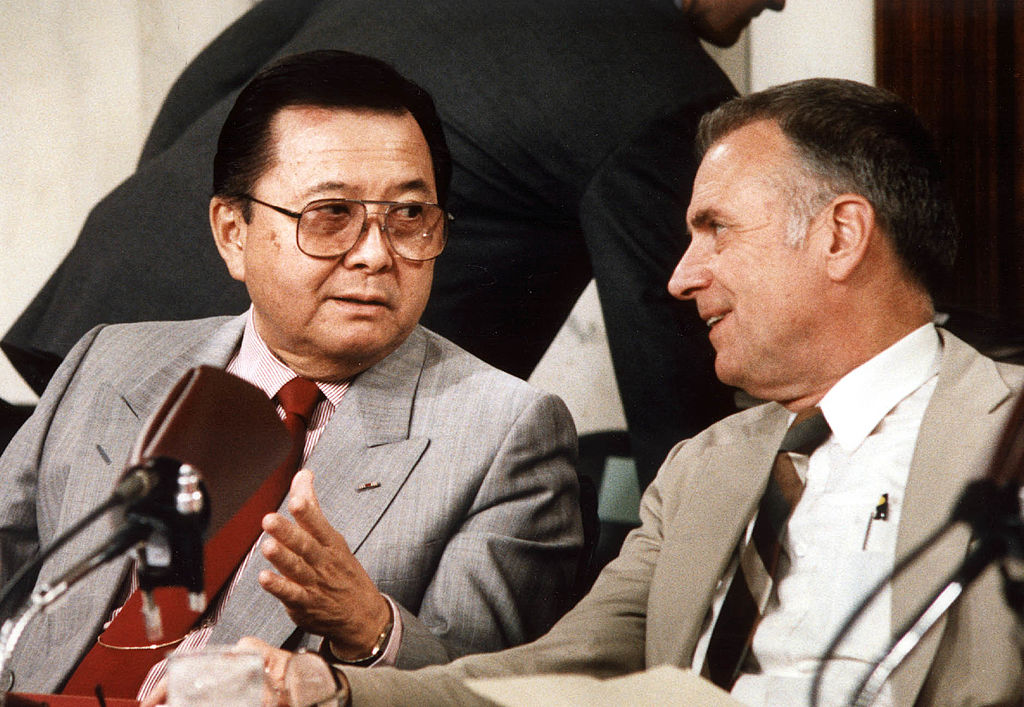
Although the majority Democrats clearly relished the opportunity to hit the Reagan administration, congressional leadership did try to keep the focus on their body’s institutional prerogatives. It was decided, for example, to have the House and Senate committees conduct joint hearings, which were broadcast to an audience of millions during the spring and summer of 1987 (this was back when hearings were taken seriously as discursive events, rather than considered primarily as sources for viral video clips). And in their approach to the proceedings, lawmakers sought to emphasize the constitutional stakes.
“The President may be the senior partner in foreign policy,” Sen. Daniel Inouye (D-HI), the chairman of the Senate committee said in his opening statement the day the hearings kicked off, “but he is not the sole proprietor.” The Iran–Contra affair, Inouye continued, was a story
not of covert activity alone, but of covert foreign policy; not of secret diplomacy, which Congress has always accepted, but of secret policy-making, which the Constitution has always rejected. It is a tale of working outside the system and of utilizing irregular channels and private parties, accountable to no one, on matters of national security, while ignoring the Congress and even the traditional agencies of executive foreign-policy making.
Sound familiar?
The committees’ work also remained bipartisan in important respects. Staffing decisions were made on a collective basis, rather than having Democratic and Republican members make separate hires. In the Senate, Sen. Warren Rudman (R-NH) was made “vice-chair” rather than “ranking member” of the select committee, which placed him on a more coequal basis with his Democratic counterpart. And when the Senate select committee issued its final report, a majority of the Republican members signed on.
This is not to say that there was no partisan rancor (indeed, this intensified as the proceedings dragged on), nor is it to claim that Congress got everything right. In fact, on this latter question, the legendary journalist Seymour Hersh published an intensely critical analysis, pointing out that the committees decided at the outset to keep their kid-gloves on when it came to the involvement of Regan himself, the idea being to spare the nation the trauma of a second Watergate. (They also probably gave themselves far too little time to work.)
Yet Congress’ investigation into Iran–Contra does offer, if not a precise model, then at least a precedent for lawmakers seriously interested in clawing back congressional power over foreign policy. Who knows, it may even help—as the Senate select committee’s final report put it—to “restore the public’s confidence in this Nation’s Constitutional system of Government.”
The post Iran–Contra at Forty appeared first on The American Conservative.