HORROR IN JORDAN: Chilling New Footage Shows Islamists Storming Greek Orthodox Church During Funeral – 7 Christians Slaughtered, 40 Wounded as Gunmen Open Fire

Surveillance footage captures the horrifying moment armed gunmen stormed a Greek Orthodox church in Karak, Jordan

New security camera footage has captured the brazen moment three Islamist gunmen approached and entered a Greek Orthodox church in southern Jordan, turning a funeral into a bloodbath.

At least 7 worshippers have been confirmed dead, with dozens more injured, in an attack authorities have labeled a terrorist act by extremists.

The assault struck St. George’s Greek Orthodox Church (also referred to as Hammoud Church) in the village of Hammoud, Karak Governorate, roughly 110 miles south of Amman, on October 23, 2026. Between 150 and 200 mourners had gathered for a funeral when the attackers arrived by vehicle, Reuters reported.

CCTV verified by multiple outlets shows two gunmen advancing through a vehicle entrance before briefly retreating and returning with a third.

Armed with handguns and at least one AK-47-style rifle, they took cover behind trees and a low wall, opened fire from the sidewalk, then sprinted into the church compound and continued shooting for several minutes.

A witness told CNN the gunmen shouted “Allahu Akbar” while targeting the courtyard where most of the congregation stood. Survivors described chaos, blood on the floors, and people collapsing as they hid behind the altar. Most victims were aged 50 to 70.

Initial reports listed six dead and 28 wounded; Jordanian officials later raised the toll to seven killed and 34–40 injured. Three doctors were among the dead, according to local accounts.

WATCH:

Jordan’s Interior Minister Mazen Al-Faraya described the perpetrators as a “group of extremists” in an “unprecedented” attack. King Abdullah II called it a “terrorist act” that would be met with the “harshest retaliation” and an “iron fist.”

A manhunt is underway. No group has officially claimed responsibility, though unverified video of the attackers reportedly includes expressions of allegiance to the Islamic State. Jordanian Prime Minister Jafar Hassan attributed the violence to “terrorist ideology and blind extremism” rooted in takfir.

The post HORROR IN JORDAN: Chilling New Footage Shows Islamists Storming Greek Orthodox Church During Funeral – 7 Christians Slaughtered, 40 Wounded as Gunmen Open Fire appeared first on The Gateway Pundit.

More Sad News for Ilhan Omar: Her Husband Was Not Only Her Brother But Likely Gay

Oh to be fooled not just once, but twice!

After several years of avoiding the subject — in July 2019, the Minneapolis Star-Tribune published a report on Ilhan Omar, her tax fraud crimes, her illegal use of campaign funds to cover travel costs and touched on her alleged marriage to her younger brother.

The Star-Tribune reported that the Omar campaign launched a concerted effort to quash details on her marriage to her brother-lover.

Obviously, Omar was afraid that information about her wedding to her brother in 2009 would go public.

The Gateway Pundit posted several updates on Ilhan’s story at the time. Our sources were hesitant to go public due to concerns of retribution from certain segments in the US Somali community.

What is interesting is that as Ilhan continues to deny her marriage to her brother there is clear evidence that she is lying.

As TGP reported at the time the birth date of her husband-brother on the wedding certificate matches the birth date on her brother’s school papers.

A TGP source in the Somaliland and Somali community sent us this information in 2019.

The story about Ilhan marrying her brother is well known and is a very common thing among Somali people in the diaspora. Ilhan had a child with her real husband while married to her brother to get him US residency and ultimately obtain US citizenship. This is clear example of someone who does not respect the laws of this country and probably thinks that the Sharia marriage with her actual husband is the one that counts.

Her brother is a bit of an issue for bigots in both our clan and the Somali community. His lifestyle was so troublesome for her support from the Somali community, that he was made to relocate back to Europe, somewhere in England I believe. Ilhan bills herself as a progressive to to one side, and conservative to the other.

You can see how the issue of her brother’s lifestyle was an issue for her during her election. In case her brother’s sexuality is not well known, he is gay.

Brother Elmi followed several gay personalities on Instagram at the time, including: gaymenonthego, queeringsomalinimo, and how-gay-Iam:

Here are a few from his list that he follows.

Obviously, The Gateway Pundit does not have an issue with her brother’s sexuality. 

And, of course, Ilhan must have been heartbroken when she found out.

But this does add more fodder to the reports that Ilhan’s marriage to her brother was a sham and a scam on the US immigration system.

The post More Sad News for Ilhan Omar: Her Husband Was Not Only Her Brother But Likely Gay appeared first on The Gateway Pundit.

Full Fifth Circuit Rules Illegal Aliens Can Be Detained During Deportation Proceedings WITHOUT Bond Hearings, Even After Decades in the US

(Photo by John Moore/AFP via Getty Images)

President Donald Trump has scored another major legal victory in his administration’s crackdown on illegal immigration!

The full U.S. Court of Appeals for the Fifth Circuit delivered a significant victory for the Trump administration on Friday, ruling that illegal aliens who entered the United States without authorization do not have a constitutional right to individualized bond hearings while their deportation proceedings are underway, even if they have lived in the country for decades.

The 10-7 en banc decision reversed three lower-court orders that had granted release to the detainees and vacated a July panel ruling that had imposed a 90-day limit before bond hearings on due process grounds.

The decision represents a major setback for immigration activists seeking to force Immigration and Customs Enforcement (ICE) to provide individualized bond hearings before continuing to detain certain illegal immigrants.

Trump-appointed Judge Cory Wilson, writing for the majority, made clear that aliens who have never been lawfully admitted have no constitutional entitlement to extra proceedings beyond what Congress wrote into the Immigration and Nationality Act.

“To the extent petitioners seek to vindicate a liberty interest to be free from physical restraint in the most abstract sense, they can do so at any moment by agreeing to leave the country,” Wilson wrote.

The court held that “Because petitioners have never been admitted to the United States, due process does not entitle them to additional proceedings beyond what Congress has provided before they may be detained pending removal.”

The consolidated cases, Sosnava Rodriguez v. Ortega and companions, involve three men who entered illegally years ago and lived in Texas: Ignacio Sosnava Rodriguez (entered around 2004), Alejandro Villegas Angel (entered 2011), and Miguel Angel Gomez Alvarado (Honduran, entered 2012).

All had lived in the U.S. for 14 or more years, worked, had no criminal records, and are fathers of U.S. citizen children.

Texas state troopers arrested them during traffic stops between late 2025 and early 2026 and handed them to ICE, which detained them under the administration’s mandatory detention policy without offering bond hearings. District courts ordered their release; the full Fifth Circuit has now reversed those orders.

Not everyone on the court agreed.

Seven judges dissented from the majority’s decision, with Biden-appointed Judge Dana Douglas delivering a sharply worded warning about the consequences of the ruling.

Douglas argued that allowing federal authorities to detain immigrants without individualized judicial review could undermine fundamental constitutional protections.

She wrote:

“Unchecked, executive authority to arrest and detain, indefinitely, echoes fearfully from history.”

For years, open-borders activists and activist judges have treated illegal entry as a temporary inconvenience rather than a continuing violation. The Fifth Circuit has repeatedly rejected that view. Aliens who crossed without inspection do not acquire the same release rights as those who followed the law simply by remaining undetected. They can end their detention at any time by accepting removal. President Trump’s ICE is enforcing the statute Congress wrote; Friday’s ruling confirms the Constitution does not rewrite it.

The post Full Fifth Circuit Rules Illegal Aliens Can Be Detained During Deportation Proceedings WITHOUT Bond Hearings, Even After Decades in the US appeared first on The Gateway Pundit.

Democrats’ DSCC and Mary Peltola Campaign Rush Overnight to Intervene in Trump DOJ Lawsuit Over Alaska’s ‘Decoy Dan’ Sullivan Ballot Scheme

Screenshot

The Alaska federal court docket heated up overnight as the Democratic Senatorial Campaign Committee (DSCC) and Alaskans for Mary, the principal campaign committee for Democrat Mary Peltola, filed a motion to intervene in the Department of Justice’s lawsuit against the State of Alaska.

They explicitly argue they cannot rely on Alaska election officials to vigorously resist the DOJ’s effort to protect the integrity of the U.S. Senate race amid the long-running “Decoy Dan” name-confusion scheme.

The case, United States of America v. State of Alaska et al., was filed by the DOJ on October 22 in the U.S. District Court for the District of Alaska.

It seeks to prevent certification of the November 3 general election results if incumbent Republican Sen. Dan S. Sullivan does not win and if reallocating votes cast for the similarly named Daniel J. Sullivan (under Alaska’s ranked-choice system) would have changed the outcome.

The DOJ cites the risk of voter confusion distorting the will of Alaskans and points to the National Voter Registration Act’s purpose of protecting electoral integrity. President Trump confirmed he directed the filing, telling reporters, “I’m the one that said do it.”

As The Gateway Pundit has extensively reported, this stems from a Democrat-linked effort to place a same-name challenger on the ballot. In June, TGP detailed how a Democratic operative worked to register Daniel J. Sullivan, a retired Petersburg educator with a history of Democratic ties and a team of Democrats working for him, as a Republican primary challenger to cause chaos and siphon votes from the real Sen. Sullivan.

Alaska Division of Elections Director Carol Beecher initially excluded him, determining the candidacy was not filed in good faith but “with the purpose of confusing or misleading the electorate.”

Sen. Sullivan called it out directly: the decoy was “obviously in it to rig it, not in it to win it.” Courts later ordered his inclusion, and the Division distinguished the candidates on the ballot by labeling the incumbent “Incumbent” with Republican affiliation while listing the other without party designation.

TGP later covered Trump’s direct involvement and the DOJ’s move to guard against certification of results tainted by the scheme, noting Democrats’ “dirty trick” with the decoy whose sole apparent purpose, per the complaint, was to benefit Peltola by reducing votes for Senator Sullivan.

In their October 23 motion, filed the day after the DOJ complaint, Alaskans for Mary and the DSCC, represented by lawyers from Elias Law Group (the firm tied to Marc Elias and a long record of Democratic election litigation) along with local Anchorage counsel, claim a “significantly protectable” interest in Peltola’s potential victory and certification.

They argue the existing defendants (the State of Alaska, Beecher, and the election boards) may not adequately represent them.

Why? Because those same officials previously tried (and failed in court) to remove the decoy from the ballot, and because, as government entities, they might prioritize “public welfare” over the Democrats’ partisan goal of ensuring a Peltola win is certified without any investigation into voter intent.

They even raise the possibility of settlement under pressure from the Trump administration and note Alaska’s prior cooperation with DOJ on voter files.

The motion frames the DOJ action as an “unprecedented pre-emptive strike on democratic elections” ordered by the President that would only kick in if his preferred candidate loses, while downplaying the name-confusion risk and the Alaska Supreme Court’s earlier role in forcing the decoy onto the ballot.

Peltola has publicly slammed the DOJ lawsuit as “corruption” and a “desperate attempt to cling to power” by Sullivan and “DC allies,” insisting Alaskans can tell the two Sullivans apart.

Her campaign has denied orchestrating the decoy, though Republicans and the DOJ have pointed to coordination indicators and the primary results (Peltola at 49.5%, Sen. Sullivan at 41.4%, the other Sullivan around 2.5%). Other groups, including the League of Women Voters of Alaska and Common Cause, also moved to intervene.

This is classic election lawfare: Democrats engineered or exploited a same-name candidacy that Alaska officials flagged as non-good-faith, courts restored it, and now national Democratic committees and the Peltola campaign, armed with Elias-linked counsel, are rushing into court to ensure no post-election scrutiny of whether voters meant to support the incumbent.

Early voting is already underway, absentee ballots went out October 9, and the race is viewed as pivotal for Senate control. Alaska’s ranked-choice system adds another layer, allowing voters to rank both Sullivans if confused.

The post Democrats’ DSCC and Mary Peltola Campaign Rush Overnight to Intervene in Trump DOJ Lawsuit Over Alaska’s ‘Decoy Dan’ Sullivan Ballot Scheme appeared first on The Gateway Pundit.

POINTLESS: Students and Employees Protest Budget Cuts and Layoffs at Temple University

Screencap of YouTube video.

A coalition of students and employees is protesting budget cuts and layoffs at Temple University.

This is completely pointless. If the school is in a position where they need to cut budgets and lay off staffers, they have a serious cash flow problem. No amount of protesting is going to change that.

What this shows and reminds us of is that this is all the left knows how to do. Protesting is their answer to everything. The don’t know how else to react to anything that bothers them. This is it.

Campus Reform reports:

Temple faces protests over layoffs, tuition hikes

Students and employees at Temple University in Philadelphia protested layoffs and budget cuts Oct. 14, accusing university leaders of mismanaging finances as the institution raises tuition for the second consecutive year.

More than 100 demonstrators gathered outside Sullivan Hall, criticizing President John Fry and Board of Trustees Chairman Mitch Morgan over staffing reductions and spending priorities. Protesters questioned the university’s $1.3 billion operating budget and accused administrators of prioritizing construction and property acquisitions over educational resources.

The demonstration follows Temple’s decision to increase tuition by an average of 3.4 percent for the 2026–27 academic year, bringing annual base tuition to $20,376 for Pennsylvania residents and $36,600 for out-of-state students, excluding mandatory fees.

Temple also eliminated 236 positions, including approximately 40 layoffs. Retirements, resignations, and vacant positions accounted for most reductions.

Temple College Republicans President Yaam Malka questioned whether the university’s spending priorities adequately serve students, particularly amid continued financial difficulties.

In an Oct. 20 interview with Campus Reform, Malka criticized low-enrollment courses within Temple’s College of Liberal Arts.

“A lot of our classes really have, like, five, ten students in them,” Malka said, citing gender studies and certain language courses.

Look at the photo in the tweet below. Notice the Palestinian flag? What does that have to do with any of this?

The left has created an entire culture around protesting. They think it is the answer to every problem.

No amount of protesting will change Temple University’s financial situation.

The post POINTLESS: Students and Employees Protest Budget Cuts and Layoffs at Temple University appeared first on The Gateway Pundit.

Communist Parties Cross Borders: Portugal, Spain and Greece Join Calls for a November 20 Youth Strike

The protest movement that began in France has reached Portugal, Greece and beyond. Photo: Afonso Dimas Martins, CC BY-SA 4.0, via Wikimedia Commons.

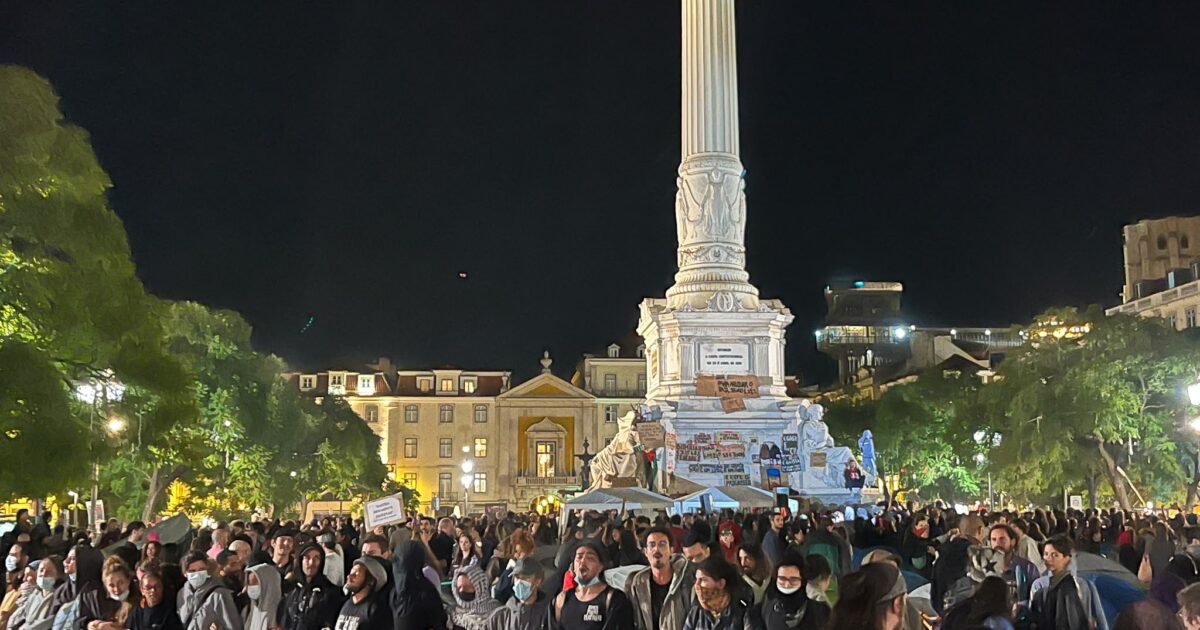
While France, Belgium, Italy and Albania saw rioting, the protest wave reached Portugal, Spain, Greece and Austria through union marches, housing encampments and student tent camps. Established communist parties are openly participating in these protests.

The parties’ own documents show cross-border coordination, including a Greek communist delegation marching in Paris and plans for a Europe-wide youth strike on November 20.

In Portugal, the CGTP, the country’s largest union confederation, called the October 17 demonstrations in Lisbon, Porto and Coimbra. The Portuguese Communist Party (PCP) announced that its general secretary, Paulo Raimundo, would join the Lisbon march with a PCP delegation.

Two days earlier, Raimundo was asked about the housing encampments in Porto. He said the party supports all such actions expressing indignation over housing. Left Bloc coordinator José Manuel Pureza and Livre spokeswoman Isabel Mendes Lopes also spoke at the march.

Popular assemblies run the housing encampments in Lisbon’s Rossio square and Porto. The Lisbon assembly voted unanimously to ask union confederations to call an “Iberian general strike” on November 11.

In Spain, housing protests began alongside the French movement, including an encampment in Madrid’s Puerta del Sol. After Congress rejected two housing decrees, the tenants’ union Sindicato de Inquilinas called marches in about 50 cities on October 3. The government delegation counted 70,000 participants in Madrid, while organizers claimed 500,000.

Izquierda Unida, a coalition that includes the Communist Party of Spain, announced on September 29 that it would participate in the mobilizations on October 3 and 4. It said its members were active in the tenants’ unions, platforms and assemblies organizing against evictions.

Under pressure from the Sindicato de Inquilinas and the anarcho-syndicalist CGT, the CCOO and UGT agreed to a 24-hour general strike over housing and wages. It will be the first since 2012 backed by both confederations.

On October 14, the first day of an indefinite education strike in Madrid, police charged a student picket at Complutense University and detained five students. The Organización Estudiantil Socialista (OES) and the Coordinadora Juvenil Socialista (CJS) demanded that the charges be dropped and called for the government delegate’s resignation.

In Greece, Athens student associations set up tents in Syntagma Square on October 13 to protest housing and study costs. They announced plans for a second encampment on October 20 and a rally with high school students, teachers and parents on October 21. The Communist Party of Greece (KKE) announced that a delegation from its youth wing, KNE, marched in Paris on October 17 behind banners of the two organizations’ branches in France.

Thodoris Kotsandis, secretary of the KNE Central Council, led the delegation. He linked the French protests to a Greek general strike planned for November 25 and the October 21 student and teacher rallies. On October 18, he spoke at a KKE event in France that included a greeting from the Union of the Communist Youth and the Communist Revolutionary Party of France.

In Austria, the national student union ÖH continued protests against university budget cuts that began in May. On October 13, it held a “Ring lecture” on Vienna’s Ringstraße, drawing about 8,000 people, according to the union. ÖH vice chair Selina Wienerroither is a member of the Socialist Students association, VSStÖ.

The next coordinated date is November 20. A coalition of student and youth organizations across Europe has called an International Youth Strike under the slogan “Fight for Our Future, Not Their Wars.” The campaign calls for walkouts, assemblies, blockades and occupations.

The national chair of Britain’s Socialist Students cited the French school blockades and Spanish housing protests as part of the campaign. He also said German students who walked out against conscription will strike again on November 20. Fox News Digital reported that 28 communist and socialist youth organizations in 12 countries are behind the strike.

The strike was announced in August, so its planning predates the French riots and October violence. Communist parties in Portugal, Spain and Greece also documented their participation in the October protests on their websites, while KNE leaders traveled to Paris to march.

The post Communist Parties Cross Borders: Portugal, Spain and Greece Join Calls for a November 20 Youth Strike appeared first on The Gateway Pundit.

Senator’s Stark Warning: France Today, America Tomorrow?

Turning foreign unrest into a domestic policy warning is a powerful move in American politics; the serious question is whether the comparison clarifies causes and consequences or collapses complex dynamics into a campaign slogan.

The Short Version

  • Senator Eric Schmitt explicitly argued that violent unrest in France previews what DSA-aligned Democrats want for the United States, tying his warning to immigration, policing, law enforcement, capitalism, and national identity.
  • Reports documented riots, fires, looting, clashes with police, arrests, and curfews amid broader protests over living costs and strained public services; many demonstrators were peaceful.
  • There are public ties between France’s La France Insoumise and the U.S. Democratic Socialists of America, but no evidence that DSA policies caused French unrest or that U.S.-based actors directed events.
  • Comparative research on riots and protest framing shows recurring roots in policing, inequality, and discrimination, and warns that media emphasis on violence can distort public understanding.

What Schmitt claimed, and why it resonated

Schmitt’s line is simple and vivid: look at France’s turmoil and see America’s future if DSA-aligned Democrats get their way. He named the policy terrain—immigration, policing, law enforcement, capitalism, national identity—and he did so against scenes of arson, looting, and curfews that make any abstract policy debate concrete. The rhetorical structure is classic: present disorder abroad as a forecast for home unless a specific faction is checked. It works because it weaves pressing U.S. anxieties about crime, borders, and social cohesion into a single explanatory banner. When politics is polarized, evocative analogies beat footnotes every time.

But effective rhetoric and established causation are different things. The backbone of Schmitt’s warning is an asserted alignment between DSA policy preferences and the social conditions under which France saw unrest. That alignment is asserted, not demonstrated, in the available reporting. The scenes in France are real; whether they are the result of the policies Schmitt indicts is the core question, and it remains unproven on the current record.

What happened in France—beyond the images of fire

Accounts of the unrest describe two overlapping dynamics. First, there was unmistakable disorder—riots, arson, looting, clashes with police, mass arrests, and localized curfews. Second, there was a broad social mobilization in which many participants were peaceful and focused on purchasing power, wages, and public services under strain. That duality is not unusual: episodes that turn violent often begin with or coexist alongside political and economic grievances, then fracture into distinct streams—legitimate protest, opportunistic criminality, and confrontations with security forces.

Comparative research across France, the UK, and the United States underscores the pattern: uprisings frequently sit at the intersection of policing practices, economic marginalization, discrimination, and spatial segregation, with a triggering incident—often involving the police—lighting a pre-existing fuse. Academic syntheses of the 2023 French riots, for example, identify police interactions and structural inequities as recurrent drivers of escalation. These literatures do not map neatly onto partisan talking points; they do, however, caution against monocausal diagnoses anchored in ideology alone.

DSA, La France Insoumise, and the difference between ties and causation

There is some connective tissue. La France Insoumise (LFI), the principal far-left force in France led by Jean-Luc Mélenchon, has described the DSA as an American counterpart and acknowledged ties. Reports also place Mélenchon at a New York City DSA event in April 2025. Those facts establish channels of ideological adjacency and dialogue; they do not, by themselves, establish that DSA programs produced the social conditions that generated unrest in France or that U.S.-based actors organized anything on French streets. Inference by association—however politically satisfying—remains inference.

If one aims to elevate the comparison from rhetoric to analysis, the next step is exacting: line up named DSA policies or resolutions alongside the specific French statutes and administrative practices most implicated in the unrest, from immigration enforcement and deportation to policing tactics, housing, and labor policy. Then test whether those policies materially led to the behaviors on display. No such crosswalk or causal study was presented in the reports underpinning Schmitt’s claim.

Competing explanations and the evidentiary bar

A counter-analysis argued that the American right’s comparison treats French unrest as a consequence of immigration policy when the mobilization widened from student protests over school conditions to national demonstrations about energy costs and inflation. It also noted that President Emmanuel Macron attributed the worst violence to radical far-left groups and criminals, not migrants. As counterpoints go, that shifts blame within France’s political spectrum and toward criminal opportunism without linking it to DSA-aligned Democrats. It complicates the immigration-centric narrative but does not decisively settle causation either.

On evidentiary strength, we can say this: the presence of severe disorder is uncontested; the existence of LFI–DSA ties is reported; and the breadth of protesters’ economic demands is documented. What is not established is a direct, testable causal path from the DSA’s U.S. policy agenda to the French outcomes. Nor is there evidence of operational direction by U.S. actors. That gap matters if the claim is that “this is exactly what they want” in the sense of intended and likely results of a concrete program.

How protest framing can distort what the public learns

Why does the causal story feel so persuasive anyway? Research on the “protest paradigm” shows that high-intensity coverage emphasizing conflict, property damage, and police-protester clashes reliably pushes audiences toward delegitimizing the protest itself. Coverage that saturates the public with images of fire but treats underlying grievances as footnotes invites viewers to adopt a criminality-first lens. That effect does not mean violence did not occur or that grievances are righteous by default; it means that the selection and weighting of frames strongly conditions how citizens think about order, policy, and blame.

What a credible comparison would require

A serious comparative assessment would do three things. First, specify the policies: cite chapter and verse from DSA national and chapter resolutions, and match them to the French statutes and budgetary choices plausibly linked to unrest—migration admissions and removals, police doctrine, housing allocation, labor regulation. Second, measure: use regional data on migration, unemployment, spending on public services, protest size, arrests, and incidents of violence to test correlations with controls. Third, trace networks: examine whether any U.S.-based organizations provided funding, messaging, or operational support in France. None of that is advanced by assertion; it is advanced by records, datasets, and sworn testimony where appropriate.

Practical takeaways for U.S. readers

Two things can be true at once: elected officials are right to scrutinize how immigration, policing, and social policy interact with public order; and voters are right to demand more than analogy-by-headline. The French case—like the 2005 banlieue riots, England in 2011, and Ferguson—illustrates how combustible the mix of policing, inequality, and youthful marginalization can be, and how quickly events split into peaceful protest, violent confrontation, and criminal exploitation. If the United States wishes to avoid similar cascades, the preventive toolkit is familiar: constitutional, accountable policing; targeted investments in opportunity where unemployment and segregation bite hardest; and political rhetoric that does not turn every social fracture into a campaign cudgel.

Sources:

foxnews.com, thehill.com, political.org, voz.us, en.bd-pratidin.com, lucianne.com, commonermanifesto.substack.com

NFL Star Found Dead At 37

Athletes live in public as avatars of durability, which is why a death in the late thirties lands with such force: it collapses the illusion that physical excellence confers immunity from life’s most ordinary finality.

The Short Version

  • Allen Bailey, the former Kansas City Chiefs and Atlanta Falcons defensive end, died at 37 at his Florida home.
  • Family members confirmed the death; reports align on the date he was found, October 20, 2026.
  • The cause of death had not been officially released; relatives indicated they believed it to be natural causes.
  • Tributes from former coaches, teammates, and his University of Miami circle underscored a decade-long NFL career and broad respect.

What happened: a confirmed death, spare official details

Allen Bailey was found dead at his home in Florida on October 20, 2026. Multiple outlets reported the news the following day, citing his family, with his brother providing confirmation and accounts describing his wife discovering him at home. The reports are consistent on core facts—Bailey’s identity, age, and the location and date he was found—anchoring the account in named family confirmation rather than anonymous rumor. Published coverage noted that no official cause of death had been announced at that time; relatives said they believed natural causes were responsible, but there was no medical determination publicly available in the immediate aftermath.

For the public, the essential points are clear and uncontested: a prominent former NFL defensive lineman died unexpectedly at 37, discovered at his residence, with confirmation from his immediate family relayed to and reported by national outlets. That is the story; the medical explanation would follow through the standard processes of death investigation and disclosure, not the first-day reporting cycle.

Career in full: from Sapelo Island to a decade on NFL lines

Bailey’s life in football traces an arc recognizable to anyone who follows the sport’s player pipelines: a standout in coastal Georgia, he became a core contributor at the University of Miami, where he shifted into full-time defensive line work and earned All-ACC honors before entering the 2011 NFL Draft. Selected 86th overall by the Chiefs, Bailey developed into a durable, scheme-flexible edge and interior presence—an assignment-sound lineman who could anchor against the run and finish plays when the pocket collapsed. He signed a four-year, $25 million extension in 2014 on the strength of that reliability and positional versatility, an organizational bet on motor, leverage, and discipline as much as splash production.

Across eight seasons in Kansas City and two in Atlanta, Bailey appeared in 133 games with 70 starts, compiling 22 career sacks and seven fumble recoveries. The 2018 campaign, his final year with the Chiefs, represented his individual production peak, with career highs in sacks and impact plays behind the line of scrimmage. To coaches, he fit a mold every coordinator prizes but often undervalues publicly: consistent edges who compress run lanes, set firm contain, and eat double-teams so others clean up. When Andy Reid called him “one of my favorite players,” it resonated because that praise maps to how Bailey played—dependable, team-first, and respected in the room.

Why this loss ripples: the culture of line play and the communities around it

Defensive line rooms form unusually tight subcultures inside NFL buildings. The job demands collective execution—gaps, hand fits, stunts—and an appetite for collisions that never make highlight reels. In that world, reputations are built on trust at the point of attack and the willingness to do unrewarded work so a teammate can flash. Bailey’s teammates and coaches described him in precisely those terms; the tributes were uniform in their admiration for his professionalism and character, which is why the shock extended from the NFL to his Miami and Georgia roots so quickly. Public mourning of a lineman rarely centers grandeur; it centers gratitude for a decade of honest snaps. The reaction to Bailey’s death followed that pattern.

There is also a regional story underneath the NFL résumé. Sapelo Island and the surrounding coastal Georgia communities have a long history of sending tough, technically sound defenders into college programs across the Southeast. Bailey carried that legacy to Miami and then the league, returning it through youth camps and community work—quietly, as linemen tend to do their best work. His path mattered to people who saw both the distance traveled and the way he traveled it.

What we know and what we don’t: the boundary between public tribute and private process

Early reporting around a death is always a test of media muscle memory. Here, the facts coalesced quickly around a family-confirmed account that multiple outlets published, naming Bailey’s brother and identifying his wife as the person who discovered him. That convergence, coupled with public acknowledgments from the football community, moved the story from rumor to report and then to accepted fact within a single news cycle. At the same time, outlets correctly avoided speculating about a medical cause; they reported the family’s belief while noting the absence of an official determination, which is the responsible line to walk in the first 24–48 hours.

This is the normal cadence in the United States: family confirmation, law enforcement and medical examiner processes, then, if the family chooses, a public statement after findings. That rhythm can feel unsatisfying to audiences conditioned by instant answers in sports, but in matters of death, it remains the right tempo—protecting both accuracy and dignity.

Remembering the player: what defined Bailey on the field

Coaches describe defensive ends in three buckets: edge-benders who win with arc speed, length-leverage anchors who constrict space, and interior-capable hybrids who can reduce down on passing downs. Bailey made a living in that third category. He was a heavy-handed technician who converted first contact into control—locking out, peeking, and shedding on schedule. He could spike inside on run stunts without losing contain integrity and had a knack for being in the right lane when plays elongated. Those traits do not fuel Pro Bowl campaigns; they fuel playoff defenses. It is why he earned a sustained career through multiple coordinators and why his departure from Kansas City in 2019 elicited universal respect rather than transactional indifference.

For fans trying to place Bailey in the Chiefs’ timeline, remember the 2014 extension as a marker of organizational trust, then his late-career productivity spike in 2018 when Kansas City’s front frequently asked ends to win first contact and create chaos. In Atlanta, his role narrowed, but the professionalism remained constant—snap after snap of sound, sturdy football that coaches lean on when the margins tighten.

The human ledger

Statistics—133 games, 22 sacks—tell you that Allen Bailey had a durable, above-mean NFL career at a position that chews through bodies. His coaches’ and teammates’ words tell you something else: that he was trusted. In the life of a football team, trust is the currency that outlasts speed and strength, the thing opponents can’t put on tape. The tributes from Kansas City and Miami, from linemates and leaders, tracked that currency to its source. They grieved a player taken far too young, and a man who carried himself the way pros try to teach rookies to carry themselves. That, more than the box score, is what endures.

Sources:

foxnews.com, ajc.com, nbcmiami.com, usmagazine.com, eonline.com

When You’re in a Hole, Stop Digging

When You’re in a Hole, Stop Digging

Despite its ambitions, Digger is a deeply stupid movie.

"Digger" Japan Premiere
(Tomohiro Ohsumi/Getty Images)

Digger, dir. Alejandro González Iñárritu. Legendary Pictures, 129 minutes

By the time this review is published, Alejandro González Iñárritu’s film Digger will be a punchline comparable to Michael Cimino’s disastrous western Heaven’s Gate or Sorcerer, William Friedkin’s unpopular remake of The Wages of Fear. Iñárritu’s failure is a classic case of a big studio betting big money on a big film from a big director for only a small reward. The only hope for it now is posterity. These days Heaven’s Gate and Sorcerer are considered neglected masterpieces, in large part because they flopped so hard. Is this to be Digger’s fate? Alas, I fear not. More likely it will join the ranks of Zabriskie Point, Ishtar, and Valerian and the City of a Thousand Planets as movies memorable only for being over-thought and over-budget underperformers.

It is not easy to explain what Digger is about. The film opens on Digger Rockwell (Tom Cruise), an overweight, corrupt oil baron who speaks in an exaggerated Texas accent. He is a humorless caricature of a Bushie Republican: swaggering and jingoistic, an Ugly American. Anyway,  Digger is informed that one of his oil rigs in Greenland has dislodged a piece of the ice cap four times the size of Philadelphia. It is headed toward the North Sea and could put much of Northern Europe underwater. An emergency council is called at Digger’s mansion. In a scene meant to resemble the war room sequence of Doctor Strangelove, President Compson (John Goodman) and his cabinet pepper Digger and his top scientist (Riz Ahmed) with questions about how the United States can wash its hands of responsibility if and when the ice floe rams Europe. At the end of the meeting, Compson takes Digger aside to tell him something personal. “I have cancer of the asshole,” he says.

So far, so stupid. At this point, about half an hour into the film, Iñárritu reveals that his overcooked satire is actually a play within the film. What we have been watching is a dress rehearsal for the critically acclaimed comedy Fossil Fools, which is being revived for its 25th anniversary. The rest of the film cuts back and forth between the events of the play—it is almost pointless to recount them now—and the anxieties of the actors backstage. 

In theory, this is an amusing scenario. And in fact, Iñárritu has successfully pulled off something like it before. But that was all the way back in 2014 when he made Birdbrain—I mean, Birdman—a film where an actor (Michael Keaton), who once played a superhero (a riff on Batman), attempts a late-career revival by writing, directing, and starring in a Broadway production of Raymond Carver’s short story “What We Talk About When We Talk About Love.” Birdman was a High Obamist exercise in pretension. Still, it was amusing and charming, reminiscent of Jean-Luc Godard at his very best.

Digger, on the other hand, is more like Godard in his usual mode, that is, his very worst. “I feel disconnected,” Curtis Markson (also Cruise), the actor playing Digger, tells the director of the play. Through the gradual unfolding of the story—if we may abuse the term—we learn that the events depicted in Fossil Fools are more or less factual. The ice floe rammed Europe and set off a chain reaction of environmental catastrophes that poisoned the air and put much of the world underwater. Compson died of rectal cancer. Digger was exiled to an oil rig in balmy Alaska where he drowned himself in the toxic sea. Markson feels disconnected from all this action because he believes the global tragedy should not be presented as “funny.” Even at the remove of more than 30 years, he is still traumatized by it. Besides, he has an environmental crisis of his own: His daughter, en route to New York to see the opening of his play, has been caught in a “Category 6” hurricane and he fears for her life.     

Iñárritu clearly intends the play within the film to be unfunny, tasteless schlock. And he intends Markson’s ambivalence about its tone as a commentary on limits of satire. So what if you make fun of the crude oilman? The world is underwater. No amount of laughing can change that fact. It’s a facile point, and critics have rightly lambasted Iñárritu for sinking more than $120 million into making it at the tedious length of two hours and eight minutes. And audiences have rightly punished him for refusing to pay $20 to see it on the big screen. 

But there’s something more cynical going on in Digger that has gone largely unnoticed. In the final half hour of the movie, a mysterious character named Kenny (Jesse Plemons) steps out of the shadows and delivers a monologue that completely changes how we are to understand the movie. Kenny, we have learned earlier in the film, is the play’s producer. He owns a technology company—something akin to Palantir—and has promised to find Curtis’s daughter. Now, just as the curtain is about to go up on opening night, he reveals that he is also Digger’s nephew, and he states that he is bankrolling the production as a way of helping the world process its collective trauma. He insists to Curtis that he must play his role as comedy. “It’s funny and it’s stupid and it’s scary and it makes no goddam sense,” he says. “But it happened.” 

Plemons delivers the speech with an eerie earnestness, almost like a threat. Curtis acquiesces. He has to: This is the guy who is going to find his daughter, after all. And when the curtain goes down—when the audience roars with laughter at the drowned oil baron—Kenny calls Curtis. His daughter is safe. The theater doors open up, and everyone departs happily into the devastated, flooded world outside.

This is the real satire of Digger. The movie isn’t about oilmen and it’s not about artists fretting over their impotence. It’s about greenwashing. This is an ugly neologism, but it’s wonderfully descriptive. Some oil company, some defense technology firm, some intelligence service cleans itself of its sins by funding an opera or a symphony orchestra or a Broadway theater production. This is essentially what Kenny has done. The uncle caused the crisis, and the nephew profits off it. But his conscience can remain clear because he also puts his money behind high-minded pursuits. Kenny is Iñárritu’s real target, but by the time the director aims at him, most people in the audience will have nodded off.   

Too bad. Even Godard at his very worst is better than no Godard at all. If history is any guide, we won’t be seeing Iñárritu working with a budget this big ever again. Nor will we have the pleasure of watching Tom Cruise don a fatsuit and fling obscenities at the president of the United States.

The post When You’re in a Hole, Stop Digging appeared first on The American Conservative.

OOPS! Troy Jackson is a NO-SHOW at ‘Women for Troy’ Campaign Event (VIDEO)

Screencap of YouTube video.

A group of women in Maine who support far left Democrat Troy Jackson for Senate decided to hold a ‘Women for Troy’ event to counter the growing perception that he has issues with women.

One little problem though, Troy Jackson didn’t show up. Oops.

The media was a little confused.

Transcript from the video below:

REPORTER: “Where is Troy today?”

ANSWER: “On the campaign trail.”

REPORTER: “Any clarification?”

ANSWER: “Nope.”

Watch:

RedState reported:

Apparently, to try to counter “negative ads” and the backlash that has been stirred up in recent weeks, a “Women for Troy” group – which includes former and current female state lawmakers – sprung into action. And on Wednesday, they held a press conference, complete with pre-printed signs in hand, to endorse Jackson while hoping to reassure female voters that he was on their side:

“If we want to secure rights and health and safety for women in Maine, we need to make sure we are electing people who are representing our needs in Augusta and D.C., and endorsements are an important way that we can help do that,” [Maine Women’s Lobby Executive Director Destie] Hohman Sprague said.

She added that she thinks Jackson, if elected, will advocate for abortion rights and both paid and unpaid women’s labor.

“Troy understands that women’s labor is also labor. And he has been fighting for it for years,” Hohman Sprague said.

The Ten Minute Drill podcast did a report on this as well:

You couldn’t make this up.

Maine Democrats need a better vetting process for political candidates.

The post OOPS! Troy Jackson is a NO-SHOW at ‘Women for Troy’ Campaign Event (VIDEO) appeared first on The Gateway Pundit.