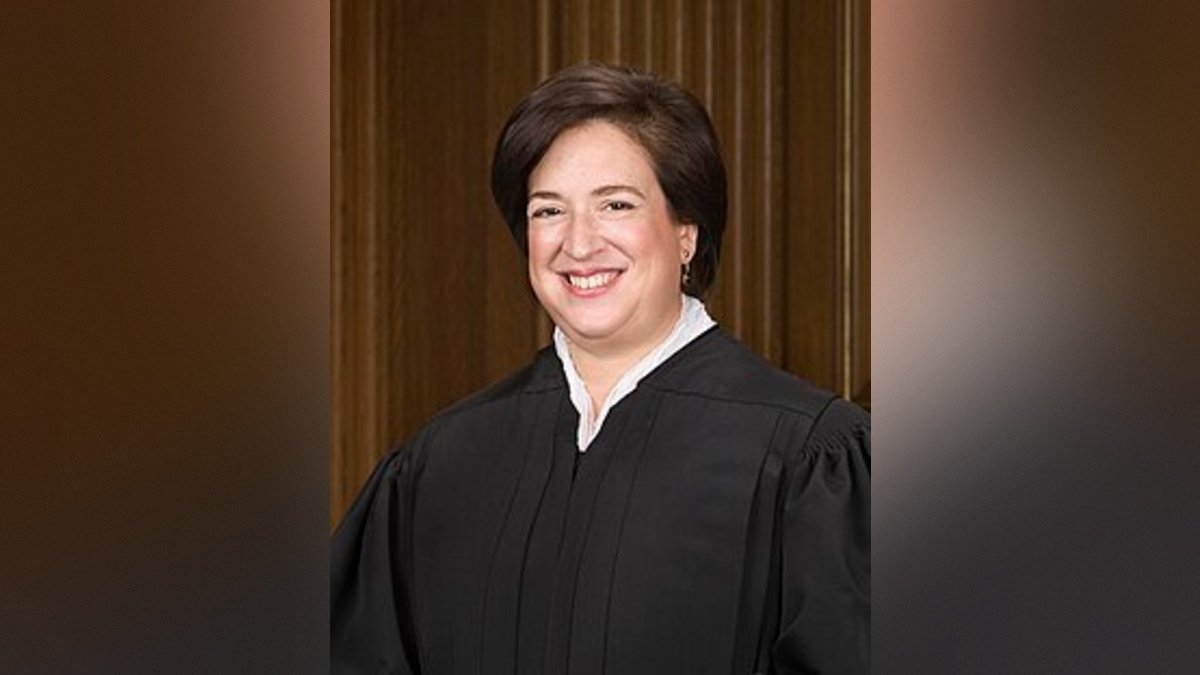
Liberal Justice Elena Kagan Attacks Supreme Court’s Conservative Majority, Claims Their Rulings Are ‘Destructive to Democracy’ as Midterm Elections Loom

Justice Elena Kagan

Supreme Court Justice Elena Kagan, one of the Court’s three liberals, took a swipe at her conservative colleagues on Tuesday, accusing the 6-3 majority of undermining American democracy and fueling political polarization by declining to police partisan gerrymandering.

Speaking Tuesday at the Catholic University of America’s law school in Washington, D.C., Kagan blasted conservative-backed rulings on congressional redistricting, voting rights, and campaign finance laws, arguing that the decisions have allowed political parties to manipulate election maps for partisan advantage.

According to Reuters, Kagan claimed the conservative majority had enabled what she described as a race to the bottom in congressional redistricting.

The Obama-appointed justice argued that the Court’s refusal to intervene in partisan gerrymandering disputes has contributed to an increasingly divided political landscape.

Kagan declared:

“Over the last couple of years especially, both political parties have been engaged in a race to the bottom in terms of doing these partisan gerrymanders, … making what I think is unfortunately a too polarized country even more so.”

Kagan went further, accusing the Court of disregarding the consequences of its own decisions.

According to the Associated Press, Kagan said the Court had blinded itself to the harmful effects its rulings have had on the American political system.

The remarks come as Republicans and Democrats engage in an increasingly bitter battle over congressional boundaries ahead of the November elections.

But there is a major constitutional issue at the center of Kagan’s complaint: Who should control America’s election maps, elected lawmakers or unelected federal judges?

Kagan’s criticism takes direct aim at the Supreme Court’s landmark 2019 decision in Rucho v. Common Cause.

In that 5-4 ruling, the Court’s conservative majority determined that claims of excessive partisan gerrymandering present political questions that federal courts lack the constitutional authority and judicially manageable standards to resolve.

Chief Justice John Roberts authored the majority opinion, joined by Justices Clarence Thomas, Samuel Alito, Neil Gorsuch, and Brett Kavanaugh.

The decision did not declare all gerrymandering legal or eliminate state-level restrictions on redistricting.

Instead, the majority concluded that the Constitution places primary responsibility for congressional election regulations with state legislatures and Congress, while leaving room for state courts to enforce state-law restrictions.

Kagan strongly disagreed, joining the Court’s liberal wing in dissent.

The ruling drew a crucial distinction between partisan gerrymandering and unconstitutional racial discrimination in redistricting, which can still raise federal constitutional questions.

Read the Supreme Court’s 2019 opinion here.

Kagan’s complaints were not limited to gerrymandering.

The liberal justice also criticized the Supreme Court’s recent decisions narrowing aspects of the Voting Rights Act and loosening restrictions on political campaign spending.

She argued that these rulings have weakened protections against political manipulation and made Americans increasingly cynical about the electoral process.

The Supreme Court’s conservative majority has taken a different position, emphasizing constitutional limits on race-based districting and First Amendment protections involving political spending.

Kagan also acknowledged that the conservative majority has ruled against President Donald Trump’s administration on major legal issues, including tariffs, birthright citizenship, and mail voting.

That acknowledgment complicates the familiar narrative that the conservative justices automatically side with the president.

The post Liberal Justice Elena Kagan Attacks Supreme Court’s Conservative Majority, Claims Their Rulings Are ‘Destructive to Democracy’ as Midterm Elections Loom appeared first on The Gateway Pundit.

A University in Florida is Trying to Block Colonel Allen West From Speaking on Campus

Screencap of YouTube video.

A conservative student group called Young America’s Foundation, or YAF, at Embry-Riddle Aeronautical University (ERAU) in Florida is trying to bring Colonel Allen West to campus for a speaking engagement, but the administration is playing games with paperwork.

This only happens to conservative student groups and conservative speakers in higher education. Left-wing student groups bring in radicals to speak to them all the time and there is almost never a problem.

It goes beyond bias. It’s an infringement on free speech.

Townhall reported:

Former Congressman and Retired Army Lt. Col. Allen West Was Barred From Speaking on College Campus

Left-wing extremism and censorship are major problems on college campuses, with everyone from students to professors to administrators holding to one ideology and doing everything in their power to make conservatives — and conservative ideals — unwelcome on campus. At Florida’s Embry-Riddle Aeronautical University (ERAU) in Daytona Beach, Florida, this extremism led to school officials blocking former Florida Congressman and retired Army Lt. Col. Allen West from speaking on campus.

Students with Young America’s Foundation (YAF) sought to host Lt. Col. West for an event promoting conservative values, and despite trying to follow the university’s procedures, members of YAF say administrators restricted the event without providing a clear explanation.

In emails shared with Townhall, Negar Afshar, the Director of Student Organizations and Engagement, communicated with Matthew Finkel, the Chairman of the Embry-Riddle chapter of YAF. The first message, from Afshar dated Tuesday, October 6, was a “friendly reminder” that YAF had agreed to meet with Afshar regularly, “as well as discussing any event or speaker ideas in advance so we can approve and renew them together.” Afshar then informed Finkle that he received a Speaker Request form.

“We need to discuss that before anything can move forward,” Afshar wrote. “Please select a time on my calendar as soon as possible so we can reconnect and review your plans.”

Allen West commented on Twitter/X:

I am one of the conservative speakers for @yaf that travels to college and university campuses in support of the student chapters.

I am scheduled to speak at Embry-Riddle Aeronautical University, Daytona Beach, on Tuesday, October 27, 2026. I was just informed that the administration has denied the students’ request to host me for the speaking engagement.

I ran into this same issue with the ERAU campus in Prescott, Arizona.

Funny, Marxist influencer Hasan Piker just spoke at the University of Texas . . . the fella who said America deserved 911. Yet a retired Army officer and former member of Congress, from Florida, is denied the opportunity to address conservative students?

These students need to call the office of Governor Ron DeSantis.

He has an excellent record of fixing problems like this one.

The post A University in Florida is Trying to Block Colonel Allen West From Speaking on Campus appeared first on The Gateway Pundit.

Massive Chemical Leak Triggers Emergency Evacuations in Toledo, Ohio — Thick Haze Engulfs Roadways as Residents Ordered to Flee One-Mile Danger Zone

Screenshot

A frightening hazardous materials emergency unfolded in northern Toledo late Tuesday night after a chemical leak at an industrial facility triggered a massive emergency response, forcing residents to evacuate their homes as a thick haze blanketed surrounding roadways.

The incident occurred near Enterprise Boulevard and Progress Avenue at the Sterling Pipe & Tube facility, where emergency responders rushed to contain an unidentified hazardous material release.

According to an official statement from the City of Toledo, Toledo Fire & Rescue ordered the evacuation of everyone within a one-mile radius of 1050 Progress Avenue at approximately 10:48 p.m. on Tuesday, October 20.

The emergency initially prompted a smaller, half-mile evacuation zone before officials expanded the perimeter to one mile as the situation developed.

Residents in the affected neighborhoods were instructed to leave immediately as hazardous materials teams descended on the area.

According to WTOL 11, Sterling Pipe & Tube was evacuated as authorities worked to identify the chemical and assess the danger to surrounding communities.

The industrial emergency also disrupted nearby businesses and transportation routes. Roads were closed, nearby rail traffic was suspended, and workers at the Toledo Assembly complex reportedly evacuated late Tuesday night.

Videos circulating online appeared to show severely reduced visibility on roadways, raising concerns about the extent of the chemical release.

However, city officials warned that dense natural fog was also covering Toledo overnight, making it difficult to distinguish ordinary fog from any chemical plume.

The city specifically cautioned residents against relying on visible haze alone to assess their exposure risk.

As of the city’s last update early Wednesday, the chemical remained identified only as an irritant capable of causing burning of the eyes, nose, mouth, and skin. Symptoms of overexposure can include headache, dizziness, tiredness, nausea, and vomiting. Serious symptoms require emergency care.

City guidance directed those outside the one-mile zone who notice an unusual odor to stay indoors and limit outside air intake, while emphasizing that dense fog made it impossible to distinguish the release visually from normal conditions. Officials have not released the specific chemical name.

This is not Toledo’s first recent industrial emergency. In August 2026, a fire and explosions at Brent Industries killed two workers and later prompted independent testing that found elevated levels of dioxin and other compounds in nearby soil and ash.

Residents and local officials have repeatedly pressed for clearer information on chemicals stored and used at city facilities so first responders can better protect the public.

The Gateway Pundit has extensively covered the pattern of downplayed chemical disasters in Ohio. In 2023, the Norfolk Southern derailment and controlled burn in East Palestine produced a toxic mushroom cloud that killed wildlife, sickened residents, and raised questions about government and railroad response.

The Gateway Pundit reported on independent testing that later found carcinogens the EPA had not detected, resident reports of dead animals, and delayed federal attention.

Similar concerns about transparency and long-term health effects have followed other industrial incidents, including the 2022 BP-Husky refinery fire in the Toledo area that killed two workers.

The post Massive Chemical Leak Triggers Emergency Evacuations in Toledo, Ohio — Thick Haze Engulfs Roadways as Residents Ordered to Flee One-Mile Danger Zone appeared first on The Gateway Pundit.

One Police Login. Nearly 1,000 Surveillance Searches

When a police login becomes a floating credential rather than a personal key, the entire audit trail collapses; in modern surveillance networks, that failure is not a paperwork glitch but a systemic risk to accountability, public trust, and due process.

The Short Version

  • The core issue is credential control: a Savannah officer acknowledged giving her Flock Safety login to her ICE-agent spouse, defeating user-level attribution.
  • Investigators tied hundreds of searches to the officer’s account over months; the department deemed the sharing intentional and terminated her.
  • The couple said all queries were for federal law-enforcement purposes, not personal use—an explanation that does not cure unauthorized access.
  • This case sits inside a larger ALPR governance problem: expanding interagency networks with uneven access controls, auditing, and sharing rules.

What happened here is about identity, not ideology

The strongest, least-contested facts are straightforward. Records cited by multiple outlets report that a Savannah Police Department (SPD) officer, Amber Harpe, admitted she provided her Flock Safety username and password to her husband, Tyler Harpe, an ICE agent who did not have his own Flock account at the time. SPD’s internal inquiry concluded the credential sharing occurred, and that searches performed by Tyler appeared under Amber’s identity within the system; the department terminated her employment after senior leadership endorsed dismissal. The activity was described as repeated and extensive—on the order of many hundreds of queries across months—undercutting any theory of an incidental, momentary lapse.

Set aside the polarizing politics of immigration. In a digital evidence system, the named user is the locus of accountability. When credentials move off the assigned user’s person and into someone else’s hands, every subsequent query becomes unauditable to the real operator, and every downstream use—an investigative lead, a stop, a warrant affidavit—carries contaminated provenance. That is why access-control policies in criminal-justice systems are not etiquette; they are integrity constraints.

How ALPR systems work—and why account provenance matters

Automated license-plate-reader (ALPR) platforms like Flock Safety combine fixed cameras, plate-recognition algorithms, hot lists, and search interfaces into a networked repository. Properly governed, each query is attributable to a specific human, tied to a permissible purpose, and captured in an auditable log—who searched what, when, and why. In mature deployments, agencies require unique credentials, forbid sharing, and increasingly bind each query to a case number or incident report to preserve chain-of-accountability and enable after-action review.

In that architecture, user identity is the first safeguard. It underlies internal compliance checks, external discovery in court, and public oversight. Break the user-to-action link and you break the audit. That is precisely what SPD says happened: Tyler Harpe lacked an authorized account and operated under Amber’s, causing the system to attribute his queries to her. Even if every search pursued a legitimate investigative target, the method still hollowed out the accountability design the platform depends on.

The husband-and-wife defense and why it falls short

The counter-case from the Harpes is not a blanket denial; it is a justification. They told investigators the searches focused on ICE targets with active warrants and were conducted exclusively for law-enforcement purposes, not personal gain. Those statements, repeated in press accounts, align with investigators’ summary that they found no state-law violation or financial motive; the problem was unauthorized access through shared credentials.

That explanation matters for proportionality—it separates “misuse of data content” from “misuse of access.” It does not, however, resolve the central policy failure. SPD publicly emphasized that another agency’s investigative purpose does not itself authorize access to SPD’s systems; authorization flows through accounts, agreements, and documented controls, not informal intent. In other words, good purpose does not sanitize bad process. The record also reflects internal disagreement over discipline—one commander recommended a short suspension, while senior leaders backed termination—indicating that while the violation was established, the penalty’s severity was contested inside the department.

What the numbers prove—and what they do not

Several reports cite approximately 983 searches conducted through Amber Harpe’s account across several months, many tied to South Carolina plates. Precision matters here. That volume, if accurate, demonstrates repetition and scale and supports the inference of intentional credential sharing rather than a one-off lapse. It does not, standing alone, prove improper substantive use of the information; the couple’s consistent statements suggest law-enforcement aim rather than personal curiosity. This distinction is legally and ethically salient. Institutions routinely impose the harshest sanctions for identity and access violations even where content misuse is not shown, because the entire compliance regime depends on trust in user attribution.

It is also relevant that state authorities did not bring criminal charges in her case while four other SPD employees in related ALPR matters reportedly faced criminal counts. That disparity may reflect differences in available evidence, statutory fit, or conduct, but the public record to date does not supply a line-by-line rationale. The absence of charges is not exoneration of a policy breach; it is a signal about criminal thresholds versus administrative standards.

The larger frame: local credentials riding a regional network

This incident is legible only against the backdrop of ALPR networks that sprawl across jurisdictions. Many agencies now participate in multi-Agency sharing through vendor-managed infrastructures, where data generated by one city can be queried by many others if permissions allow. That growth has raised frictions over who may search, on what legal basis, and with what audit guarantees. Investigations and audits elsewhere have documented improper federal access to local ALPR repositories and expansive interagency sharing, underscoring that governance, not only user behavior, determines risk.

Vendors often insist that cities control sharing settings and that every query is logged, but those assurances assume that the identity bound to each query reliably maps to an authorized human. Once credentials roam, logging loses its evidentiary value. Security researchers have also criticized weak authentication practices and inconsistent operational hygiene around ALPR portals, arguing that even well-intentioned officers can become vectors for systemic risk when controls lag behind the sensitivity of the data. The Savannah case is best read as a concrete illustration of that structural truth, not an outlier that can be solved with one termination.

What competent governance looks like

Mature ALPR governance couples clear policy with enforceable technical controls. At minimum, agencies should mandate unique, non-transferable credentials; multifactor authentication; periodic password rotation; device and network restrictions; and immediate deprovisioning when roles change. On the process side, require case-number binding for queries, supervisor attestation for interagency assist searches, and formal data-sharing agreements that spell out roles, permissible uses, and audit rights. The audit practice itself should be routine and adversarial enough to matter: compare query logs against incident reports; sample for purpose codes; escalate anomalies to internal affairs; and preserve logs for discovery and external review.

For interagency cooperation—the frequent defense in this matter—the remedy is not informal credential lending but properly provisioned accounts for partner officers, governed by memoranda of understanding and vendor-enforced permissions. If a federal agent needs access, the pathway is documented authorization with their own audit trail, not a borrowed identity at a kitchen table. Anything less invites the exact accountability vacuum at issue here.

What this means going forward

On the facts reported, the decision to terminate centered on a basic, provable failure of identity control, amplified by scale. The competing narrative—that the searches were for legitimate law-enforcement ends—mitigates motive but not the violation. The penalty debate will persist, and reasonable commanders can differ on what sanction teaches the right lesson; the lesson itself should be non-negotiable. Surveillance networks that aspire to legitimacy cannot tolerate collapses in user attribution.

The broader takeaway is for every agency and vendor operating ALPRs or analogous tools: access control is not a compliance box, it is the substrate of trust. Build systems and agreements that make the right thing easy, the wrong thing technically hard, and the audit indelible. Otherwise, the next controversy will not be about whether a termination was too harsh—it will be about whether courts can trust any of the evidence at all.

Sources:

wtoc.com, ibtimes.co.uk, news.ssbcrack.com, standingrecord.com, libero.pe, theverge.com, npr.org, kqed.org

FBI Finds Nothing – Prosecutors Press On

Threat cases built on early, fragmentary signals sit on a knife edge: move too slowly and you risk a mass-casualty attack on a house of worship; move too aggressively on thin hearsay and you risk criminalizing disturbing talk without operational substance.

At a Glance

  • Prosecutors in Maricopa County have outlined a specific alleged attack sequence: bombings at a Jewish or Muslim house of worship followed by shooting survivors; a judge found probable cause, but on reduced bond and with monitoring.
  • Investigators reportedly seized three firearms and ammunition from the suspect’s home, though the FBI earlier found no bomb-making materials and brought no federal charges.
  • The public file lacks a named target, corroborated accomplice, or disclosed primary-source plan; reporting reflects prosecutors’ in-court descriptions and defense rebuttals.
  • Research on pre-attack “leakage” and religious-site targeting explains why authorities respond to scant signals—but also why evidentiary gaps matter when intent and capability are unproven.

What Has Been Alleged, and What Has Been Seized

According to contemporaneous court reporting, Maricopa County prosecutors described a two-stage plan: detonate explosives at a Jewish or Muslim house of worship in the Phoenix metro area and have an accomplice “picking off people” who tried to flee with firearms. That sequence matters; it asserts intent, method, and victim category in concrete terms rather than vague menace. A judge found probable cause, declined the state’s request for a higher cash bond, and ordered release on a $100,000 bond with electronic monitoring—an acknowledgement of both risk and the case’s preliminary posture.

Physical recovery at the suspect’s residence is narrower than the narrative implies. Investigators reportedly seized three firearms and ammunition, which aligns with the alleged follow-on shooting phase. But federal agents who searched earlier found no explosives components and filed no terrorism charges; the FBI review of devices likewise did not yield inculpatory material, according to multiple reports summarized from court statements. Those two facts—a state account of an explosives-first plan and the federal absence of explosive precursors—are in tension and define the evidentiary gap the case must close.

Hearsay, Defense Pushback, and the Limits of an Early Record

The defense case, as reported from open court, is straightforward: the core allegations stem from an embittered former acquaintance and amount to unverified hearsay; the firearms were legally possessed following rights restoration; the ammunition was of ordinary quantity; and the FBI’s search of the home and electronics turned up no terrorism evidence, leading to no federal charges. The judge reportedly flagged the prosecution’s early reliance on hearsay as well. At a probable-cause stage, hearsay is admissible and not unusual—but it is also the point at which specificity, corroboration, and a clean chain from utterance to act begin to differentiate alarming talk from executable conspiracy.

Critical materials are not yet public: no charging affidavit, warrant returns, or device-extraction reports appear in the open record described by the coverage. No named house of worship, reconnaissance activity, timeframe, or communications with an alleged accomplice have surfaced in primary-source form. The prosecution will need one or more of those anchors—documented target selection, operational steps, or authenticated planning artifacts—to convert a vivid story line into trial-grade proof. Without them, the firearms seizure supports the existence of guns, not the existence of an explosives plot or coordinated attack team.

Why Authorities Respond to Sparse Signals in the First Place

There is a reason prosecutors spend capital advancing thin early cases that center on religious targets: the base rates and patterns are unforgiving. Studies of lone-actor and ideologically motivated attackers show that pre-incident activity leaves only a few detectable traces on average; one analysis across U.S. and international incidents found roughly 2.3 pre-attack activities were registered by authorities before attacks materialized. That scarcity makes each signal—boastful talk, target scoping, materials acquisition—carry disproportionate weight.

Within threat assessment, “leakage” is a core warning behavior: communicating an intent to do harm to a third party before an attack. Multiple empirical and practitioner studies identify leakage as frequent among lone actors and a practical entry point for intervention. Religious institutions, especially Jewish, Black, and Muslim houses of worship, remain common targets in racially or ethnically motivated violent extremist plots; firearms are the most typical method, with some actors experimenting with explosives or arson. Against that backdrop, a claim that someone valorized a bomb-making manual and articulated a bomb-then-shoot sequence at a synagogue or mosque will—and should—trigger an aggressive investigative posture.

Separating Disturbing Expression from Operational Mobilization

The hard problem in cases like this is distinguishing a person who reads a notorious manual, repeats violent fantasies, and owns guns from a person who has crossed into operational preparation: named target selection, reconnaissance, acquisition of specific components with functional intent, dry runs, or co-conspirator coordination. Structured professional judgment tools in counterterrorism emphasize that risk escalates when stated intent coexists with capability and observable steps toward an attack; absent that triangulation, prediction is noisy and false positives multiply.

Applied here, the state’s narrative claims intent (the attack sequence, a religious-category target), and the firearms seizure speaks to partial capability (the shooting phase). What remains unshown in the public record is the connective tissue: explosives precursors, wiring or initiators, target naming or casing, digital blueprints, or corroborated co-conspirator exchanges. The defense seizes on that gap, pointing to the FBI’s negative search and the lack of federal charges as undermining the explosives component. A prosecution that can surface authenticated communications, lab reports linking the suspect to procurement or testing, or independent corroboration of an accomplice will move the case from alarming to actionable proof. Without such material, jurors will be asked to infer too much from too little.

How to Read Cases Like This as a Citizen

Do two things at once. First, take threats to houses of worship seriously; they fit known targeting patterns, and early “leakage” is often the only window to prevent tragedy. Second, demand the primary evidence that turns narrative into fact: the probable-cause affidavit, warrant returns and inventories, device-extraction logs, and any transcript that distinguishes firsthand testimony from hearsay. Those documents, if and when released, will show whether investigators found a named target, a plan with dates or materials lists, or communications with a real accomplice. If they do, aggressive intervention looks prescient. If they do not, skepticism about stretched inferences will be warranted.

Sources:

thegatewaypundit.com, fox10phoenix.com, newsbreak.com, azfamily.com

NY Times Journo on MSNOW Sounds Alarm for Democrats – Says Lifelong Democrats in Michigan Are Crossing Over and Voting Republican (VIDEO)

Screencap of Twitter/X video.

New York Times journalist Jeremy Peters recently appeared on MSNOW and told hosts Joe and Mika that large numbers of lifelong Democrats in Michigan, particularly Jewish Democrats, are crossing party lines to vote Republican for the first time.

Peters describes this as a ‘big deal’ and goes on to say that he can’t think of a race where the opposite is happening. He is right about that. There is no race in this election cycle that is causing Republicans to vote for a Democrat candidate.

In Michigan, this is happening because a huge number of voters in the state simply do not trust Abdul El-Sayed.

Hannity.com has more details:

Even a New York Times reporter sees it. Mike Rogers is winning over lifelong Democrats.

Times national reporter Jeremy Peters dropped the bombshell Monday morning on MS NOW’s “Morning Joe.” He pointed to “lifelong Jewish Democrats, especially in the Detroit suburbs, who are saying for the first time in their lives they’re voting Republican.”

“That’s a big deal,” Peters said. “I don’t know of any other marquee race in the country right now where the Republican candidate is converting Democrats.”

Rogers, the Republican, faces far-left Democrat Abdul El-Sayed for Michigan’s open Senate seat. Voters decide Nov. 3.

Peters knows the turf. “I grew up not far from where El-Sayed is from,” he told the hosts.

He called it “really quite striking” that some Democrats are “so concerned about their party’s nominee” that they’re “willing to vote for the candidate who’s aligned with Donald Trump.”

Watch the video below:

During the Democrat primary in Michigan, we were told that Abdul El-Sayed would win by double digits and he barely squeaked out a win by a percentage of a point.

If the same trend holds during the general election, his candidacy could be toast.

The post NY Times Journo on MSNOW Sounds Alarm for Democrats – Says Lifelong Democrats in Michigan Are Crossing Over and Voting Republican (VIDEO) appeared first on The Gateway Pundit.

Burnham Inadvertently Reinvigorates Scottish Separatism

Burnham Inadvertently Reinvigorates Scottish Separatism

The prime minister’s rhetoric about reversing Brexit raises uncomfortable questions about Scottish independence.

Andy Burnham Speech At 2026 Labour Party Conference
UK Special Coverage
(Andrew Aitchison / In pictures via Getty Images)

Is the United Kingdom on its way out? Has the break-up of Britain finally arrived? Certainly, the political map of the United Kingdom has changed in the past six months, with nationalists now dominating all three devolved parliaments.

Michelle O’Neill, the deputy leader of Sinn Féin (which used to be the political wing of the Irish Republican Army), is currently first minister of Northern Ireland. The Welsh nationalist leader, Rhun ap Iorwerth of Plaid Cymru, is now in command in Cardiff, following his party’s sweep of the Senedd in May 2026. That same month, John Swinney became first minister of Scotland, after his Scottish National Party (SNP) won its fifth consecutive Scottish parliamentary election. It looks as if it is all kicking off in the Celtic fringe.

Swinney told his recent conference that there is “panic in the streets of London” at the prospect of these three nationalist leaders working together to demolish the 300-year-old Union. Last month, the trio got together in Cardiff to sign a memorandum of understanding demanding “democratic self-determination.”

“For people watching across these islands”, it said, “[and] for people watching around the world, there could be no clearer sign that Westminster’s time is coming to an end.”

Moscow is certainly watching. The Russian Foreign Minister Sergey Lavrov said that the departure of “the Celts” from the UK could raise questions about Britain’s continued membership of the United Nations Security Council. The British state “has diminished to the utmost degree,” he claimed.

Mind you, there is no direct constitutional significance in these devolved legislatures being controlled by nationalists. Sinn Féin shares power in Northern Ireland with a unionist party. Plaid Cymru is not demanding an immediate referendum on secession. And in Scotland, support for an early repeat referendum seems to be waning.

According to a YouGov poll published on the eve of the recent SNP conference in Aberdeen, fewer than 20 per cent of Scots regard an independence referendum as a political priority. This is despite the UK Prime Minister Andy Burnham apparently doing his best to make it one.

The new PM said this month that he is determined to bring Britain closer to Europe, possibly by holding another referendum on Brexit. Bring it on! cried the SNP, which is dedicated to rejoining the European Union, and bring on “Indyref2” while you’re at it.

“Mr. Burnham needs to explain to the people of Scotland,” said the party’s Economy Secretary, Stephen Flynn, “why it is legitimate to reopen the democratic question of Brexit but not legitimate to reopen the democratic question of Scottish independence.” He has a point. 

The PM’s musings on Europe have revived all the grievances about how Scotland was dragged out of the EU by “English votes” in the 2016 Brexit referendum.  Sixty-two percent of Scots voted to remain in the European Union, but the referendum was UK-wide, and Scotland’s result was eclipsed by the overall vote to leave (which was 52 percent to 48 percent).

The SNP also claims that the 2014 Scottish independence referendum was fought on a “false prospectus.” One of the key arguments of the unionist Better Together campaign, led by the former Labour Chancellor Alistair Darling and backed by then-PM David Cameron, was that Scotland could not stay in the EU if Scots voted to leave the UK. It would have to apply to Brussels to rejoin as a third country. 

In the event, remaining in the UK led to Scotland being dragged out of the EU: precisely what many unionists thought they were voting to avoid. Now here is Andy Burnham claiming, in effect, that this whole Brexit thing was a mistake and needs to be reversed. But if that is the case, say the Scottish nationalists, then surely they should get a do-over on the independence vote as well?

The PM also raised unionist eyebrows last month at Prime Minister’s Questions, when he equated Scotland’s constitutional position in the UK with that of Northern Ireland under the Good Friday Agreement. “The situation is exactly the same,” he said.

The SNP could hardly believe their ears. The 1998 agreement that brought an end to the Irish Troubles provides for a referendum on Irish reunification—a “border poll”—if there is a clear demand from the people of the province. Why not a border poll for Scotland, then?

One the even of this month’s SNP conference in Aberdeen, Burnham seemed to concede that there could be a repeat Scottish referendum if enough Scots wanted one. But he later “clarified” this by saying that another Scottish referendum was “off limits.”  John Swinney lost no time exploiting the contradiction.

He told his party conference this month that the campaign for the next independence referendum “has already begun” and that it would be held no later than 2031. This was just rhetoric, however, and Swinney knows it. The UK Supreme Court ruled four years ago that the Scottish Parliament lacks the power to hold its own referendum on independence, even an advisory one. 

Only the UK Parliament in Westminster can authorize another ballot for Scotland. And none of the main party leaders in the Commons is prepared to propose such a measure.

Yet no one seriously doubts that, if there were a mass movement of Scots demanding Indyref2, it would be politically very difficult to refuse one. At present, there is no such movement in Scotland, though around half of Scots say they favor independence as a long-term destination.  Andy Burnham must be careful what he says if he wishes to avoid jump-starting this latent Scottish separatism—and making good Swinney’s recent boast that Burnham will be “the last prime minister of the United Kingdom.”

The post Burnham Inadvertently Reinvigorates Scottish Separatism appeared first on The American Conservative.

Russiagate II: Loser Edition

Russiagate II: Loser Edition

Liberals are trotting out the 2016 playbook once again.

Donald,Trump,And,Vladimir,Putin.,Portrait,Drawing,Illustration.,July,11,

Remember Russiagate? Remember former British spook Christopher Steele’s dodgy dossier? Remember Crossfire Hurricane? Remember when it went nowhere and destroyed all trust in the FBI? We now have a decent idea what Russiagate was all about: It was intended to create a strong base of support among Democrats for a proxy war with Russia. The trick was to link this project with the political passions stirred up by Donald Trump. It worked like a charm. There is now an army of liberals who are almost as obsessed with Russian President Vladimir Putin as they are with President Trump.

Russiagate was a classic psychological warfare operation. It used the old propaganda technique of “association” to build up the idea that Putin and Russia were entwined in some foundational way with the right-wing populism then finding such purchase among the American electorate. The people behind Russiagate were frustrated with the realist foreign policy being pursued in Europe by the likes of President Barack Obama and former German Chancellor Angela Merkel. “Obviously,” Obama said in March 2014 after the Russian annexation of Crimea, “we do not need to trigger an actual war with Russia. The Ukrainians don’t want that. Nobody would want that.”

But Obama was wrong: Some people very much wanted that, including his own former Secretary of State Hilary Clinton. And to get their confrontation, they first needed to build a core base of support. 

The Clinton campaign could have chosen any number of issues on which to attack Trump in 2016. With the benefit of hindsight—and, as Trump recently blurted out, “over a million [Ukrainians] killed”—it is now clear why they chose the Steele dossier. Russiagate may have been a flop legally; its basic disconnection from reality made it a nonstarter in the courts. But as a propaganda piece it was an enormous success. When the Obama administration trod lightly on the Crimea question, few Democrats questioned it. Indeed, many saw it as proof of his return to rational, level-headed foreign policy after the excesses of George W. Bush. After Russiagate, no Democratic president could get away with such realism without triggering a wave of condemnation from Putin-obsessed liberals.

Well, it is starting to look like there is an effort underway to summon the ghost of Russiagate before the midterms in November. It started in the same city out of which the Steele dossier emerged: London. Britain’s new Prime Minister Andy Burnham went on a popular politics podcast and stated that Russia had intervened in the Brexit referendum. This ran contrary to what investigations showed shortly after the election and was seen as so destabilizing that the head of MI5—Britain’s domestic counter-intelligence agency—felt the need to make a statement downplaying (though not denying) Burnham’s comments. Why was Burnham beating this dead horse? The clue came in the days that followed.

Around the same time as Burnham’s interview went live, reports started to circulate that Ukraine had managed to strike a Yandex facility in Moscow. Yandex is Russia’s primary internet technology company, roughly equivalent to their version of Google. Shortly after the strike, a Czech member of the European Parliament posted a dubious looking chart showing that after the strike on Yandex, online activity around Alternative für Deutschland (AfD) accounts plummeted. The chart had no source and looked AI-generated. What is more, it showed data up until October 15th but was posted on October 11th. The chart was such an embarrassment that even the BBC had to concede that it was disinformation. But not before prominent foreign policy voices like Ian Bremmer of Eurasia Group and even Zelensky himself seemed to endorse the idea that the Yandex strike had knocked out Russian propaganda accounts. 

What a tantalizing possibility for your average liberal X user. The change in online political discourse that has taken place in recent years is partly a result of Elon Musk’s purchase of X, turning it into a space of open political discourse. But it is also part of a broader shift away from the pieties of the Obama-era liberal progressives. This shift has been jarring for many on the left, who have had to watch their previously hegemonic opinions become “cringe.” People previously heralded as “right-thinking” and “cool” have seen their worldview turned into a running joke in only three election cycles. Imagine if they could blame this shift on Russian propaganda bots that could be knocked out by a well-placed Ukrainian attack drone!

In the weeks prior to Burnham’s comments and the Yandex hysteria, there had also been attempts to find new financial links between the Trump administration and the Kremlin. The most promising of these for the neo-Russigaters seems to center on the Republika Srpska, the Serb-majority political body in Bosnia and Herzegovina. Publications like The New York Times and The Financial Times have recently run profiles about senior White House figures working for DC lobbying firms on behalf of Republika Srpska. (The political entity is currently living under cartoonish political constraints imposed by the European Union that effectively allow an EU-appointed judge to overrule domestic political decisions made by the democratically elected government.) But instead of engaging with the facts on the ground, the liberal publications focus on the fact that Republika Srpska’s leadership is “pro-Russian.”

This gives more speculative commentators the space needed to concoct a florid conspiracy wherein the government of Republika Srpska is not really lobbying for more political autonomy, but is instead a sort of front for Kremlin influence, operating as a proxy lobbyist for Putin in Washington. This focus on issues in the Balkans follows on from recent efforts by Republican Congressman Joe Wilson of South Carolina introducing the SRBIJA Act that targets Serbia itself as a Russian (and, apparently, Chinese) puppet. (The congressman had also previously tried to label Georgia as a Kremlin proxy, introducing the MEGOBARI Act in 2025.) Wilson and his ilk seem to know that keeping the anti-Putin dog and pony show going will require new targets after the Ukraine war.

The Israelis are getting in on the act too. In recent months, there has been a notable tendency of pro-Israel voices online to blame Russia for a variety of problems. Laura Loomer’s recent Damascene conversion is a case in point: She went from calling Zelensky a dictator to lauding him as a hero. No doubt this recent shift has something to do with the disappointing progress of the Iran war—and, since Russia and Iran are close partners, they probably see linking the conflicts as somehow geopolitically helpful. Israel’s Prime Minister Benjamin Netanyahu himself has used the Yandex attack as evidence that the Kremlin is directing bot networks to attack Israel and stir up antisemitism worldwide. If these indications are anything to go by, if we are not currently in World War III, we soon will be as conflicts across the world are linked together and given a common ideological framing. 

The evidence suggests there will be a second attempt at Russiagate after the midterms. The immediate goal will no doubt be to shore up support for the Ukraine war. But smarter operators behind the scenes may also understand that the situation on the Ukrainian frontline is hopeless, and that it is highly unlikely that the conflict will still be raging by the time Trump leaves office. They are therefore looking for new places to continue their pressure campaign against Russia—the Balkans, the South Caucasus, anywhere Kremlin influence can be plausibly alleged. 

But can a new Russiagate build the same momentum as the original? Probably not; politics, especially in America, rewards novelty. Yet rehashing the issue may nonetheless help Democrats somewhat, especially given the change in America’s geopolitical position since 2016.

For the plain fact is that in the wake of the Ukraine and Iran wars, American influence is collapsing globally.  By the end of the Trump administration, the superpower’s reach will be a shadow of its former self. This presents the United States with two choices. One is to realize that the unipolar moment is over and adapt, maximally leveraging what power and influence the country still retains. The other is to take the “British option”: to stubbornly pretend that your empire still exists, and continue to meddle in the affairs of others even as your own society rots from the inside out. Indeed, it should come as no surprise that both Russiagate I and Russiagate II originated in London. The UK is trying to lure the United States down the same disastrous path that its foreign policy elite took after the collapse of the British Empire. The only question is whether the Americans will follow them into the abyss.

The post Russiagate II: Loser Edition appeared first on The American Conservative.

How Trump’s Turn Against Zelensky Can Lead to Peace

How Trump’s Turn Against Zelensky Can Lead to Peace

The president’s latest mood swing opens diplomatic possibilities on Ukraine and Iran.

President Trump Returns To Washington From Ireland
Photo by Anna Moneymaker/Getty Images

The Iran War just might help end the Russia–Ukraine War. And the Russia–Ukraine War just might help end the Iran War. But first, senior Trump advisors need to play their cards right.

President Donald Trump is both uniquely independent of his political advisors and uniquely dependent on them. “Independent” in that he makes big decisions on impulse, often while ignoring wise counsel. “Dependent” because Trump’s erratic persona ensures policy successes will be rare unless the White House translates his impulses into a coherent strategy.

Trump of late has been acting extra erratically. In two recent cases—the canceling of a planned execution livestream and the firing of a new White House press secretary—key Trump insiders steered the tornado-man president into political fiasco. Secretary of Defense Pete Hegseth had boasted that a high-profile execution by firing squad would be public, only for the public to predictably oppose the idea. And Trump whisperer Natalie Harp had urged hiring as press secretary Katie Zacharia, who proved less-than-composed before a firing squad of reporters.

The walkbacks were embarrassing, though expedient, suggesting Trump is sensitive to popular opinion ahead of the midterm elections in November. I’m normally not one for optimism when it comes to Trump 2.0 foreign policy, but here’s an idea: Trump’s enhanced sensitivity to popular opinion could lead to resolutions of the two biggest foreign policy crises of Trump’s second term—if admin officials find a way to channel his impulses productively.

Much has been made of the perilous military connections between the conflicts in Ukraine and Iran and the risks of World War III. But the economic and diplomatic connections between these two wars bring new possibilities for peace.

The deeply unpopular Iran War, in a roundabout way, has wound up pushing Trump toward diplomacy with Russia. Iran continues to disrupt traffic through the Strait of Hormuz, raising prices at the pump and lowering Trump’s tolerance for Ukrainian strikes on Russia’s oil refineries. Earlier this month, Trump not only struck a deal with Russia’s President Vladimir Putin to import Russian diesel—a move intended to calm oil markets—but also called on Ukraine’s President Volodymyr Zelensky to halt the refinery strikes.

Amid the resulting spat with Zelensky, the Trumpian pendulum continued to swing in Putin’s favor. Trump waived new Russia sanctions passed by Congress, and Zelensky said the U.S. had cut intelligence sharing to Ukraine, including advance warning of ballistic missile strikes. Meanwhile, Ukraine has run out of the U.S.-provided munitions needed to defend against those attacks, and the Pentagon is delaying new shipments.

To be sure, these are grim developments for Ukraine. On Monday, Zelensky announced that a Russian strike on a park had killed several civilians, including a one-year-old baby girl. Ukrainians have described the added terror of ballistic missile strikes when air raid sirens don’t warn civilians to take shelter.

But the security situation in Ukraine was growing ever more dire even before Trump’s turn against Zelensky. Russian attacks on Kiev and other population centers have been escalating for many months, and the Iran War has depleted global stockpiles of missile interceptors. Moreover, the White House isn’t simply kicking the Ukrainians in the teeth. Trump’s special envoys Steve Witkoff and Jared Kushner told Kiev the diesel deal was part of an effort to “soften” Putin and jump-start peace talks, a point reiterated publicly by Trump and Energy Secretary Chris Wright.

It’s not a preposterous notion. The strategy of pressuring Putin has tended to make him dig in and lash out, not back down. By introducing some carrots into the mix, Washington stands a better chance of rebuilding trust and coaxing Moscow back to negotiations. Indeed, in the same October 9 call on which Trump and Putin hammered out a diesel deal, the Russian leader proposed trilateral, Russian–American–Chinese talks on a Ukraine peace settlement, an idea that gained traction this week.

Of course, Zelensky would prefer that Ukraine and its European partners had seats at the table, but there’s a silver lining in all this for him. Wartime leaders, after years rallying their nations, can struggle to reach negotiated settlements, which require painful concessions from the weaker side. If Trump plays the bad guy, pushing Zelensky to accept a hard peace rather than continue a horrific war, the Ukrainian leader will have more political leeway.

The Europeans too would prefer they were the ones talking to Putin—but that itself is a new development brought about by Trump’s latest mood swing. On previous occasions when Trump turned against Ukraine, European leaders embarked on a groveling charm offensive to get him back onside, but not this time. “There is a growing consensus in European capitals that the continent’s leaders can no longer tolerate a situation where only the Americans are talking to Putin,” reports Gideon Rachman of the Financial Times. “Channels with the Russians are already open and a call between European leaders and Putin may happen soon.”

All this suggests Trump’s new anti-Zelensky groove, though motivated by short-term political calculations related to the Iran War, is reinvigorating diplomacy on Russia–Ukraine. And if you squint, you’ll notice this incipient outbreak of diplomacy, handled responsibly, could be brought full circle, raising the chances of productive peace negotiations with Iran.

During their October 9 phone call, Putin laid out for Trump an Iranian peace proposal. And this Monday, Russia’s Foreign Minister Sergey Lavrov flew to Tehran for talks with top Iranian officials, his first visit to the country since the war began. A Russian government readout said discussions centered around strengthening the two nations’ security partnership, but also expressed Moscow’s “readiness to help bring about a solution regarding the situation around Iran.”

Again, this whole sequence of events appears to have been sparked by Trump’s concerns about gasoline prices, rather than any commitment to enlightened statecraft. Nevertheless, Trump’s latest seesaw has raised a diplomatic opportunity that White House officials should seize.

The post How Trump’s Turn Against Zelensky Can Lead to Peace appeared first on The American Conservative.

DHS Chief Markwayne Mullin Goes Off on the ‘Prophet’ Muhammad, Issues Warning About Islam (VIDEO)

DHS Chief Markwayne Mullin went off on the ‘Prophet’ Muhammad and issued a warning about “extreme Islam” as he launched an attack on Michigan Democrat Senate candidate Abdul El-Sayed.

“The Muslim Brotherhood is a terrorist organization. To say they are non-existent anymore doesn’t even resonate with those of us that are in law enforcement…” Mullin said.

“The Muslim Brotherhood is still an organization that wants to harm the United States. They have made that very clear and when they have someone that is associated with it, you gotta question their conviction…” Mullin said.

Mullin said Islam permits Muslims to lie.

“This is affiliated to the Prophet Muhammad. When it’s permissible to lie, it says there’s three reasons that it’s permissible,” Mullin said.

“One is in a time or war, one is in a time of conflict, to try to reconcile, and one is when you’re trying to persuade your wife essentially to stay with you,” he said.

“And you go okay, where does other religions say it’s permissible to lie? So you can’t compare that. Extreme Islam is dangerous,” Mullin said during an appearance on Fox News.

“It’s dangerous to the world and it’s dangerous to the United States,” Mullin said.

WATCH:

Mullin’s comments come as Abdul El-Sayed denies he has familial ties to the Muslim Brotherhood, calling the accusations “racist and untrue.”

Social media posts authored by Abdul El-Sayed’s sister, Eman Abdelhad, reveal familial ties and support for the Muslim Brotherhood.

El-Sayed’s GOP opponent, Mike Rogers, said Abdul El-Sayed still has not disavowed the Muslim Brotherhood.

The post DHS Chief Markwayne Mullin Goes Off on the ‘Prophet’ Muhammad, Issues Warning About Islam (VIDEO) appeared first on The Gateway Pundit.