Building a Better World?

Building a Better World?

A new book lays out how progressives would reshape U.S. strategy.
Artificial Intelligence Data Center Moratorium Act
(Tom Williams/CQ-Roll Call, Inc via Getty Images)

A World for All, edited by Matt Duss, OR Books, 2026, 250 pages.

Opposition to U.S. foreign policy has always tended to bring together strange ideological bedfellows. During the 1890s, when our republic shed its innocence to don the gaudy trappings of empire, populist Democrats joined aristocratic Mugwumps to take a stand against what one far-sighted pamphlet called “the conquest of the United States by Spain.” Before both world wars, a ragtag collection of socialists and pacifists found themselves on the same side as fanatical capitalists in futilely opposing America’s entry into the conflicts of the Old World. And from the Cold War through the Global War on Terror, libertarians and paleocons made common cause with hippies, Marxists, and other assorted denizens of the left to attack America’s globe-spanning military commitments. 

These sorts of coalitions are easiest to maintain when the establishment is at its most imperial. It is no coincidence that the wild excesses of the Bush years produced the most durable and influential critique of interventionism since the Vietnam War, one that would eventually break containment to shape how the electorate as a whole thought about the country’s “forever wars.” Indeed, so thoroughgoing was this backlash that by 2016, the most exciting and compelling candidates vying for the Republican and Democratic nominations—Donald Trump and Bernie Sanders—would both be unrelenting critics of America’s foreign policy orthodoxy. And each held out strikingly similar prescriptions: end the wars, stop policing the world, and turn our gaze inwards.

Today, the promise of such a transpartisan alliance remains a major element of the movement known in DC circles as “restraint”—a loose but very real project to bring the national security state to heel, retrench from our garrisoning of the globe, and unwind an empire that has proven far more of a liability than an asset. But big struggles have a way of papering over differences. And although both left-wingers and right-wingers do meaningfully come together to advance restraint, their premises, priorities, and ultimate aims often diverge significantly.

One of the most influential and, I think, accurate taxonomies of this movement posits three distinct species of “restrainers” (to use the inelegant but unavoidable term): realists, conservatives, and progressives. 

Realists come to restraint through their understanding of the international system, which they believe tends to punish overextension and make the employment of military force particularly risky. Of the three schools, they tend to be the most focused on the material costs of primacy. (Although realism and restraint are often used synonymously, they are conceptually distinct: The former is a descriptive theory, while the latter is a set of prescriptions.)

Conservative restrainers are more concerned about what interventionism does to America’s own values, domestic institutions, and republican traditions. Although they, too, decry the waste and risk associated with our global entanglements, they also see empire as inherently corrosive, even if the bill in blood and treasure could be kept manageable.

And progressive restrainers are most exercised about war and militarism. They are comfortable with engagement, broadly speaking, and in fact often harbor their own plans to remake global order, but reject an American hegemony that is enforced with or underwritten by military power.

A World for All, a new volume of essays edited by the leftist foreign policy guru Matt Duss, represents an attempt to articulate the worldview of this last group. The foreword—which is written by Sanders, Duss’s old boss—frames things in starkly moral terms, as an epic struggle between oligarchy and democracy. “A progressive foreign policy,” Sanders writes,

must begin with moral clarity. We cannot champion human rights abroad while violating them at home. We cannot condemn Russia’s bombing of civilians while funding Israel’s atrocities. We cannot lecture others about democracy while billionaires buy our elections and policymakers serve their donors rather than their constituents. Authoritarian rivals are exploiting our hypocrisy, making consistency not only a moral obligation but a strategic necessity.

But clarity is not enough. We must also articulate an affirmative vision: a foreign policy that confronts global oligarchy, strengthens democratic institutions, and builds genuine partnerships. This means focusing on collective action rather than dominance. It means making anti-corruption a central pillar of our foreign policy. It means supporting democracy not through military intervention but by helping societies meet the needs of their people. It means recognizing that true security comes not from trillion-dollar arsenals but from addressing the root causes of instability: inequality, injustice, and environmental catastrophe. And it requires humility—an understanding that US leadership must be earned, not assumed.

The book is divided into three thematic sections: one offering regional sketches; one focused on economics and migration; and one mainly concerned with government and technology. It draws from a range of contributors, including former officials in Democratic administrations, academics, and think-tankers, all of whom share a firmly left-wing and broadly idealistic orientation.

But despite the aspirations of the foreword (and the introduction, and the prologue—the volume does a hat trick of prefatory materials), what we get falls a little short of an “affirmative vision.”

Partly this is because the essays are uneven. Some are sharp and thought-provoking. The piece on Congress, for example, deftly analyzes the causes of our current dysfunction and lays out the foreign policy stakes of continuing to tolerate an utterly supine legislature. The chapter on corruption puts forward specific, actionable policy fixes, ones that seem to me to have a decent chance of cutting down the sale of political outcomes both here and abroad.

Others read as throwbacks to the nadir of what we’re now calling “Woke 1.” One chapter ponders earnestly the question of how America can build a “feminist, anti-racist foreign policy;” another recommends open borders and a return to the “see no evil” approach to immigration policy that Americans so roundly rejected in 2024.

And then there are some contributions that leave the reader scratching his head. The essay on Europe, for instance, talks airily of the need for both “deeper engagement and genuine give-and-take,” while entirely ignoring the most pressing issue in transatlantic relations: namely, what should be done with the 80,000 or so American troops currently stationed on the continent. In the volume’s piece on Russia, the role of the United States in the Ukraine War—obviously the gravitational center of bilateral relations right now—is disposed of in a few hand-wavey sentences:

If negotiations on ending the war become possible with Russia, the key diplomatic instrument will not be rhetoric or the art of persuasion but the cumulative leverage over Russia that Ukraine and its partners are able to amass. Military aid to Ukraine should be organized accordingly, not around the unobtainable goal of defeating Russia outright but of blocking Russia from moving forward in Ukraine and of demonstrating to Russia that the war is futile—a costly dead end. The unpredictable details of such military aid will vary month by month and year by year.

Perhaps it’s just me, but those “unpredictable details” seem rather important!

But the other reason the effort to build a coherent blueprint falls short is because there are major, unresolved tensions at the heart of progressive thinking about foreign policy. The most important of these concerns the relationship of values to statecraft. On the one hand, there is a strong impulse among leftists to orient themselves around bright, moral lines—to lay down sweeping, universal principles and build upwards from those. At the Munich security conference this year, AOC mused that rather than the post-rules-based international order many IR theorists profess to see in the aftermath of Ukraine, Gaza, and Iran, we may in fact be living in a pre-rules-based international order. Progressives, she said, therefore “have an opportunity to explore what a world would look like if we upheld democracy, human rights, trade that actually centers working-class people.”

At the same time, there is also a nagging sense that the United States is itself a morally compromised actor, which leads naturally to a discomfort with Washington unilaterally setting and enforcing the rules by which the rest of the world must play. In addition, many progressives’ aversion to militarism and securitized rivalries gives them a pragmatic streak when it comes to great power diplomacy, even when that involves (as it must) legitimating forces that are antithetical to many of the values upon which a left-wing vision for world order supposedly rests.

We can see this tension at work in the different approaches to issues like regime character. Authoritarianism is often seen by the progressive set as a foreign policy problem with both ethical and strategic costs. Coziness with autocratic states is often decried in the strongest moral terms, and U.S. policy mistakes tend to be framed as natural outgrowths of our relationships with evil governments. This perspective is most influential in the approach to places like Latin America and the Middle East, whose strongmen—Bukele, Netanyahu, MbS—are particularly distasteful to the progressive left.  (This book’s chapter on the Middle East, for example, makes reference to “the mistaken belief that authoritarian regimes could ensure American interests,” and goes on to blame “short-term authoritarian bargains” for most of our troubles in the region.)

Yet when it comes to China, there is a markedly different—and, I should add, vastly more reasonable—approach. This is to accept the existence and legitimacy of a repressive, non-democratic regime ruling over 1.4 billion people; explicitly to reject the logic of great power competition and the “authoritarianism versus democracy” framing of the Biden years; and instead to reach for a grand bargain to minimize the risk of war and work to manage irreducibly international problems like AI risk and climate change.

There is a similar ambiguity about another major component of American statecraft: trade policy. On the one hand, the left is perfectly willing to employ public power to shape the economy for social and political ends; the use of tariffs as part of a broader effort to reverse neoliberalism, globalization, and the immiseration of American workers seems a perfectly natural aim for a progressive foreign policy. And obviously until Trump came along, Democrats were far the more protectionist of the two parties. But the Donald has scrambled that, particularly in his second term, and now opposition to a tariff regime directly and seemingly irreducibly associated with Political Enemy No. 1 is orthodoxy for most Democrats. Moreover, some progressives are uncomfortable with the adversarial character of tariffs, which they fear drive interstate conflict and competition. (Indeed, the book’s prologue argues the United States should “unwind its tariff regime toward China and marry Western capital with Chinese green tech overcapacity.”)

But if these uncertainties make it difficult to predict exactly what a progressive administration would do, they shouldn’t obscure the fact that there is an underlying coherence to much of this worldview. Two elements of this are particularly important. 

The first is internationalism, the embrace of universalizing aims that imply deep and sustained engagement with the rest of the world. This is not McGovern’s “Come Home, America;” it is resolutely interventionist, in the broadest sense of that word, and sees the United States as an (if not, as Albright had it, the) indispensable nation. Its adherents would harness U.S. influence to advance ambitious—some might say utopian—projects like halting climate change, combating “oligarchy,” and redistributing wealth from the global North to the global South.

The second is a related tendency to look at geopolitics as an extension of domestic politics. Developments inside and outside our borders are connected; it is all “one struggle,” as some of the more radical proponents of this view used to say. Thus fighting inequality and corruption in the United States requires tackling it in Central America as well, and advancing gay rights in Africa is part and parcel of defending them here. 

It must be said that there are some things for which this is obviously true: If one believes that multinational corporations pay too little tax, for example, trying to coordinate an international corporate tax regime makes eminent sense. Likewise for restricting carbon emissions, if fighting climate change is your bag.

Still, there is something quite unsettling about such a Weltanschauung. Even accounting for the progressive aversion to militarism, this is the stuff of which crusades are made.

So what are other restrainers to take away from all this?

Progressives remain important allies for those of us who care about right-sizing America’s global posture, and who aspire to an international system shaped by something more than brute force. This is especially true as an administration which came into office with such promise degenerates into the crudest, most overtly imperialistic version of primacy imaginable. I’ll take a flawed idealism that seeks to unwind American empire over a bloody-minded interventionism built around the precept that (as the president put it while cataloguing his various acts of aggression in front of the UN) “to the victor belong the spoils.” 

Yet as 2028 heaves into view, the differences between the respective camps will start to matter more and more. It is conceivable that both the Republican and Democratic nominees could plausibly claim the mantle of restraint: a Vance–AOC showdown, for instance, could well be seen as pitting the project’s realists and conservatives against its progressives. This is especially important given the way the second Trump administration has bulldozed the U.S. foreign policy establishment, clearing out decades of accumulated policy choices, personnel, and bureaucratic inertia. Whoever steps into the Oval Office in January 2029 will have more latitude to reshape U.S. strategy than any president since the end of the Cold War. Restrainers would therefore do well to ponder their allegiances carefully before then.

The post Building a Better World? appeared first on The American Conservative.

The Savage Within

The Savage Within

Modernity has inured us to danger, but it has not abolished it.

The Death of Munrow
TakiMag

In England, a young man (lately identified as one William Chapman) was recently mauled to death by a Siberian tiger—a species not, I need hardly add, native to the country. 

The tiger did not come to him; he went to the tiger. It was in a zoo, and Chapman insisted on jumping into the tiger’s compound. A woman tried to restrain him, but he overcame her resistance. According to reports, once in the compound he fell to his knees and appeared to pray (as well he might). The tiger took no notice of his prayers and made short work of him. 

Was he suicidal? Was he a Nature mystic, trying to prove that Nature was fundamentally beneficent, if only one has the right feelings toward it? Was he trying to convert the tiger to whatever God he was praying to? As yet, we do not know and perhaps will never know. 

If Chapman was of the Nature mystic school, he was not the first to find out the hard way that some creatures do not reciprocate benevolent human feelings toward them. I once read with amazement that a man went to live with grizzly bears in the wild, apparently in the belief that they would get used to him and even come to like or befriend him. He ended up as their dinner. 

A lady in the United States kept many snakes of the large, constricting variety, but snakes do not become affectionate even to those who feed them; unlike dogs, they do not know on what side their bread is buttered, and she ended by being strangled by one of her pets. Naughty, naughty snake! Ungrateful serpent, reptilian reptile! 

A slightly different story is that of John Allen Chau, an American missionary who went, illegally, to North Sentinel Island, an island in India’s Andaman archipelago. The Sentinelese are what would once have been called a primitive tribe. They are Stone Age people who are known to be hostile to any intrusion by outsiders, a hostility that they rarely have to put into effect because the Indian government has kept them completely isolated from the rest of the world. There are only about 150 of them.

Chau, however, was determined to convert them to evangelical Christianity, and paid some boatmen to drop him off on the island. Reader, they killed him—all too predictably.

Assuming that the man who jumped into the tiger pit was actuated either by Nature mysticism or religious enthusiasm, and not because he was suicidal (on one report, he made a gesture appealing for help as he was mauled), what unites these cases is sentimentality.

The actors in these dramas believed that reality could be molded by their goodwill: that as love makes the world go round, so goodwill turns the tiger vegetarian, the grizzly bear cuddly, the boa constrictor grateful, and an isolated Stone Age people (whose language, incidentally, remains completely unknown) ready for dialogue and thirsting for religious enlightenment. These people projected the goodness of their heart onto the world of tigers, bears, snakes and what used to be called savages—though the history of the 20th century has rendered us loath to use the word. If that century taught us anything, it was that the kingdom of the Savage is within us. 

Now it does not follow from the fact that goodwill cannot do everything for you, that it can do nothing. On the whole, goodwill is to be preferred to ill will. But there are limits to what the former can achieve. The lion may sometimes lie down with the lamb, but it is best not to depend upon it. 

A kind of goodwill, both saccharine and oleaginous, pervades a great deal of modern thought (or is it feeling rather than thought?). For example, I recently read a book by Hilary Cremin, the head of the Faculty of Education at Cambridge University, titled Rewilding Education, published this year. Cremin it was who so unctuously welcomed Jason Arday to her faculty for a position for which he was patently unsuited and unqualified, revelation of which fact led to his death once it was so cruelly (though rightly and justifiably) exposed in the press. 

In her book, Cremin extols free-floating and objectless unconditional love as an attitude one should instill into children. It is obvious, of course, that love of everything is love of nothing; but even if it were possible to love everything, it would not be desirable to do so—for it would mean loving what is evil, and even rap music. 

She believes that all living creatures have equal rights, so that, presumably, there is nothing to choose between a man and Plasmodium falciparum, and it would be the purest speciesism to attach more importance to the man’s life than to that of the plasmodia that are killing him. On this view, all predators are guilty of abuse of animal rights, and even plants—the Venus flytrap, for example—can be guilty of violating the rights of the fly (to life, liberty and the pursuit of happiness). Am not I a fly like thee, asked William Blake, but he didn’t mean it literally, unlike the head of the School of Education at Cambridge University. 

Perhaps the population of rich countries has faced too little danger to resist indulging in the type of sentimentality outlined above. We have forgotten what was obvious until well into the 20th century: namely, that our lives hang by a thread. Thus we find it difficult to believe that danger could be real. At the same time, we seek out danger, because it excites us and relieves us of monotony. But we want, and expect, there to be an ambulance waiting to save us if the danger turns out to be nasty or more than we bargained for; if, that is, the danger is really dangerous. 

In the case of the man who jumped into the tiger pen, ambulances (or rather, helicopters) did arrive, but too late to save him. The tiger, by the way, lives to maul another day. After all, it is not really his fault if he is a tiger.

The post The Savage Within appeared first on The American Conservative.
The Seedy Underbelly of U.S. Trade With Mexico

The Seedy Underbelly of U.S. Trade With Mexico

American businesses are funding violent cartels south of the border.

MEXICO-CRIME-JUSTICE
Photo by ULISES RUIZ / AFP via Getty Images

The U.S. attorney for the Western District of Texas did not mince words:

Nothing crosses into or out of Mexico without the approval and payment to Mexican drug cartels. American businesses that engage in any cross-border trade bear a significant amount of responsibility to do so without benefiting those cartels and without threatening our national security.

The statement came last July in the context of a bribery case brought by the Department of Justice against the Scoular Company, a Nebraska-based agricultural trading firm with billions in annual revenue. The Justice Department used the Foreign Corrupt Practices Act (FCPA) to prosecute a scheme in which Scoular authorized more than $400,000 in bribes to Mexican officials between 2015 and 2019. The payments enabled the company to avoid approximately $6.5 million in inspection fees and transportation costs associated with agricultural shipments entering Mexico.

Mexican customs brokers were the intermediaries in arranging the corrupt transactions. Customs brokers are private agents, not government officials. Importers and exporters contract with them to manage the complicated cross-border shipping process. Licensed by their respective governments, customs brokers prepare paperwork and advise on compliance with the rules governing international freight transportation.

Indeed, customs brokers are indispensable in moving the more than $870 billion in merchandise traded annually between the United States and Mexico. Many brokerage firms coordinate shipments on both sides of the border, working through separately licensed Mexican and American brokers to manage customs clearance with both Mexican authorities and U.S. Customs and Border Protection. They also provide professional advice and services involving transportation, storage, and security. When it comes to moving cargo south of the border, Mexican customs brokers are key actors in managing the criminal cartel wild cards.

In the Scoular case, the brokers involved seemed remarkably bold—or sloppy. According to the Justice Department, these agents asked Scoular to authorize payments of approximately $2,000 to $3,000 per train to the Mexican officials responsible for inspecting rail shipments. Disguised as legitimate reinspection fees, these were in fact bribes. Over several years, Scoular authorized over $400,000 in corrupt payments before the scheme was exposed. The company subsequently agreed to pay more than $10 million in criminal penalties and forfeiture.

The most disturbing aspect of the case was the U.S. government’s contention that some of the bribery proceeds ultimately benefited cartel associates. Federal prosecutors, however, said the American company representatives were not aware that their bribes were ending up in the hands of Mexican organized crime, and it wasn’t publicly established how the money passed from corrupt Mexican officials or intermediaries to cartel-associated individuals. Nevertheless, the case demonstrates how American corporations can be unaware—perhaps willfully so—that their legitimate commercial transactions are fueling corruption and organized criminality.

Consider another federal prosecution announced in May 2025. The Department of Justice charged executives of Sport LA, a Los Angeles freight-forwarding company, with operating an international smuggling scheme involving billions of dollars of merchandise shipped into Mexico. According to the indictment, the defendants used fraudulent customs documents, shell companies, and bribes to Mexican officials. More significantly, prosecutors alleged that the operation paid kickbacks directly to Mexican drug cartels, including the Jalisco New Generation Cartel, to facilitate its activities.

The defendants were also accused of laundering the proceeds through Mexican shell companies and American bank accounts. These allegations have yet to be proven in court, but the indictment describes a commercial shipping operation in which cartel payments allegedly formed part of the business arrangement itself—made-in-the-USA corruption finding partners in Mexico.

The American trade lobby would say both the Scoular and Sport LA cases are routine, and show why we have a DOJ to investigate and prosecute these matters—no big deal. But the truth is that these cases illustrate the vast complex of corruption and criminality that has a stranglehold on the Mexican state, and that growing legal commerce between our countries inadvertently feeds that beast.

Since the negotiation of NAFTA in the early 1990s, one of the assumptions underpinning hemispheric trade has been that growing wealth would help Mexico modernize its government institutions, defeat widespread corruption, and ultimately begin winning the war against its powerful criminal cartels. But despite the wishful thinking of the American trade lobby and the international business community, this has not in fact occurred.

The troubling reality is that Mexico’s homegrown corruption and powerful criminal cartels prosper by taking a cut of legal commercial activity—and that commerce is overwhelmingly tied to the country’s northern neighbor. And patriotic Mexicans who seek to change this have few tools to do so. They are losing their battle.

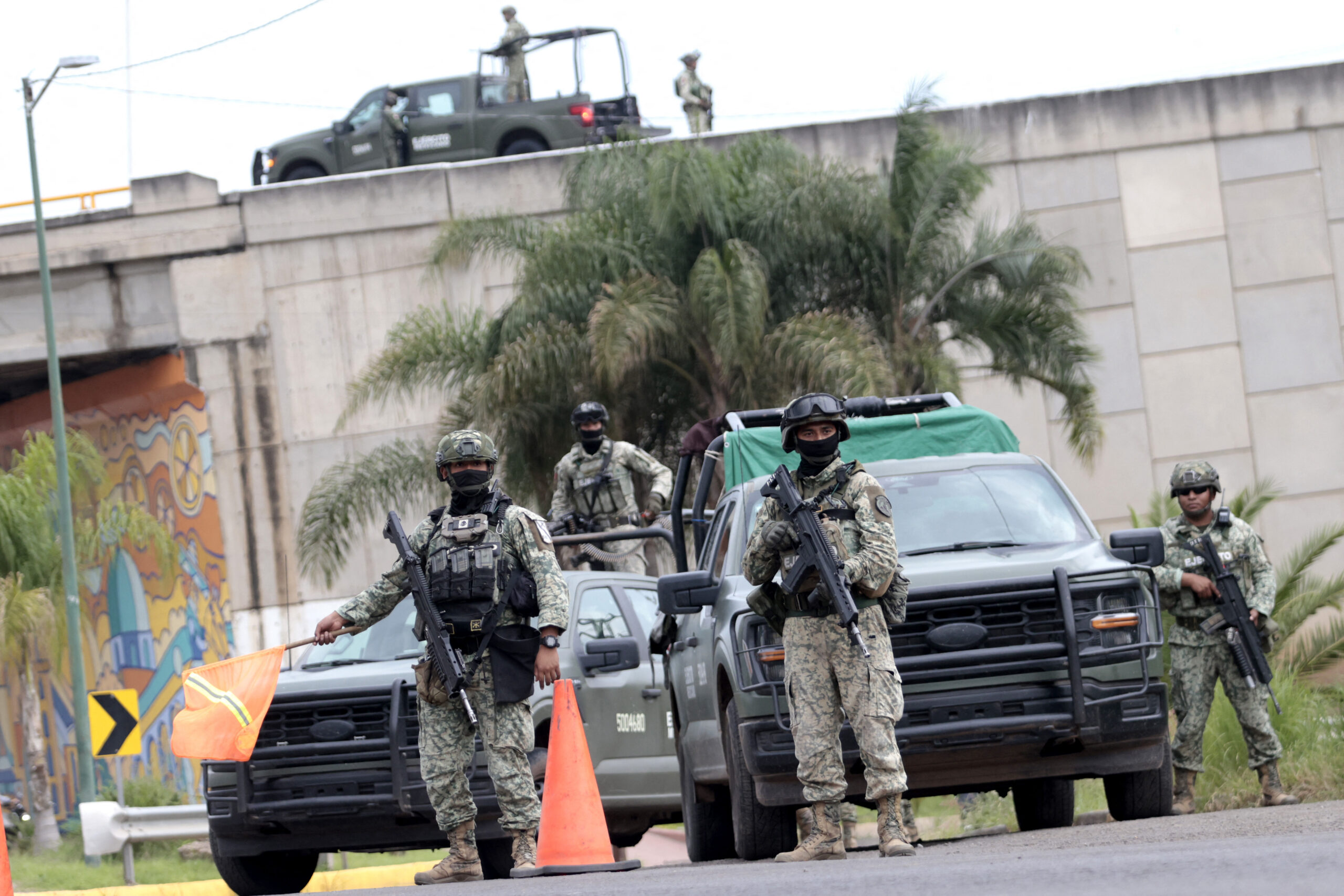
It is no secret that Mexico has assigned major responsibilities for maritime ports and land-border customs security to its armed forces. This was a desperate decision taken by former President Andrés Manuel López Obrador and continued by current President Claudia Sheinbaum. This policy is a recognition that Mexican civilian government authorities have lost control amid corruption and criminal penetration of their country’s international trade infrastructure. The situation in these ports should be understood as the proverbial canary in the coal mine.

Mexican customs brokers are hardly the only intermediaries involved, but the Scoular case illustrates the deeply interwoven nature of the problem. Most Americans understand how cartels make money from smuggling illicit drugs into the United States. But U.S. policymakers should also be aware of the vast profits these gangs make from extortion, protection payments, fuel theft, and other criminal activities that are embedded in legitimate commerce. The cartels rarely send gunmen to rob banks. They do not want to kill the golden goose. Instead, they see their future as continuing to take a small cut of growing business, which in Mexico means international trade, now approaching a trillion dollars a year.

Through normal business practices inside Mexico, American and multinational companies pay substantial costs associated with freight transportation, storage, insurance, and security. These are all part of countless opaque and mundane business transactions, mostly handled for multinational companies through Mexican intermediaries. The payoffs to criminal actors remain commercially affordable because Mexico offers other massive advantages in labor costs, taxation, and environmental compliance.

Major U.S. investors in Mexico, such as General Motors, Walmart, and Constellation Brands—the brewers of delicious Mexican beer—do not publicly disclose how much they spend on private security to ensure their products move safely through a country in which cartels exercise control or influence over as much as a third of national territory. Much of that territory includes trucking routes and railroad lines that run up to the U.S. border.

To its credit, the Trump administration announced in February 2025 that it would prioritize investigations involving cartels and transnational criminal organizations. In June, the DOJ issued revised FCPA enforcement guidelines specifically addressing corruption connected to cartel operations. But FCPA enforcement can only go so far. One significant issue with the statute is that it is designed principally to punish Americans who bribe foreign officials. But that is only a small part of the looming corruption and criminality iceberg threatening the U.S. homeland out of Mexico.

The central point is that neither DOJ investigators nor State Department officials on the ground can unravel the countless legitimate arrangements in Mexico that also mask corrupt activities in which payments from American corporations are routinely siphoned off to criminal enterprises.

Earlier this month, the office of the U.S. Trade Representative (USTR) announced that it was seeking public comment in advance of the 2027 joint review of the United States–Mexico–Canada Agreement. It is time for USTR to grapple with the reality that robust cross-border trade is not simply growing Mexico’s legitimate economy. It is also making Mexico’s corruption problem worse. And it is making the Western Hemisphere’s most powerful cartels stronger, more entrenched, and more dangerous.

In considering next steps with Mexico, it is useful to recall that USTR once told us that robust U.S. trade would modernize, reform, and democratize Communist China. That is why Washington needs a real Mexico trade plan now.

The post The Seedy Underbelly of U.S. Trade With Mexico appeared first on The American Conservative.

Billy Joel Announces Bleak Health Update: He’s No Longer Allowed to Drive

Billy Joel announced that he has new limitations on his health, leading the legendary singer-songwriter to drastically change his lifestyle.

Joel, 77, revealed in an interview with The Hollywood Reporter that he needs to “take a series of tests” before deciding whether he can perform.

“I can’t drive right now. I’m not allowed to drive,” Joel told the outlet.

Joel is not only getting older, but also suffers from hydrocephalus — a condition where fluid builds up in the brain’s ventricles, affecting balance and potentially damaging brain tissue.

He underwent surgery back in 2025 and canceled his performances last May.

His doctors advised him against performing.

“What the neurologist told me, every time you do a show, it’s like you’re getting a concussion,” Joel explained.

The loud volume and bright lighting, as well as stress and high energy levels, may worsen his condition.

Joel is also selling off his motorcycle collection.

“I ended up having over a hundred motorcycles, and the truth is you can only ride one at a time,” the singer said.

“I’m into my 70s now, and I realized I can’t ride as much as I used to.”

“I don’t want to die like a bug on a windshield,” he added. “So I thought I’d put a lot of them on auction.”

Gooding Christie’s will auction off the collection between Nov. 20 and Nov. 21 at the Javits Center in New York.

“I love motorcycles. I love biking. I love driving. I love the anonymity of it,” Joel told The Hollywood Reporter.

“And I love the customization of these bikes, the modifications, the messing around with things. I was not a collector. I was actually a rider. So I figured it was just time to let it go.”

The music video for Joel’s hit 1983 song “Uptown Girl” ends with the singer and Christie Brinkley on a motorcycle.

But that bike will not be available for sale.

“No, that wasn’t even my bike. I think that was an old Harley-Davidson or something,” he described.

“I’m not necessarily a Harley enthusiast. I know everybody in America loves Harleys, but everybody assumes if you ride a motorcycle, it’s a Harley, but it’s not.”

But one bike available for sale will be his 1987 Triumph Bonneville T140 — which was a gift from Madison Square Garden after he sold out the venue for the 150th time.

That sale will benefit the Joel Foundation — a nonprofit that supports school recording studios, music therapy programs, and similar initiatives.

This article appeared originally on The Western Journal.

The post Billy Joel Announces Bleak Health Update: He’s No Longer Allowed to Drive appeared first on The Gateway Pundit.

ACTUAL FASCISM: Dem Senator Elissa Slotkin Wants to Scare Young People from Working for Trump Out of Fear of Prosecution (VIDEO)

Screencap of Twitter/X video.

Democrat Senator Elissa Slotkin of Michigan recently appeared at the University of Chicago for the live taping of a liberal podcast.

At one point in the conversation, she described her preferred strategy of going after not only President Trump, but the people in his inner circle who ‘enabled’ him.

She then says that she wants young people coming out of college to be too afraid to work with his administration for fear of ‘a ton of problems.’

These are the people who are calling you a fascist.

Transcript:

I want to look at these signature cases, and not just focus on the president, but on the people who enabled him.

I want young people coming out of school to say, should I go work for the Trump administration? Like, that sounds fun, I might get an opportunity.

I want them to be like, Lord, that might be buying myself a ton of problems that I don’t want, and so let me avoid participating in that.

I want that deterrence message sent.

Watch the video:

More from the Chicago Maroon:

Slotkin also called for a “radical reform and ethics package” to rebuild public trust in elected officials and judges. Her proposals included “ban[ning] corporate PACs,” establishing term and age limits for Supreme Court justices, and restricting stock trading by members of Congress and their spouses. She said Democrats should pursue investigations into alleged government misconduct and introduce safeguards against future abuses of power.

“We have to Trump-proof the government going forward, so that no president of any party can ever abuse the system the way he did,” Slotkin said.

Slotkin argued that the divide between moderate and progressive Democrats mattered less than whether lawmakers were willing to use their political power to challenge the Trump administration. “I don’t think the divide is moderate versus progressive,” she said, “I think it is fight versus flight.”

Slotkin pointed to her work with Michigan Senate candidate Abdul El-Sayed, a progressive Democrat whose primary campaign she did not endorse but whom she campaigned with after he won the nomination. She said the two disagreed on some issues, particularly foreign policy, but shared priorities on democracy and economic security. “We may come from different so-called wings of the party,” Slotkin said, “but we can work together as a team on the things that we both believe in.”

Democrats are the fascists that they keep warning others about.

The post ACTUAL FASCISM: Dem Senator Elissa Slotkin Wants to Scare Young People from Working for Trump Out of Fear of Prosecution (VIDEO) appeared first on The Gateway Pundit.

Jessica Tarlov Gets DOG-PILED on ‘The Five’ for Trying to Defend Abdul El-Sayed From Claims of ‘Islamophobia’ (VIDEO)

Screencap of Twitter/X video.

Liberal commentator Jessica Tarlov got more than she bargained for during an episode of ‘The Five’ on FOX News this week, when she tried to defend far left Michigan Senate candidate Abdul El-Sayed from supposed claims of Islamophobia.

Co-hosts Greg Gutfeld and Jesse Watters completely demolished her arguments and left her scrambling to defend her position.

Tarlov has a unique ability to come off as a hectoring Karen. It’s like she is the living embodiment of the Democrat Party.

PJ Media has details:

It started when Tarlov was griping about Mike Rogers, El-Sayed’s Republican opponent, flip-flopping on tariffs. Gutfeld asked the obvious question.

“But so what? That still, that makes them worse than Abdul who doesn’t like Jews?” he said.

Tarlov’s answer? Don’t worry, she checked.

“That’s not… If you listen, listen, I have interviewed Abdul, I have talked to him about this, I’ve talked about the concern of Jewish Michiganders, we have talked about the situation in the Middle East, we have talked about the situation here and preserving Jewish safety, and the Israel question,” she said…

Tarlov wasn’t done. She accused Republicans of running on Islamophobia and insisted that it “will not sit well with Jews.” Gutfeld looked like he’d been hit with a frying pan… or maybe she had.

“Wait, what did you say? I don’t get that you said that Islamophobia won’t sit well with Jews,” he replied.

When Gutfeld demanded she define Islamophobia, Tarlov’s best example was Republicans calling El-Sayed “Muhammad.” Both hosts pointed out that it’s his actual name.

“It’s his middle name,” she said, apparently believing this was a winning rebuttal.

“Oh, it’s his middle name!” Watters said.

Watch the whole crazy exchange below:

The Michigan Senate race is extremely important to the left because it’s a test case.

They think that if they can drag Abdul El-Sayed across the finish line in Michigan, they can do it anywhere else in the country.

The post Jessica Tarlov Gets DOG-PILED on ‘The Five’ for Trying to Defend Abdul El-Sayed From Claims of ‘Islamophobia’ (VIDEO) appeared first on The Gateway Pundit.

NJ Governor Mikie Sherrill Complains About Firing Squad for Fort Hood Shooter, Calls Him ‘Guy Who’s in a Wheelchair’ (VIDEO)

Screencap of Twitter/X video.

New Jersey Governor Mikie Sherrill recently appeared on MSNOW and complained about the fact that Fort Hood shooter Nidal Hasan will be executed by firing squad.

Sherrill cloaked her criticism in concern for the members of the military who will be part of the firing squad.

She also refers to the killer Hasan as a ‘guy who’s in a wheelchair’ in an obvious attempt to garner sympathy for him. She conveniently leaves out the fact that Hasan is in a wheelchair because he was eventually shot to stop his attack.

Partial transcript via Breitbart News:

On Friday’s broadcast of MS NOW’s “The Weeknight,” New Jersey Gov. Mikie Sherrill (D) discussed the now-canceled plans to publicly stream the planned execution of the Fort Hood shooter and said that soldiers are going to be told, “you’re going to go shoot this guy who’s in a wheelchair.” And “there are going to be people receiving these orders to the firing squad who are going to, for the rest of their lives now, have to carry that burden.”

Sherrill said, “I think the thing, as I think about it, that just keeps breaking my heart, imagine the 20-year-old, imagine, maybe, the 18-year-old, that stepped up to serve, that gets orders and says, you’re going to go shoot this guy who’s in a wheelchair. Imagine feeling like, I don’t know what to do here. And I think there are going to be people receiving these orders to the firing squad who are going to, for the rest of their lives now, have to carry that burden.”

Watch the clip below:

Every time Democrats are given an opportunity to be on the right side of an issue, they fail.

Sherrill could have easily handled this by saying that while she opposes the firing squad, the death penalty is appropriate in this case, or something to that effect.

Instead, she tries to create sympathy for the shooter by emphasizing the fact that he’s in a wheelchair. Just amazing.

The post NJ Governor Mikie Sherrill Complains About Firing Squad for Fort Hood Shooter, Calls Him ‘Guy Who’s in a Wheelchair’ (VIDEO) appeared first on The Gateway Pundit.

ZERO SHAME: After Going Missing for Almost Two Weeks, James Talarico Says if You’re Running for Office You Have to ‘Show Up’ (VIDEO)

Screencap of Twitter/X video.

Far left Texas Democrat James Talarico recently went completely missing, vanishing from the campaign trail for almost two weeks. The only explanation that was ever given was that he was suffering from the flu.

Despite this, Talarico boasted to a crowd this week about doing a town hall event on CNN, which was little more than a campaign infomercial, and said that when a person is running for office, they have to ‘show up’ for the interview.

Democrats do stuff like this because they have absolutely no fear that anyone in the media will call them out for it.

From Twitchy:

James Talarico is out here delivering a sermon on the sacred duty of “showing up for the job interview” as U.S. senator—complete with a rally video scolding Ken Paxton for partying in London on the Fourth of July and Dubai with alleged fugitives while dodging debate stages — yet the same guy who just vanished from the campaign trail for nearly two weeks with a suspiciously persistent “flu” that had Paxton’s team and half the internet circulating missing-person posters and demanding proof of life.

The Presbyterian seminarian who spent his time off the trail apparently too contagious (or too something) to face Texas voters now wants credit for attending a friendly CNN town hall, as if that erases the disappearing act right before early voting. Nice try, preacher boy; maybe preach that “show up” gospel to the mirror before you start pointing fingers at Paxton’s travel itinerary.

Talarico even tweeted this:

He has no shame.

The Dallas Democrats are also pushing this laughable talking point.

Do they have any idea how people see this?

The post ZERO SHAME: After Going Missing for Almost Two Weeks, James Talarico Says if You’re Running for Office You Have to ‘Show Up’ (VIDEO) appeared first on The Gateway Pundit.

Jake Paul Speaks Out at Trump Rally: “We Face Evil… Hate Has Never Built a Country. And the Woke Socialist Movement We Face Has NEVER Built a Country” (VIDEO)

Jake Paul brought the red meat to Trump’s Ohio rally on Monday. He traveled with the president along with former NFL Coach Jon Gruden.

Jake Paul traveled with President Trump this week to his rally in Youngstown, Ohio on Monday, October 12.

Paul is famous as a former Disney star and popular social media influencer and YouTuber who in recent years became a professional boxer.

Jake Paul is an Ohio native from the Cleveland area. He traveled with President Trump on Air Force One alongside former NFL coach Jon Gruden.

President Trump brought him on stage during the rally, where Paul led “USA” chants and gave a short speech.

Paul said it was “good to be home,” and noted that his mother, a blue-collar worker was in the crowd at the rally. He criticized left-wing protesters, “Do they not have jobs? That’s all they do, just carry signs around while we’re doing the work.”

He also defined the foe we face in this year’s election. You have to give him credit for calling out evil with no hesitation!

Jake Paul: We have to protect Ohio. We face evil. We face these people who are willing to do anything to destroy us. All they do is talk on Twitter. But Twitter fingers never built the country.

Hate has never built a country. And the woke socialist movement that we face has never built a country.

And so the power, The power, is with you Ohioans to go and vote for Vivek, (Vivek Ramaswamy for governor) for Jon Husted (for US Senator). We have to protect this state because Washington doesn’t belong to celebrities like me. It doesn’t belong to the politicians. It belongs to you guys and us, the American people.

** Please donate to these two great candidates if you can – We linked their websites above.

The post Jake Paul Speaks Out at Trump Rally: “We Face Evil… Hate Has Never Built a Country. And the Woke Socialist Movement We Face Has NEVER Built a Country” (VIDEO) appeared first on The Gateway Pundit.

Watch: Stunt Chopper at Navy SEAL Fundraiser Thrills Guests With Small Explosions and Red, White and Blue Smoke Show

A helicopter drops small explosives at Newport Beach Country Club in California on Oct. 8, 2026.

A helicopter drops small explosives at Newport Beach Country Club in California on Oct. 8, 2026.

A foundation supporting Navy SEALs thrilled onlookers at a private club in Newport Beach, California, earlier this month by performing stunning helicopter feats.

The Oct. 8 helicopter demonstration at the Newport Beach Country Club was performed during the SEAL Future Foundation’s annual gala, according to local station KABC. The organization is a nonprofit dedicated to taking care of Navy SEALs as they adapt to civilian life.

The stunning performance featured a helicopter flying close to the ground as flames shot up from below. Later, the helicopter circled around some trees as red and blue smoke poured out from its rear.

“By the end of the stunt, the golf course was blanketed in smoke,” KABC reported.

Prior to the performance, the police warned local residents not to freak out.

“Residents near Newport Beach Country Club may notice increased noise and activity during a private event from 5:45– 6:00 p.m.,” Newport Beach Police wrote on social media. “The event will include a helicopter flyover, fireworks, loud noises and theatrical smoke effects as part of a planned demonstration,” the warning continued.

“The demonstration is expected to last approximately 15 minutes,” the warning added. “These effects are part of a planned event and are not a cause for concern. We appreciate your understanding.”

The foundation was launched by Jonathan Wilson, a former Navy SEAL himself.

According to a profile on the SEAL Future Foundation’s website, when Wilson returned to civilian life as an investment banker, he struggled mightily.

“I just didn’t belong,” the self-written profile reads. “My family was as supportive throughout my transition as they were throughout the numerous deployments, but even at home, I was lost. I felt like an outsider, and, just like at work, I couldn’t articulate what was going on.”

Unsure of what to do, Wilson decided to reenlist.

“It was, of all places, during a funeral for one of my SEAL brothers that it became clear, my only option was reenlistment,” he explained in the profile. “So, after 9 months of civilian life, I was back in the teams. I was happy and content — until I wasn’t.”

After two additional deployments, he thought about returning home, but was scared another transition back into civilian life would be no different. That’s when the idea of starting a foundation first occurred to him.

“Founding SFF marked my true transition,” Wilson wrote. “I found a purpose and a new way to serve my brothers, by creating an organization where support and community are at their fingertips in a world where this is difficult to find.”

“SFF has helped me recognize where I belong and focus on what’s important,” he added. “I am back in finance full time and, thanks to the services offered by SFF, I can communicate my needs and expectations with my employer.”

Two years ago, Wilson appeared in an interview with fellow former Navy SEAL Shawn Ryan:

In the interview, he called for society to do more to take care of struggling veterans.

This article appeared originally on The Western Journal.

The post Watch: Stunt Chopper at Navy SEAL Fundraiser Thrills Guests With Small Explosions and Red, White and Blue Smoke Show appeared first on The Gateway Pundit.