
The post TAC Right Now: Is Trump Winning the Hormuz Battle? w/ Rosemary Kelanic appeared first on The American Conservative.
Category: Uncategorized
Illegals Wanted for Stabbing NYPD Officer Nabbed in Massachusetts Basement

The Gateway Pundit reported that last week, off-duty NYPD detective Jose Mercedes was brutally attacked during a robbery attempt in broad daylight.
While Mercedes was clearing out the trunk of his car, two men on an e-bike approached him and reached for his gold chain.
Mercedes fought back and was brutally stabbed at least seven times to the neck and leg.
The accused slasher was identified as 25-year-old D’Angelo Caraballo, and his getaway driver was ID’d as 24-year-old Sneider Mejia.
Fox News’s Bill Melugin reported that both suspects are alleged to be Dominican illegals.
”I’m told by DHS sources that the two suspects wanted for attempted murder in connection to the stabbing & robbery of an off-duty NYPD detective in NYC on Friday are both Dominican illegal aliens who were caught and released at the AZ border by the Biden administration & both have lengthy criminal histories in NYC, including an ignored ICE detainer.”
The two have been on the run since the attack, but the officials announced the duo is in custody after being found in a basement in Massachusetts.
UPDATE: NYPD detectives assigned to the U.S. Marshals Regional Fugitive Task Force with support from the Boston Regional Fugitive Task Force arrested D’Angelo Caraballo and Sneider Mejia overnight in Lynn, Massachusetts for the attempted murder of an off-duty NYPD detective last Friday. The suspects were hiding in the basement of a house when they were apprehended.
Thank you to the @USMarshalsHQ for their support on this case. If you come for one of us, you’ll have the full force of the NYPD coming for you.
— NYPD NEWS (@NYPDnews) October 7, 2026
The Department of Homeland Security shared video of Detective Mercedes being released from the hospital.
TWO illegal aliens who are accused of stabbing an off duty NYPD detective should have NEVER been allowed into our country.
Dangelo Rafael Jean Caraballo and Sneider Mejia Bautista, both illegal aliens from the Dominican Republic, were RELEASED into the country by the Biden Administration.
Despite multiple prior arrests in New York, sanctuary politicians refused to cooperate with ICE and released them.
— Homeland Security (@DHSgov) October 6, 2026
The post Illegals Wanted for Stabbing NYPD Officer Nabbed in Massachusetts Basement appeared first on The Gateway Pundit.
67-Year-Old Woman Arrested For Drunkenly Doing Donuts on Indiana Courthouse Lawn (VIDEO)


A 67-year-old woman was arrested for drunkenly doing donuts on an Indiana courthouse lawn on Monday afternoon.
The woman was intoxicated at the time of the arrest.
The video of the incident was shared by the Jennings County Sheriff’s Department.
The Jennings County Sheriff’s Office put out a statement on the event:
A Friendly Reminder:
If you’ve had a few too many margaritas with dinner, please don’t get behind the wheel, and definitely don’t do donuts on the courthouse lawn.
Yesterday afternoon, a 67-year-old woman was arrested for Operating a Motor Vehicle While Intoxicated, along with numerous other charges, following an incident at the courthouse.
We encourage everyone to enjoy themselves responsibly and always make arrangements for a safe ride home if you’ve been drinking.
WATCH:
The post 67-Year-Old Woman Arrested For Drunkenly Doing Donuts on Indiana Courthouse Lawn (VIDEO) appeared first on The Gateway Pundit.
12-Year-Old Boy Driving STOLEN Car Allegedly Blows Through Red Light and Kills Elderly Motorcyclist – Will Face NO CRIMINAL CHARGES

One of America’s most notorious crime-ridden cities is giving a literal get-out-of-jail free card to a boy driving a stolen vehicle.
As WBAL reported, Baltimore police on Friday said that a 12-year-old youth was driving a stolen car on Sept. 30 and collided with an elderly motorcyclist around 1 p.m. on North West Avenue.
The motorcyclist, 69-year-old Barry Wright of Baltimore County, died at the scene.
The boy was driving the car with a 15-year-old female passenger. According to WBAL, officers found them near the intersection of North Dukeland Street and West North Avenue, where the car became disabled.
Video shows the two getting out of the vehicle and trying to run away. They were later apprehended.
Witnesses revealed more details about the horrific and avoidable accident to WBAL. These included the victim flipping into the air upon impact and the fact that the 12-year-old boy blew through a red light.
“I was at the corner of North (West) and Dukeland waiting for the light for me to go across. I seen the car hit the motorcycle and I was just like ‘oh my God,” and debris was coming over on the side,” A woman named Trina told the outlet. “I seen the guy flip in the air (and) then these two cowards going to get out of the car and run.”
“The teenagers decided to run a red light,” said Viola Church. “I was actually there when the ambulance was performing CPR and at that time you just knew there was nothing else they could do for him.”
WBAL reported that the young boy will face no criminal charges for the incident. Instead, police submitted a Child in Need of Supervision (CINS) referral and met with the Maryland Department of Juvenile Services.
The department will decide in 15 days what comes next for the boy. This could mean counseling or court-ordered supervision for the child.
The 15-year-old girl, however, was arrested and charged with motor vehicle theft. She is being held at the Baltimore City Juvenile Justice Center.
Church called out what she understandably viewed as completely lackluster punishment for the children.
“I think it does a disservice when you’re not holding these kids accountable. I think it’s imperative that not only the parents are held accountable but the kids as well,” Church told WBAL. “I absolutely think (the victim’s family) is going to want some type of justice and if you’re not going to charge these young people, there has to be an alternative.
“You have to keep in mind the victims, he didn’t ask for that.”
The post 12-Year-Old Boy Driving STOLEN Car Allegedly Blows Through Red Light and Kills Elderly Motorcyclist – Will Face NO CRIMINAL CHARGES appeared first on The Gateway Pundit.
Air Force Faces Criticism and Calls for Reform Over Improper Disability Evaluation Process, and They Respond to The Gateway Pundit

The Air Force improperly used an unauthorized prescreening process that obstructed service members from receiving necessary disability evaluations, leading to calls for accountability and reform, as well as inquiries directed at the highest echelons of the Air Force.
In September, The Gateway Pundit reported that a federal court has determined that the Air Force improperly diverted numerous service members from the Integrated Disability Evaluation System (IDES), which is mandated by Congress for assessing disabilities. The court ruled that the unauthorized prescreening process, known as Initial Review-in-Lieu-of (IRILO), violated the Administrative Procedure Act and hindered wounded or ill service members from receiving the necessary medical evaluations and protections they deserve. This ruling, issued by the U.S. District Court for the Eastern District of Virginia, underscored that the Air Force lacked the authority to implement such a procedure.
Despite this significant judicial decision, the IRILO process remains in effect until a remedy is finalized, potentially affecting tens of thousands of service members. The ongoing situation has drawn criticism from retired Air Force personnel, such as Jeremy Sorenson, who highlighted the Air Force’s awareness of IRILO’s illegality yet continued use of it for financial gain. Sorenson, a former fighter pilot, has been a longtime advocate for accountability and reform within the military system to ensure that the rights of service members are upheld and that they receive the benefits they have rightfully earned.
Last month, The Gateway Pundit sought to examine the claims made by Sorenson by reaching out via email to Gen. Stephen Davis, who is the former Inspector General of the Department of the Air Force and is currently the Commander of Air Force Global Strike Command (AFGSC). It must be noted that Gen. Davis did not receive the author’s inquiries, and therefore, he was unable to respond.
However, the author has since connected with an Air Force public affairs officer to answer the questions previously posed to Gen. Davis.
In response to these allegations and whether Gen. Davis was informed about the complaints from 2023 and 2024 that described the IRILO process as unlawful or illegal, an public affairs officer stated to The Gateway Pundit:
In August of 2023, Mr. Sorenson copied then-Lt Gen Davis on e-mails Mr. Sorenson addressed to the Secretary of the Air Force and the Department of Defense Inspector General. Then Lt-Gen Davis responded to the e-mails and was told by Mr. Sorenson the communication was sent to the Secretary of the Air Force and that Mr. Sorenson was “requesting [the Secretary’s] direct involvement in this matter, not DAF/IG.” Mr. Sorenson further stated, “DAF/IG is not the appropriate office to address Determinations which are to be made by the Secretary of the Air Force per DODI 1332.18.” At the direction of DOD IG, the Air Force IG processed the complaints IAW AFI 90-301 and the actions were subsequently reviewed by the DOD IG. Finally, neither of the e-mails referenced in the article involved a complaint by the Airmen who filed the lawsuit that was filed in 2025.
Gen. Davis was also asked if he would concur that those complaints were never resolved and that they were omitted from the Air Reserve Component (ARC) Line of Duty (LOD)? In response, the Air Force official stated:
All complaints received by the Air Force IG were handled IAW AFI 90-301 and resolutions were also subject to DOD IG oversight and review in accordance with standard IG procedures. Regarding the Air Reserve Component (ARC) Line of Duty (LOD) report, as the report states, it does not provide an assessment or judgement of the medical conditions and adjudications of any individual case; rather, the inquiry assessed whether systemic issues impacted the effectiveness of air reserve component (ARC) processes and procedures to meet established standards regarding line of duty determinations. Individual complaints were handled separately. Also as stated in the report, the ARC LOD inquiry was formally initiated in November 2023 and predates by almost a year the alleged “very specific allegations” the article says Mr. Sorenson made in October 2024. The report is available for public review at this link.
In another question, Gen. Davis was asked about whether he anticipates the current Inspector General of the Department of the Air Force to look into the complaints. The public affairs officer simply said:
General Davis completed his assignment as the Department of the Air Force Inspector General in October 2025 and assumed duties as the Commander of Air Force Global Strike Command in November 2025.
Finally, he was asked about what actions, if any, he anticipates Lt Gen [David] Lyons (the current Inspector General of the Department of the Air Force) will take concerning those complaints now that a federal court has declared the IRILO process illegal or unlawful. The reply:
This matter is still pending in Federal Court. Appropriate Air Force officials will review the decisions from the case when it is completed.
While the implications for the Air Force’s internal procedures remain uncertain, the revelations made by Sorenson still highlight significant concerns regarding the Air Force’s treatment of service members and the legal implications of the IRILO process. As investigations continue and the federal court weighs in on the legality of these practices, the need for transparency and accountability becomes paramount.
Alongside Gen. Davis’ responses, the military’s response to these allegations will not only shape the future of disability evaluations but also impact the trust and morale of service members who rely on a fair and just system. As stakeholders await the outcome, it is crucial for the Air Force to prioritize the rights and welfare of its personnel, ensuring that such systemic issues are addressed with urgency and integrity.
The post Air Force Faces Criticism and Calls for Reform Over Improper Disability Evaluation Process, and They Respond to The Gateway Pundit appeared first on The Gateway Pundit.
WATCH LIVE: President Trump Makes an Announcement on Trump Accounts Automatic Enrollment for New Families – 1 PM ET

President Trump will make an announcement this afternoon on the automatic enrollment of children in his Trump Accounts program.
The program, which officially launched on July 4, provides a tax-advantaged investment account for children to get a head start on saving for adulthood. A $1,000 federal pilot contribution is also available for children born between January 1, 2025, and December 31, 2028, and additional benefits are available for children born in low-income areas.
Trump spoke in the Oval Office alongside Dell CEO Michael Dell, who pledged a $6 billion donation to the program, and his wife, Susan, to officially launch his Trump Accounts program in July.
Now, Trump is expanding the program to ensure that every American child is enrolled and able to reap the benefits before he leaves office.
“Trump Accounts are a life-changing initiative that will jump-start the American dream for generations to come,” White House spokeswoman Taylor Rogers told the Daily Signal.
“With automatic enrollment now complete, every American child under the age of 18 has a Trump Account in their name, making it easier than ever for families to participate. Nearly 70 million Trump Accounts have already been created, giving young Americans a new opportunity to build lifelong financial security.”
Millions of children have already been automatically enrolled in the program since automatic enrollment began.
More from the Hill:
The department said last month that accounts would be created for more than 60 million children. The move was, in part, to allow a $6.25 billion contribution pledge from Michael Dell to reach more eligible children, The Hill reported in September.
Prior to the auto-enrollment, Trump accounts had been established for roughly 7 million children. As many as 70 million may qualify, according to Treasury Secretary Scott Bessent.
The Treasury Department confirmed Thursday that automatic enrollment had been completed.
“This is a transformative milestone in the Trump Administration’s effort to give every American child the opportunity to build generational wealth and jump-start their financial future,” Bessent said in a press release.
Parents can now claim their children’s accounts and begin making contributions with tax-deferred earnings through the Trump Accounts app.
According to America.gov:
- Download the official Trump Accounts app for iOS or Android, or use TrumpAccounts.gov.
- Treasury also lists a web app at https://trumpaccount.com/ if you do not have a mobile device.
- Follow the in-app steps to claim and set up the account.
The event is scheduled to begin at 1 pm ET.
Watch live below:
The post WATCH LIVE: President Trump Makes an Announcement on Trump Accounts Automatic Enrollment for New Families – 1 PM ET appeared first on The Gateway Pundit.
Mayor of ‘Little Palestine’ Condemns Violence as Video Shows Rocks Thrown at Protesters and No Arrests

Steven Landek rented SeatGeek Stadium to American Muslims for Palestine, then praised police while Palestinian activists, Antifa, the People’s Defense Corps, and Corriente Popular stoned a legal protest, hit a 70-year-old pastor in the head, kicked and spray-painted vehicles, and set off an explosive.
Hispanic gangs showed up in anti-ICE rammer trucks. No one was arrested

BRIDGEVIEW, Ill. — Mayor Steven Landek wants Sunday remembered as a celebration. His statement said Palestine Fest was “an overwhelmingly positive day,” that the protests “ended with no arrests,” and that Bridgeview police should be proud.
Then he added the line the video breaks: “But let me be very, very clear about this. We condemn any hateful message and any mischaracterization of our strong, vibrant, and united community. We will not tolerate violence or other behavior that threatens the safety of our community.”
What reporters and witnesses saw was a rock fight in the village that just branded a stretch of Harlem Avenue “Little Palestine Way.” The men throwing rocks were from the crowd Landek called united. The rocks were the violence he said he would not tolerate.

An explosive went off in that parking lot. This reporter has the video. A 70-year-old pastor was hit in the head with a large rock. Photos of that injury will run with this story. Landek mentions “projectiles” and two people treated. He does not mention a blast or a pastor.

WATCH:
The other side was smaller than the message. Local Christian protesters were identified by Antifa organizers before the event, threatened, and told to denounce it.
In some cases, the plan relayed to them was to send Antifa to their homes. People stayed home. Empty the other side before the first rock, then call the remainder a handful of extremists. On September 22, 2025, President Trump designated Antifa a domestic terrorist organization for using political violence to shut down lawful activity. Bridgeview was a local copy.
American Muslims for Palestine Chicago held the stadium contract. Chairman Hatem Bazian told NBC Chicago it was “open to everyone.”
Pre-event promotion of the bloc defending the festival, named the People’s Defense Corps and Corriente Popular, a communist organization.
The flyer used the line “In the Spirit of the Resistance.” CAIR attacked Jake Lang’s march before it started. Antifa supplied the street muscle. Palestinian activists supplied the crowd, the flags, and the rocks.
Someone paid for two digital billboard trucks and pointed them at Lang. One called him a pedophile.
Landek later told the Sun-Times he “didn’t know the controversy was going to occur.” He knew who he signed with. He spent the weekend condemning the protesters’ “bigotry and hate-filled rhetoric” and praising Palestinian businesses.
He did not condemn the rock through a windshield, the kicked and spray-painted vehicles, or the rock that hit a pastor. He did not mention Hamas or the home threats.

In April 2004, while Hamas’s second intifada was still blowing up buses, Hatem Bazian shouted in San Francisco: “How come we don’t have an intifada in this country?… It’s about time we have an intifada in this country… well, you haven’t seen radicalism yet.” Bazian later told Bill O’Reilly he meant a “political” intifada.
In October 2023, asked on camera by Asra Nomani if he condemned Hamas for killing about 1,400 Israelis, Bazian refused. His answer was “I like falafel.” He also would not condemn kidnapping and murdering civilians.
In 2017 he retweeted a meme of an Orthodox Jew captioned “I can now kill, rape, smuggle organs & steal the land,” hashtagged “#Ashke-Nazi,” then said he had not read it. AMP is in a Chicago federal case accusing it of being the successor to a group already found liable for Hamas support.
The mosque is the local half of that record. Jamal Said, principal imam of the Mosque Foundation since the 1980s, was an unindicted co-conspirator in the Holy Land Foundation case. HLF leaders were convicted in 2008 of sending more than $12 million to Hamas.
The Chicago Tribune, from a translated tape, reported that in 2000 Said asked a crowd to donate in memory of a Palestinian suicide bomber.
In 2003, he raised about $50,000 at the Bridgeview mosque for Sami Al-Arian, later convicted of supporting Palestinian Islamic Jihad, and called Israel “a foreign, malignant and strange element on the blessed land.”
Former imam Kifah Mustapha, also an unindicted co-conspirator, admitted he was a registered HLF agent in Illinois. A trial exhibit shows him singing “O mother, Hamas for Jihad.”
Former mosque president Rafeeq Jaber ran the Islamic Association for Palestine, hit with a $156 million judgment over Hamas ties. The mosque donated about $374,000 to charities later shut down over terrorism allegations.
ABC7 reported counter-protesters launching rocks. The Sun-Times reported water bottles thrown near the stadium.
Witnesses saw batteries and handmade glitter bombs thrown with the rocks. Antifa was in the crowd doing the throwing, beside Palestinian activists, the People’s Defense Corps, and Corriente Popular. Hispanic gangs rolled in with anti-ICE rammer trucks.
Video from the lot shows it. One clip has a rock in the air toward a truck carrying a “Little Palestine is a disgrace” sign, then the windshield spiderwebbed from the hit.
A second shows a man in a thobe and a Bears jersey mid-throw. A third shows the 70-year-old with the crown-of-thorns tattoo ducking, then the bloody cut over his eye. Police are in the background. They are standing there.
WGN photojournalist LJ Tabano said it blew up when the targeted group tried to leave under police escort. Protesters swarmed the caravan. Silly string hit the vehicles.
They were kicked and spray-painted. CBS Chicago confirmed a truck windshield was broken. An explosive detonated. Landek admits two people needed medical care and two officers took minor injuries.
Lang told the Chicago Tribune that two of his protesters needed stitches and four vehicles were damaged. He said he had worked with Police Chief Ricardo Mancha ahead of the protest, then said the department failed them. He called Landek and the department “weak and feckless” for failing to arrest the counter-protesters.
“No arrests” is the cover. A rock or a battery thrown at a person is a battery. A rock through an occupied windshield is a crime. Spray-painting a vehicle is a crime. Hitting a pastor in the head is a crime.
The Sun-Times reported at least two people detained. The Tribune’s photos show a detention and a pepper-spraying. Detained and released is not nothing happened.
The protesters who showed up went home alive because this is still Illinois, not Gaza. A Catholic procession outside a mosque in Gaza does not end with a press release. It ends with a funeral.
The crowd imported the tactic — threaten the house, then stones, batteries, glitter bombs, an explosive, kicked and spray-painted cars — and the mayor who put up “Welcome to Little Palestine” signs said he would not tolerate violence.
Officers escorted the caravan and watched a windshield cave in. A pastor was hit. An explosive went off. Two officers were hurt. Nobody was booked. In Little Palestine, one side gets a stadium rental and a mayoral absolution. The other side gets rocks.
The post Mayor of ‘Little Palestine’ Condemns Violence as Video Shows Rocks Thrown at Protesters and No Arrests appeared first on The Gateway Pundit.
Who Profiles the Profilers? Inside the FBI’s BAU


Who Profiles the Profilers? Inside the FBI’s BAU
Republished with permission from AbleChild.
Sandy Hook, Parkland, the attempted assassination of Donald Trump, the killing of Charlie Kirk. Americans know the names and the devastation. But how much can they actually verify about the explanations offered afterward? AbleChild.org has repeatedly examined these events and others, demanding evidence, transparency, and answers beyond the official narratives.
In the Thomas Crooks investigation, records did not simply arrive through routine public disclosure. Judicial Watch filed a Freedom of Information Act lawsuit against the Justice Department in July 2025. In September 2026, the organization announced that the litigation had obtained 180 pages of heavily redacted FBI records. In October, it announced another 249-page release. More than two years after the attack, the public is still receiving pieces of the investigative record.
Who inside the FBI is responsible for turning that evidence into a behavioral analysis, and how well has that system served the American people?

The answer is the FBI’s Behavioral Analysis Units, or BAUs. The units examine criminal behavior, assess threats, and advise investigators. Understanding criminal behavior is the core mission, not an optional task.
The framework’s history deserves scrutiny, not automatic praise. In 1972, the FBI established the Behavioral Science Unit at Quantico. Howard Teten and Patrick Mullany helped develop the approach under unit leader Jack Kirsch. Even this largely glowing account reveals the divide: longtime FBI director J. Edgar Hoover called early profiling “hokum,” while Teten and Mullany pursued methods the author describes as grounded in scant scientific data, police experience, intuition, and guesswork. Looking back, was Hoover’s skepticism justified and did the FBI take the wrong direction?
One could easily see how this might have ushered in the billion-dollar behavioral health industry and Hollywood connections, and weakened our national security.
The work helped shape today’s BAUs and the broader framework of the National Center for the Analysis of Violent Crime. Expansion, however, is not proof of accuracy. A 2008 scholarly critique argued that criminal profiling lacked strong scientific support.
It is time to consider an audit and propose some key benchmarks for accountability. Federal law authorizes FBI audits. Where is the independent review of BAU methods, accuracy, and errors?

The government’s catalog summary of the center’s 1991 annual report describes offender profiles, personality assessments, interviewing techniques, investigative strategies, expert testimony, and prosecution assistance. Its programs included psychological services, crime-linkage support, research, training, and media relations. This description comes from the catalog summary, not a review of the complete report. The mission widened. Where is the matching public accounting of results?
On CSI, Criminal Minds, and Mindhunter, investigators turn disturbing behavior into answers. The FBI’s real-world research reveals a less reassuring picture: missing medical records and incomplete treatment histories.
John Douglas, Robert Ressler, and Ann Burgess helped build a profiling framework whose scientific foundation has faced serious challenges. An independent study found no support for the distinct “organized” and “disorganized” crime categories central to that framework.
Yet profiling became a commercial product, complete with a Netflix series based on Douglas’s Mindhunter and neatly packaged explanations. Where is the evidence of accuracy? Where are the records needed to examine mind-altering drug exposure?
The FBI’s own Law Enforcement Bulletin warned that television and film made profiling appear almost psychic. It also acknowledged disputes over methods, reliability, and effectiveness, with longstanding controversies receiving “little systematic assessment.” Has the public image of FBI profiling received more attention than the evidence needed to test its conclusions?
The Bureau’s November 2019 lone-offender terrorism study examined 52 offenders responsible for attacks between 1972 and 2015. On page 22, the FBI’s report acknowledges missing medical records and inconclusive treatment and medication data. Did mind-altering drugs contribute to the violence? Why were the records missing, and what steps did the FBI take to obtain and analyze them? Without complete histories, a critical question remains unresolved, not ruled out.
Congress imposed a specific reporting obligation in 1998. Section 703 of the Protection of Children From Sexual Predators Act established the Morgan P. Hardiman Child Abduction and Serial Murder Investigative Resources Center, known as CASMIRC, under NCAVC management. The law required the Attorney General to report to Congress one year after the center’s establishment, describing its activities, personnel qualifications, equipment, support, and projected needs. It did not create the BAU itself.
Where is that report?
It has not been located in the public sources reviewed for this article. That does not establish that it was never submitted. Congress should determine whether it was submitted and make it accessible. The 1991 annual report cannot satisfy a requirement enacted seven years later.
The reporting provision required neither annual follow-up reports nor independent performance audits. It specified no penalty for failing to submit the report. A one-time reporting requirement is not a durable oversight system.
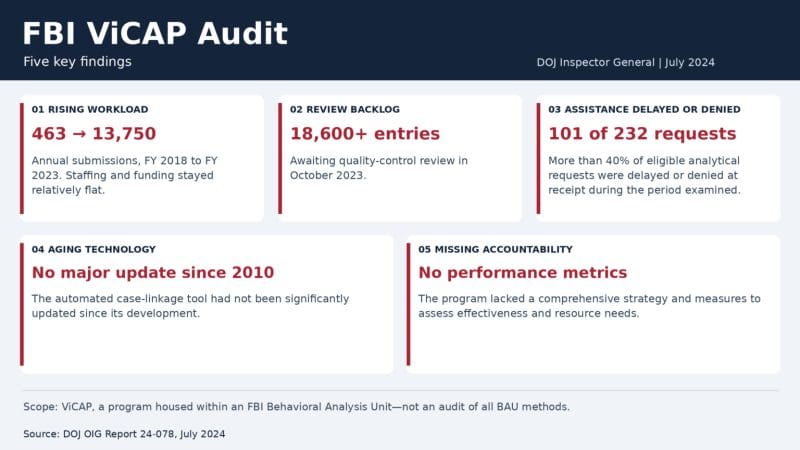
Outside scrutiny has identified real operational problems. A July 2024 DOJ Inspector General audit examined the Violent Criminal Apprehension Program, or ViCAP—a national database that helps police connect violent crimes, supported by analysts who assist investigations. The program is housed within a BAU. Its audit findings expose the gap between an expanding workload and the systems needed to handle it.
The post Who Profiles the Profilers? Inside the FBI’s BAU appeared first on The Gateway Pundit.
Burnham’s Big, Bad Speech Offered One Good Idea
UK Special Coverage
Burnham’s Big, Bad Speech Offered One Good Idea
The prime minister highlighted real problems with elder care but ignored deeper crises.

UK Special Coverage
(Andrew Aitchison / In pictures via Getty Images)
Britain has a new prime minister who can, at least, deliver a speech. Andy Burnham, the former Blairite who has reinvented himself as an old-school socialist, electrified British politics at the end of September with a speech that promised to take Britain back to the 1970s.
Not since John Smith, the Labour leader whose early death paved the way for the Blairite centrist revolution in the early 1990s, has there been a Labour leader, and PM, who is so unapologetically Labour, and he lovingly caressed every party prejudice about why Britain isn’t working as it should. And in further proof that most of British politics remains an argument with the legacy of Margaret Thatcher, he got his biggest cheer for a promise to undo the former Conservative leader’s privatization of the water industry.
The speech was left-populist, tribal, emotionally manipulative, ideologically blinkered, and wrong about most of Britain’s biggest problems. But it also had one useful and original idea at its heart: paying for reform of the underfunded system of elder care by ending the expensive so-called “triple lock” on the public pension system, which guarantees that the state pension rises in line with earnings, inflation, or 2.5 percent, whichever is highest.
Burnham’s lackluster predecessor, Keir Starmer, would not have had the courage or imagination to come up with such an idea. But neither would he have been so naively ideological to suppose that Britain has a built-in center-left majority waiting to govern in perpetuity once the old first-past-the-post voting system is replaced with a new, more proportional system, another of Burnham’s promised reforms. Nor would Starmer have been apparently so unconcerned with Britain’s constipated state machine and spluttering economic engine as to make a whole speech without, as one commentator noticed, using the words “entrepreneur,” “biotech,” “Oxford,” “Cambridge,” “London,” “financial services,” or many of the other right-coded things that Britain is actually quite good at.
Nonetheless, the speech has had its desired short-term effect and provided a Burnham bounce in the opinion polls, allowing Labour to narrowly lead the insurgent right-populists of Nigel Farage’s Reform party, mainly by winning back some of the disillusioned younger graduate voters in the big cities and university towns who had deserted the party for the leftist Greens.
Does Burnham really believe in all that back-to-the-1970s and public-ownership stuff? It is one thing to take back control of failed organizations like Thames Water, but all of energy and water? Burnham’s leftist ambitions will certainly be constrained by the fact that he can’t increase public spending and Britain is already paying more for its debt pile—which reaches nearly 100 percent of GDP—than comparable European countries. But the left-inclined voters cannot be fed on rhetoric alone.
The run-up to the next general election in 2029 is more likely to confirm the view that the great tragedy of British politics is the failure of the Boris Johnson–led realignment after the big Conservative election victory in 2019. In the light of the Brexit vote to leave the European Union, there was an opening for the main party of the right to lock in a new swathe of socially conservative lower-income voters who were impatient with the left’s social liberalism but also wanted protection from the harsh winds of the market economy.
Johnson—the joker anti-politics politician—should have been the perfect figurehead for such a realignment, but the combination of his capricious personality, Covid, and the fact that the Conservatives were constantly divided between their conservative and liberal wings put paid to the realignment and ushered in a badly timed Labour Government in 2024. Labour entered with a huge majority—thanks to the divide on the right between Reform and the Conservatives—but with no idea what to do with it.
The new government was certainly in no position, temperamentally or ideologically, to respond to the accumulated failures and unintended consequences of the Blair/Cameron era. One reason I am no longer a member or supporter of the Labour party (I was a member from my student days until 2017) is that I believe we need a government that can address those problems. What are they?
The problem of overregulation, state incapacity, and too much dispersal of power to the courts and regulators; the absence of “tough love” in health and social services, including the over-diagnosis problem and the inability to control welfare spending; the economy-throttling high energy costs, which are the result, in part, of the chaotic and over-rapid path to “net zero” in the name of global leadership; the indifference to both high levels of immigration and deindustrialization (from both Labour and Conservatives), the combination of which has been a main driver of populism; the neglect of technical/vocational education in favour of university over-expansion; the creation of a new progressive establishment—Oxbridge, the British Medical Association and all health institutions, the Senior Civil Service, most of the legal profession—with views some way to the left of the average voter on both social and economic issues.
It is very hard for the party that ushered in most of these changes, admittedly with some help from the Conservatives, to perform a volte-face. And Burnham’s speech underlines just how little he wants to. He expatiated on public ownership, though with the wriggle room provided by the phrase “public control,” and said nothing at all about the overregulation/state incapacity problem, or the welfare incontinence, or the self-inflicted energy cost wound, or even how to stimulate economic growth.
Moreover, while Burnham has proved adept at appealing to the economic nostalgia of less-well educated, more locally connected people, often in post-industrial places—the people I call the Somewheres (as opposed to highly-educated, more mobile Anywheres)—as the leader of a party dominated by liberal graduate Anywheres he has had nothing to say about their social and cultural anxieties.
In his speech, Burnham made cursory reference to stopping the wave of refugees illegally entering Britain on small boats. He also talked about the common belief that “the powers that be are pulling against the people, not with them.” He clearly did not include himself or the progressive-establishment-dominated Labour party in the “powers that be.”
But many former Labour voters believe that free speech, promotion on merit, and common sense itself have been abandoned by the Labour “powers that be,” who are also indifferent to the dramatic demographic change in many towns and cities. The white British population of the UK was still around 90 percent in 2000 and it is now shy of three-quarters: London, Birmingham, Manchester, and several smaller towns and cities are all now majority-minority or close to it, and the school population of England is now barely 60 percent white British. Burnham has nothing to say about this, because social liberals do not think there is an issue.
The centerpiece of Burnham’s speech, and the most powerful political punch, was the elder care reform/triple lock combination. Almost everyone agrees the care status quo is unsatisfactory in many ways. I do too. I even wrote a book partly about how to reform it (The Care Dilemma: Freedom, Family, Fertility).
Yet is there really a care crisis? What about the defense crisis, or the energy cost crisis, or the overregulation crisis, or the economic growth crisis? Are there not more important places to start sorting out the country?
Elder-care reform is in many ways a surprising place for Burnham to invest so much passion and political capital, and is perhaps further testimony to the importance of personal experience in setting political priorities. (His father was in a care home with dementia for several years and died just before the conference.) The failure to reform has become, in the political class, an emblem of the inability to think beyond the short-term. But there are good reasons why the issue has not been tackled by preceding governments.
For a start, the public does not prioritize it. Only 3 to 4 percent of people mention it as one of the top three issues facing the country, compared with more than 30 percent for the National Health Service (NHS). Moreover, many more people are already getting heavily subsidized care than is generally realized, despite the ungenerous means-test; meanwhile local and central government combined are already spending about £35 billion a year on care.
There are about 300,000 younger people in the care system with long-term, often severe, disabilities, like cerebral palsy. The number is rising because of modern medicine’s ability to keep more people with severe conditions alive for longer, and most if not all of their care is paid by the state.
Another 600,000 people are in the elder care system—roughly 350,000 in care homes and 250,000 receiving visits from carers in their own homes. Over half of care home residents are getting much of their care, and accommodation, paid by the state, and nearly three-quarters of people receiving care at home are substantially covered by the taxpayer.
But most elderly people do not use the formal system at all and any support they have comes from their family. There are roughly 6 million people over the age of 75 in England, and around 5 million people who provide some degree of informal care for the younger disabled or elderly relatives.
The means-test for those in residential homes includes the value of someone’s house, but the house is excluded from the calculation if a spouse or a child, or even a friend in some circumstances, is living in it. The King’s Fund, a health think tank, reckons that at any given time only about 220,000 people are fully self-funding for elderly social care.
Politicians have quietly accepted that it is perfectly fair to claw back some of the unearned property value increase that some people have enjoyed in recent decades, especially in more affluent places. Polls suggest public opinion is on their side. It is true that a few people are exposed to very high costs, which is why there has been interest in some kind of cap on overall costs even for those blessed with expensive property.
So the irony is that the main beneficiaries of making care free would be affluent home owners, mainly in the south of England, and the main losers, assuming that ending the triple lock would mean less generous pensions, would be poor pensioners concentrated in the north of England, Burnham’s territory.
But Burnham is nevertheless right—there may not be an imminent crisis of elder care, but we do need a much better organized and better funded system. The current system is unfair in that cancer treatment is free, covered by the NHS’s general tax-based insurance, while dementia might in rare cases cost you hundreds of thousands of pounds.
Moreover, there are plenty of unmet care needs in the current system and there are those 5 million informal carers, mainly family members, who might be able to contribute more to the GDP if their relatives could lean more on the formal care system. And by 2047 there will be 3.3 million people over the age of 85, many of whom will need some kind of support in an era when families are smaller, if they exist at all, and more dispersed.
Although Burnham ventilated hyperbolically about his National Care Service reform, planned for 2030, being equivalent to the founding of the NHS, he is glamorizing what should actually be a few relatively prosaic decisions about structure and funding.
The NHS analogy is, in fact, completely inappropriate for elder care reform, and we have to hope that Burnham was using it as a kind of metaphor. The NHS is an increasingly unpopular and struggling institution based around giant, publicly owned, hospitals. Elder and social care is delivered by about 18,000, mainly small, private institutions, hand-in-hand with local authorities.
It does make sense to raise the visibility of the system and give it a name, a logo, and a clearer identity. I argued in my Care Dilemma book that it should be called the National Preventative Service (NPS). The job of the NHS is to deal with your problem and get you out the backdoor as quickly as possible; the job of the NPS should be to stop so many old people going through the front door in the first place.
The 1.6 million people who work in care need to be better paid and trained. Their pay should be pegged to that of an NHS care assistant with a greater possibility of career progression. There is a case for more care staff to have some limited medical skills—minor wound care, injections, taking vital signs—and to review some of the archaic demarcation lines that prevent a care worker cutting someone’s toe-nails. Better links between family carers and the care system could also keep more elderly people self-sufficient for longer.
There needs to be much more emphasis in care packages on taking exercise—old people falling over costs the NHS £2 billion a year—and much better use of technology especially in the smaller homes which tend to resist innovation. More volunteering and gap years should be encouraged in care homes, with perhaps an equivalent of Now Teach (the organization that encourages professional people near retirement to spend a few years teaching) for care managers.
Burnham talked, again hyperbolically, about how the failures of the care system are causing the NHS to collapse. True, the chronic illnesses of the elderly in an aging society inevitably take up more of the NHS’s resources, but a better organised and funded care system will only be able to relieve those pressures to a limited extent. Moreover, some of the problems of bed-blocking by the elderly are due to the NHS’s organizational inefficiencies and the length of time it takes to organise a care package, and these are problems that could in principle be sorted out right now.
Providing the entire care service free to a decent standard for everyone who needs it plus improving pay and training for care staff would be both prohibitively expensive—costing maybe around £25 billion—and regressive. When Burnham talks about free care for all, in fact he seems to mean the state covering the care element of a weekly care home charge, now about £1,400 in total, with the accommodation costs left to be paid by users, at least by better-off ones. When people discover that they may actually be paying more for Burnham’s supposedly free service he will have a bit of explaining to do.
But by then, Andy’s premiership is likely to have been engulfed by all those other, bigger, potential crises that he didn’t talk about at all in his speech.
The post Burnham’s Big, Bad Speech Offered One Good Idea appeared first on The American Conservative.
Time To Upgrade Your Old Pillows With Mike’s Made-In-America Queen For $29.98 – Now They’re Buy One, Get One Free

(Note: Thank you for supporting businesses like the one presenting a sponsored message below and working with them through the links below which benefits Gateway Pundit. We appreciate your support!)

That old pillow on your bed is already flat. Your neck is stiff, and you are up again at 3 a.m. flipping it over like that will fix it.
“Years ago, like you, I found myself extremely frustrated with my pillow going flat,” says Mike Lindell. “I would wake up in the morning with a sore arm, my neck would hurt, my fingers would be numb, and I would toss and turn all night not knowing why. So finally, I decided to do something about it.”
He created MyPillow, with its patented interlocking fill. It moves with you, holds the loft you fluff it to, and does not go flat or clump, so you sleep through instead of flipping the pillow at 3 a.m.
People who got the Premium MyPillow talk about waking up rested, and a pillow that still has its shape in the morning. A stomach sleeper said it was the first one that worked. Another bought three more for the family after it came out of the washer like new.
A Queen Premium MyPillow is $29.98 when you use promo code TGP. A King is $5 more with the same code, and both are made in the USA.
Now, they are Buy One, Get One Free:

You fluff it to the height you want and it stays there, whether you sleep on your side, your back, or your stomach. The cover is 100% cotton, you can wash it and dry it, and it carries a 10-year warranty.
Mike’s guarantee is blunt. “I guarantee that your MyPillow will be the most comfortable pillow you’ll own or YOUR MONEY BACK.” If you send it back within 60 days of receipt, for any reason, you get 100% of the purchase price back, less shipping, and you pay the return shipping.
On the TGP discounts page, a Queen is $29.98. Orders over $100 ship free.
Go there and put the Queen (or the King) in your cart.
Use promo code TGP to get the $29.98 price.
The post Time To Upgrade Your Old Pillows With Mike’s Made-In-America Queen For $29.98 – Now They’re Buy One, Get One Free appeared first on The Gateway Pundit.