The Atlanta Dream, featuring the perpetually controversial Angel Reese, will host their home games in the 2026 WNBA Finals in a venue that seats just 3,500 fans, roughly the size of a large high school gym, after failing to secure anything bigger.
According to USA Today, the Dream’s efforts to move Games 3 (October 22), 4 (October 24), and a potential Game 6 (October 29) to State Farm Arena, which holds more than 17,000, have collapsed.
State Farm is already booked for singer Sombr’s concert and two Atlanta Hawks regular-season games, including the Hawks’ home opener.
Attempts to secure Gas South Arena (up to 13,000 seats) or Georgia Tech’s McCamish Pavilion (about 8,600) also hit roadblocks.
Barring a last-minute miracle, the games stay at Gateway Center Arena in College Park, Georgia, the Dream’s regular home since 2021.
This comes days after the franchise announced a multi-year deal to play all home games at State Farm Arena starting in 2027, touting “record growth,” a 400% jump in season-ticket members, and the “passion of our fans.” The timing is awkward.
The Dream hosted several regular-season and earlier playoff games at the larger arena this year, drawing strong crowds, yet the championship series gets the tiny building.
This comes days after the franchise announced a multi-year deal to play all home games at State Farm Arena starting in 2027, touting “record growth,” a 400% jump in season-ticket members, and the “passion of our fans.” The timing is awkward. The Dream hosted several regular-season and earlier playoff games at the larger arena this year, drawing strong crowds, yet the championship series gets the tiny building.
In recent weeks, TGP reported that viewership cratered after Caitlin Clark and the Indiana Fever were eliminated, dropping sharply as the “wokest league in professional sports” continued its pattern of favoring drama, questionable officiating, and preferred personalities over the one player who actually filled arenas and drove ratings.
New York Attorney General Letitia James, the hyper-partisan Democrat who built her career targeting President Trump, is now facing a formal bar ethics complaint for publicly prejudging the “Cornell 7” sexual assault case just days before Governor Kathy Hochul appointed her special prosecutor.
According to the New York Post, the National Legal and Policy Center (NLPC), a Washington, D.C.-based watchdog organization, filed a nine-page bar complaint against James with New York’s Attorney Grievance Committee on Friday, October 9.
The complaint accuses James of a clear, incurable conflict of interest and a “flagrant, obvious and therefore shocking” violation of the New York Rules of Professional Conduct after she posted supportive comments about the accuser before any investigation under her authority had even begun.
On September 28, 2026, three days before Hochul’s October 1 executive order naming her special prosecutor, James wrote on X and Facebook:
“What this young woman has been forced to endure is horrific and unacceptable. I’m holding her in my heart and in my prayers. To her, and to all survivors: you’re not alone. We stand with you.”
Legal ethicist Jack Marshall, whose expert report accompanies the complaint, concluded that James has a “serious and incurable conflict of interest.”
He stated she is “ethically and legally obligated to recuse” as special counsel and must be removed if she refuses. Marshall added that her comments raise “suspicion of a rigged, pre-determined and illicit investigation.”
NLPC counsel Paul Kamenar told the New York Post that James “exhibited a clear bias in favor of Jane Doe’s allegations and against the Chi Phi defendants” and “cannot serve as a special prosecutor in this case.”
He warned she risks the same fate as Fani Willis in the Georgia case against Trump.
The complaint comes as two of the accused former Cornell Chi Phi members, Gillio Lopes and Winston Lee, have already filed court motions seeking to disqualify James.
Their lawyers argue her public statements show she “has already reached the conclusion” that the defendants are guilty and that Hochul and James together created a “blatant appearance of impropriety.” A hearing is scheduled for October 29.
As The Gateway Pundit has previously reported, President Trump immediately warned that the seven young men “won’t get a fair shake” under James, calling her a “corrupt person” and questioning why Hochul would appoint her to the “highly controversial” case.
The Gateway Pundit has also detailed newly released text messages in which Jane Doe reportedly told one of the men she “really liked” the encounter, said “none of the sexual stuff was illegal,” and described aspects of the night in positive terms before later alleging rape.
The local Tompkins County DA had previously declined to prosecute after reviewing the evidence. Cornell’s own Title IX process resulted in limited sanctions, not wholesale expulsions for all seven.
James has dismissed the ethics concerns as mere “empathy,” insisting politics “stops at the door” in her office and that her team will follow only the facts and the law.
A spokesperson for her office told the Post the office is committed to a review of “nothing but the facts, the evidence and the law.”
The irony is hard to miss.
During a recently concluded debate, James herself declared, “You don’t have to look at the facts and the law, all you have to do is study what they do.”
“You don’t have to look at the facts and the law.”- Letitia James https://t.co/jm8mYT7nrT
Federal agents raided the Washington, DC, area home of Rep. Ilhan Omar (D-MN) on Monday as part of a criminal investigation, the Associated Press reported.
Two people familiar with the search told AP it was conducted by agents of the Department of Homeland Security.
Vice President J.D. Vance said in May that the Trump administration would investigate Omar over allegations of immigration fraud. Omar denies the allegations.
Some Republicans have said that Omar married her brother in 2009 to commit immigration fraud.
An Illinois Democrat state lawmaker and her county clerk husband are heading into the November election while facing federal criminal charges tied to an alleged corruption scheme involving campaign kickbacks, taxpayer-funded grants, and efforts to obstruct an FBI investigation.
And here’s the kicker: Their federal trial has been postponed until December 7, more than a month AFTER Election Day!
Democrat State Rep. Carol Ammons of Urbana and her husband, Champaign County Clerk Aaron Ammons, were indicted by a federal grand jury on July 7, 2026. Both pleaded not guilty on July 16.
As The Gateway Pundit previously reported on July 9, 2026, the federal indictment against Carol and Aaron Ammons came just weeks after their daughter, Titianna Ammons, was separately indicted on federal wire fraud charges.
Despite the serious allegations, both remain in their elected positions and are seeking reelection in November.
Even more troubling, Aaron Ammons remains responsible for overseeing elections in Champaign County while facing charges that he attempted to obstruct a federal investigation involving his own family.
Official Champaign County election records list Carol Ammons for Illinois House District 103 and Aaron Ammons for county clerk in the November 3 election.
Their trial was previously scheduled for November 17 but was moved to December 7 by U.S. District Judge Colleen Lawless. Aaron requested the postponement because of his election administration responsibilities, Carol requested corresponding dates, and federal prosecutors did not object.
The clerk’s office has already drawn criticism for ballot errors that mixed up districts, including the one his wife is running in.
On October 7, Capitol News Illinois reported that the Illinois Republican Party had requested intervention from the state attorney general after hundreds of ballots were distributed with incorrect state legislative district information.
Aaron Ammons acknowledged that voters in nine precincts received erroneous ballots.
Although he blamed a vendor, Ammons admitted his office failed to catch the mistakes before the ballots were distributed.
According to the report, 28 voters had already cast affected ballots that officials could not change.
Republican House Leader Tony McCombie called for state intervention to protect voters and ensure every legitimate ballot is counted.
The mistakes are especially concerning because the 104th House District includes one of Illinois’ closely contested legislative races.
Federal Prosecutors Allege Years of Campaign Kickbacks and Taxpayer-Funded Family Benefits
According to the July 7 federal indictment, prosecutors allege that Carol Ammons orchestrated a scheme between 2017 and 2025 to divert political contributions and public resources for personal and family benefit.
Federal investigators allege Ammons used her campaign committee, Friends of Carol Ammons, to issue inflated payments to individuals who then returned portions of the money to her in cash.
These alleged kickbacks were sometimes disguised as innocent-sounding “gifts.”
The indictment further alleges that her campaign paid her daughter approximately $600 per month, totaling $15,585, despite payments being disproportionate to the work performed.
But the allegations do not end with campaign contributions.
Prosecutors contend Ammons used her position in the Illinois General Assembly to help direct state grant funding to nonprofit organizations that employed her daughter, Titianna Ammons.
Among the organizations named were Hood Vote Neighborhood Transformation, Bridgewater Sullivan Community Life Center, and the Urbana-Champaign Independent Media Center.
At Bridgewater Sullivan, the lawmaker allegedly helped draft her daughter’s employment contract after facilitating a $612,000 state grant. Her daughter subsequently received more than $60,000 annually as program director.
Federal prosecutors allege that Ammons and her daughter received more than $100,000 in financial benefits through the broader arrangement.
Carol Ammons also faces a charge alleging she made a false statement to an FBI agent in May 2024 about her knowledge of a conflict of interest involving her daughter’s compensation.
Meanwhile, the accusations against Aaron Ammons add another disturbing dimension to the case.
According to prosecutors, the county clerk allegedly sought to interfere with investigators attempting to trace the suspected financial transactions.
The indictment accuses him of encouraging a potential witness to use coded language and to “muddy the waters” during the federal investigation.
He faces charges of conspiracy to obstruct justice and obstruction of justice.
Meanwhile, his wife faces eight wire fraud counts, one false-statement count, and one conspiracy-to-obstruct-justice count.
The growing influence of Islamists linked to the Khomeinist Regime in the United States was shown on September 23, 2026, when a University of Michigan student of Iranian heritage named Iman Dashti asked Michigan’s Democratic Senate Candidate Abdul El-Sayed if he opposed the Islamic Revolutionary Guards Corps (IRGC).
Confronting El-Sayed with his words from earlier this year that he would not comment on the death of Regime leader Ali Khamenei because “there are a lot of people in Dearborn who are sad today,” Dashti asked him “if you renounce the people who held vigils that supported this terrorist for all the stuff that he’s done.”
El-Sayed meandered and didn’t give a direct answer, instead criticizing US foreign policy and stating he didn’t believe the US government should engage in regime change.
He didn’t address the suffering faced by Dashti’s family, who had said “my cousin was hunted in the streets of Iran by the IRGC because her hijab wasn’t on right,” (Dashti later added that his cousin’s uncle had been sentenced to death and received 50 lashes.) Instead, Dashti became the victim of an online harassment campaign, which included the publication of his personal information.
El-Sayed went on to double-down on his apologia for Tehran during a debate with his Republican opponent, Mike Rogers, on October 8. He equated the Islamic Regime to Israel, stating that “both of them have proven dangerous in their own way,” while condemning the US’s ongoing conflict with Tehran as “a war we shouldn’t be fighting, because here we are fighting this stupid war because people like him (Rogers) have been pushing for it for 20 years.”
This unwillingness even to appear to be opposed to the Khomeinist regime would have been shocking only a few years ago. The fact that El-Sayed feels he be can so frank about his opinions results from the reality that he has a voting base of Michiganders who share his views.
The Khomeinist-Backed Candidate
A strong case can be made that the thin margin by which Abdul El-Sayed won the Democratic Party primary on August 4 came from Muslims voters energized by Tehran-supporting clerics.
On July 31, Shi’a cleric Hassan Qazwini, head of the Islamic Institute of America, gave a Friday prayer sermon in Dearborn calling on congregants to vote for El-Sayed; “The way to deal the Zionist a bigger blow is to go and cast your vote on Tuesday, and don’t allow the Zionist candidate to win.”
El-Sayed himself had previously spoken at Qazwini’s Institute on June 6. The Qazwini family, several of whom are now serving as clerics in Michigan, are a religious dynasty from Karbala, Iraq, who relocated to Qom, Iran. Hassan Qazwini himself is a graduate of the same Qom hawzeh (seminary) where the regime leadership is educated.
Also on July 31, in Canton, Michigan, cleric Mohammad Qazwini, a relative of Hassan, gave a sermon demanding votes for El-Sayed.
Mohammad Qazwini’s congregation (named MECCA) was founded by Saleh Qazwini, another Qom seminary graduate who has been recorded uttering statements repeating Khomenist conspiracy theories. Mohammad Qazwini himself has been filmed celebrating the death of Senator Lindsay Graham and asking his congregation to pray that God strikes down President Trump.
On August 3, cleric Husham Al-Husayni gave a sermon in Dearborn endorsing El-Sayed and telling congregants to send a message to “Zionist lowlifes.”
El-Sayed himself was at the mosque, and claimed there that the reason Michiganders don’t have adequate social services is because the US government spends money fighting Muslims overseas. In 2022, Husham Al-Husayni had said “Thank God we have the Islamic Republic of Iran.”
On June 23, Hojatoleslam Mohammad Ali Elahi told his Dearborn congregation that it was a religious obligation to vote for El-Sayed, in order to stop “this war against Iran.”
Hojatoleslam Elahi participated in the Islamic Revolution of 1979 and served as the Director of the Iranian Navy’s Political-Ideological Department beginning in 1982. Elahi afterwards worked as head of research and documentation for the Martyrs Foundation and was on the editorial board of the English-language newspaper Tehran Times.
According to a 1993 report from the US Institute for Peace, he came to the US in 1991 in order “to inspect American branches of Hizbullah.” In 2018, he praised the regime’s ideology of Guardianship of the Jurist as being superior to the American presidency.
In 2025, Elahi was photographed meeting President Masoud Pezeshkian and Foreign Minister Abbas Araghchi at the United Nations, while in 2026, he received press coverage for holding a mourning ceremony after Khamenei’s death.
Elahi continued to campaign for El-Sayed after the primary victory. On September 4, he gave another sermon in which he appeared to connect El-Sayed’s election to the survival of the Islamic Republic.
A Growing Community
Michigan’s Muslims are heavily clustered in the Metro Detroit area. Their presence is most notable in the cities of Dearborn and Hamtramck. A growing Muslim population has also brought with it a use of the political system to enforce Islamic norms.
For example, in 2004, the Hamtramck city council allowed mosques to broadcast the call to prayer from loudspeakers, and in 2023 it allowed halal animal slaughter – a practice some animal rights activities consider cruelty.
From Qom to Detroit
Many of Michigan’s Muslims are Twelver Shi’as. When discussing Shi’a Islam, it is important to note that the Shi’a clergy are an organized hierarchy, akin to that of the Roman Catholic Church.
Thus, it is easy for the Khomeinist elite to introduce clerics into American society simply through the pattern of immigrants building a mosque and asking Shi’a authorities to send them a prayer leader.
The largest mosque in the USA, Dearborn’s Islamic Center of America, is Shi’a. Hassan Qazwini was the prayer leader of this mosque until leaving in 2015.
The next imam, Ibrahim Kazerooni spent years delivered sermons lauding the Islamic Regime before achieving some notoriety in January 2020 after holding a vigil to mourn Qassem Soleimani. Weeks later, he endorsed revenge operations against American soldiers.
Another cleric spouting Khomeinist rhetoric is Haj Hassanain Rajabali. On June 15, 2026, he spoke at Hojetoleslam Elahi’s mosque, and claimed that the (Jewish) Rothschild family has controlled the world since the XVIIIth century. This conspiracy theory was mentioned by Ruhollah Khomeini in the first chapter of his Islamic Government.
In 2015, Sheikh Usama Abdulghani – an African-American convert to Islam who spent decades studying in Qom – established the Hadi Institute in Dearborn.
This institute contains a school, publishing company, and a service called the Light of Guidance. On Light of Guidance’s YouTube channel, one can watch Sheikh Abdulghani’s Moharram lecture dedicated to Ali Khamenei or his commemoration of Hezbollah leader Hassan Nasrallah. Hadi Publications, meanwhile, has printed a children’s book praising the Palestinian intifada entitled “The Echo of Stones”.
When the Twelve-Day War began in June 2025, Abdulghani told his followers to “trust our leadership” while another Hadi Institute representative described Khamenei as the “leader of the resistance” and going to on explain “they are speaking about attempting to kill our beloved (Khamenei), are we just going to sit back idly…we have a role to play.”
Tarek Bazzi, another of Abdulghani’s deputies, led a public demonstration in 2024 praising “Imam” Khomeini, shouting “Death to America” and calling for the annihilation of Israel.
Political Implications
With a polarized electorate in a ‘swing state,” the Muslim vote is of extreme importance. Thus, instead of investigating these clerics, local politicians have embraced them.
Hojatoleslam Elahi gave an invocation at the second-term inauguration of Governor Gretchen Whitmer in 2023, and his mosque was visited by then-Vice President Kamala Harris in 2021.
Michigan Muslims gravitated toward voting for Democrats, and formed an alignment with the “anti-imperialist” left. Thus, in 2018, Rashida Tlaib was elected to Congress representing Dearborn. Abdul El-Sayed is following her path.
As they’ve gained in power, however, Michigan Muslims’ views have begun to differ from those of most Democrats. In 2022, Muslim groups advocated for banning teaching LGBT in public schools. In 2023, the now all-Muslim Hamtramck city council banned public display of gay pride flags. Liberal LGBT groups who had helped Muslim politicians later stated they felt betrayed.
After the Gaza conflict began, due to their anger over what they perceived as former President Joe Biden’s support for Israel, many Michigan Muslims refused to vote for Kamala Harris, thus helping Donald Trump return to the White House. This sent a message to Party leaders: you can’t win without us.
For Iranians, these developments bring back painful memories.
The Alliance of the Red and the Black – and the Fate of the Left
The Islamic Revolution in Iran was won by a coalition of Islamists and Leftists. This coalition did not emerge by accident. While clerics could bring crowds from the mosques into the streets, they did not have the skills of modern political organizing.
Likewise, the left had the skills to launch a successful international propaganda campaign, and build guerilla warfare units in Iranian cities, but their intellectual base was too small to form a mass movement. Only by working together could the clerics and the left achieve their shared goal of overthrowing the Shah.
The intellectual left had assumed that clerics, unable to manage a modern state, would defer to their abilities, but instead Khomeini quickly inaugurated his vision of Islamic law and leftists were either executed, imprisoned, or exiled.
For decades, the Iranian Diaspora has been telling the West that what happened in Iran could occur to them too. Today’s Michigan is a vivid example of what can happen when warnings are ignored.
(Photo by ullstein bild/ullstein bild via Getty Images)
At first glance, François Truffaut’s 1966 adaptation of Ray Bradbury’s 1953 science fiction novel Fahrenheit 451 might be considered, for its maker, the ultimate departure.
To start with, the film evokes a future world—a world in which firemen confiscate and then incinerate printed material, especially books. For Truffaut, this sort of setting contrasted sharply with the milieus he had favored since the start of his career. His films, through the mid-1960s, were either urgently contemporary—such as his 1959 debut about a Parisian adolescent, The 400 Blows, or his 1960 Frenchification of a crime novel by the American writer David Goodis, Shoot the Piano Player—or aglow with the fading light of days gone by, such as his 1962 dream of bohemia at the time of the Great War, Jules and Jim.
That Fahrenheit 451 was also the first film Truffaut elected to make in color was a significant but ultimately superficial feature; so is the fact that it was his lone film in English. Its conjuring of the future was the real divergence. Until his death in 1984 at age 52, Truffaut would again burrow into the past (1975’s The Story of Adele H.; 1978’s The Green Room) and toil in the present (1968’s The Bride Wore Black; 1981’s The Woman Next Door), but the closest he ever came to resuming his involvement with science fiction was his appearance as the kindly scientist Lacombe in Steven Spielberg’s Close Encounters of the Third Kind (1977)—a genuine sci-fi epic, albeit one set in relatively more contemporary times than Truffaut’s fable.
As it happens, in a 1966 interview collected in the book Truffaut on Cinema (2017), he described Fahrenheit 451 as just that—“a fable, a moral tale.” This raises the question as to whether the film—despite its jetpack-wearing firemen and monorails—should be characterized as science fiction at all. As Truffaut told it, his attraction to the film was not a matter of speculating about times to come—the impetus for so many great science fiction films, from Fritz Lang’s Metropolis (1927) to Franklin J. Schaffner’s Planet of the Apes (1968) to Stanley Kubrick’s 2001: A Space Odyssey (1968)—but attending to present concerns in a novel context. “Censorship of books, in fact, is a current issue, and not simply a theme in science fiction,” Truffaut said in that same interview. “Books are being burned every day across the world, and Fahrenheit interested me because it pushed this book-burning tragedy to an extreme degree.”
In other words, Fahrenheit 451 was fantastical only in imagining the widespread formalization of book-burning rather than the act itself, which, as Bradbury himself explained in a 2002 interview on the film’s DVD release, was common throughout history. “Over the years, I’ve read about the various libraries of Alexandria burning three or four thousand years ago, I think twice by accident, once on purpose,” Bradbury said. “And then in China, I heard rumors of burnings of libraries and books, and Hitler, of course, in Germany in the early ’30s.”
The film stars Oskar Werner as Montag, among the firemen who ransack residences rumored to contain books before his curiosity about, and eventual devotion to, literature leads him to renounce his vocation. As the film opens, Montag is presented as a slick figure—Werner’s dour, unsentimental countenance peaks through his dark helmet—who executes his task not with the urgency of the firemen of old (the men who, some speculate, once put out blazes) so much as the dutifulness of a garbage man. In the opening scene, as the firemen plunder an apartment in which books have been secreted away inside a light fixture and behind a TV screen, Montag comes across as neither enthusiastic nor dubious. “Books are just too much rubbish,” he says half-heartedly but unquestioningly. And the burning of them has become as routine as pest exterminations, although those who have books, unlike those who are beset by roaches, are in violation of the law and flee to avoid arrest.
Yet Truffaut chose to film this future world in a recognizably old world. The movie was photographed (by Nicolas Roeg, later the director of Walkabout and Don’t Look Now) in England, and its few dystopian flourishes—the monorail, the strangely designed fire engine, the basic concept of a book-burning squad—stand out amid the countryside, the suburbs, the Tudor houses that look of their own time, not the future.
“There is practically only one science fiction scene, that of the flying men who are searching for Montag as he is trying to escape,” Truffaut said in the interview in Truffaut on Cinema. “Science fiction effects are very difficult to create, and often risk appearing ridiculous.” Yes, logistics may have dictated some of Truffaut’s choices, but the effect is to evoke a society in transition: The future is trying to crowd out the past, but the past—recognizable to us as a normative present—is hanging on in the form of England around the time of Churchill’s death: the coziness of an old house, the comfort of a rocking chair on a porch, the pleasure of picking up a pocket-sized paperback and flipping through its pages.
“The book becomes an object that one cherishes increasingly over time—even the binding, the cover, the smell of the pages acquire great sentimental value,” Truffaut said.
Of course, these things have no pull on Montag, who is awakened only by his friendship with Clarisse (Julie Christie), a bright, pixieish, covertly book-hoarding young woman who is a kind of variation on a theme of Montag’s proudly unthinking wife Linda (underscored by the fact that she, too, is played by Julie Christie). When told that Clarisse’s house is not fireproof, Montag says that it is a prime candidate to be torn down. This is modern society’s answer for what it deems outmoded or dangerous, whether books that stir the mind or domiciles that lack indoor sprinkler systems.
It is a measure of Montag’s growth that, his interest piqued by Clarisse, he starts inhaling great books like fresh air amid the flames—and that we wince for him when, his accumulation of contraband reading materials having come to the knowledge of his superiors, his books shrivel and darken in the fire: There goes Tolstoy, there goes Nabokov. The score by Hitchcock collaborator Bernard Herrmann gives the book burning scenes an operatic dimension; certainly, the tracking POV shots and striking use of jump cuts, high angle shots, and even a Vertigo dream sequence connote the Master of Suspense’s influence on his protégé.
Although Fahrenheit 451, book and film alike, is widely considered to inveigh against censorship, what we can perceive about the authorities’ justification for book burning seems to stem less from a wish to suppress ideas per se as much as to dull potentially excitable inner lives—to guard against people becoming whipped up by too much Dickens. “Just keep ’em busy and you keep ’em happy,” says Captain Beatty (Cyril Cusack), referring to the mindless diversions that people consume instead of books, including insufferable “interactive” TV programs. In a few quick scenes, Truffaut shows that when people are denied the chance to inhabit other worlds, they will get lost in themselves: In one scene, a young woman embraces her own reflection in a monorail window; in another, a lady of means pats her own fur coat. These people could desperately use some Austen or Dostoevsky.
So could we. If anything, seen 60 years after its release, the “futuristic” aspects of Fahrenheit 451 call to mind our ghastly present, where we outsource our sources of satisfaction to selfies, screens, and AI while we tolerate the populace’s blooming illiteracy. The book scenes that were normative for Truffaut—the things that anchored his movie of the future to reality—now seem so very distant. In 1966, one could likely still fathom the commitment and sacrifice of the Book People, seen at the end of the movie, whose charge is to retain the contents of whole books in their minds—the place no fireman’s blaze can touch. Today, their dedication is the most literally fantastic thing about the movie, and the final words spoken, by a boy supposedly reciting a text by Robert Louis Stevenson, have the quality of a dirge: “And he died as he thought he would, as the first snows of winter fell.”
The Chinese Communist Party has been trying for more than a decade to rewrite the international order, with Beijing displacing Washington as its center. Photo courtesy of Russia’s Pivot to Asia.
China is turning its ambition to displace American leadership into an institutional strategy, building a coalition inside the UN while establishing organizations that could expand Beijing’s influence over international rules, mediation, AI, and data. Its promises of equality and cooperation raise questions about whether these institutions will serve their members or advance CCP interests.
A system that places state sovereignty above individual rights could shield authoritarian governments from international condemnation, while Chinese influence over technology standards could promote surveillance and censorship.
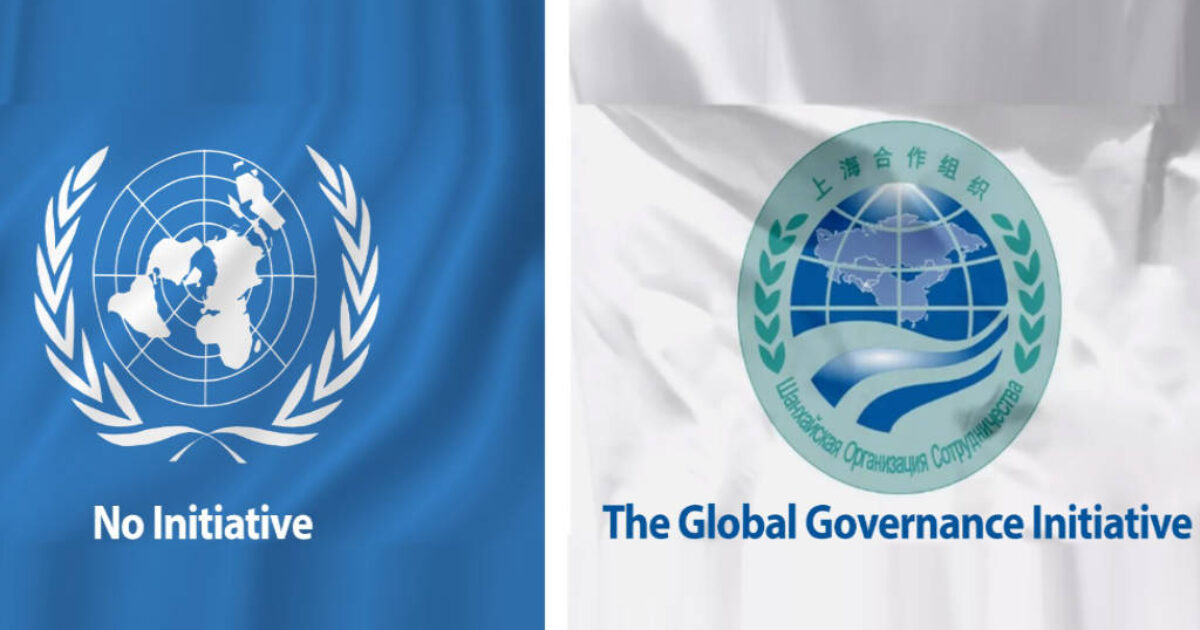
CCP officials have announced that China will host the first Xiong’an Global Governance Forum in Hebei Province this autumn and the APEC Economic Leaders’ Meeting in Shenzhen on November 18 and 19. Foreign Minister Wang Yi has listed both events among the next steps for implementing Xi Jinping’s Global Governance Initiative (GGI), Beijing’s plan to change how the world is governed.
Xi announced the initiative on September 1, 2025, at the “Shanghai Cooperation Organization Plus” meeting in Tianjin. It followed three earlier Xi frameworks: the Global Development Initiative in 2021, the Global Security Initiative in 2022, and the Global Civilization Initiative in 2023.
These initiatives continue an older CCP ambition. Two decades before the GGI, Hu Jintao called for strengthening global governance as part of building a “harmonious world.”
Wang Yi made the GGI’s target clear when he said “a few countries monopolize global governance” and that this should no longer continue. A concept paper released by the Chinese government on the day of the announcement says the initiative seeks to make existing institutions more responsive to developing countries without overturning the international order or building a framework outside it. Its five core concepts are sovereign equality, international rule of law, multilateralism, a people-centered approach, and “real results.”
The Group of Friends of Global Governance is Beijing’s vehicle for promoting the GGI inside the UN. Nearly 40 founding member states attended its launch meeting in New York on December 9, 2025, chaired by China’s UN ambassador, Fu Cong. The group has since added chapters in Geneva and Vienna. At the group’s May 2026 meeting, Wang Yi proposed nine areas for reforming global governance.
On June 17, 2026, the State Council Information Office released a white paper titled “More Just and Equitable Global Governance: China’s Principles, Proposals and Actions.” Beijing claims nearly 160 countries and international organizations have backed the GGI and more than 60 countries have joined the group. No independent membership list has been published.
The white paper calls on countries to uphold the UN-centered international system “instead of reinventing the wheel.” However, this call is no guarantee that the CCP will not hijack the existing UN-centered system while asking other countries to support it.
Beijing has paired this diplomacy with new institutions headquartered in China. The International Organization for Mediation, jointly initiated by 19 countries, including China, began operating in Hong Kong in October 2025.
On July 16, 2026, 29 countries signed an agreement in Shanghai establishing the World AI Cooperation Organization, headquartered there. Its founding members include Russia, Pakistan, Kazakhstan, Laos, and Indonesia. Beijing has also backed a World Data Organization in the capital and offered to host the secretariat of the UN high-seas biodiversity agreement in Xiamen.
The U.S.-China Economic and Security Review Commission has assessed that Xi’s three earlier initiatives seek to change global governance to serve Chinese Communist Party interests. Together, the commission wrote, they form a blueprint for replacing the rules-based order led by the United States and its allies.
According to the commission, under such a system, other states would respect or emulate China’s Party-state model, while human rights and democracy would no longer be treated as universal standards. The commission also found that working through UN platforms lowers Beijing’s coordination costs, lends legitimacy to its goals, and amplifies its influence.
Beijing is advancing the GGI as Washington reduces its participation in international bodies. On January 7, 2026, Trump signed a memorandum directing U.S. withdrawal from 66 international organizations: 31 UN entities and 35 non-UN bodies.
The White House said many promote radical climate policies, global governance, and ideological programs that conflict with U.S. sovereignty. The memorandum followed earlier U.S. exits from the World Health Organization, the Paris climate agreement, and the UN Human Rights Council.
Beyond the Trump administration, analysts differ in their assessments of China’s goals. The Mercator Institute for China Studies found that Beijing uses widely accepted terms to criticize the liberal order and build a coalition of states dissatisfied with the United States or the European Union. India’s Observer Research Foundation described the initiatives as a repackaging of familiar Chinese ideas under new names.
The China Observers in Central and Eastern Europe network argued that the GGI seeks to shift the balance of power within the existing order rather than replace it. Although these analysts differ on whether Beijing seeks to replace the international order or change it from within, their assessments point to a common goal: an international system that reflects China’s vision of global governance.
President Trump’s withdrawals from international organizations that undermine American sovereignty could also help shield the country from China’s malign influence. Americans must remain vigilant against that influence at home and continue to vote against future participation in transnational or supranational organizations. Washington must also counter Beijing’s influence by strengthening cooperation with U.S. allies through bilateral agreements.
The price of Brent crude oil on Monday morning topped $105 per barrel—a two-week high—amid an escalation in fighting between Saudi Arabia and the Yemeni Houthis, an Iran-aligned group. President Donald Trump said Saturday he may join Saudi Arabia’s retaliatory strikes following attacks by the Houthis including on the main international airport in Riyadh.
The skies over Riyadh were empty on Monday as Saudi Arabia maintained a suspension of operations at the airport.
Iran said Sunday night it had offered to mediate between Saudi Arabia and the Houthis. “Insisting on a military approach and ignoring a political solution will further complicate the current situation,” said a statement published by the Iranian foreign ministry on social media. While the Houthis are often described as a “proxy” of Iran, regional experts say they act independently of Tehran in pursuit of their own distinct objectives.
A 2022 truce between the Houthis and the Saudi-backed Yemeni government forces broke down in recent months. The resumption of fighting in Yemen, as well as successful Houthi attacks on Saudi Arabia, have raised fears of an escalating regional war drawing the U.S. and Iran back into major direct hostilities.
Iran’s national security advisor said Sunday that Tehran would target digital infrastructure in the Gulf if fighting with the U.S. resumed.
Less than one in three organizations leading the violent “student protests” in France are student groups or youth groups.
The rest of the groups are international agitators and communist groups.
They’ve launched their revolution on the West in France. How soon before these same communist, anarchist groups bring their violence to the streets of America!
Behind all of the chaos and street unrest is the American-born, Shanghai-based tech tycoon and communist Roy Singham.
Tech billionaire and communist Neville Roy Singham -screengrab
And, Roy Singham is central to all of these staged and paid for protest movements in the US today.
The fake news WILL NEVER report on this. They must agree with him.
And now, we learn that Neville Roy Singham is indirectly funding the rioting in France.
FOX News Digital also reported that less than one-in-three groups linked to the French protests are student or youth groups.
A Fox News Digital investigation has found that a transnational network of far-left communist and socialist organizations is seizing on France’s fiery student protests to advance a wider political and ideological agenda, using tactics deployed in the United States over the past decade to amplify unrest, deepen divisions and project an image of chaos.
Earlier in the week, BreakThrough News splashed another headline across the front of its website: “French students shut down schools in historic strike against austerity,” mobilizing “with support from unions and progressive forces.”
But those “progressive forces” aren’t limited to students demanding education reform as part of their “Lycéenne Mobilisation,” or high school student mobilization.
From France to the United States, the United Kingdom, Brazil, Greece and India, adults with deep pockets are tapping France’s school protests and turning a domestic education dispute into a platform for broader political and ideological confrontation. BreakThrough News is a pro-communist propaganda outlet based in New York City, funded by an American-born, Shanghai-based communist tech tycoon, Neville Roy Singham, who has financed a network of communist and far-left groups in the U.S. that have capitalized on grievances to stoke similar street unrest for almost a decade.
A Fox News Digital investigation traces how a movement that the media is mostly framing as students protesting deteriorating school conditions is actually part of an extensive infrastructure of unions, communist activists, far-left political parties and international media organizations that are organizing demonstrations, calling strikes, mobilizing supporters and broadcasting the unrest around the world with “BREAKING” alerts.
In a digital analysis of scores of news articles, social media posts and public statements, Fox News Digital has identified 50 organizations in the French student protest movement and its wider network of supporters and international amplifiers, revealing an activist ecosystem extending far beyond the students who launched the demonstrations.
Of the network of 50 groups, 15 are student or youth groups, including several communist youth movements and a Muslim student association.
From our previous reporting–
The Gateway Pundit’s Antonio Graceffo reported that Singham is the funder behind the communist part network that is fueling the anti-ICE protests across the US.
FBI Confirms Investigation Into Foreign Funding as Violence Spreads to 25+ Cities, and Cash Trail Leads Back to the Chinese Communist Party.
The anti-ICE riots engulfing Los Angeles and spreading to more than 25 American cities are not the spontaneous uprisings the mainstream media wants you to believe.
It all goes back to the Communist Chinese. Aren’t you glad the American presidents and political leaders helped shape that communist regime into what it is today?
Hamas, the Iranian-backed terrorist organization that slaughtered 1,200 Israelis and took hundreds of hostages on October 7, 2023, has just issued an official press statement celebrating the 2026 Nobel Peace Prize award to South African jurist Navi Pillay.
The terror group called the decision a “crucial step in the path of international accountability for war crimes in Gaza.”
The statement, dated 9 October 2026, opens with the Islamic invocation “In the Name of Allah, the Most Gracious, the Most Merciful” and declares that Pillay’s award “represents a crucial step in the path of international justice and a new international acknowledgment of the crimes committed by the occupation against our Palestinian people.”
Hamas specifically praised her chairmanship of the UN Independent International Commission of Inquiry and its September 2025 report that claimed Israel had committed genocide.
It also highlighted her earlier work defending African National Congress activists and her role as president of the International Criminal Tribunal for Rwanda.
Senior Hamas figure Bassem Naim described the award as a “message of hope for Palestinians in Gaza” because it supposedly shows that “humanity continues to resist the forces of evil that target international justice,” according to multiple reports of the statement.
The press release reads:
Honoring Navi Pillay a Crucial Step in the Path of International Accountability for War Crimes in Gaza
In the Name of Allah, the Most Gracious, the Most Merciful
The Islamic Resistance Movement (Hamas) affirms that the awarding of the 2026 Nobel Peace Prize to South African human rights advocate and judge Navi Pillay, in recognition of her career in defending human rights and promoting international law, particularly in the Palestinian territories, represents a crucial step in the path of international justice and a new international acknowledgment of the crimes committed by the occupation against our Palestinian people.
Pillay contributed to the defense of African National Congress activists in the face of the apartheid regime and served as President of the International Criminal Tribunal for Rwanda. This honor reflects a distinguished career in defending rights and holding perpetrators of international crimes accountable.
The findings reached by the Independent International Commission of Inquiry, chaired by Pillay, regarding the crimes committed in the Gaza Strip, and the conclusions of its report issued in September 2025 that a crime of genocide had been committed, underscore the gravity of what our people have endured and necessitate serious international action to translate the documented facts into legal measures and genuine accountability for those responsible.
BREAKING:
Hamas just issued a statement in support of Navi Pillay, the recipient of the Nobel Peace Prize.
The Nobel Peace Prize is a joke. https://t.co/uxqRMPQ6I5
The Gateway Pundit previously reported on the widespread outrage over the Nobel decision. Jewish leaders, including Israeli Prime Minister Benjamin Netanyahu, condemned the award. Netanyahu stated that the Nobel committee “has lost its moral compass” and had honored “a bigot who built her career around inventing and propagating blood libels against the one and only Jewish state.”
UN Watch also criticized the choice, citing Pillay’s prior public statements calling to “Sanction Apartheid Israel,” her letter to President Biden urging punishment of Israel after the May 2021 fighting with Hamas, and her defense of a fellow commissioner who invoked antisemitic tropes about “the Jewish Lobby.”
President Trump responded by noting that he had helped end multiple conflicts while the committee chose a figure largely unknown outside anti-Israel circles who, as he put it, “very obviously hates Israel.”
Pillay herself joked after the announcement that she might share the prize with Trump if people clapped enough, an odd quip given the context of last year’s laureate handing her medal to the American president.
The Nobel Committee cited Pillay’s long career promoting international law and accountability for war crimes, crimes against humanity, and genocide.
Critics point out that the prize has a history of controversial choices, including the 1994 award to Yasser Arafat alongside Israeli leaders, which prompted a Nobel committee member to resign in protest over Arafat’s terrorist record.