Secret Service Removes Gun From Home of Retired Professor Who Said He Wanted to “Shoot” President Trump During City Council Meeting (VIDEO)

Elderly man speaking at a public meeting with signs advocating for civil rights and community safety in the background.

Elderly man speaking at a public meeting with signs advocating for civil rights and community safety in the background.
Wesley Arnold via Warren City Council


The Secret Service has removed a gun from the home of a Michigan man who said he wanted to “shoot” President Trump.

On Tuesday night, during a Warren City Council meeting, retired professor Wesley Arnold stated, “I ordered a high-powered ATL 36X arriving shortly, which I hope to actually use to shoot the president of the United States. I’m not kidding.”

He added, “This is a very high, powerful item. It’s great for a headshot at a distance. I didn’t want it to be delivered by drone because I wouldn’t want something like that to be in the wrong hands.”

Due to his comments, the Secret Service later visited Arnold’s home and confiscated a gun from his residence.

WATCH:

Per Fox 2 Detroit:

A man said he wanted to shoot the President during public comments at the Warren City Council meeting Tuesday night. Now that man, Wesley Arnold, is being investigated by the Secret Service. He claims it is all a big misunderstanding.

“I just gave the Service Service my picture I took,” he said.

FOX 2: “You talked to the Secret Service?”

“They just left, they’re the ones that left before you got here,” said Arnold, 80. The Secret Service did remove a handgun from the home.

FOX 2: “The Secret Service just left, they didn’t arrest you though.”

“That may or may not happen we’ll see,” he said, adding that he isn’t worried. “No, I’m a harmless old man and I believe in freedom of speech.”

However, Arnold’s comments appear to be just a bad joke.

Warren City Council President Angela Rogensues stated, “He (Arnold) came up after the meeting to clarify he was referring to a camera lens. I think Mr. Arnold was trying to be a bit cheeky and clever in his rhetoric.”

Arnold told local outlet C&G News, “I have no intent, absolutely no intent of shooting the president. I don’t particularly like Mr. Trump. He’s done some lousy things. He’s done some good things.”

Despite notifying the City Council that he was referring to a camera, Warren Police Lt. John Gajewski filed a police report and contacted Federal partners.

The post Secret Service Removes Gun From Home of Retired Professor Who Said He Wanted to “Shoot” President Trump During City Council Meeting (VIDEO) appeared first on The Gateway Pundit.

Kamala Harris POWER PLAY Stuns Conservatives…

Kamala Harris teases a 2028 presidential run despite her crushing 2024 defeat to President Trump, signaling Democrats’ refusal to abandon failed leadership.

Harris Exits Governor Race, Eyes National Stage

On July 31, 2025, Kamala Harris announced she would not seek the governorship of California in 2026. She cited deep reflection and a commitment to Democrat values through new methods outside elected office. This move ended months of speculation tied to Gavin Newsom’s term limits. Instead, Harris hinted at broader ambitions, planning nationwide Democrat support, a book, and a political organization. Her decision shifts attention from state politics to a potential White House return, frustrating conservatives who see it as a dodge of accountability for past failures.

Book Tour and DNC Moves Signal 2028 Intent

Harris launched her book tour for “107 Days,” detailing her 2024 campaign, starting early 2025. By December 2025, she expanded stops to South Carolina, Jackson (Mississippi), Memphis (Tennessee), and Montgomery (Alabama)—early primary hotspots with strong Black voter bases. At the DNC’s winter meeting in Los Angeles, she criticized bipartisan failures, calling Trump a “symptom” of deeper issues. Attendees chanted “You!” in 2028 encouragement. Spokesperson Kirsten Allen emphasized midterm engagement and future shaping, keeping options open without formal commitment.

Polling Strength Amid Electability Concerns

Harris leads early 2028 Democrat primary polls, such as Morning Consult, particularly among Black voters—a crucial bloc. She outpaces rivals like Newsom and JB Pritzker. DNC Chair Ken Martin provided subtle boosts at events. Supporters like United Farm Workers showed enthusiasm at a December gala.

Yet party insiders question her electability after her 2024 loss to Trump. Axios describes her actions as initial steps toward a campaign, blending optimism from base support with skepticism over broader appeal. Conservatives view this as Democrats clinging to divisive figures.

Doug Emhoff, her spouse, gained visibility as a potential “first gentleman.” Rivals like Pritzker fundraised separately, highlighting competition. Harris’s team focuses on midterm travel starting fall 2025 and UFW advocacy. No formal 2028 campaign exists yet, but nationwide efforts sustain viability. This positioning energizes Democrat bases while pressuring competitors. For Trump supporters, it underscores the left’s persistence in promoting leaders tied to open borders, inflation, and woke policies that burdened American families.

Impacts on Democrats and 2028 Landscape

Harris’s opt-out reshapes California’s 2026 governor race, advancing contenders like Xavier Becerra and Katie Porter. Short-term, it boosts the Democrats’ midterm energy. Long-term, she consolidates anti-Trump forces or fragments the primary field. Black communities see a prominent advocate; rivals face poll pressure. Politically, her “disrupt the status quo” messaging pivots Democrats amid Trump’s successes in securing borders and the economy. Conservatives celebrate Trump’s mandate but remain vigilant against Harris reviving globalist agendas that eroded family values and national sovereignty.

Sources:

Axios: Kamala Harris president 2028

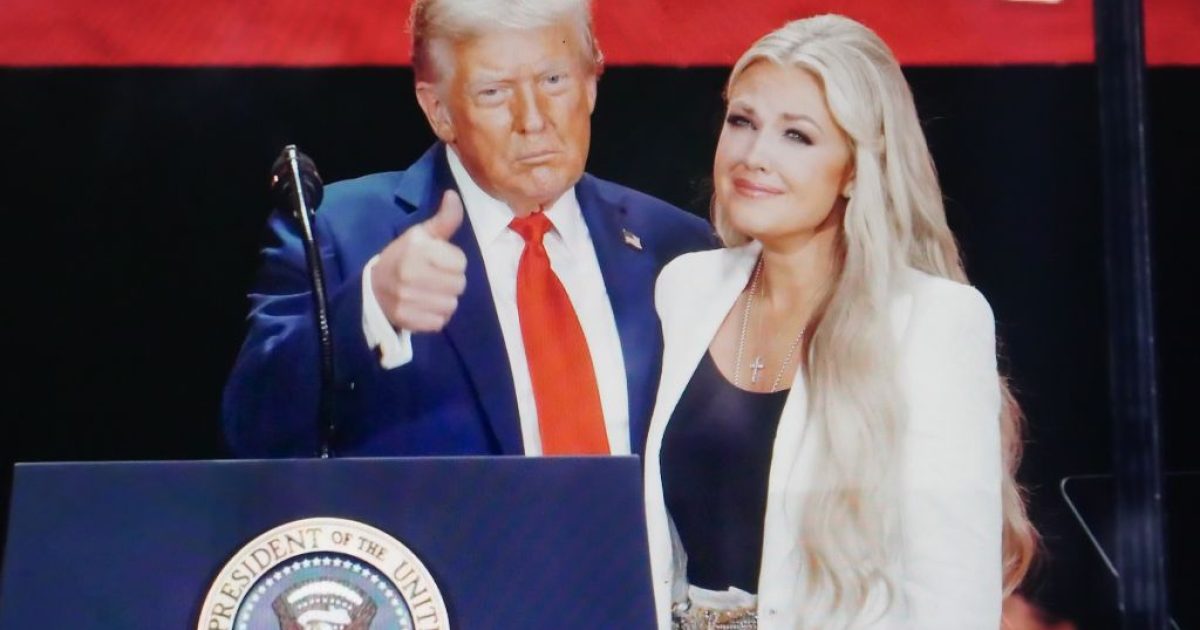
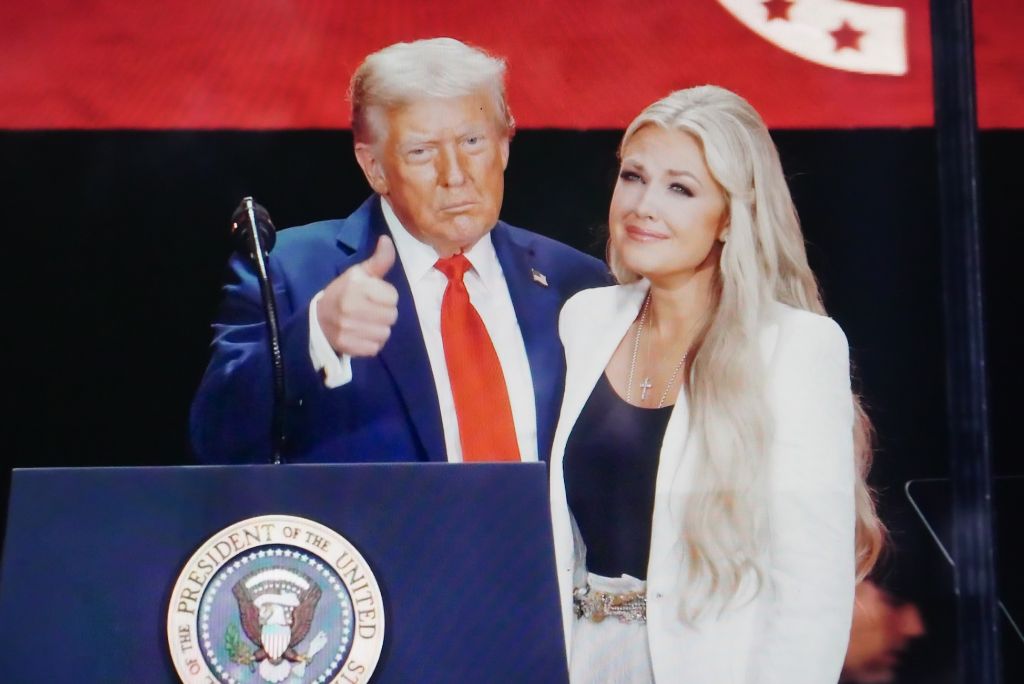
Trump Honors Erika Kirk at the 2026 State of the Union and Introduces Her as the Widow of Charlie Kirk, “Martyr of Freedom”

Donald Trump giving a thumbs up while standing next to a woman in a white blazer at a public speaking event with a presidential seal backdrop.

Donald Trump giving a thumbs up while standing next to a woman in a white blazer at a public speaking event with a presidential seal backdrop.


This is a Gateway Hispanic article.


The post Trump Honors Erika Kirk at the 2026 State of the Union and Introduces Her as the Widow of Charlie Kirk, “Martyr of Freedom” appeared first on The Gateway Pundit.

Trump’s China Trade War Deepens Beijing’s Economic Vulnerability – Implications for a Taiwan War

Automotive assembly line featuring workers and robotic arms engaged in vehicle manufacturing with sparks flying from welding operations.

Automotive assembly line featuring workers and robotic arms engaged in vehicle manufacturing with sparks flying from welding operations.
Photo courtesy of China Daily

As of February 2026, U.S. tariffs have significantly slowed China’s economic growth without collapsing its export sector.

Direct exports to the United States fell roughly 20 percent in 2025, but China offset much of that loss by redirecting trade, reaching a record $1.2 trillion trade surplus by early 2026.

Exports surged to ASEAN by 13 percent, Africa by 26 percent, and Latin America by 7 percent, cushioning the blow from the U.S. market.

Some goods continue to be routed through intermediary countries such as Vietnam and Mexico to avoid China-origin tariffs, a practice Washington is increasingly targeting.

The more meaningful damage is visible in growth and profitability. Economists estimate that cumulative U.S. tariff actions since 2025 have reduced China’s annual GDP growth rate by approximately 1.5 percentage points, or 150 basis points.

This refers to a direct reduction in the headline growth rate. For example, if baseline growth had been 6 percent, a 1.5 percentage point drag lowers it to about 4.5 percent.

Current projections place China’s 2026 GDP growth between 4.5 and 4.8 percent, below the long-standing 5 percent-plus targets and reflective of cooling industrial momentum.

During the peak of the 2025 emergency tariffs, the drag was estimated at 2.5 to 3 percentage points, pushing growth toward 4 percent.

After the February 20, 2026 Supreme Court ruling struck down the IEEPA-based emergency tariffs and replaced them with a 15 percent Section 122 global surcharge effective February 24, the drag moderated to roughly 1.5 percentage points.

Despite record trade volumes, structural weaknesses are deepening. To remain competitive under tariff pressure, Chinese factories have cut prices aggressively, contributing to persistent producer price deflation and squeezing manufacturing profits.

Low-margin final assembly operations are shifting abroad to avoid the China-origin label, contributing to gradual manufacturing hollowing. Meanwhile, foreign direct investment remains weak as companies delay long-term commitments amid trade uncertainty.

In sum, U.S. tariffs have not crushed China’s export machine, but they have reduced growth, compressed profits, and intensified structural strain.

Beijing has preserved trade volume through diversification, yet the quality and profitability of that trade have declined, leaving the economy more vulnerable even as surplus figures reach record highs.

The idea that the trade war deepens China’s economic vulnerability and influences the likelihood of a Taiwan conflict has become central to 2026 geopolitical analysis.

Although Beijing has pivoted toward a “fortress economy” strategy, cracks have emerged. China enters 2026 grappling with a fragile property sector, high youth unemployment, and massive local government debt.

The trade war compounds these pressures by constraining the export engine Beijing relies on to offset weak domestic demand.

The “Silicon Shield” theory holds that Taiwan’s dominance in advanced semiconductor manufacturing, producing roughly 92 percent of the world’s most advanced chips, makes war prohibitively costly for China. In 2026, however, that assumption is being tested by competing pressures.

Economists estimate that even a limited conflict or blockade in the Taiwan Strait could trigger between $2 trillion and $10 trillion in global economic losses. Beijing understands that such a shock could destabilize its economy and strain the social contract tied to rising living standards.

At the same time, U.S. Commerce Secretary Howard Lutnick has pressed to bring 40 percent of Taiwan’s semiconductor supply chain to the United States by 2029.

While intended to reduce American exposure, some analysts argue that decreasing global dependence on Taiwan could unintentionally weaken the very “Silicon Shield” that has helped deter conflict.

The relationship between economic vulnerability and the risk of war is a double-edged sword. One school of thought argues economic deterrence: Beijing’s fragility makes a full-scale invasion unlikely in 2026.

The CCP’s legitimacy is tied to economic stability, and a war triggering near-total embargoes and disrupting roughly 20 percent of GDP tied to exports could generate domestic unrest threatening party control.

The opposing view is the “cornered tiger” risk. If trade war pressures and technology decoupling continue degrading China’s industrial base, Beijing may conclude time is not on its side.

If leaders believe the United States will eventually achieve escalation dominance or permanently alter Taiwan’s status through policy shifts, they may choose to act while they still perceive relative military parity.

A complicating factor is the Trump administration’s more transactional posture, at times framing Taiwan within broader trade negotiations.

This has created strategic anxiety in Taipei, even as Washington has approved record $11 billion arms packages for the island.

High tariffs have reduced China’s growth and contributed to capital flight, while potentially lowering the likelihood of war due to CCP concerns about economic destabilization.

Conversely, technology decoupling has restricted China’s access to advanced AI and high-end semiconductors, which could increase the risk of conflict if Beijing believes its window of opportunity is narrowing.

Ultimately, while the trade war has made China more economically vulnerable, it has also increased geopolitical unpredictability.

The post Trump’s China Trade War Deepens Beijing’s Economic Vulnerability – Implications for a Taiwan War appeared first on The Gateway Pundit.

Focus Group Member on Democrats at SOTU: ‘They Gave a Middle Finger to the Oath of Office They Took’ (VIDEO)

Screencap of Twitter/X video.

Today on the Will Cain Show, a focus group made up of voters of varying backgrounds reacted to Trump’s State of the Union address.

One member, a young woman named Ajua Mason, who is a Republican, reacted to the behavior of Democrats during the speech by saying that they “gave a middle finger to the oath of office that they took.”

It’s really a perfect description of what the Democrats did. It was a disgusting display on multiple levels.

Transcript via Real Clear Politics:

WILL CAIN, FOX NEWS HOST: Democrats, but do you think there’s anything deeper to the fact that they would not stand in that moment when they were describing the job of an American congressman?

TAMMY WOODARD, REPUBLICAN VOTER: I do. I think it’s shameful that they wouldn’t stand. I mean, what is their job but to represent us and our interests first above anything else? And to not be able to just stand for that, it’s, it’s just wrong. It doesn’t make them look good.

AJUA MASON, REPUBLICAN VOTER: The way I viewed it last night watching it is that they gave a middle finger to the oath of office that they, that they took. In fact, their new oath of office is oppose Trump on anything, on any situation. The one thing that they seem to want to come together on is to oppose Trump. Trump could find a cure for cancer and they would, they would find a reason to disagree with it.

CAIN: Yeah.

MASON: And I don’t know if that is just their strategy to get them through the midterm or whatever, but I think that if, if it’s just about opposing Trump, I don’t think that the people that elected them sent them there to do that. Number one, it is about the American people first. You got to take care of home. You got to take care of your family before you can take care of, or try to help to take care of someone else’s.

Here’s the video:

Perfectly stated.

Democrats should listen to this young woman. She has more common sense than all of them combined.

The post Focus Group Member on Democrats at SOTU: ‘They Gave a Middle Finger to the Oath of Office They Took’ (VIDEO) appeared first on The Gateway Pundit.

The Immigration Angle to the Epstein Scandal

The Immigration Angle to the Epstein Scandal

The late sex trafficker had no problem bending American immigration law for his “girls,” with a little help from Democratic officials.

Patrick McMullan Archives

Democrats are exulting over their brilliant move of bringing Jeffrey Epstein “survivors” to Trump’s State of the Union address. (It didn’t seem to faze him.) I gather that this means Democrats and the media have moved on from their complete indifference to Epstein’s victims to deep concern. Notwithstanding their current garment-rending, liberals could not have been less interested in Epstein’s victims when they first came forward.

Back in 2006, across the entire national news landscape, only Fox News’ Bill O’Reilly billboarded Epstein’s sex crimes, and attacked the first government official to betray the girls, Palm Beach D.A. Barry Krischer. Incomprehensibly, he had intentionally thrown the case, hitting Epstein with a single charge of soliciting prostitution. Federal prosecutors stepped in to take up the case, only to let Epstein off with a non-prosecution agreement in exchange for a $30-a-month fine and a promise of good behavior for 18 months.

The New York Times ran a single article on the sweetheart deal—on page A-19, under the riveting headline “Questions of Preferential Treatment Are Raised in Florida Sex Case.” (That almost beats the winner of Michael Kinsley’s Most Boring Headline Contest: “Worthwhile Canadian Initiative.”)

Over the next 10 years, the Times seems to have run only four more articles about the underage sex ring until someone in the newsroom shouted, OMG! Trump and Epstein had once been friends!

Surprised by the media’s sudden interest in his sexual depredations, Epstein himself emailed journalist Michael Wolff in 2018, saying, “Dems think I have the silver bullet.”

Whether we’re supposed to “Believe Women!” or “Ignore Women!” evidently rests entirely on the media’s ability to assemble a link between Epstein and Trump with Scotch tape and chewing gum. And no, we would rather not discuss Epstein’s consorting with Democrats Bill Clinton, George Mitchell, Bill Richardson and Larry Summers.

But as long as we finally have the media’s attention, perhaps they’d be interested in knowing how simple it was for Epstein to traffic his sex slaves into the U.S. under our immigration laws.

The bulk of Epstein’s sexual playthings came from Eastern Europe, as indicated by innumerable witness statements and the hundreds of flight itineraries for females from Russia, Poland, Belarus, Latvia, and Ukraine. (As any number of lonely American guys can tell you, 50 years of communism really did a number on the morals of Eastern European girls.)

Epstein operated like the worst of American corporations, getting his concubines here with phony student visas, work visas, sham marriages and English language visas. (Yes, you can get a visa to come to our country simply in order to enroll in an English language class, although this strikes me as putting the cart before the horse.)

Consider how Epstein gamed our immigration laws on behalf of his Belarus girlfriend, Karyna Shuliak.

Fraud No. 1: Epstein first brought Shuliak to the U.S. on a student visa to attend Columbia’s dental school, despite the fact that she’d never received a bachelor’s degree, an admission requirement.

Fraud No. 2: Shuliak had also requested asylum, meaning she’d simultaneously filed two completely contradictory immigration applications. Student visas require the applicant to prove an intent to return to her native country, whereas asylum requires the exact opposite: proof that the applicant is being persecuted in her native country and wouldn’t return if you threatened her with hot pokers.

Fraud No. 3: After Shuliak overstayed her visa, Epstein called on some Democrat bigwigs to bend the law for her. Specifically, Greg Craig, Clinton’s special counsel on the impeachment trial (Craig has an illustrious history of going to bat for sexual predators!) and—guess who!—Alejandro Mayorkas, who, as head of Obama’s INS, was apparently available to perform special favors for Jeffrey Epstein. (In a country of laws, knowing somebody who knows a guy is not supposed to be the path to citizenship.)

Fraud No. 4: Whether on their advice or his own initiative, a few months later, Epstein arranged for Shuliak to “marry” another one of his girls, “Jennifer.” This is the same Jennifer whom Epstein had directed to date Elon Musk’s brother in a futile attempt to ingratiate himself with the Space X founder.

On the basis of these four sleazy maneuvers, Shuliak became a U.S. citizen in 2018—and promptly divorced her fake “wife.”

Democrats keep carrying on about Trump’s “racist” immigration policies, on the grounds that—although Biden alone rushed in more than 4 million Latin Americans, 700,000 Venezuelans and 400,000 Haitians—Trump’s admission of 59 white South Africans is straight out of the Nazi playbook.

I will leave it to you to parse the logic there, but you know what would be a great way for Trump to prove he won’t admit just anyone for being white?

How about deporting Epstein’s immigration-scamming, Eastern European hustlers, and disbarring the lawyers who enabled their frauds?

COPYRIGHT 2026 ANN COULTER
DISTRIBUTED BY IMPOLITE DEBATES

The post The Immigration Angle to the Epstein Scandal appeared first on The American Conservative.

Can the UK Populists Remain Popular?

Can the UK Populists Remain Popular?

The Reform juggernaut could run aground on fiscal policy.
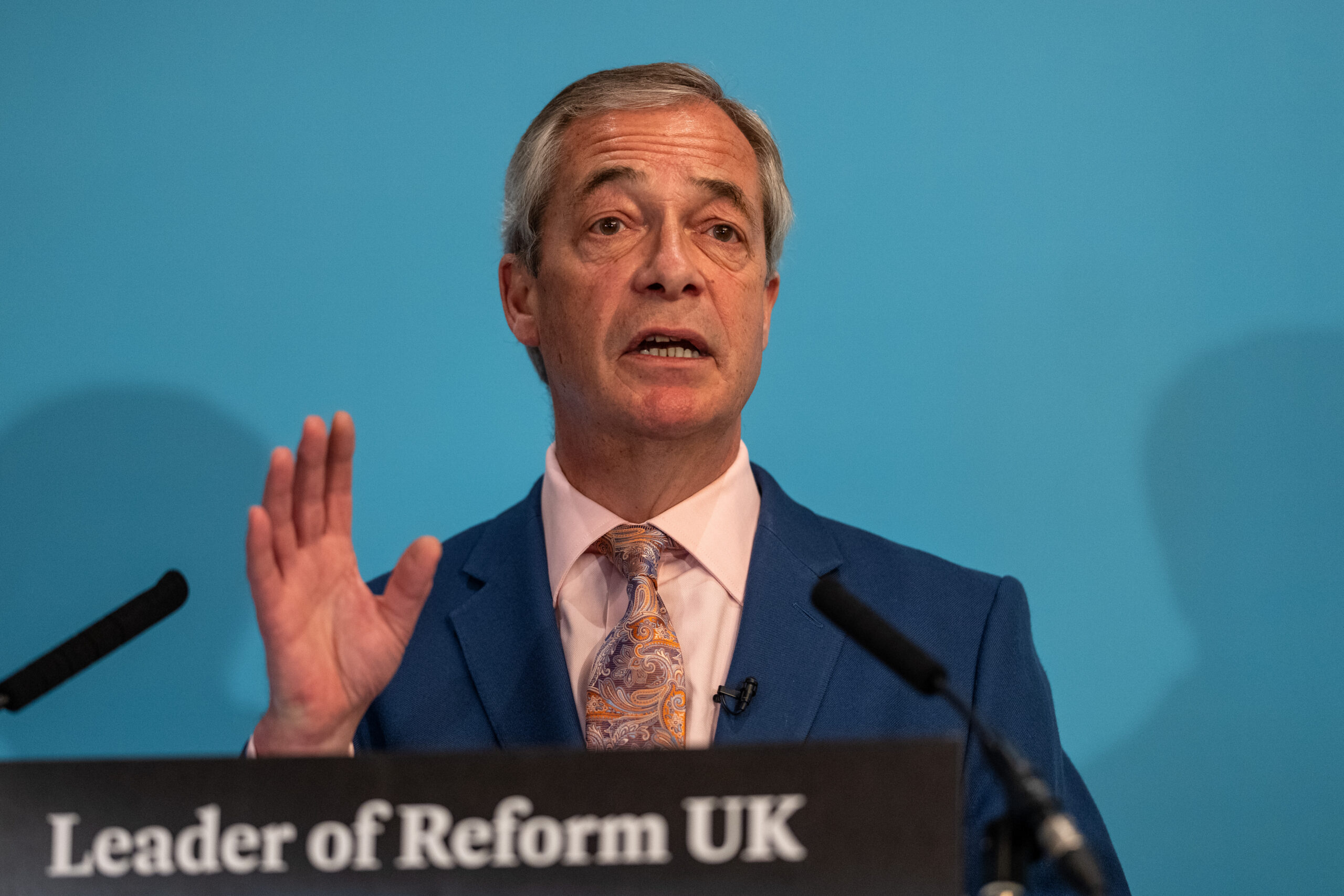
Reform UK's Zia Yusuf Gives A Speech In Dover
UK Special Coverage

The paramount aim of populist nationalist parties like the Rassemblement National (RN) in France, the Scottish National Party (SNP), or Reform UK is to be, well, popular. That may seem a banal observation, but their success depends on appealing to the widest possible range of voters, albeit united by their love of country and opposition to the dilution of national culture by immigration. Coherent policies on economics, tax, and spending come second to la Patria.

Reform has dominated the British opinion polls for most of the last year and could be the next government. Yet, true to form, it offers a ragbag of disparate policies drawn from right and left. 

Reform UK has supported nationalization of water companies, redistributing tax money to lower earners, and increased spending on public services like the NHS, police, and prisons. It even called for a £20 billion raid on commercial bank profits by scrapping Bank of England interest payments on reserves created through Quantitative Easing.

Until this week, Nigel Farage also appeared to support the abolition of Britain’s most controversial welfare policy: the two-child cap on benefits. Paid to those in Universal Credit, this benefit is worth over £3,000 a year per UK child. The cap was introduced by the Conservatives in 2015 on the grounds that it is unfair for people on benefits to afford larger families than working couples not on benefits.

In her recent budget, Labour’s Chancellor Rachel Reeves abolished the two-child cap, claiming that it was a major cause of child poverty. Reform UK agreed with the abolition—until last week, when their new treasury spokesman, Robert Jenrick, announced that he would restore the cap as part of an assault on Britain’s unaffordable benefits bill.

Jenrick wants to support “alarm-clock workers” and stop them having to fund, through their taxes, an army of working-age benefits claimants which has grown to some 10 million according to the UK government’s figures. Health-related benefits alone are scheduled to rise to nearly £100 billion in the next four years. 

But all this talk of fiscal rectitude and welfare cuts comes at a price. In compassionate Britain, no one talks of benefit “scroungers” any more—at least not in public. The problem with Britain’s social democratic state is that many voters support it. 

A majority wish to see more money for the inefficient National Health Service, which now accounts for nearly half of all day-to-day departmental government spending. There is genuine loathing of utility companies like energy and water, and state ownership is approved by a majority of British voters, as are higher taxes on the wealthy.

It may come as a shock to discover just how socialist the UK has already become. The state now consumes 45 percent of GDP. At 36 percent, the overall tax burden is the highest since the Second World War. The overall benefits bill, including the state pension, is now over £300 billion.  The Labour government abandoned its attempt to curb disability benefits after a backbench rebellion by Labour MPs afraid of blowback from voters who have come to expect these benefits.

But the picture painted by the left-wing Green Party, which is leading the latest opinion poll for today’s Gorton and Denton by-election, is of Britain as a workhouse-stricken Dickensian land dominated by greedy billionaires and fascist right-wingers. Many voters seem to agree with this portrayal. Yet it is almost comically wide of the truth.  

Income inequality, measured on the internationally-recognized Gini coefficient, is lower than during the last Labour government. The national minimum wage, at two-thirds of median earnings, is higher than ever. Diversity mandates apply throughout the public and most of the corporate sector.

Capitalism is seen by many Brits as inherently immoral. Seventy percent of young voters say they want a socialist system. The wealth taxes and rent freezes offered by the charismatic Green leader, Zack Polanski, are absurdly popular, though even Labour-supporting tax experts say they don’t work. 

Winding back these socialist aspirations and abolishing benefit entitlements is going to be an immense task. There is no doubt that things need to change and that Britain can no longer afford its quasi-socialist economy. But people don’t want realism—or at least the UK media doesn’t. There is outrage whenever a government attempts to curb benefit entitlements, like disability benefits, even though there is evidence they are abused.

Voters want more money spent on public services as well as lower taxes. Many seem to believe this can be paid for by taxing the rich, even though the top 1 percent of earners already pay nearly 30 percent of income tax revenues. Indeed, the top 0.1 percent pay more than the bottom 50 percent of UK earners combined.

Attacking the “1 percent” is irrational. The wealthy bring businesses and jobs to Britain and finance the National Health Service. The hated billionaires are leaving Britain and taking their businesses and taxes with them. This is partly because of the threat to their assets posed by confiscatory inheritance taxes introduced by Reeves. Britain arguably needs more wealthy people and more enterprise to promote growth. 

But Jenrick has already had to promise not to cut taxes. Some in Reform sound as if they would  prefer to follow the approach of the most successful national populist party in Europe: the Scottish National Party.

The SNP has increased income taxes in Scotland to an even higher level than the rest of the UK. It is currently spending some 30 percent more on public services than England, according to the Institute for Fiscal Studies. The Scottish government has abolished university tuition fees and introduced a £20-a-week Scottish Child Payment on top of UK child benefits. 

The SNP has nationalized the rail service and introduced a raft of giveaways like free prescriptions, free bus travel for under-22s, and the Baby Box of maternity products that New York’s Mayor Zohran Mamdani recently sought to emulate.

And it seems to work. The nationalists have been in government for nearly 20 years, and are on course to win a fifth consecutive term in May.  Of course, Jenrick would say that it is time Scotland learned to live without UK fiscal transfers through the Barnett Formula on public spending. But spending public money is popular.

The RN in France has learned from the SNP and is offering social protectionism as well as economic protectionism. The supposedly “far-right” party, which has been on the cusp of power in recent legislative elections, is promising to reduce the retirement age for French workers, increase workers’ rights, and promote social housing, along with more traditional right-wing policies on immigration and borders.

This is the trouble with populism. It is not really interested in talking truth to the people, to paraphrase the left-wing cliche. Jenrick will face immense pressure to keep Reform policy vague and in line with public prejudices while it concentrates on its core issue of immigration and defending “Christian culture,” as the deputy leader, Zia Yusuf, has described its mission. The problem with that is that the New Testament is generally regarded as the property of the left.

The post Can the UK Populists Remain Popular? appeared first on The American Conservative.

Three Things to Remember If U.S. Bombs Iran

Three Things to Remember If U.S. Bombs Iran

War was chosen, not inevitable.

Israel Launches Strikes Against Iran

Credit: Stringer/Getty Images

The air and sea power that is massing near Iran is terrifying. The same aircraft carrier that was deployed to Venezuela is now on its way to Iran, where it will join a second aircraft carrier. They are accompanied by guided missile destroyers, cruisers, submarines, hundreds of fighter jets, and ballistic missile defense systems. Axios reports that “the Trump administration is closer to a major war in the Middle East than most Americans realize.”

Sometimes, U.S. President Donald Trump has set the red line by saying simply that Iran can have “NO NUCLEAR WEAPONS.” At other times, he has said that a deal must include zero enrichment in Iran. When asked why the U.S. is considering bombing Iran, though, White House Press Secretary Karoline Leavitt said, “There are many reasons.” But she listed none. She then said that Trump’s previous Operation Midnight Hammer mission had “totally obliterated Iran’s nuclear facilities.”

There are three things to remember if the U.S. goes to war with Iran: It was never about nuclear weapons, it was never about helping the Iranian people, and Iran was genuinely negotiating a diplomatic solution.

First: It was never about nuclear weapons. If it were, there would be no urgency because the White House claims to have obliterated Iran’s nuclear facilities. 

More importantly, the U.S. does not believe Iran is building a nuclear weapon. The 2022 U.S. Department of Defense Nuclear Posture Review concludes that “Iran does not today possess a nuclear weapon and we currently believe it is not pursuing one.” That assessment was maintained in the 2025 Annual Threat Assessment, which “reflects the collective insights of the Intelligence Community,” and clearly states that U.S. intelligence “continue[s] to assess Iran is not building a nuclear weapon and that [Ayatollah Ali] Khamenei has not reauthorized the nuclear weapons program he suspended in 2003.”

And, if it were ever about nuclear weapons, then Trump would not have pulled out of the JCPOA nuclear agreement with Iran in his first term. That agreement successfully restricted Iran to enriching uranium to levels necessary for civilian use but insufficient for military use. Multiple consecutive International Atomic Energy Agency reports verified that Iran was completely and consistently in compliance with the commitments made under that agreement. The JCPOA nuclear agreement assured Iran would not build a nuclear bomb. If going to war with Iran were about nuclear weapons, Trump would not have pulled out of the deal.

Second: If the U.S. goes to war with Iran, it will not be to help the people of Iran. The U.S. has never been concerned with the people of Iran. If the U.S. were concerned with the welfare and wishes of the people of Iran, it would never have supported the coup that took out their democratically elected leader, Mohammad Mosaddegh, in 1953. It never would have installed the savage and repressive dictatorship of Shah Mohammad Pahlavi. It never would have supported the Shah’s murderous SAVAK secret police and their notorious torture chambers.

More recently, if the U.S. were concerned with helping the people of Iran, it would not use their suffering as the way to bring about that goal. The U.S. attempted to instigate a coup by bringing the Iranian people out to the streets in mass protest. But it brought them out into the streets by starving them. 

Iranians took to the streets initially to protest a cost-of-living crisis largely brought on by American sanctions. It was U.S. policy to bring about its goal of regime change by causing economic suffering to the people of Iran. U.S. Treasury Secretary Scott Bessent explained that “the Iranian currency was on the verge of collapse… President Trump ordered… maximum pressure on Iran. And it’s worked, because in December, their economy collapsed… and this is why the people took to the street. This is economic statecraft… Things are moving in a very positive way here.”

On February 5, Bessent again boasted of this deliberate policy. He told the Senate Banking Committee that “what we have done is created a dollar shortage in the country… The Iranian currency went into free fall, inflation exploded, and hence we have seen the Iranian people out on the street.” 

Finally: If the U.S. bombs Iran, it will not be because Iran was unwilling to negotiate. Iran was willing to put itself under maximum inspections, to convert its stockpile of 60 percent enriched uranium, cease high-level enrichment, and cap its enrichment at the 3.67 percent needed for a civilian energy program.  Under a second proposed solution, Iran was potentially willing to limit their role in the enrichment cycle by becoming a member of a nuclear enrichment consortium.  The consortium could include Saudi Arabia, the United Arab Emirates, and perhaps others. Enrichment would be capped at the 3.67 percent required for civilian use and monitored by the International Atomic Energy Agency. Most importantly, a consortium would allow Iran to enrich uranium but deny it access to the full enrichment process by distributing various roles in the process across different member states.

At the most recent round of talks, Iran reportedly indicated a willingness to compromise even further. Iranian officials told the New York Times that Iran was willing to dilute its stockpile of enriched uranium, suspend nuclear enrichment for three to five years, and then join the already proposed nuclear consortium. The head of  the Atomic Energy Organization of Iran, Mohammad Eslami, has suggested that the dilution of Iran’s 60 percent enriched uranium was conditional on sanctions being lifted.

All of this is more than Iran has to do, since, as a signatory to the Nuclear Non-Proliferation Treaty, Iran has “the inalienable right to a civilian program that uses nuclear energy for peaceful purposes.” But this diplomatic willingness would satisfy Trump’s hard redline of no weapons and no ability to enrich uranium on its own.

There is a clear diplomatic path to peace with Iran. If that path is not taken, it will not be because Iran was unwilling to negotiate and compromise, it will not be because of U.S. concern for the well-being of the Iranian people, and it will not be because the U.S. prioritizes preventing Iran from building a bomb.

The post Three Things to Remember If U.S. Bombs Iran appeared first on The American Conservative.

Trump Actually Gained Support During SOTU Speech Reports… CNN (VIDEO)

Screencap of Twitter/X video.

Last night after Trump’s State of the Union address, CNN did some snap polling and found that Trump actually gained support during the course of the speech.

Can you even imagine how upsetting this news must be for Democrats?

David Chalian revealed that 64 percent of people who watched the speech believe that Trump’s policies will move the country in the right direction.

All the Democrat noise about the speech is simply that. Noise.

The Washington Examiner reports:

President Donald Trump‘s record-breaking State of the Union speech Tuesday night resonated with more than 6 in 10 prime-time viewers, according to a flash CNN poll.

The survey, conducted by SSRS, showed 64% of respondents had a very or somewhat positive reaction to Trump’s address, which lasted nearly two hours and was the first of his second term. By contrast, just 36% said they had a somewhat negative or very negative response.

In more positive news for Trump, 65% said they had a lot or some confidence in Trump’s ability to provide “real leadership” for the country, compared to the 35% who said they had no confidence.

The poll also found that 64% believe the policies Trump proposed will move the country in the right direction, with another 36% saying the policies would move the nation in the wrong direction.

During his speech, Trump called on lawmakers to ban institutional investors from buying up single-family homes, asked for them to codify his executive order giving “most favored nation” pricing for prescription drugs, and supported a crackdown on insider trading by members of Congress.

See the clip below:

Note how Jake Tapper had to interject with a comment about ‘red meat’ for the base. He is incapable of getting through a segment about Trump without saying something snarky and obnoxious.

Trump’s speech was very effective, not just in highlighting his policies, but for revealing the Democrats to be complete lunatics.

The post Trump Actually Gained Support During SOTU Speech Reports… CNN (VIDEO) appeared first on The Gateway Pundit.

OUTRAGEOUS: Florida House Democrats Oppose Bill Honoring TPUSA Founder Charlie Kirk — Insist He Was “Not Assassinated,” but Died from “Gun Violence”

A woman speaks into a microphone in a legislative setting, with colleagues and a colorful mural in the background, highlighting civic engagement and dialogue.

A woman speaks into a microphone in a legislative setting, with colleagues and a colorful mural in the background, highlighting civic engagement and dialogue.
Rep. Ashley Viola Gantt

The radical Left’s hatred for conservative heroes apparently follows them even to the grave.

In a disgusting display of partisan spite, Florida House Democrats spent Wednesday afternoon attempting to block a bill that would honor the late Turning Point USA founder and conservative icon Charlie Kirk.

Despite Kirk being gunned down in cold blood while exercising his First Amendment rights at a rally in Utah last September, Florida Democrats took to the floor to argue that the man who inspired millions of young patriots was “mediocre” and, wait for it, was not actually “assassinated.”

Instead, these radical lawmakers insisted that the targeted political killing of a prominent conservative leader should merely be classified as “gun violence.”

The bill, HB 125, which designates October 14 as “Charlie Kirk Day of Remembrance,” was sponsored by Rep. Yvette Benarroch (R-Marco Island).

Benarroch described the bill as a tribute to a man who “encouraged a generation to read the Constitution and love this great country.”

The measure cleared the chamber by a vote of 82–31, with nearly all opposition coming from Democrats.

But during committee deliberations, Florida House Democrats took issue with language describing Kirk’s death as an assassination, instead insisting it should be categorized more broadly as an act of “gun violence.”

Democrat State Rep. Ashley Viola Gantt openly objected to the bill’s wording.

Rep. Ashley Viola Gantt:
“We want to talk about the exercise of free speech. Let’s ball.

The First Amendment protects free speech. We don’t need this day of remembrance for a man who was mediocre and racist—I say mediocre at best. He was not a Floridian. He had no ties to Florida other than owning property. We have a number of Floridians—both individuals and organizations—that promote free speech that is not divisive like this individual was.

If we want to talk about free speech, let’s talk about being precise with our words. When we hear “assassination,” that’s typically related to a person in a political position. Charlie Kirk died from gun violence. We continuously advocate for gun policy—legislation that would ensure that people who probably shouldn’t have a gun don’t have a gun.

Was his passing tragic for those who loved him? Absolutely. There is no denying that. But he was not assassinated, and words being accurate matters. It was a death by gun violence. That is an issue here in the country that we should all be on the same page about addressing.

And if we want to talk about free speech, a lot of people say, “That was some white-on-white crime.” Why aren’t we addressing it in that regard? What are we doing about white-on-white crime? So, Charlie Kirk was not someone whom children in the state of Florida should be subjected to honoring.”

WATCH:

The post OUTRAGEOUS: Florida House Democrats Oppose Bill Honoring TPUSA Founder Charlie Kirk — Insist He Was “Not Assassinated,” but Died from “Gun Violence” appeared first on The Gateway Pundit.