In a breathtaking finish, American marathoner Nathan Martin delivered a dramatic last-minute surge to win the 2026 Los Angeles Marathon, beating Kenya’s Michael Kimani Kamau by an astonishing 0.01 seconds, the closest finish in the race’s 41-year history.
The 36-year-old American runner staged an incredible comeback in the final miles of the 26.2-mile race, chasing down Kamau after the Kenyan had led much of the closing stretch.
Martin crossed the finish line in 2 hours, 11 minutes, 16.50 seconds, edging Kamau by a fraction of a second in a photo finish that left spectators stunned, Santa Monica Observer reported.
For much of the race, Kamau appeared poised to take the title. But Martin refused to give up.
“In any race, I just want to give 100%,” said Martin, 36. “I saw an opportunity to race at the end and give one last push. All I wanted to do is push myself.”
Martin didn’t make his move until mile 21 — which is either brilliant strategy or the kind of thing that looks brilliant only when it works.
“I made an actual move five miles out when I saw no one else was picking up the pace. I decided I needed to push,” he said. “At a mile and a half to go, I could see the leader and with 800 meters to go, I was thinking, ‘I’m catching him.’”
His personal best of 2:10:45 came at the 2023 Grandma’s Marathon in Duluth, Minnesota. Sunday’s 2:11:16 wasn’t a PR, but it was something arguably better — a race win decided by less time than it takes to tie a shoelace. If you’ve ever wondered what separates elite race strategy from sheer instinct, this finish was a pretty good demonstration.
Martin is now the second straight American man to win in Los Angeles, following Matthew Richtman, who ran 2:07:56 in 2025 — the fastest time ever on the current Stadium to the Stars course. Before Richtman, no American man had won the race since 1994.
On the women’s side, 45-year-old Kenyan Priscah Cherono dominated with a time of 2:25:20, leading wire-to-wire in a runaway victory.
Federal authorities launched court-ordered raids in Pennsylvania after a violent protest in New York City escalated into a potential terror incident involving improvised explosive devices (IEDs).
This comes just one day after two teenage Muslim extremists hurled improvised explosive devices (IEDs) during a protest outside the mayor’s residence at Gracie Mansion in Manhattan.
As The Gateway Pundit previously reported, the chaos unfolded on Saturday when 18-year-old Amir Balat and 19-year-old Ibrahim Nick, allegedly launched homemade bombs during an anti-Islam protest organized by former January 6 political prisoner Jake Lang, who was pardoned by President Trump last year.
According to the New York Post, authorities said the homemade device was constructed using sports drink bottles packed with triacetone triperoxide (TATP)—a highly unstable explosive widely favored by terrorists and often referred to as the “Mother of Satan.”
Due to its extreme volatility, officials noted that TATP can detonate with minimal disturbance and typically does not require a fuse to explode.
Miraculously, the device failed to detonate. Had it exploded, officials say it could have killed or severely injured people in the crowd.
The explosive device itself is being analyzed at the FBI laboratory in Quantico, Virginia, where specialists are working to determine its exact composition and origin.
A THIRD device linked to Muslim terror suspects found—one already a confirmed IED.
Police: “Now, we’ve got a total of 3 suspicious devices…” Amir Balat and Ibrahim Nikk arrested.
— Brandon Straka #WalkAway (@BrandonStraka) March 9, 2026
Video footage captured the second suspect, Ibrahim Nick, screaming “Allahu Akbar!” as he was arrested outside Gracie Mansion, the residence of far-left New York City Mayor Zohran Mamdani.
NYPD Commissioner Jessica Tisch announced the arrests of Balat and Nick, along with four other unidentified counter-protesters from the pro-Islam side.
“The NYPD Bomb Squad has conducted a preliminary analysis of a device that was ignited and deployed at a protest yesterday and has determined that it is not a hoax device or a smoke bomb. It is, in fact, an improvised explosive device that could have caused serious injury or death.
Further analysis will be conducted, including on a second device.
Emir Balat and Ibrahim Kayumi were arrested on scene yesterday and are in custody in connection with this matter. The NYPD is working on this investigation with our partners at the U.S. Attorney’s Office for the Southern District of New York and the FBI through our Joint Terrorism Task Force.
I want to again thank the brave members of the NYPD who ran towards the danger without hesitation and quickly apprehended the suspects.”
The NYPD Bomb Squad has conducted a preliminary analysis of a device that was ignited and deployed at a protest yesterday and has determined that it is not a hoax device or a smoke bomb. It is, in fact, an improvised explosive device that could have caused serious injury or…
But now, federal authorities are digging deeper, revealing that these aren’t just misguided kids, they’re part of a broader network with alarming links to foreign radicals.
Fox 29 reported:
The FBI and local police are investigating two Bucks County homes Sunday afternoon in connection with protests in New York City on Saturday where two people were arrested for allegedly trying to set off improvised explosive devices.
Officials are serving warrants at two homes in Bucks County — one near Durham Road and Frosty Hollow Road in Middletown Township, the other near Stoopville Road and Clymer Street in Newtown Township.
Officials said there was no threat to the public at either location, but asked that people stay away from the areas while teams investigated.
Law-enforcement sources say both suspects had become self-radicalized in recent years and had consumed extremist propaganda online.
Investigators believe the pair also traveled internationally, including trips to Turkey and other regions that have historically served as transit points for jihadist networks.
The suspects allegedly admitted they carried out the attack after becoming enraged by protesters they believed had insulted their religion, according to the Post, citing sources close to the investigation.
Authorities are now working to determine whether the suspects were connected to larger extremist networks or operating independently.
Investigators are looking into the overseas travel for Balat and Kayumi. Balat left the U.S. for several months and traveled to Istanbul from May 6 to Aug. 26, 2025. He most recently traveled back to the U.S. from Turkey in January of this year. Meanwhile, Kayumi traveled to Istanbul for several weeks in July and August 2024 and to Saudi Arabia in late March of that year.
Federal investigators have also been interviewing family members of Balat and Kayumi as part of their investigation, as well as looking at their online communications.
Balat’s parents were born in Turkey and were naturalized as U.S. citizens in 2017. Balat is
a U.S. citizen and has been living with his family in a large two-story home in Pennsylvania. A woman at the residence confirmed to CBS Philadelphia that Balat lived at the house.
Kayumi’s parents are originally from Afghanistan. They became naturalized U.S. citizens in 2004 and 2009. It is unclear if Kayumi was living with them at the time of the incident Saturday.
Iran has appointed Mojtaba Khamenei, son of the late Ayatollah Ali Khamenei, to be the country’s new Supreme Leader, the country’s Fars news agency reported Sunday.
Khamenei, who was a member of the Islamic Revolutionary Guard Corps and fought in the Iran–Iraq War in the 1980s, is considered one of Iran’s strongest hardliners. Until Ali Khamenei’s death, his son effectively served as his chief of staff, managing his political affairs and controlling access to the late Supreme Leader.
According to the Iranian government, Khamenei’s mother, sister, wife, and one of his sons were killed along with his father in U.S.–Israeli airstrikes on the first day of war.
President Donald Trump is not mincing words about the chaotic regime in Tehran, issuing a blistering warning to Iran’s new “Supreme Leader,” following the historic joint U.S.-Israeli operation that eliminated the tyrannical Ayatollah Ali Khamenei.
At least 40 other senior Iranian regime leaders were also killed in the strikes.
Within days, Iran’s clerical establishment moved to consolidate power, announcing that his son Mojtaba Khamenei, 56, would take over the country’s most powerful position.
“The vote to appoint the leader has taken place, and the leader has been chosen,” said Ahmad Alamolhoda, a member of the Assembly of Experts.
The decision effectively created the first hereditary-style transfer of power in the Islamic Republic, sparking controversy even within Iran’s political system.
Mojtaba Khamenei had long operated behind the scenes as a powerful figure with close ties to the Islamic Revolutionary Guard Corps (IRGC), despite never holding elected office.
Mojtaba Khamenei was reportedly injured in an airstrike but survived.
He is reportedly even more extreme and violent than his wicked father, which would be awful news for the people of Iran.
President Trump did not hold back in his response to the regime’s decision.
According to reports, Trump told ABC News that Iran’s new leader would have to secure U.S. approval if he expected to remain in power.
The news outlet reported:
…President Donald Trump said Sunday the new leader “is not going to last long” if the Iranians don’t get his approval first.
“He’s going to have to get approval from us,” the president told ABC News. “If he doesn’t get approval from us he’s not going to last long. We want to make sure that we don’t have to go back every 10 years, when you don’t have a president like me that’s not going to do it.”
He added, “I don’t want people to have to go back in five years and have to do the same thing again or worse let them have a nuclear weapon.”
When asked if he would be willing to approve someone with ties to the old regime, Trump replied, “I would, in order to choose a good leader I would, yeah, I would. There are numerous people that could qualify.”
Seeming to offer yet another justification for this war, Trump said Iran was planning to take over the entire Middle East, and suggested he stopped them from doing so.
“They are a paper tiger. They weren’t a paper tiger a week ago, I’ll tell you. And they were going to attack,” he said. “Their plan was to attack the entire Middle East, to take over the entire Middle East.”
Rihanna’s Beverly Hills mansion was struck by gunfire on Sunday afternoon.
The “Umbrella” singer, whose real name is Robyn Rihanna Fenty, was inside her mansion when a 30-year-old woman allegedly unleashed between seven and nine rounds from an AR-15-style rifle, with at least four bullets striking the house.
According to reports from the Los Angeles Police Department (LAPD), officers responded to gunfire calls around 1:21 p.m. in the upscale Post Office neighborhood.
A law enforcement source confirmed to the New York Post that one bullet pierced a wall of the $13.8 million estate, which Rihanna shares with her husband, rapper A$AP Rocky, and their three young children.
“Authorities are now working to determine a motive. A source telling the Post that A$AP Rocky and Rihanna ‘don’t know much’ and they’re in the dark as to why this happened,” the Post reports.
The 7,600-square-foot, five-bedroom home neighbors properties owned by other A-listers like Mariah Carey, Madonna, and Paul McCartney.
According to eyewitness accounts and LAPD radio dispatches, the suspect fired from a vehicle parked across the street from the gated property before speeding off southbound on Coldwater Canyon Drive in a white Tesla.
NEW: The Los Angeles Police Department is on the scene after a woman fired several shots into the Beverly Hills home of Rihanna on Sunday, while she was home. Luckily, no one was injured.
One round penetrated a wall of the mansion, according to The Los Angeles Times.
The suspect, who has not been publicly named, was apprehended just minutes later in a Sherman Oaks shopping center parking lot, about three miles away.
Authorities are still probing the motive behind the brazen daylight attack, with the LAPD’s Robbery-Homicide Division taking over the investigation.
A family insider told the outlet that everyone is “doing okay.” A$AP Rocky was not home at the time of the incident.
In 2018, a stalker named Eduardo Leon broke into the singer’s Hollywood Hills home while she was away, camping out for 12 hours before being caught.
Leon later pleaded no contest to stalking and received a 10-year restraining order.
Meanwhile, A$AP Rocky himself dodged a bullet legally in February 2025, when he was acquitted on felony assault charges stemming from a 2021 shooting incident involving a former friend.
As the Trump administration continues its decisive campaign to dismantle the Iranian terror apparatus under Operation Epic Fury, liberal Archbishop Blase Cupich of Chicago decided Saturday to lecture the American people on their “morality.”
In a statement titled “A Call to Conscience,”Cupich, the Archbishop of Chicago, blasted the official White House X account for a viral, high-energy video that celebrates American military might.
The video, captioned “JUSTICE THE AMERICAN WAY,” features slick edits of Hollywood action stars interspersed with actual footage of U.S. and Israeli missiles hitting their targets in Iran.
While millions of Americans cheered the video’s aesthetic, Cupich calls it “horrifying” and “sickening.”
Cupich argued that the video trivialized the suffering of both civilians and soldiers and reduced the realities of war to what he described as a spectacle.
According to Cupich, the conflict has already claimed the lives of more than a thousand Iranian civilians while American service members have also been killed. Yet instead of sober reflection, he says the conflict is increasingly portrayed through viral clips and social-media spectacle.
The Chicago archbishop delivered a stark warning that societies can become numb to violence if it is repeatedly packaged as spectacle.
He argued that when explosions, missile strikes, and destruction are consumed through viral videos and cinematic montages, viewers slowly become desensitized to the real cost of war.
Cupich said the trend risks eroding a nation’s moral compass.
Statement of Cardinal Blase J. Cupich, archbishop of Chicago, “A Call to Conscience”
“As more than 1,000 Iranian men, women and children lay dead after days of bombardment from U.S. and Israeli missiles, the official White House X account on Thursday evening posted a video of scenes from popular action movies spliced with actual strike footage from their war on Iran. The clip was captioned: “JUSTICE THE AMERICAN WAY.”
A real war with real death and real suffering being treated like it’s a video game — it’s sickening. Hundreds of people are dead, mothers and fathers, daughters and sons, including scores of children who made the fatal mistake of going to school that day. Six U.S. soldiers have been killed.
They are also dishonored by that social media post. Hundreds of thousands displaced, and many millions more are terrified across the Middle East.
This horrifying portrayal demonstrates that we now live in an era when the distance between the battlefield and the living room has been drastically reduced.
The moral crisis we are facing is not just a matter of the war itself, but also how we, the observers, view violence, for war now has become a spectator sport or strategy game.
Indeed, the prediction market Kalshi recently paid a $2.2 million settlement related to users who were unhappy with how the company paid out the $55 million wagered on Iran’s Supreme Leader Ali Khamenei’s ouster after his was killed.
Journalists now use the term “gamifying” the war to describe this dynamic. What a profound moral failure, for gamifying strips away the humanity of real people. Let’s not forget, a “hit” isn’t putting points on the board; it’s a grieving family whose suffering we ignore when we prioritize entertainment, and profit, over empathy.
Our government is treating the suffering of the Iranian people as a backdrop for our own entertainment, as if it’s just another piece of content to be swiped through while we’re waiting in line at the grocery store.
But, in the end, we lose our humanity when we are thrilled by the destructive power of our military.
We become addicted to the “spectacle” of explosions. And the price of this habit is almost unnoticeable, as we become desensitized to the true costs of war.
But the longer we remain blind to the terrible consequences of war, the more we are risking the most precious gift God gave us: our humanity.
I know that the American people are better than this. We have the good sense to know that what is happening is not entertainment but war, and that Iran is a nation of people, not a video game others play to entertain us.”
Cupich has been vocal in supporting Democratic-aligned causes. He delivered the invocation at the 2024 Democrat National Convention in Chicago, calling for unity and decrying “fear of the other,” despite the event’s proximity to a Planned Parenthood mobile clinic offering free abortions.
On immigration, Cupich has strongly opposed Trump-era policies, describing them as “inhuman” and urging bishops to speak out.
In early 2026, he joined Cardinals Robert McElroy and Joseph Tobin in a joint statement denouncing U.S. foreign policy under the Trump administration for undermining America’s “moral role in confronting evil.”
He has also criticized libertarian individualism, arguing it conflicts with Catholic social teaching, particularly as articulated by Pope Francis.
The Obama administration actively assisted the evil Khamenei Regime to crush the 2009 Green Rebellion.
Obama ordered the CIA to sever contacts it had with the green movement’s supporters. He abandoned the protesters who were slaughtered in the streets by their own government. He was afraid his support would ruin the nuclear talks he was holding with the mullahs.
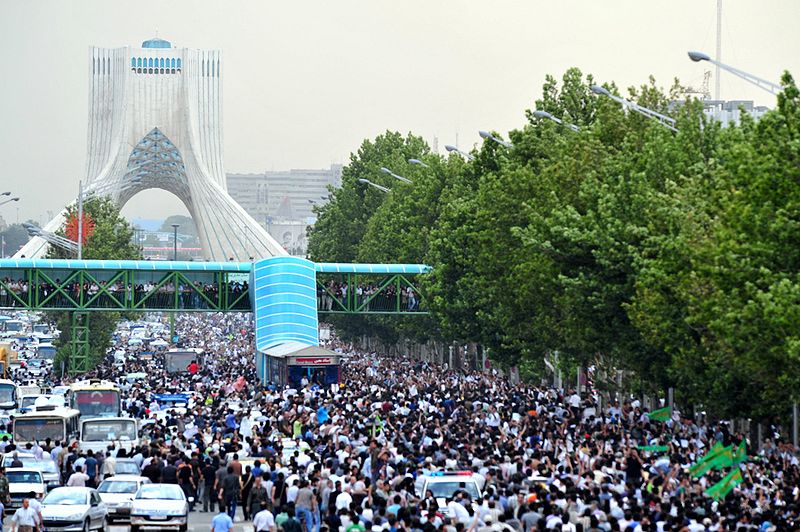
In 2009, tens of thousands of brave Iranian democracy protesters rose up against the brutal Khamenei regime after President Mahmoud Ahmadinejad was announced the winner in a disputed national election.
The protests quickly turned bloody when Iranian hardliners started firing on the protesters.
One beautiful young protester was shot in the neck by the regime.
Her name was Neda Soltani or Neda Agha Soltan — she was shot in the neck during a protest in Tehran on June 20, 2009. (AFP)
After several days the protesters called out to President Obama, “Obama, Obama, Are you with the regime or with us?”
But Obama did nothing — Instead he worked with the evil regime to quash the rebellion.
This week, Barack Obama admitted he should have supported the Iranian protesters in Iran during the Green Revolution in 2009, over a decade ago.
“In retrospect, I think that was a mistake.” @BarackObama on how his administration held back on public support for the 2009 Iran protests, and that we should “express some solidarity” with the Iranian protests now. pic.twitter.com/z7F3heSrQB
If you thought Obama was expressing regret about his Iran policy when you saw the clip yesterday…you got played. Watch the rest of the clip: pic.twitter.com/3s1w7dsSEd
Former US President @BarackObama has admitted that he made “a mistake” by not supporting the Iranian people’s 2009 Green Movement against the Islamic Republic. “In a retrospect, I think that was a mistake. Every time we see a glimmer of hope, we have to express solidarity.” pic.twitter.com/J7sWtkrCOh
Harrison Pitt, Martin Sellner, Renaud Camus at European Conservative Remigration Discussion in Vienna
A private gathering in Vienna, hosted by The European Conservative, brought together highly esteemed French writer Renaud Camus, Austrian writer and activist Martin Sellner, and British writer and commentator Harrison Pitt for a discussion that treated mass migration not as a technical policy dispute, but as the defining civilizational question of our age.
The focus was remigration, demographic replacement, and whether Europe still has the will to defend its own peoples, borders, and cultural inheritance.
From the opening minutes, Camus invoked the Siege of Vienna in 1683 and cast the Austrian capital as a city that once stood as a bulwark of Christian Europe and now finds itself, once again, on the front line of a historical struggle.
That was not presented as a metaphor for its own sake. The point was clear: Europe’s migration crisis is no longer something that can be discussed in the sterile language of parliamentary NGOs and think tanks. It is, in the eyes of the speakers, a struggle over whether Europe remains Europe at all.
The event itself was private and filmed for later release, but the substance of the evening was anything but hesitant. This gathering was built around one central conviction: that demographic change in Europe is real, measurable, and accelerating—and inseparable from the collapse of political courage among the continent’s ruling class.
Camus was introduced as the man who gave the issue its most famous name: “the Great Replacement.” The argument made on his behalf was not that he is a demographer or a technocrat, but that he saw clearly what millions of Europeans had already begun to sense in their daily lives and gave it language.
That is why his work continues to resonate. He does not speak in the dry vocabulary of public administration, but in the language of memory, inheritance, beauty, and loss. His supporters see him as someone who named what polite society refused to name.
Sellner was introduced a bit differently—not as a literary figure, but as an activist who helped turn these anxieties into political language, organization, and action. His role in the Identitarian movement was presented as transformative, especially in shaping how a younger generation of European nationalists talks about migration, identity, and sovereignty.
Moderator Harrison Pitt pushed the conversation toward its core strategic question: why has remigration become such a central word for Europe’s conservative Right? Why, more broadly, has the defense of demographic continuity become the issue around which so many other debates now orbit?
Camus answered by going back to Europe’s twentieth-century collapse. In his telling, Europe emerged from the age of war and totalitarianism with a uniquely destructive form of guilt—one that no longer produced self-knowledge or restraint, but civilizational self-disgust.
That guilt, he argued, hollowed out Europe’s instinct for self-preservation. A continent that once believed in itself began to doubt its own legitimacy, then its own culture, and finally its own right to survive as a distinct civilization.
Sellner went on to expand that point further. Europe’s problem, he said, is not simply that it is being pressured from the outside, but that it is sabotaging itself from within. He likened the crisis to an “autoimmune” disease, only applied at a macro level—a civilization attacking its own defenses under the influence of ideological poison.
The culprits, in his telling, are not hard to identify: business interests that profit from cheap imported labor, political parties that hope to build new client electorates, and an entrenched ideological class in media, academia, churches, and NGOs that treats national continuity as something shameful or obsolete.
Camus then widened the lens. He distinguished between the “Great Replacement,” which he treats as a description of demographic change, and “global replacement,” a broader process in which modernity strips human beings of rootedness and turns them into interchangeable economic units.
That argument connected migration to a much larger civilizational breakdown. In his view, mass production did not stop with factories and consumer goods; it eventually produced mass culture, mass politics, and, finally, mass man—detached from ancestry, place, language, and historical memory.
That is why, for Camus, immigration is not merely a labor-market issue or even a border issue. It is tied to the flattening of all distinctions—to the idea that peoples, cultures, nations, and ways of life are all exchangeable.
He argued that once a society abolishes hierarchy, standards, and inherited forms in the name of egalitarianism, it also loses the mental framework needed to defend itself. A civilization that no longer believes in excellence, beauty, or continuity will not fight to preserve them.
Pitt compressed that idea into a useful phrase: “mass-produced synthetic culture” and “mass-produced synthetic man.” Camus accepted the formulation readily, and it captured much of the evening’s worldview in a single line.
The discussion also turned to Christianity, and here too the tone was unsparing. Sellner argued that traditional Christianity is not the root of Europe’s weakness, but that modernized Western churches have largely abandoned civilizational self-respect and become accomplices to mass migration under the cover of moral universalism.
Camus approached the matter from a more aesthetic and spiritual angle. He argued that the Church has stripped itself of beauty, seriousness, and transcendence, reducing faith to flat moral slogans about openness and welcome—precisely the kind of sentimental language that has accompanied Europe’s surrender.
Both men agreed on the broader point: Europe cannot defend what it no longer itself values. If its own elites are embarrassed by its history, indifferent to its culture, and hostile to its majority populations, then demographic replacement becomes not an accident but the predictable result of elite abandonment.
From there, the conversation moved to legitimacy. Pitt noted that remigration, whatever its appeal to sympathizers, still sounds harsh to many outsiders. Sellner’s answer was that the right’s problem is not logistics but moral confidence.
His argument was straightforward: if the right continues to speak defensively, apologetically, or in purely technical terms, it will lose. It must instead say openly that remigration is necessary, just, and morally serious—not only for Europe’s sake, but because mass migration itself is destructive, destabilizing, and exploitative.
He described today’s migration model as brain drain for the countries migrants leave behind and social disintegration for the countries they enter. In that sense, he argued, remigration should be understood not as cruelty, but as a restoration of order, legitimacy, and rootedness.
Camus made the most striking rhetorical move of the evening when he argued that “decolonization” is the strongest and most morally resonant framework for remigration. If colonization means population transfer, dispossession, and the erosion of a native people’s control over its homeland, then Europe, he argued, has every right to see itself as undergoing colonization and to reverse it.
That framing was not incidental. It was the centerpiece of the event’s attempt to put remigration on higher moral ground. By calling it decolonization, the speakers sought to replace the language of guilt with the language of national liberation.
When Pitt asked how this could be done without violence, Sellner insisted that remigration is the peaceful alternative to future unrest. If present trends continue unchecked, he argued, Europe will eventually face disorder, communal fracture, and possibly outright ethnic conflict; legal, orderly remigration is what might still prevent that outcome.
He also insisted on a point that now sits at the heart of many nationalist arguments: Europeans are the indigenous peoples of Europe. That simple fact, he said, has been systematically obscured by institutions that are willing to speak the language of indigenous rights everywhere except in Europe itself.
On the EU, the verdict from both men was grim. Sellner rejected the current European Union as a fundamentally anti-identitarian structure—hostile to borders, Christianity, nationhood, and any serious attempt to reverse demographic change.
He made clear that if Brussels blocks governments elected on a remigration platform, those governments should ignore it or leave. Pitt reinforced that point by raising the idea of a kind of “deportation NATO,” in which sovereign states cooperate on enforcement, removals, visa sanctions, remittance controls, and logistical coordination.
Camus, for his part, emphasized that he remains pro-European in the civilizational sense while rejecting the present Brussels order. He even suggested Vienna, rather than Brussels, as a more fitting symbolic capital for Europe.
The evening closed with a clear sense of urgency. Sellner argued that Europe may have only ten to fifteen years before current demographic trends become far harder to reverse, and he pointed to Vienna itself as an example of how quickly the social landscape can change.
The core message of the event was: remigration is no longer being presented merely as a policy preference, but as a civilizational necessity. In that view, Europe’s crisis is not temporary, not manageable through technocratic tweaks, and not something that can be solved by the same elites who created it.
It is a crisis of survival, legitimacy, and political will. And in Vienna, the speakers agreed that if Europe is to remain a home for its own peoples, it will have to rediscover the courage to say so—and to act accordingly.
How AOC shows why the future of the antiwar movement must be on the right.
Rep. Alexandria Ocasio-Cortez (D-NY), America’s foremost socialist, raised eyebrows during her recent appearance at the Munich Security Conference with surprisingly hawkish, internationalist statements. The antiwar left heavily criticized AOC for her speech, viewing it as an endorsement of the foreign policy of the Democratic establishment. “AOC sounds almost identical to Hillary Clinton or Madeleine Albright in her defense of NATO, except less articulate and confident,” the journalist Max Blumenthal tweeted, expressing the position of many people on the subject.
On one panel, AOC criticized the Trump administration for not being sufficiently active on the world stage. She charged,
They are looking to withdraw the United States from the entire world so that we can turn into an age of authoritarianisms… where Donald Trump can command the Western Hemisphere and Latin America as his personal sandbox, where Putin can saber-rattle across Europe and try to bully our allies there, and where authoritarians essentially control their own geographic domains.
Of course, there are factual issues with this analysis: Despite the dovish platform that carried Trump back to the White House, the United States has become more aggressive abroad, continuing to provide escalatory assistance to Ukraine in its war with Russia and striking Iran last June (and now, of course, launching a war against Iran last weekend).
Notwithstanding this, AOC seems to think that the antidote to America’s ailments is but more foreign entanglements in the service of combating “authoritarianism” and in the name of a “class-based internationalist perspective” (a term she used in a subsequent appearance in Berlin).
While AOC’s support for foreign policy internationalism may be disappointing to our friends on the antiwar left, she is in many ways just following in the footsteps of earlier progressives.
While the American republic was founded, nurtured, and thrived under the principles of geopolitical nonintervention, it was America’s progressives who abandoned this principle and went abroad to search for monsters to destroy.
The first of these progressive interventions took place against Spain in 1898. William McKinley, remembering the brutality of the Civil War, favored a peaceful resolution to the Cuba crisis. Following the sinking of the USS Maine in Havana Harbor by an internal explosion, the progressives got their war. Progressives sold the war to Americans as an ideological crusade against reactionary Spain, and in a pattern that would be repeated by progressives to the present, portrayed it as a war to liberate various peoples in the name of “democracy.”
A decade and a half later, the American people wanted no part of World War I, but a combination of America’s then-Anglophile elite, American business interests tied to the Entente, and pro-British propaganda, aided by the German blunders of unrestricted submarine warfare (although itself no more a violation of neutral rights than Britain’s blockade), and the intercepted Zimmermann telegram in which Germany’s government proposed military ties with Mexico led the United States into the world’s most destructive conflict to date.
Once at war, progressives, from Woodrow Wilson on down, rhetorically turned the war into a crusade to “make the world safe for democracy” (never mind that Germany and Austria had extended the suffrage wider than even Britain), and Wilson promoted his “League of Nations” as a utopian solution to Europe’s problems. “Regime change” in Berlin made things worse; toppling a stable constitutional monarchy led ultimately to the anarchy of Weimar and the totalitarianism of the Nazis.
Witnessing its bitter fruits in the trenches of the Western Front, Americans turned away from progressivism. They realized that they had been duped into fighting a war on England’s behalf and noninterventionist Republicans were swept into power in electoral landslides in 1920, 1924, and 1928. By the time that Democrats retook the Oval Office in 1932, they too had rhetorically embraced noninterventionism.
However, during the Second World War, progressives again worked to involve America in a European war. U.S. opposition to the conflict was fierce (most notably from the bipartisan America First Committee), forcing the Anglophile administration of Franklin Roosevelt to lie when he ran for re-election in 1940 and claimed to keep American troops out of foreign wars.
While Roosevelt attempted to enter the war through things such as aid to Britain and France or escorting allied shipping with “Neutrality Patrols” (named with an Orwellian flair), it was Roosevelt’s oil blockade on Japan (and Japan’s attack on Pearl Harbor) that would ultimately enable him to bring about his desired outcome. Once at war, Roosevelt foreclosed the possibility of a negotiated peace (the only way to have alleviated the suffering of peoples under German and Japanese occupation sooner) through his demands of “unconditional surrender.”
While justly decrying the totalitarianism of the axis powers, Roosevelt aided Stalin’s Soviet Union, oftentimes at the expense of American interests, and gave half of Europe to Stalin at Yalta. Rather than benefiting the U.S. or American ideals, it only aided the totalitarian systems that Americans opposed. As TAC’s co-founder, Patrick J. Buchanan, wrote:
In 1917 Wilson had gone to war to make the world safe for democracy, and had made the world safe for Lenin, Mussolini, and Hitler. In 1941 Roosevelt had gone to war to make Europe and Asia safe for democracy, and had made Europe safe for Stalinism and Asia safe for Maoism.
Harry S. Truman deepened U.S. involvement in the affairs of Europe. While many Americans viewed the best counter to communism as allowing Europe to rebuild and rearm, so as it could defend itself, (with even Robert Taft backing the Marshall Plan for this reason), Truman created NATO instead, which though intended to be temporary, has transformed into a permanent vehicle involving America in the petty grievances of the European continent.
While FDR could at least have been credited for going to Congress to get approval for Lend-Lease, his successor, Harry S. Truman did no such thing in Korea, claiming that American involvement there was merely a “police action.”
The progressive streak of military adventurism was reprised in the Vietnam War. Embodying the managerial spirit of American progressivism at the time, Lyndon Johnson believed that our government could transform Vietnam through a technocratic approach to war, just as he was attempting to transform America. The cost of this folly was 58,000 American lives and a significant blow to American prestige.
The backlash against the Vietnam War caused many of the more hawkish of the Great Society liberals to move towards the right, and by the 1980s, this group had entered the GOP, where they began to purge non-interventionist Republicans. By the time of the second Bush administration, these Wilsonian “neoconservatives” were the dominant force in Republican foreign policy.
These neocons used 9/11 as an excuse to attempt wars of nation-building during the Global War on Terror. With these wars came massive growth in the security state and the creation of new programs of government surveillance that would have shocked earlier generations of Americans.
During the Obama years, these policies were continued, as was the commitment to regime change. Obama’s administration played a major role in the overthrow of Gaddafi in Libya, leading to anarchy, terrorism, and slavery, and in the Syrian Civil War, where the Obama administration made common cause with Al Qaeda terrorists against Syria’s secular Assad government.
Seen in this light, AOC’s Munich appearance, rather than representing a breach with the antiwar left, in many ways represents a continuation of over a century-and-a-quarter of American progressive hawkishness.
But why do leftists (including former leftists like the neocons) trend towards supporting wars abroad? While conservatives, since Louis de Bonald, have recognized that “all politics is local” (and only religion is universal), leftism blurs these lines, universalizing politics, and viewing political goods and rights as applying to humanity as a whole, rather than within specific contexts.
An example of this can be seen in the difference between the American and French Revolutions. While the Jacobins (as leftists) saw themselves as fighting primarily for universal “Rights of Man” and were in open hostility to their inherited traditions, America’s patriots saw themselves as going to war to defend and conserve their inherited rights as Englishmen.
Indeed, Americans traditionally saw that intervention abroad poses a threat to our patrimony and way of life. George Washington understood this, warning Americans to avoid “permanent alliances,” as they would “entangle our peace and prosperity in the toils of European ambition, rivalship, interest, humor or caprice.” John Quincy Adams admonished Americans against going abroad “in search of monsters to destroy,” as it would doom our free government and render America “the dictatress of the world” rather than “the ruler of her own spirit.” The later writers of America’s “Old Right,” such as Garet Garrett and Albert J. Nock made similar arguments against foreign entanglements and in defense of American identity.
Thus, conservatism is complementary to noninterventionism in a way that leftism is not. While our friends on the antiwar left may be earnest and good allies, ultimately these reasons point to the future of the antiwar movement being on the right.
Relatedly, if American conservatism fails to be noninterventionist and antiwar, it ceases to be conservative. This has happened before. During the George W. Bush years, the right’s foreign adventurism led to the abandonment of fiscal conservatism (with massive increases in federal spending), while the incorporation of neoconservatives into the Republican Party empowered a new conservative elite less committed to social conservatism. This may very well happen again.
It is accordingly in the interests of both American conservatives and the antiwar movement to work together to create a strongly noninterventionist conservative faction. This is entirely doable—indeed it has been done before—and presents the best chance of both conserving the American tradition and keeping the United States out of destructive wars.


 (@razingarizona)