WATCH: Anti-ICE Minneapolis Mayor Tells Trump to “Just Hire More TSA Agents,” Completely Clueless That He Can’t During Democrat-Blocked Shutdown

Person speaking on a virtual news segment with a colorful background, discussing current events and issues of interest.

Person speaking on a virtual news segment with a colorful background, discussing current events and issues of interest.

Leftist lunatic Minneapolis Mayor Jacob Frey appeared on MSNBC’s The Weekend with co-host Jonathan Capehart on Sunday and suggested President Donald Trump could simply “hire out more TSA agents” to fix the growing airport chaos caused by the ongoing partial government shutdown.

Frey is apparently unaware that the president cannot hire additional agents while funding remains blocked.

“If the goal here was safety at airports, he could hire out more TSA agents who do an incredible job at keeping our airports safe,” Frey claimed.

Capehart did not bother to correct him or inform the audience that his suggestion is not possible or allowed.

The Democrat mayor went on to accuse the Trump administration of trying to “terrorize people” with the president’s plan to temporarily deploy ICE agents to airports.

“If the goal was keeping our streets safe and our cities [safe], he would work with cities around hiring additional police officers and creating the kind of safety infrastructure that we need to keep people safe,” Frey said. “But of course, we all know that’s not the goal. The goal is to terrorize people. And for someone that states that they care so much about bringing the economy back — causing a ton of fear in airports, preventing the kind of safe air travel that we need for commerce, is not a good mechanism to do it.”

WATCH:

Senate Democrats have blocked House-passed DHS funding legislation five times in recent months, including a key vote on Friday, causing the shutdown.

Without appropriations, the administration cannot hire new TSA officers or expand staffing.

The funding impasse has triggered widespread staffing shortages. Thousands of TSA employees are calling out sick daily, and 366 officers have already quit.

Travelers are facing hours-long security lines at major airports nationwide during peak spring break travel.

To deal with the Democrats’ stubborn blocking, President Trump announced that ICE agents will be deployed to airports starting Monday to help with security and detain illegal aliens while they’re at it.

The post WATCH: Anti-ICE Minneapolis Mayor Tells Trump to “Just Hire More TSA Agents,” Completely Clueless That He Can’t During Democrat-Blocked Shutdown appeared first on The Gateway Pundit.

Tom Fitton and Judicial Watch File Major New Lawsuit Against California to STOP Counting Ballots Received After Election Day – Live Feed From Monday Courtroom

Man in a light sweater speaks against a blue background featuring the U.S. Capitol dome, discussing political issues or legal matters.

Man in a light sweater speaks against a blue background featuring the U.S. Capitol dome, discussing political issues or legal matters.

Judicial Watch founder Tom Fitton posted a tweet on Sunday about a significant federal lawsuit in California to stop the state from counting ballots received up to 7 days after Election Day.

Tom Fitton wrote: Hey everyone, Judicial Watch just filed a major new federal lawsuit in California to stop that state’s counting of ballots that are received up to 7 days after Election Day. We filed the lawsuit on behalf of Congressman Darrell Issa, who’s from California. Federal law sets an Election Day, not an election week, not an election month. In fact, an appellate court in another Judicial Watch lawsuit ruled that counting ballots received after Election Day violates federal law. It undermines election integrity, undermines confidence in the people in the fair administration of the elections, and of course violates federal law.

As The Gateway Pundit previously reported, the U.S. Supreme Court is set to hear arguments today, Monday, in a landmark election integrity case over whether the federal Election Day laws prohibit the counting of mail-in ballots that arrive after Election Day.

At the center of the dispute is Watson v. RNC, a case challenging Mississippi’s law allowing absentee ballots to be received up to five business days after Election Day, so long as they are postmarked on or before Election Day.

Mississippi law requires that voters submit their ballots by Election Day, but allows election officials to receive and count them afterward.

The public can view the High Court’s oral arguments here.

You can listen to the live oral argument audio. Here is the link.

From the Judicial Watch webpage:

Judicial Watch’s legal team seeks to uphold a historic ruling by the U.S. Court of Appeals for the Fifth Circuit, which found that Mississippi’s counting of ballots received up to five days after Election Day to be unlawful.

The suit has been consolidated with a similar challenge brought by the Republican National Committee (RNC), the Mississippi Republican Party, and others against Mississippi Secretary of State Michael Watson and local election officials (Watson v. Republican National Committee et al. (No. 24-1260)) (Libertarian Party of Mississippi v. Wetzel et al. (No. 1:24-cv-00037)).

Judicial Watch argues that the ordinary meaning of “election” at the time Congress enacted the statutes includes the full process of voting and the receipt of ballots by officials. Counting post-Election Day ballots is a relatively recent practice without any historic foundation. Allowing ballots to “trickle in” after Election Day creates opportunities for fraud and erodes public confidence.

The post Tom Fitton and Judicial Watch File Major New Lawsuit Against California to STOP Counting Ballots Received After Election Day – Live Feed From Monday Courtroom appeared first on The Gateway Pundit.

Trump Says No DHS Funding Deal with Democrats Until the SAVE America Act is Approved “For As Long As It Takes” — Pressures Thune to CANCEL Easter Recess

Former President Donald Trump speaking in the Oval Office, gesturing with his hands, with U.S. flags and a model aircraft visible in the background.

Former President Donald Trump speaking in the Oval Office, gesturing with his hands, with U.S. flags and a model aircraft visible in the background.
Credit: The White House

During a phone call with NewsNation correspondent Hannah Brandt, President Donald Trump delivered a clear message to the radical Democrats holding the Department of Homeland Security (DHS) hostage: no deal on funding until they pass the critical SAVE America Act to safeguard our elections from non-citizen voting and ensure only American citizens decide American elections.

Democrats are now scrambling to cut a deal on DHS funding after a month of obstruction, following Trump’s order to deploy brave ICE agents to airports to fill the gaps left by unpaid TSA workers amid the ongoing Democrat-caused partial shutdown.

“The Radical Left Democrats have hurt so many people with their vicious and uncaring ways. What they have done to the Department of Homeland Security, our fantastic TSA Officers, and, most importantly, the great people of our Country, is an absolute disgrace,” Trump said on weekend.

“If the Democrats do not allow for Just and Proper Security at our Airports, and elsewhere throughout our Country, ICE will do the job far better than ever done before! The Fascist Democrats will never protect America, but the Republicans will. Just like the Radical Left allowed millions of Criminals to pour into our Country through their ridiculous and dangerous Open Border Policy, the Republicans closed it all down, and we now have the Strongest Border in American History,” Trump said.

“Likewise, I look forward to moving ICE in on Monday, and have already told them to, “GET READY.” NO MORE WAITING, NO MORE GAMES!” Trump said on Truth Social.

Democrats are now panicking, but Trump won’t allow any agreement until they pass the critical SAVE America Act.

Hannah Brandt wrote:

“In a phone call just minutes ago President Trump told me Democrats want to make a deal on DHS funding but he doesn’t “think any deal should be made on this until they approve save America.”

First I asked him how long he’s prepared to have ice agents help out at airports

He told me, “For as long as it takes.”

Then I asked “Some lawmakers are saying they should just fund TSA while they negotiate on DHS. What do you think about that?”

President Trump said “Now that I did this the Democrats want to make a deal. And I don’t think any deal should be made on this until they approve SAVE America. Ok, so you have a scoop.””

Just hours after his explosive phone call with NewsNation, President Trump ramped up the pressure on the radical left Democrats and any wavering Republicans, making it abundantly clear: There will be NO compromise on funding the Department of Homeland Security until the SAVE America Act is passed and he’s ready to bundle it all into one massive, America-First package that crushes election fraud, protects women’s sports, and saves our children.

Trump also turned his attention to Senate leadership, specifically calling on John Thune to take aggressive action.

Trump wrote on Truth Social:

“I don’t think we should make any deal with the Crazy, Country Destroying, Radical Left Democrats unless, and until, they Vote with Republicans to pass “THE SAVE AMERICA ACT.”

It is far more important than anything else we are doing in the Senate, and that includes giving these same terrible people, the Dems (who are to blame for this mess!), a Five Billion Dollar cut in ICE funding, a deal which, even when disguised as something else, is unacceptable to me and the American people – UNLESS it includes their approval of Voter I.D., (with picture!), Citizenship to Vote, No Mail-In Voting (with exceptions), All Paper Ballots, No Men In Women’s Sports, and No Transgender MUTILIZATION of our precious children.

Put it all together, and also, let Leader Thune clearly identify those few “Republicans” that are Voting against AMERICA. They will never be elected again!

In other words, lump everything together as one, and VOTE!!! Kill the Filibuster, and stay in D.C. for Easter, if necessary. MAKE AMERICA GREAT AGAIN!”

As The Gateway Pundit has repeatedly reported, the SAVE America Act is essential to preserving election integrity. Non-citizens should never dilute the votes of American citizens, a fundamental right that millions fought and died to protect.

Democrats’ reckless shutdown has already hurt hardworking federal employees and travelers nationwide.

Now, faced with ICE stepping up to keep airports secure and the president refusing to cave, they’re scrambling. But Trump isn’t budging: fund DHS only after they secure our elections with the SAVE America Act.

The post Trump Says No DHS Funding Deal with Democrats Until the SAVE America Act is Approved “For As Long As It Takes” — Pressures Thune to CANCEL Easter Recess appeared first on The Gateway Pundit.

EXCLUSIVE: “The People Are Happy!” – Heroic Christian Convert Who Fled IRGC Returns to Iran to Topple Evil Regime

A muscular man in military-style clothing poses for a selfie in a gym, while a crowd gathers in the street near police on motorcycles at night.

A muscular man in military-style clothing poses for a selfie in a gym, while a crowd gathers in the street near police on motorcycles at night.
Ali Majd fled Iran with the IRGC hot on his heels and is now returning to fight for freedom. Photos courtesy of Ali Majd and Saghar Erica Kasraie.

Ali Majd, a Christian convert and anti-regime influencer, fled Iran and took refuge among the Kurds a few weeks ago after learning that the IRGC was coming for him.

Now, he is heading back to Iran on a mission to help his country and his people free themselves from the regime that has ruled the country since the Islamic Revolution.

In an interview from the field, he told The Gateway Pundit, “What’s happening in Iran right now is not just about me, it’s about all the Iranians. All the Persians are so happy because this is the only way we can get freedom,” said Ali.

In Iran, on top of all the other forms of repression and rights denied to its citizens, converting to Christianity is punishable by death. Ali kept his religion secret and operated his gym while quietly encouraging members to go with him to pray in the mountains.

The regime eventually shut down his gym. When he asked why, officials said, “You have long hair. That is not allowed.” Around that time, anti-regime protests began, and Ali joined them.

The government responded with violence. Ali said there was only one way to change the regime, which was to protest, and that they did so repeatedly.

“We came to the streets so many times, maybe four protests, maybe five protests. The majority of people came to the streets, and the government killed all of them.”

He took a somber tone and asked, “So how can we make a change in Iran? We don’t have a way. You come to the streets, asking for your rights, asking for freedom, and it is so easy for them. They will kill you so easily, like you are not a human, like you are a fruit, like you are a rock. They just shoot you. I lost so many of my friends, the best ones.”

However, the U.S.-Israeli strikes on Iran have brought hope to the anti-regime movement. “The people, and me as an Iranian, I am happy, and the other Iranians are happy, because your government is killing evil inside my country. This is how we see the situation, the Iranians.”

He went on to talk about the hard work ahead and how the Iranian people themselves will have to do most of the fighting and dying.

“I think it’s going to take a long time, but it will help a lot. So much destruction will happen, but this is the only way that we can get freedom back. We will rebuild our country once more without any IRGC, without any dictatorship, any tyranny like the Islamic Republic of Iran. Maybe more than anything, I haven’t met one Iranian who is sad about the operations against Iran. We are all happy. We feel free after 50 years of oppression in Iran.”

The U.S. and Israeli strikes, in his estimation, “will help a lot.” He said the United States is “doing the best thing for us,” and that, after the strikes, Persians now have a real chance to fight for their freedom.

“Before the United States started attacking, they didn’t have a chance,” he said. “But now we have a chance. Now we can fight with that enemy, because the United States beat them so hard.”

He added that the regime is “so weak right now,” whereas before it had been “so strong, so powerful.”

He cautioned that the fight will take time, possibly “one year, two years,” because the struggle is not only against the government but also against its supporters.

Those supporters, he explained, “live inside people,” and some are armed, while ordinary people are not, making change more difficult.

Still, he insisted there is no alternative. “This is the best way. There is no other way, brother. This is the only way,” he said, adding that freedom may require sacrifice. “Maybe we have to pay some blood for our freedom. Why not? Like every nation on the planet earth.”

Speaking personally, he said he is willing to risk his life for freedom and would do so again. “Life without freedom is nothing. That means nothing,” he said.

He emphasized that they must continue to fight and expressed gratitude for the role of the United States and Israel, saying they would “owe our freedom to the United States… and also the Jewish people, the Israelis. They help us a lot.”

While he was in Kurdistan, Ali attended a Christian church for the first time in his life. Before that, back in Iran, he had prayed in secret. He said he had only dreamed of being in a church, surrounded by other believers, praying together.

Describing his first experience, he said, “That was amazing. That was like a miracle for me.” He explained that, as someone without a pastor and living under constant threat from the IRGC, it had once seemed impossible. Leaving Iran, reaching another country, and finding a church felt, in his words, “like a miracle for me.”

In Iran, he had been reading a Bible that he kept hidden, and it appears he drew strength from the story of David. He said something inside him gave him the courage to “pick a stone,” explaining that when you trust God, He will protect you.

He reiterated that the Iranian people appreciate the support of the United States and Israel, as well as the support of the Kurds, but said they are prepared to fight by any means possible, even with stones against the IRGC’s guns.

“I feel so courageous right now. I don’t fear anything,” he said. “God shows me His miracles in my path. I can pick up a stone and fight against an army. I believe that God will stop the bullets. He shows me He can do that.”

Ironically, Ali realizes that he and his people not only have to overcome the IRGC but must also contend with political uncertainty in the U.S. He said they worry about the possibility of a deal between the United States and Iran and are praying that the regime will be finished during the current operations.

“We just worry about a deal between the United States and Iran,” he said. “We are just praying for the regime to fall.” He added that they are also concerned about support from China and Russia and the possibility that pressure could push U.S. politicians, including President Trump, toward an agreement with Tehran.

The post EXCLUSIVE: “The People Are Happy!” – Heroic Christian Convert Who Fled IRGC Returns to Iran to Topple Evil Regime appeared first on The Gateway Pundit.

Why The Senate Filibuster Must Be Put On The Chopping Block

Group of four U.S. senators speaking at a press conference in a formal setting, discussing legislative issues and policy decisions.

Group of four U.S. senators speaking at a press conference in a formal setting, discussing legislative issues and policy decisions.

It is imperative that the Senate filibuster be put on the proverbial chopping block if Republican leadership has any intention of passing legislation, large or small, between now and the remainder of President Trump’s term.

It is bad enough already that such little legislative progress has been made since the President assumed office on the coattails of the greatest political comeback, and unprecedented landslide victory, in American history.

The decisiveness of 2024 has historically given presidents with similar margins of victory a mandate to implement a legislative agenda centered on key campaign promises without issue.

For 2024, on the domestic policy side, the President ran on ending the Biden border crisis, reforming the election system, and ending the weaponization of the justice system.

To date, the President has only been able to get a few of his campaign promises through the Congress, and arguably none of the most popular ones.

The One Big Beautiful Bill helped extend tax relief from his first term, while making good on several notable campaign staples like no tax on tips, social security, and overtime.

However, aside from the OBBB, Congress has been derelict in passing other high demand bills – including legislation to fortify election integrity measures and to fund Homeland Security, the primary agency responsible for mass deportations.

And all this lack of progress has occurred under a Republican controlled Congress; imagine what might happen if one or both chambers were to swap parties following a disappointing midterm election, or any other event like a special election that could well transfer the razor-thin Republican-controlled Congress into Democratic hands.

This underscores the tremendous stakes of the moment, particularly with mounting legislative priorities like the Save America Act and resuming funding for Homeland Security, which are currently in limbo.

The inaction from the Congress, which has been the least active Congress measured by legislation passed in modern American history, heightens the need for a radical course correction.

Congressional rules must be changed to either dramatically modify the filibuster and revert it to its original design, which historically required Senators to physically get up and “talk a bill to death” if they disagreed with legislation (rather than just make the threat, as became commonplace in recent years, a lazy alternative that had the same effect of the traditional filibuster without any of the effort), or to rid themselves of the filibuster completely, as the President has strongly advocated for.

With the filibuster in place, Republicans must win over several of their Democratic colleagues – to reach the 60-vote threshold, the minimum number under current Senate rules to advance legislation.

The problem, however, is evident: no Democrat is willing to sign off on any Republican-supported legislative program whatsoever. 

The Democratic Party constantly panders to the far-left flank of its party.  That flank, which includes Antifa and BLM activists as well as Palestinian protestors, believes ICE and, really, all law enforcement agencies ought to be defunded outright.

There are no moderates anymore.  Thus, there is no realistic scenario where Democrats, save for a low-interest appropriations package that keeps the bare essential functions of government operational, will side with their Republican peers.  And especially not for legislative items that the President strongly backs.

To add insult to injury, there are deep factions within the Republican party writ large.  Especially in the Senate, which is traditionally the establishmentarian counterpart to the more rogue House of Representatives, there is a great prejudice in that body towards upholding the pre-Trump status quo, and thus to not move on any policy that would generally be considered a win for the administration (and the hundreds of millions of ordinary Americans who support it).

John Thune, the departing majority leader, cares not in the slightest about the President’s priorities, and never relinquishes an opportunity to double down on any bad press affecting the administration, particularly negative press centered on a popular MAGA policy or its chief enforcers, such as mass deportations.

There is also the issue of priorities: many Republicans, particularly in the Senate, do not feel compelled to do anything on the domestic policy front.

Their attention, these types believe, is best placed elsewhere, such as on foreign policy, where their campaign contributors tend to reap the biggest profits.

This calculus proves at one and the same time a lucrative business for them as well as a convenient distraction from having to deliver results on the substantive policies that so many millions of Americans had otherwise held out hope they would do everything possible to help realize.

One would expect, for at least a few of them, that the past five or six years would have chastened them a bit – teaching them a little bit of humility, if not some necessary political strategy, to work in tandem with President Trump’s administration, and not oppose his every move, in order to enact a legacy-defining, massively popular legislative agenda with staggering results for the American people.

Instead, facing the prospects of a Democratic comeback, the Republicans have opted to play it safe: which in Washington, means do nothing – lest they offend their friends across the aisle, and risk being the target of Democratic persecutions if and when the latter should reclaim power.

On that note, it’s apt to mention the problem is indeed the p-word: power.  Whereas Democrats know what to do with power, Republicans shun it with every possible move.

Nobody in their right mind thinks that if the roles were reversed, Democrats would not immediately eliminate the filibuster (among other procedural blockades) and do everything within their capacity to augment their power, while sidelining Trump and his Republican accomplices.  Of course they would!

This is why the urgency to pass the Save America Act could not be overstated: Republicans have a one-time shot to solidify election systems, and curb some of the excesses of an electorate contaminated by illegal voters and other procedural abnormalities that have corrupted the integrity of our elections.

This is also why Democrats have pulled out every stop to prevent such reforms from taking place.

They are fortunate to have an opponent in the modern Republican Party that is not known for revolutionary action, making their obstructionism a walk in the park – and Chuck Schumer’s job easier than it should be.

This is why it is hence incumbent upon the President, once again, to rescue our political system, lest we forfeit the opportunity handed to us, and risk descending one more into banana republicanism, at which point we will have nobody to blame but ourselves.

The post Why The Senate Filibuster Must Be Put On The Chopping Block appeared first on The Gateway Pundit.

JUST IN: State Department Issues “Worldwide Caution” Alert to Americans Citing Threats Against US Interests Outside of the Middle East

Credit: Wikimedia Commons

The Department of State issued a “worldwide caution” security alert on Sunday as the war in Iran continues into its fourth week.

The alert directs Americans across the globe to “exercise increased caution” due to airspace closures, targeting of US diplomatic facilities outside of the Middle East, and potential threats against US interests by pro-Iran groups. 

The alert reads,

March 22, 2026 – The Department of State advises Americans worldwide to exercise increased caution.

Location: Worldwide

Event: The Department of State advises Americans worldwide, and especially in the Middle East, to exercise increased caution.  Americans abroad should follow the guidance in security alerts issued by the nearest U.S. embassy or consulate.  Periodic airspace closures may cause travel disruptions.  U.S. diplomatic facilities, including outside the Middle East, have been targeted.  Groups supportive of Iran may target other U.S. interests overseas or locations associated with the United States and/or Americans throughout the world.

Enroll at step.state.gov to receive the latest security alerts and follow the “U.S. Department of State – Security Updates for U.S. Citizens” channel on WhatsApp(opens in a new tab) or @TravelGov on X.  When planning travel, carefully read the Travel Advisory and detailed information for your destination, and any recent alerts at travel.state.gov/destination.

This comes as the war escalates with Yemen-based Houthi militants preparing to join Iran’s fight against the US and Israel.

Additionally, Trump warned on Saturday evening that “America will hit and obliterate” Iran’s energy infrastructure within 48 hours amid Iran’s ongoing closure and targeting of ships in the Strait of Hormuz.

Army spokesman Ebrahim Zolfaghari responded to Trump’s threat, calling him the “terrorist president of the United States” and threatening to retaliate against Israeli and US infrastructure in the Middle East.

“We have repeatedly said the Strait of Hormuz is closed only to the enemy and to harmful traffic. It has not yet been completely closed and is under our intelligent control, and harmless transit – under specific regulations that ensure our security and interests – is allowed,” he said. 

“However, if the United States carries out its threats against Iran’s power plants, the following punitive actions will be taken immediately. The Strait of Hormuz will be completely closed and will not reopen until our damaged power plants are rebuilt. All power plants and the energy and information‑technology infrastructure of Israel will be widely targeted.”

“All similar companies in the region that have American shareholders will be completely destroyed. Power plants in regional countries hosting US bases will be considered legitimate targets,” he added.

MORE:

Iran Threatens to Shut Down Strait of Hormuz, Hit Gulf Power Grids if Trump Attacks Power Plants

The Gateway Pundit will continue to provide updates on the Iran war.

The post JUST IN: State Department Issues “Worldwide Caution” Alert to Americans Citing Threats Against US Interests Outside of the Middle East appeared first on The Gateway Pundit.

REPORT: Savannah Guthrie Eyes ‘Today’ Show Return Next Month as Search for Missing Mother Continues

NBC personality Savannah Guthrie pictured with her mother, Nancy.

NBC personality Savannah Guthrie pictured with her mother, Nancy.
NBC personality Savannah Guthrie pictured with her mother, Nancy. (@TODAYshow / X)

Savannah Guthrie could return to NBC’s Today show as early as next month, according to a report.

Sources told Page Six that the longtime host is aiming to be back on air after her children’s spring break. Most New York schools resume classes around April 10.

Guthrie has been off the show following the disappearance of her mother, Nancy, who went missing from her Arizona home between January 31 and February 2.

The timeline for her return remains uncertain. Sources say the situation depends on developments in the investigation, as well as Guthrie’s personal circumstances.

She is also said to be spending time with her family, including her husband Michael Feldman and their two children, before returning to work.

In her absence, fellow host Hoda Kotb has been filling in on the program.

However, another source told Page Six that there has been no official confirmation of Guthrie’s return date and that Kotb is expected to continue covering her role for now.

Guthrie briefly returned to Rockefeller Center earlier this month to visit colleagues.

“I wanted you to know that I’m still standing, and I still have hope,” she said at the time. “And I’m still me.”

Suspect Seen in Chilling Porch Video Approached Nancy Guthrie’s Door Before the Night of Her Abduction

She also indicated she plans to return to the show.

“I have every intention of coming back,” Guthrie said. “I don’t know how to come back, but I don’t know how not to.”

The family is still holding out belief that their mother will be found and her kidnappers brought ot justice.

“Someone knows something,” they said in a statement. “No detail is too small. It may be the key.”

However, it appears they may have given up on the hope that she may still be alive.

“We miss our mom with every breath, and we cannot be in peace until she is home. We cannot grieve; we can only ache and wonder.”

“Our focus is solely on finding her and bringing her home.”

“We want to celebrate her beautiful and courageous life, but we cannot do that until she is brought to a final place of rest.”

The post REPORT: Savannah Guthrie Eyes ‘Today’ Show Return Next Month as Search for Missing Mother Continues appeared first on The Gateway Pundit.

Iranian-Backed Houthis Poised to Join War Against U.S. and Israel as Early as Monday

Crowd of protesters in Yemen holding banners and weapons, expressing political sentiments during a demonstration.

Crowd of protesters in Yemen holding banners and weapons, expressing political sentiments during a demonstration.
Houthis protest against airstrikes by the Saudi-led coalition on Sana’a in September 2015.

Iranian-backed Houthi militants in Yemen are preparing to officially join the war against the United States and Israel as early as Monday.

Security officials cited by Israeli media indicate that Tehran and Hezbollah are actively pressuring the Yemen-based terror group to escalate and join the fight,” KAN reported.

The news outlet reported:

Security sources in the region told Kan News that pressure from Iran and Hezbollah is increasing on the Houthi rebels in Yemen to join the campaign, and that it is not impossible that this will happen in the coming days, with the end of Eid al-Fitr on Monday.

Declaratively, the Houthis continue to emphasize that they stand on Iran’s side and that they will join the campaign when developments require it.

Sources in the ranks of the forces opposing the Houthis in Yemen told Here News that in recent days the Houthis have increased their forces in the area of ​​the port city of Al-Hodeidah, which could indicate that they are preparing to join the campaign soon. 

An Iranian military official briefed local media today on the Houthis’ possible joining of the campaign in the maritime arena – blocking the Bab al-Mandab Strait in the Red Sea – in the event of an American ground invasion of Iran. 

The Houthi Foreign Ministry warned any foreign power against sending forces to the region and expanding the “circle of aggression.” The statement said that the Americans “have put themselves in a major strategic dead end” and are trying to involve others and drag them into the quagmire they have sunk into, but “the free elements among the nation in the region will not allow any foreign intervention.” It also said: “The Republic of Yemen is monitoring the developments and will take the appropriate step regarding them, and will not stand idly by.

Analysts warn that if the Houthis officially enter the war:

  • Red Sea shipping lanes could be targeted immediately, choking off one of the world’s most critical trade routes
  • Oil tankers and U.S. naval assets could come under direct attack
  • Saudi and Gulf energy infrastructure may be hit again, triggering a global energy crisis

Experts have long warned that the Houthis act as a strategic “force multiplier” for Iran, capable of stretching U.S. and Israeli defenses across multiple fronts simultaneously, The Soufan Center reported.

Nearly 30 oil tankers are already sitting vulnerable near key shipping routes, effectively becoming floating targets if the Houthis pull the trigger, according to The Times.

New York Post reported:

The Houthis have missile and drone capabilities which they used to harass shipping after Israel’s war with Hamas following the Oct. 7, 2023 attack inside the Jewish state.

Houthi spokesman Abed al-Thawr told Iran’s state-run Press TV “all options are on the table” and threatened a naval blockade against the US and Israel.

Iran and its allies are “going up the ladder of escalation, quite methodically, whatever is being done to them they’re, in turn, doing to the Gulf states” and other tactics, said Amir Handjani of the Quincy Institute for Responsible Statecraft.

That is what Iran did in a revenge attack on two Gulf neighbors, Qatar and the United Arab Emirates, after Israel struck its main natural gas field last week.

The post Iranian-Backed Houthis Poised to Join War Against U.S. and Israel as Early as Monday appeared first on The Gateway Pundit.

MASS CASUALTY EVENT: Air Canada Plane Collides with Firetruck at LaGuardia Airport

Emergency response vehicles on a wet airport runway during a nighttime incident with low visibility and scattered lights in the background.

A plane collided with a vehicle at New York’s LaGuardia Airport on Sunday evening.

According to reports, an Air Canada plane, operated by Jazz Airlines (known for its high diversity quotas), collided with a firetruck on the tarmac.

Emergency vehicles responded as passengers were evacuated from the plane.

The airport is now closed.

Initial reports claim at least two people are dead and three are critically injured.

More than 70 people are injured.

The Air Canada flight from Montreal collided with a firetruck on runway 4 at LaGuardia.

The New York Post reported:

An Air Canada flight arriving at LaGuardia Airport crashed into a firetruck on Sunday night — leaving four firefighters critically injured, according to sources.

Emergency vehicles swarmed Runway 4 at the Queens airport after a regional jet heading from Montreal hit the fire truck just before 11:40 p.m., according to the FDNY and footage captured by the Citizen App.

Images showed the front of the commuter plane smashed and tilting in the air. The injured firefighters are from the Port Authority Police Department, sources said.

One hundred passengers were on the jet — a Bombardier CRJ-900 — and their conditions are being evaluated. Sources said the plane was carrying a group of Orthodox Jews from the New York area.

The collision happened as the plane, operated by regional carrier Jazz Airlines, was. was heading to a gate, as heavy weather hit the area, according to ColLive.

The post MASS CASUALTY EVENT: Air Canada Plane Collides with Firetruck at LaGuardia Airport appeared first on The Gateway Pundit.

Will Iran Blink on the Strait of Hormuz?

Will Iran Blink on the Strait of Hormuz?

Constricting oil exports cuts both ways.

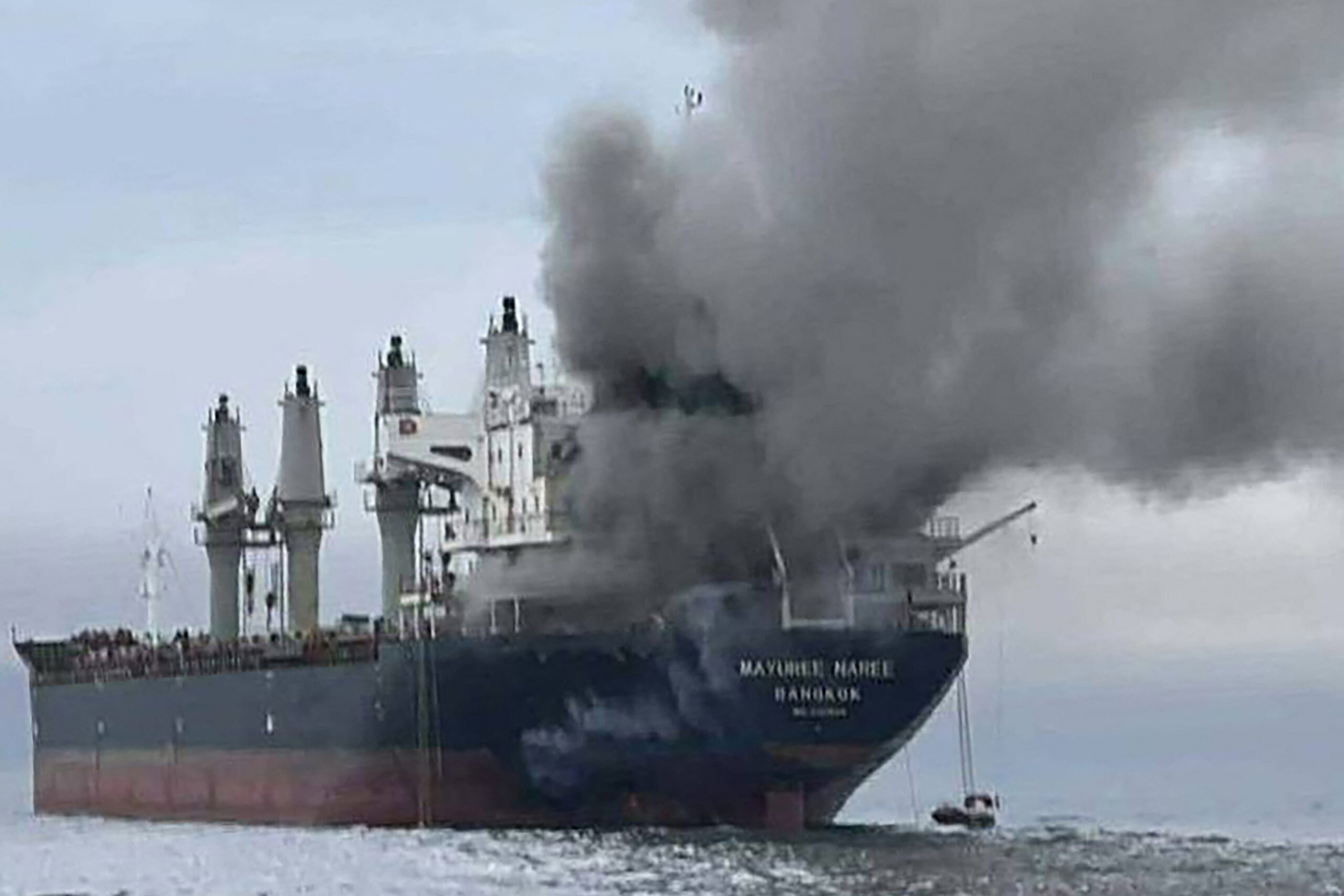
WAR-IRAN-US-ISRAEL-THAILAND-ATTACK-LOGISTICS

Much of the commentary on the confrontation in the Strait of Hormuz assumes the United States has stumbled into an unprecedented crisis. CNN started the meme, claiming unidentified “sources” leaked a classified briefing saying that what is unfolding is conditioned by confusion and disbelief. The Atlantic followed with a scolding think piece, the New York Times with its own version, and then the New Yorker, calling the unpreparedness “inexcusable.” In reality, Washington and Tehran have fought variations of this maritime contest before. What is unfolding today is not Armageddon, just Round Three.

During Trump’s first term, Tehran used the same tactics of threatening to block the Strait and attacking oil infrastructure in the Gulf states. In 2018, after pulling out of the Obama nuclear deal, Trump launched a “maximum pressure campaign” against the Islamic Republic, which included extensive sanctions designed to shut down Iran’s oil industry. In February 2019, the Islamic Revolutionary Guard Corps threatened it would close the Strait. It backed off from full closure, understanding Iran’s need to export oil would likely cripple its society long before global reserves were used up. In early summer 2019, Iran turned up the pressure, sabotaging four oil tankers in the United Arab Emirates. Iranian mines in the Gulf of Oman were likely responsible for damaging two tankers, Japanese and Norwegian. A barrel of oil was projected to spike from $65 to as much as $170.

But it didn’t, as Iran backed away from the fight. It could not afford a full blockade of its oil exports to China, which the U.S. could have effected at very low cost, in the Indian Ocean, away from Iranian interference and any closed Strait. Iran also knew that, while it could harass shipping, it could not seal the Strait to all traffic in the face of the massive U.S. Navy deployment. This was asymmetrical warfare, not peer-to-peer fighting. Iran in 2019 instead chose the long-game: survive sanctions while applying calibrated pressure rather than risking an all-out regime-threatening war. The strategy worked because oil markets react to risk—fear—not necessarily reality. When tensions rise between Iran and the United States, oil prices spike because investors fear shipping could be interrupted. Insurance rates rise over worry about the future, not the present. Threats to the strait get Iran most of what it needs (survival) at low cost. Temporary chaos can achieve political goals, and makes a helluva diplomatic bargaining chip.

Many of the lessons Iran applied in 2019 were learned in the Iran–Iraq “Tanker War.” Between 1984 and 1988, oil tankers, merchant vessels, and neutral shipping became targets in a campaign designed not to defeat an enemy navy but to strangle an enemy economy. After years of brutal stalemate on land, both Iran and Iraq looked for ways to inflict economic damage on each other. Oil exports were the lifeblood of both states, and nearly all of that oil moved by ship through the narrow waters of the Persian Gulf (back then, the Strait carried a larger share of globally traded oil than today’s 20 percent). Beginning in 1984, Iraq began attacking tankers carrying Iranian oil. Iran targeted vessels linked to the Arab states, which were mostly supporting Baghdad and selling to the U.S. Hundreds of ships were attacked, but few were destroyed outright. In total, only 55 of the 239 petroleum tankers (23 percent) struck were completely sunk.

Iran learned its strategy was less about sinking ships than about creating fear of sinking ships. Oil tankers are massive vessels designed to withstand damage. Many ships struck by missiles or mines did not sink but burned before being towed to safety.

But it was the threat that soon drew the United States into the conflict. Kuwait sought protection, and in 1987 Washington agreed to the controversial arrangement of reflagging Kuwaiti tankers as American and having the U.S. Navy escort them. But even the world’s most powerful navy could not fully guarantee safety in such a narrow waterway. The first escorted convoy immediately encountered trouble when the tanker Bridgeton struck an Iranian mine in July 1987. The explosion did not sink the vessel, but it was a public embarrassment. Iran’s tactics exposed the vulnerability of modern shipping. Mines, cheap and difficult to detect and remove, proved effective as tools of harassment. A handful of mines could shut down vast areas of sea.

But a change in American tactics ultimately neutralized the Iranians. The United States shifted from escorting tankers to directly confronting Iranian forces. The turning point came in April 1988, after a U.S. guided-missile frigate struck a mine in the Gulf. Although the ship survived, the incident triggered a massive American retaliation. American ships and aircraft destroyed Iranian oil platforms used for military surveillance and sank or damaged Iranian naval vessels. That the 31st Marine Expeditionary Unit (MEU) is today steaming toward the Gulf with 2,500 special operations–capable Marines and suggests the U.S. may be planning to follow a similar strategy.

The operation demonstrated the overwhelming conventional superiority of the U.S. Navy. By the time the Iran–Iraq War ended later in 1988, the Tanker War had produced no victor. Both Iran and Iraq continued exporting oil throughout the conflict. Despite hundreds of attacks, the flow of petroleum through the Gulf never stopped entirely. The maritime campaign could not achieve its strategic objective for Iran, the same lesson learned anew in 2019.

The central lesson is a cautionary one. Military power can keep sea lanes open, but it cannot eliminate fear and risk. The Gulf remains a narrow, congested waterway where accidents, miscalculations, and asymmetric tactics can rapidly escalate if the U.S. allows them to do so. The war reinforced another lesson important today, that protecting commerce at sea may be necessary, but it is never simple, and it is rarely without consequences. America has kicked off a lot here, and it will cost her lives and money to finish it.

So what happens next?

Despite decades of threats, Iran has never fully closed the Strait. It is vital to remember that Iran, even in 2026, has not actually closed the Strait. Ships are just afraid to go through. Yes, a small number of mines may have been sown, but Iran is offering safe passage under a number of scenarios. It promises safe travel to any country that expels its American and Israeli ambassador. It doubled down by saying at one point that any ship not connected to America or Israel may pass safely, thus precluding the widespread use of mines, which target indiscriminately. It has effectively lost its navy and air force, leaving only small boats to carry out its plans. Drones are a new threat since the last time, but they can be countered and are unlikely to sink a large ship.

A closure would disrupt Chinese energy supplies and damage the last relationship that keeps Iran’s economy afloat. It may need to once again pull back. Iran holds a useful card in threatening the Strait of Hormuz. But history suggests it is a six, not an ace. Tehran can create fear and temporary disruption, but it has never shown the ability to permanently close the waterway against determined naval opposition and the right strategic response.

The post Will Iran Blink on the Strait of Hormuz? appeared first on The American Conservative.