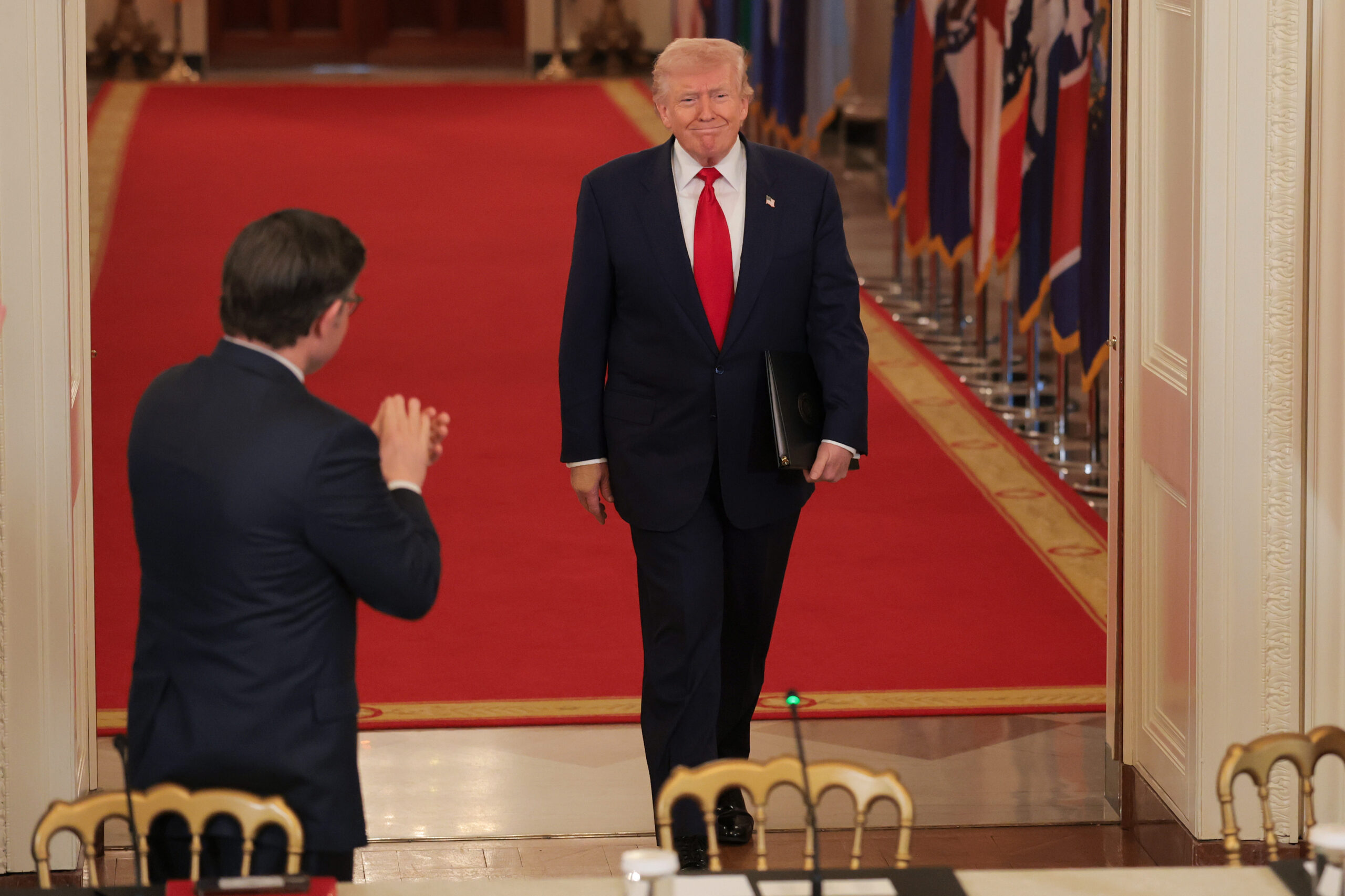
WATCH: Speaker Mike Johnson Capitulates on Mass Deportations, Says “Course Correction” Needed Going into Midterms After “Overzealous” Immigration Enforcement as White House Tells GOP to Avoid Running on Mass Deportations

Man in a blue suit and glasses speaking into a microphone at a congressional event.

Man in a blue suit and glasses speaking into a microphone at a congressional event.

House Speaker Mike Johnson publicly admitted this week that mass deportations are over after a “hiccup” with Hispanic voters and that a more thoughtful approach is needed with regard to immigration enforcement. 

Trump and Republicans ran on the promise of “the largest deportation in the history of our country,” with Trump saying he hoped to send “nearly 20 million” back to their home countries.

But since two left-wing radicals attacked ICE agents and got shot, the GOP’s tune on immigration crackdowns has changed.

During an interview onstage at the House Retreat in Doral, Florida, Johnson argued that the GOP is losing Hispanic and Latino voters because “some of the immigration enforcement was viewed to be overzealous,” and that a “course correction was necessary.”

Trump’s new pick for DHS Secretary, Senator Markwayne Mullin (R-OK), he said, is going to “do a great job in that role,” alongside “Tom Homan,” who he lauded for withdrawing immigration agents and bringing “calm to the chaos” in Minnesota.

“I think these people will see we did what we said we were going to do. We calmed down the immigration enforcement concern. We uphold the rule of law, but we do it in a way that honors the dignity of everyone, and they’ll understand that our party is with them, cares about them, and this is the permanent home where they should be,” Johnson added.

WATCH:

Interviewer: You’ve said you’re going to defy the odds, defy history, and keep the majority. But how do you go about doing that? Do you somehow preserve that coalition that you had built, or do you see a new coalition form?

Johnson: No, listen, we had a huge demographic shift in the 2024 election, as you reference, and all those groups and others who came into the Republican Party— not reluctantly, but they came with hopeful anticipation— two reasons for that. We were presenting common sense solutions to the challenges they were facing, and the Democrat Party left them behind. As I say all the time, I said earlier this morning, this is not your father’s Democratic Party. They do not resemble what, a generation ago, they did. Their platforms are radically different now, and they’re, most of them, are avowed socialist or Marxist, and they’re, they’re, they’re going too far left. So all those people we can hold and have a durable governing common sense majority for their foreseeable future.

We got a little hiccup with some of the Hispanic and Latino voters, for certain, because some of the immigration enforcement was viewed to be overzealous. And, you know, everybody can describe it differently. But here’s the good news, we’re in a course correction mode right now. We’re going to have a new Secretary of Homeland Security. Mark Wayne Mullen is going to be, do a great job in that role. I’m sure that he’ll be confirmed by the Senate. He’s a thoughtful guy. He’ll bring a thoughtful approach. You have somebody like Tom Homan, who has 40 years experience in the field and was decorated by former Democrat presidents for his acumen and expertise, and he went into Minneapolis and brought calm to the chaos there.

That’s what you’re going to see. And I think that the Hispanic and Latino voters who came to us came for a number of reasons. They were very animated about the open border and all the negative secondary effects that came from that, but they also concerned about the cost of living and the lack of jobs and all these other things that everyone’s concerned about. So, we have a great record to run on, Scott.

The reason we’re going to win the midterms, the reason we’re going to defy history and do it is because a number of factors. I Have a very boring 90 minute slide show that I could show you this morning and show you all the reasons we’re going to win, but we have great candidates. We have a fundraising advantage right now. We have much better policy and a strong record to run on, and all these demographics, good people, who are going to feel the positive effects of that. We’re anticipating extraordinary economic growth going into this year in the midterms. All boats will rise, salaries and wages will go up, you have bigger tax refunds and bigger paychecks, and the average family $10,000 more money in their pocket because of Republican policies. I think these people will see we did what we said we were going to do. We calmed down the immigration enforcement concern. We uphold the rule of law, but we do it in a way that honors the dignity of everyone, and they’ll understand that our party is with them, cares about them, and this is the permanent home where they should be

This comes as the White House quietly urges GOP lawmakers to avoid the term “mass deportations” during the midterm elections.

As The Gateway Pundit reported, sources said that White House Deputy Chief of Staff James Blair urged GOP lawmakers at the annual House retreat to stop talking about mass removals of illegal aliens who hadn’t committed additional violent crimes.

The White House responded to the reports by touting deportations of criminal illegal aliens, the same policy used under Obama, and did not deny claims that they’ve sought to end the focus on mass deportations.

MORE:

JUST IN: White House Responds to Report that House GOP Told by White House to Avoid Mass Deportation Messaging in Midterms

The post WATCH: Speaker Mike Johnson Capitulates on Mass Deportations, Says “Course Correction” Needed Going into Midterms After “Overzealous” Immigration Enforcement as White House Tells GOP to Avoid Running on Mass Deportations appeared first on The Gateway Pundit.

Hawley Introduces Bill to Ban Major Abortion Pill

Sen. Josh Hawley (R-MO) introduced legislation Wednesday that would end the Food and Drug Administration’s (FDA) approval of the medication mifepristone to end pregnancies. The bill would preserve its use for Cushing’s syndrome, and would allow women alleging harm from the medication to sue its manufacturer.

“We’ve known for years that mifepristone is risky but it’s really just in the last few years that we’ve learned that this drug is inherently dangerous and it is inherently prone to abuse,” Hawley said.

“One liberal administration after another, President Obama and then President Biden, removed almost all of the safety protocols around mifepristone such that today it is almost wholly unregulated,” he added. “They did it because of abortion politics. They did it because they wanted to turn mifepristone into the driver of abortion on demand.”

The bill faces an uphill battle in the Senate. But Hawley said “I’m going to make that case to my colleagues.”

The post Hawley Introduces Bill to Ban Major Abortion Pill appeared first on The American Conservative.

A Golden Moment: The Pro-life Movement Benefits from the Wider Trends in America

Guest Post by Pro-life Leader Frank Pavone, National Director, Priests for Life

Throughout American history, powerful waves of religious renewal known as the Great Awakenings have shaped the nation’s identity and moral direction. These revivals stirred spiritual fervor and often coincided with major social movements, influencing events such as the American Revolution and the Civil War and inspiring reform efforts around slavery, women’s rights, and labor conditions.

The First Great Awakening began in the 1730s during the height of the Enlightenment, a period that emphasized human reason, individualism, and rational inquiry. For many Christians, however, something seemed to be missing. They argued that faith could not be reduced to intellectual conclusions alone. True transformation, they believed, came through the Word of God and the work of the Holy Spirit. Their message emphasized personal conversion, moral responsibility, and a renewed focus on biblical authority. The resulting revival movement spread widely and had lasting cultural and political effects.

I believe that today, the United States is experiencing a similar moment—a 21st-century Great Awakening that is reshaping the cultural and political landscape

Signs of renewed interest in faith and spirituality appear in several areas of American life. Bible sales, for example, have risen significantly in recent years. Millions of copies are being sold annually, suggesting that many Americans are searching for deeper meaning and moral guidance. For people who feel overwhelmed by the woke agenda, moral relativism, sustained attacks on the sanctity of life, marriage, family, and the very notion of truth, the rise of anti-Semitism, or the weaponization of government, the Bible represents a source of clarity, purpose, and stability.

Young people appear to be part of this trend. Researchers who study religion and culture report increased church engagement among younger generations, particularly members of Generation Z and Millennials. In many cases, these groups are attending worship services at higher rates than previous generations did at the same stage of life. For some observers, this signals a cultural shift in which younger Americans are rediscovering religious traditions and community life after years of declining participation.

At the same time, the broader cultural environment is changing in ways that could strengthen our cause. President Trump, his administration, and those who voted for him are challenging bias in media, academia, and social media platforms and are winning. DEI is being abandoned or weakened by many businesses and institutions. Legal battles, financial pressures, and changes in leadership have moved academia and media towards more ideological balance. These developments suggest that ideas once labeled “woke” are losing influence and that a wider range of viewpoints is gaining space in public discussion.

Public expressions of faith have also gotten a boost recently. Several recent Supreme Court rulings have reinforced protections for religious freedom, and the Trump administration has reminded public schools that teachers, staff, and students have the right to express their faith. These decisions strengthen the role of religion in American civic life and restore constitutional protections that had been weakened over time.

Executive actions taken by President Trump have also been supportive of religious expression and the pro-life cause. These include the establishment of a task force to eradicate anti-Christian bias, the pardoning of pro-life protesters and the weakening of laws that were used against them, and efforts to emphasize free speech in media and educational institutions. Such policies create a more favorable environment for faith-based activism, the soul of the pro-life movement.

International policy has also entered the discussion. The United States has recently withdrawn funding from 66 global organizations, including many that actively promote abortion. Reducing American financial support for such organizations will slow the global spread of pro-abortion initiatives.

The 2024 election was more than a standard political contest; it was a decisive moment in a broader cultural battle between competing moral visions for our country. Our electoral victory has created an opportunity to advance policies that protect religious freedom and promote the sanctity of human life.

This is why I see the current period as a “golden moment” for pro-life activism and a Great Awakening for the nation. Increased religious engagement, legal protections for faith in public life, and supportive political leadership are forces that could reshape American culture for decades to come. Maintaining this momentum through this year’s midterm elections is essential to sustaining these gains.


Prolife Leader Frank Pavone (@frfrankpavone) is the National Director of Priests for Life, the President of the National Pro-life Religious Council, and the Pastoral Director of Rachel’s Vineyard and Silent No More. See www.ProLifeCentral.org.

The post A Golden Moment: The Pro-life Movement Benefits from the Wider Trends in America appeared first on The Gateway Pundit.

THE INVISIBLE AYATOLLAH: Mojtaba Khamenei Still Nowhere To Be Seen, as Reports Suggest He Has ‘Lost a Leg’ and Is ‘In a Coma’

Portrait of a man with glasses and a beard, set against a fiery background, conveying intensity and seriousness.

Portrait of a man with glasses and a beard, set against a fiery background, conveying intensity and seriousness.
Where is Mojtaba?

With each passing day, it becomes more likely that Iran has elected a dead or incapacitated Ayatollah.

Iran’s new Supreme Leader, Mojtaba Khamenei, has allegedly ordered his nation to ‘weaponize the Strait of Hormuz’ in his first ‘written statement’.

But Mojtaba still hasn’t been seen, as claims are mounting that he has ‘lost a leg’ and is ‘in a coma’ as a result of injuries sustained during air strikes.

Daily Mail reported:

“A written statement attributed to Mojtaba Khamenei, 56, was read out by a news anchor on state TV this afternoon.

He himself did not appear on national TV. Amid rumors of his incapacitation, serious questions over who is currently in charge of Iran linger over the nation as it continues to duke it out with the US, Israel and its Gulf neighbors.”

“The Iranian leader, who took over from his father Ayatollah Ali Khamenei following his assassination on February 28, added that while he believes in maintaining a friendship with Iran’s Gulf neighbors, attacks on US bases in the region will continue. He said: ‘We are not an enemy of the countries around us, and we are only targeting the bases of those Americans.’

Despite the release of the statement, Mojtaba is said to be in intensive care at the Sina University Hospital in the city’s historic quarter surrounded by security officials, according to a source in Tehran. A section of the hospital has been sealed off to guard Iran’s Supreme Leader.”

Read more:

Iranian TV Says Khamenei’s Son Mojtaba, Elected New Supreme Leader, Has Been Wounded by US-Israel Strikes

The post THE INVISIBLE AYATOLLAH: Mojtaba Khamenei Still Nowhere To Be Seen, as Reports Suggest He Has ‘Lost a Leg’ and Is ‘In a Coma’ appeared first on The Gateway Pundit.

Constitutional BOMBSHELL Democrats Want Buried

Collage of historical images related to U.S. constitutional amendments with a central plaque displaying amendment numbers

The first ten amendments to the Constitution stand as America’s most sacred bulwark against government tyranny, yet many patriots remain unaware of the critical protections these founders crafted to shield us from federal overreach.

Anti-Federalist Victory Against Government Expansion

The Bill of Rights represents a stunning victory for those who feared unchecked federal power. Anti-Federalists correctly predicted that without explicit constitutional restraints, the new government would inevitably expand beyond its intended limits. Their insistence on written protections forced James Madison to draft amendments that would legally bind future administrations. This foresight proves remarkable given today’s struggles against government overreach, demonstrating that conservative concerns about federal expansion were justified from America’s founding.

Constitutional Safeguards for Individual Liberty

The First Amendment protects religious freedom, free speech, press freedom, assembly rights, and petition rights—all fundamental to conservative values. The Second Amendment explicitly protects gun ownership rights that remain under constant attack from leftist politicians. The Fourth Amendment requires warrants for searches, preventing government fishing expeditions. The Fifth Amendment ensures due process and protects private property from seizure without just compensation, cornerstones of economic freedom that conservatives champion.

States’ Rights and Limited Government Principles

The Tenth Amendment reserves all non-delegated powers to states and people, embodying the conservative principle of federalism. This amendment directly counters federal overreach by establishing that Washington possesses only enumerated powers. The Third Amendment prevents military quartering in homes, while the Eighth Amendment prohibits excessive punishment—both limiting government’s coercive power. These protections reflect the founders’ understanding that government naturally tends toward tyranny without constitutional restraints, a lesson conservatives must vigilantly remember.

The Bill of Rights continues serving as America’s constitutional firewall against government tyranny. Every conservative should understand these protections and demand their enforcement, particularly as modern politicians attempt to circumvent constitutional limits through regulatory overreach and executive orders.

Sources:

Bill of Rights Transcript – National Archives

Bill of Rights Primary Sources – Bill of Rights Institute

What Does the Bill of Rights Say – National Archives

Constitutional Amendments – Constitution Center

The Madness of King Trump

The Madness of King Trump

The president has pursued a policy of war and plunder.

President Trump Participates In A Saving College Sports Roundtable In The East Room

President Donald Trump has lawlessly launched a full-scale war against a distant nation that neither attacked nor threatened America. Instead, Iran was negotiating with the United States, offering substantial concessions. The president justified his aggression with rhetoric similar to that of Russia’s Vladimir Putin in launching Moscow’s “special military operation” against Ukraine. 

So far some 1,200 civilians, including more than 160 children, have been killed by American and Israeli (underwritten by America) action. Iran continues to retaliate, raising energy prices and roiling the global economy. Nevertheless, Trump demands Tehran’s abject surrender, even refusing to rule out the possibility of deploying ground forces in Iran. 

He is acting more as Roman emperor than American president, wandering the globe conquering foreign lands and looting subject peoples for personal as well as national gain. He has become the sort of reckless despot feared by the nation’s founders. This tragic perversion of the American experiment demonstrates the terrible truth of Lord Acton’s famous axiom: “absolute power corrupts absolutely.”

Indeed, the U.S. no longer contains the president’s ambitions. Trump’s fantasies have metastasized. As he explained last year, “The first time, I had two things to do—run the country and survive.” But “the second time, I run the country and the world.” When asked if there was any limit to his powers, he responded: “My own morality. My own mind. It’s the only thing that can stop me.” When will he decide that his writ extends to the entire universe?

Trump now uses the American republic’s military guardians to rain death and destruction on other peoples for the benefit of—indeed, pushed and even directed by—another nation and government, whose leader exhibits a similar taste for international aggrandizement and self-enrichment. Trump even promotes, or at least tolerates, subordinates who promote the bloody military campaign as a sacred religious crusade.

All this from a president who promised to put America first. 

Admittedly, the Islamic Republic of Iran is a tempting target. To start, it is brutally repressive. However, that’s likely of no concern to the president. After all, most of his favorite foreign leaders, such as Saudi Arabia’s Mohammed bin Salman, are ruthless, even murderous, authoritarians.

Although also a loathsome regime, Iran does not threaten America. Antagonisms between Washington and Tehran are many, but Americans have done their share of escalating the conflict. While Trump complained that Iran’s activities “endanger” U.S. bases, it was not Tehran which encircled its adversary with military forces and launched military strikes.

As for the Islamic Republic’s potential nuclear ambition, even if it had nukes it would not attack America, since doing so would trigger annihilating retaliation. Ironically, its nuclear program was begun by Mohammad Reza Pahlavi, the U.S.-backed shah, or monarch, who was overthrown in 1979. In any case, American intelligence agencies long ago concluded that the Islamist regime abandoned weapons development. Instead, Tehran sought nuclear latency, preserving the possibility of weaponization. After all, the regime had barely survived a murderous invasion by Saddam Hussein’s Iraq, supported by the U.S. and Gulf states, and then suffered through years of economic sanctions and military threats from Washington, and, more recently, nearly continuous, low-grade warfare from Israel. Today the president’s aggressions are proving Iranian hawks to be right: Only nukes can secure the regime.

Nevertheless, Tehran negotiated serious restrictions over its nuclear activities with the Obama administration, restrictions that contained Iran’s nuclear ambitions. Trump foolishly dropped the accord during his first term—more out of personal pique than perspicacity in policy. The Islamic regime moved ahead with its nuclear program, but later offered the Trump II administration even more concessions. However, the president decided—or was talked into, even forced—to wage war on Iran despite the lack of any serious, let alone convincing, justification. Last year he claimed to have “obliterated” Tehran’s nuclear program, yet he now demands that Iran surrender its missiles as well, which would leave it defenseless against Israel as well as America. He also insists on approving the country’s next leader, something no serious government anywhere would accept.

Iran is not the president’s only target. He is ostentatiously employing America’s armed forces globally to squeeze money and resources out of other nations. In Venezuela he kidnapped President Nicolas Maduro—but left in place the Chavista dictatorship in exchange for control over oil and other resources. He dismissed the opposition’s María Corina Machado while calling then-Vice President and now President Delcy Rodriguez, a product of the Maduro regime, “a wonderful leader.” He appears determined to turn Venezuela into his foreign policy template. Even though war continues to rage in the Persian Gulf, he is talking about additional military targets, such as Cuba.

In this way, Trump is entrenching authoritarian regimes, making liberal, democratic transitions elsewhere less likely. Indeed, he appears to prefer that result. For instance, Venezuela’s Rodriguez may be more likely than Machado, who would have trouble consolidating power, to do business with him. Moreover, Trump has employed various coercive tactics against allies and friends, such as Denmark, Mexico, and Panama, prioritizing territorial and commercial benefits for privileged Americans, including his family. European policymakers frankly admit that they now make economic concessions to buy military protection. Japan and South Korea are behaving similarly.

Using its enormous power for predatory purposes undermines America. Overall, Trump has made American foreign policy about little more than power and dollars. Observed Harvard’s Stephen Walt, the president seems determined “to use Washington’s privileged position to extract concessions, tribute, and displays of deference from both allies and adversaries, pursuing short-term gains in what it sees as a purely zero-sum world.” This ignores the extraordinary benefits of mutual cooperation, as well as the vital importance of constraints on every government, including America’s. Nothing in principle distinguishes Trump’s approach in, say, Venezuela, from that of dictators the world over. 

Indeed, his policy of untrammeled national and personal aggrandizement is classic mercantilism and imperialism. The Roman Empire perfected this approach. European colonial powers followed, though they usually focused their ill-attention on much weaker, nominally “uncivilized” peoples. The U.S. joined this process with the Spanish-American war, seizing the Philippines from Spain and cruelly crushing a pre-existing indigenous independence movement. Later the terrible totalitarian dictators, Adolf Hitler and Joseph Stalin, perfected the practice of extorting and extracting wealth from anyone within geopolitical reach. Obviously, Trump is no Hitler or Stalin, but his strategy is still remarkably un-American.

He is degrading constitutional limits on presidential power, claiming the right to bomb, invade, and occupy other nations at will. Even Alexander Hamilton, the great apostle of executive authority, emphasized that the founders were not replicating the English king’s powers, but rather, shifting the authority to go to war to Congress. The president’s authority as commander-in-chief “would amount to nothing more than the supreme command and direction of the military and naval forces.” Although the president would manage any conflict, Congress was to decide whether there was one for him to fight.

Moreover, Trump is romanticizing the use of force, ignoring the terrible human cost of war. Instead of reducing dangerous U.S. military commitments and risks to America and its people, he is waging unnecessary wars. He routinely backs mass slaughter by allies like Saudi Arabia and Israel, and does not even acknowledge those killed by Washington, such as the scores of Iranian school children in its February 28 strike on the Iranian town of Minab. Indeed, his officials, most notably Defense Secretary Pete Hegseth, showcase the sort of ugly bloodlust normally expected from America’s adversaries, such as Tehran. 

Ultimately, like the French “Sun King” Louis XIV, Trump apparently believes that “L’état, c’est moi,” or “I am the state.” All that matters is his will. For instance, the president talked of banning trade with Spain because Prime Minister Pedro Sanchez criticized his counterproductive war of choice: “We don’t want anything to do with Spain.” This mimics his petulant outburst against Canada, accompanied by a massive tariff hike, after one province ran an ad quoting President Ronald Reagan’s criticism of protectionism. The interests of more than 340 million Americans matter not at all.

A decade ago candidate Trump denounced “a reckless, rudderless and aimless foreign policy, one that has blazed the path of destruction in its wake.” He highlighted his opposition to the invasion of Iraq, promising that “unlike other candidates for the presidency, war and aggression will not be my first instinct. You cannot have a foreign policy without diplomacy. A superpower understands that caution and restraint are really truly signs of strength.”

Alas, his policy has become one of careless and callous brutality, with his ambition bounded by neither morality nor principle. He has become a threat to global peace, killing prodigiously while setting an entire region on fire, and doing so for no recognizable U.S. interest. Ultimately, he is likely to prove more dangerous to Americans than anyone else.

The post The Madness of King Trump appeared first on The American Conservative.

Congress Has Yet to Declare War on Iran, but This Campaign is Consistent with Historical Precedent

Military operations featuring naval vessels, fighter jets launching from an aircraft carrier, and missile launches, showcasing modern warfare capabilities.

Military operations featuring naval vessels, fighter jets launching from an aircraft carrier, and missile launches, showcasing modern warfare capabilities.
Image: Wikimedia Commons (2026 Iran War Collage)

The U.S. is now two weeks into a military strike campaign against the government of Iran, prompting observers to question whether Congress will officially declare war on the Islamic Republic.

The Gateway Pundit spoke to Dr. Chase Spears, a retired U.S. Army combat veteran, public affairs officer, writer, and host of the Finding Your Spine podcast. In a recent article for RedState, he described himself as an “almost-isolationist,” indicating that he largely supports a policy of remaining apart from the affairs or interests of other countries.

Why? Because Dr. Spears is a product of the Global War on Terrorism (GWOT), having been deployed to combat zones twice throughout his career, and serving with soldiers who spent years of their lives in hostile zones overseas. “We saw how Iraq turned out; we saw how Afghanistan turned out,” he explained.

He went on to reveal two reasons why his primary default is one that’s against wars. First, he said, “the [U.S.] nation has not shown a willingness to commit to what’s needed to get the job done in the entirety of my lifetime.”

He contended, “When you go to war as a nation, you should go as a last resort, willing to exert the amount of force and violence necessary in order to get the job done as quickly as possible to quickly restore a just peace.”

Second, Spears said, he’s “traditionally against new military campaigns because there is a lot of reason to question the constitutionality of how we’ve done war since the end of World War II.” The U.S. Constitution divides war powers between Congress and the President. According to Article I, Section 8, Congress holds the exclusive power to “declare War.”

However, he pointed out that “when you look at the course of American history, only a very small number of the wars that we’ve been engaged in were ever congressionally declared.”

For example, the United States never formally declared war for the Civil War, Vietnam, or Afghanistan. In recent history, the United States formally declared war during World War II, starting with a declaration against Japan on December 8, 1941, one day after the attack on Pearl Harbor.

Many have declared President Donald Trump and War Secretary Pete Hegseth’s actions against Iran as unconstitutional. In response, Spears asked, “Where have they been the entirety of our lifetimes? Where were they on Vietnam, Desert Storm, Afghanistan, Operation Enduring Freedom, on Operation Iraqi Freedom? Where are they on our proxy war with Russia through Ukraine?”

“I’m not saying it’s the right thing to do, that we have walked away from how the Constitution says we declare war, but if we’re going to throw the flag on this action is Iran and we have nothing to say about all the other wars, then there’s a selective use of that flag and there’s hypocrisy in that,” declared Spears.

The U.S. Army veteran said he has “come to accept, lamentingly, that presidents do not necessarily follow the constitutional provision for consulting Congress.”

In his opinion, Congress has largely abrogated its responsibility, being more willing to “complain, whine, and moan, while avoiding the responsibility of making the decision to go to commit troops to combat.”

“If Congress wants to do something about it,” Spears said, “its elected members control the purse. That’s why the framers of the Constitution split control of the military between Congress and the President, [explaining] Congress is also the funding agent [according to Article I, Section 8], and the president is established as Commander in Chief [in Article II, Section 2].”

Despite the widespread criticism directed at Trump and Hegseth for their actions regarding Iran, Spears is in favor of the campaign. He explained, “Iran has been the world’s leading exporter of terrorism for 47 years, [and] they have murdered my comrades in arms.”

“They have killed indiscriminately for decades, while funding, enabling, equipping, training, and encouraging all these other terrorists around the world to do the same,” added Spears. “The can has been kicked down the road for too long, [and] it’s time to cut the head of the snake.”

The father of five is also concerned about his children. “Do I want my kids and my grandkids to have to adopt the fatalistic view of this age that nothing virtuous can be done with state power?” The answer is no. “If we have an opportunity to actually make a meaningful difference in global security by crushing the Iranian regime, I think we need to do it.”

In conclusion, Spears also noted that “this military campaign is a noble cause, a reality heightened by the fact that the Iranian people want it.”

Retired Air Force Colonel Rob Maness, a former bomber squadron commander who served the U.S. military for more than 30 years, agreed with Spears, pointing out that “Iran is the world’s leading exporter of terrorism.”

What’s more, Maness contended, “Iran declared war on us in 1979, so I view this quite differently than a lot of MAGA types and fully support [this campaign] as long as we don’t do a stupid occupation and/or invasion.”

Numerous historians and analysts agree, viewing the takeover of the U.S. Embassy in Tehran on November 4, 1979, along with the capture of 52 American hostages, as an act of war or the onset of a prolonged, undeclared conflict.

Additionally, the 2001 Authorization for Use of Military Force (AUMF) is a congressional joint resolution enacted shortly after the September 11 attacks, authorizing the President to employ all “necessary and appropriate force” against nations, organizations, or persons involved in the attacks.

“[Iran] harbored 9/11 associated terrorists so the AUMF post 9/11 still applies,” Maness also argued. “So, when a nation goes to war with us and the POTUS/CINC decides to end it,” he simply said, “we have to be ruthless.”


The post Congress Has Yet to Declare War on Iran, but This Campaign is Consistent with Historical Precedent appeared first on The Gateway Pundit.

Music, Film, and Sports Treasures Shine in Christie’s Spotlight

Beatles-themed Ludwig drum set and Gretsch guitar displayed in a modern setting, showcasing iconic music memorabilia.

On Tuesday afternoon, I visited Christie’s headquarters at Rockefeller Center for a temporary display of the Jim Irsay Collection, just before it goes on auction.

This “chorus of cultural touchstones,” as Christie’s heralds it, represents the life-long passion of the late, Indiana-based billionaire, philanthropist, and owner of the Indianapolis Colts. Irsay supported a spectrum of causes, from medical research to oceanography. He also invested much of his fortune in exceptional memorabilia.

Here are several of Irsay’s most amazing artifacts.

Custom electric guitar featuring a beautifully crafted wooden body, intricate inlays, and unique hardware, ideal for musicians and collectors.
Grateful Dead frontman Jerry Garcia’s custom “Tiger” guitar. (All photos courtesy of CHRISTIE’S IMAGES LTD. 2026)
  • Guitar Magazine called Irsay’s “the greatest guitar collection on Earth.” If not hundreds, then certainly scores of them line Christie’s walls and fill its presentation spaces. These include beauties owned and played by Eric Clapton, Janis Joplin, Prince, and many other rock, folk, and soul greats.

“Tiger,” Grateful Dead co-founder Jerry Garcia’s famous Doug Irwin-bespoke guitar, is a special treat. The solos that Garcia coaxed out of that instrument routinely launched into orbit millions of Deadheads, including your humble correspondent.

Other guitars, particularly a brushed-aluminum National or two, are appealing for their looks alone — regardless of who strummed them.

Elegant black grand piano with an open lid, showcasing polished keys and a beautifully crafted interior, perfect for music enthusiasts and performers.
Sir Elton John’s touring Steinway concert-grand piano (All photos courtesy of CHRISTIE’S IMAGES LTD. 2026)
  • Sir Elton John’s touring Steinway concert-grand pianois still standing, after all this time. The rock & roll god played the black-lacquered model at countless shows, from 1973 through 1988. The Rocketman autographed the internal cast-iron plate: “Enjoy this as much as I have/Elton John.”
  • Centered perfectly at the base of Christie’s double staircase, one finds Ringo Starr’s drum kit from The Beatles’ seismic breakthrough on CBS-TV’s The Ed Sullivan Show on February 9, 1964. Christie’s photographed those sacred objects beside John Lennon’s Gretsch guitar, among other stringed instruments and an upright piano that once belonged to the Fab Four.
  • A weathered Fleetwood Mac touring-guitar case is here, quite weary for the wear.

    Beatles-themed Ludwig drum set and Gretsch guitar displayed in a modern setting, showcasing iconic music memorabilia.
    Ringo Starr’s drum kit from The Beatles’ seismic breakthrough on CBS-TV’s The Ed Sullivan Show on February 9, 1964. (All photos courtesy of CHRISTIE’S IMAGES LTD. 2026)

  • Dazzling in bright red, with white interior, Hunter S. Thompson’s 1973 Chevrolet Caprice convertible, AKA “The Shark,” co-starred in the film of his landmark book, Fear and Loathing in Las Vegas. The auction lot includes cassette tapes of Jimmy Buffett and Allman Brothers Band recordings. Thompson surely played these as he cruised around in this lovely example of Detroit’s pre-Energy Crisis automotive design.
  • Cinematic items include Austin Powers’ thick-rimmed eyeglasses, shooting scripts of The Godfatherand Scarface, and a red spiral notebook in which Sylvester Stallone jotted his thoughts while directing Rocky.

  • Behold a baseball that Babe Ruth and Lou Gehrig jointly signed, sometime between 1927 and 1931.
  • Boxing mementos from Muhammad Ali include a program for his September 10, 1966, faceoff against Karl Mildenberger in Frankfurt, West Germany. This keepsakerecalls what locals called the Weltmeisterschaft im Schwergewicht. (Germans say this without chipping their teeth!) Americans knew this as the World Heavyweight Championship. (Spoiler: Ali defeated Mildenberger in a 12th-round TKO.)
  • Irsay also gathered KGB intelligence tools, not least a purse with a hidden camera, shoes with clandestine compartments, and a belt for concealing secrets.

    Vintage concert poster for the Winter Dance Party featuring Buddy Holly, Ritchie Valens, and Big Bopper, held at Moorhead Armory on February 3 with two showtimes.
    Winter Dance Party poster(All photos courtesy of CHRISTIE’S IMAGES LTD. 2026)

  • Most eerily, Irsay acquired a poster for the February 3, 1959, Winter Dance Party in Moorhead, Minnesota. Buddy Holly, Ritchie Valens, J.P. Richardson (AKA the Big Bopper), and pilot Roger Peterson all died in a plane crash en route to that engagement. Don McLean immortalized The Day the Music Died in his elegiac masterpiece, “American Pie.”

Those in a hurry can swing through this free exhibit in about 35-40 minutes. At leisure, an hour to 90 minutes should allow abundant time to appreciate the Jim Irsay Collection, in its totality and for its individual gems.

After this event concludes, these articles — and lots more — will be auctioned off to the highest bidders.

Don’t miss it.

Viewing

Christie’s New York
20 Rockefeller Plaza

(Between Fifth and Sixth Avenues)
New York, NY 10020
Through 4:30 p.m. ET today

Auction

Live: From 5:00 p.m. today through Saturday, March 14.

Online: Through Tuesday, March 17.

Contact
212-636-2000
info@christies.com

Deroy Murdock is a Manhattan-based Fox News Contributor.

The post Music, Film, and Sports Treasures Shine in Christie’s Spotlight appeared first on The Gateway Pundit.

DOJ Probe Uncovers Tens of Thousands of Noncitizens on Voter Rolls — Dozens of Illegal Aliens Cast Ballots

A stunning new federal review of voter registration lists has uncovered tens of thousands of noncitizens, hundreds of thousands of dead registrants, and widespread duplicate registrations, according to the U.S. Department of Justice.

The bombshell findings were disclosed by Assistant Attorney General for Civil Rights Harmeet Dhillon during an interview with Just the News.

This is the LARGEST federal check of voter rolls in American history, and it comes straight from the Trump DOJ’s aggressive push for real election integrity.

The investigation, which currently covers 16 states that voluntarily provided voter registration data, is already revealing serious problems in the nation’s election infrastructure.

HUNDREDS OF THOUSANDS of dead voters still active. TENS OF THOUSANDS of noncitizens — some illegal — sitting on the rolls ready to vote. And that’s only from 16 states so far.

“We’re finding tens of thousands of noncitizens on the voter rolls, hundreds of thousands of dead people on the voter rolls, and duplicate registrations between states,” Dhillon said during an interview on Just the News, No Noise.

Federal investigators say dozens of noncitizens have already been proven to have cast ballots in federal elections.

The Justice Department is now pursuing 29 additional states through lawsuits to obtain their voter registration records and determine whether they are complying with federal law.

As The Gateway Pundit has reported for years on dirty voter rolls and stolen elections, this is exactly the systemic rot we’ve been screaming about while Democrats and weak-kneed Republicans pretended everything was fine.

On Steve Bannon’s War Room, John Solomon connected every dot and made it crystal clear why every U.S. Senator needs this information right now ahead of the scheduled vote on the wildly popular Save America Act:

“Last night, we had Harmeet Dhillon… She has obtained 16 State’s voter rolls. She is fighting to get 29 more… This is the largest federal check of voting rolls in the history of America… In the first 16 states, she has found tens of thousands, tens of thousands of non-citizens, some of them illegal aliens, who have made it in a position to vote… Then she said, They have proven already, dozens of illegal aliens and non-citizens have actually cast ballots in federal elections… hundreds of thousands of dead people that they were able to find on the voter rolls who were still active on these states. That’s just the first 16 states.”

Solomon hammered home that this isn’t speculation, it’s proven fact that must reach every senator before they vote on the Save America Act next week:

“That should be an informational point every senator should have on their front plate… We should know by state the number of non-citizens that got on the rolls, the number of dead people that were on the rolls… There’s a false sense of security that has wavered over this debate, and it’s time to give people the data points.”

He also called out the big blue-state obstruction: California and New York are leading the resistance while the patterns of fraud are already forming even in states that claim to have “pretty good” rolls.

WATCH:

The numbers are backed up by actual arrests. This week, ICE and the FBI nabbed Mahady Sacko, an illegal alien from Mauritania, for voter fraud in Philadelphia. Sacko illegally voted in seven consecutive presidential elections since 2008, despite a 2002 removal order he ignored for over two decades.

“United States Attorney David Metcalf announced that Mahady Sacko, 50, of Philadelphia was arrested and charged by criminal complaint with fraudulent voting in the 2024 federal election by an illegal alien,” the DOJ said.

“Sacko is an illegal alien who was ordered deported in 2000. Despite being an illegal alien, Sacko allegedly unlawfully voted in person in the 2024 general election for federal office,” the Justice Department said.

“Sacko falsely represented that he was a U.S. citizen in order to vote and register to vote,” the DOJ said.

Sacko is facing five years in prison.

The post DOJ Probe Uncovers Tens of Thousands of Noncitizens on Voter Rolls — Dozens of Illegal Aliens Cast Ballots appeared first on The Gateway Pundit.

Iran’s Mine Warfare in the Strait of Hormuz

Two military personnel in tactical gear operate a small boat on calm waters, with a drone trailing behind them, showcasing modern naval operations.

Two military personnel in tactical gear operate a small boat on calm waters, with a drone trailing behind them, showcasing modern naval operations.
Explosive ordnance disposal Marines from the 1st Marine Company, 7th Engineer Support Battalion, tow an unmanned sea-floor-mapping and mine-detection vehicle during Baltic Operations 2021. Photo: U.S. Marine Corps (Robin Lewis).

IRGC Deputy Commander Ali Fadavi said on Iranian state broadcaster IRIB, “We have missiles that are launched from underwater, and their speed is 100 meters per second. We may use them in the coming days.” He also claimed that only Iran and Russia possess the technology for such weapons.

However, the claims have not been independently verified. Such statements are consistent with Iran’s broader pattern of using public statements to project deterrence. Tehran is attempting to scare the U.S. and Israel into disengaging.

Aside from advanced weapons that may or may not exist, the most concrete escalation is Iran’s mining of the Strait of Hormuz, one of the world’s most critical energy chokepoints through which roughly one-fifth of global crude oil passes.

U.S. intelligence sources told CNN that only a few dozen mines have been deployed so far, but Iran retains more than 80 percent of its small boats and mine-laying vessels and could deploy hundreds more.

A declassified report from the Directorate of Intelligence noted that Iran views mine warfare primarily as a deterrent strategy.

Iran’s Islamic Revolutionary Guard Corps, which shares control of the strait with Iran’s navy, has trained personnel in mine warfare and maintains multiple methods for deploying mines.

These include small boats, helicopters, midget submarines, and other naval platforms, while shore-based rocket artillery and explosive boats could be used to threaten vessels attempting to transit the waterway. Destroying surface minelayers would not eliminate the threat.

The waterway has effectively been closed since the war began, and Iran’s Revolutionary Guard had previously warned that ships passing through the strait could be attacked, with officials describing the passage as extremely dangerous for shipping and no U.S. naval escorts currently guiding vessels through the area.

The disruption has stranded approximately 15 million barrels per day of crude and another 4.5 million barrels per day of refined fuels in the Persian Gulf.

Countries such as Iraq and Kuwait rely on the strait to export oil and have few alternative routes. The G7 has signaled it may release strategic reserves to offset shortages.

President Trump warned on Truth Social that any mines must be removed immediately or Iran would face consequences “at a level never before seen,” adding that their removal would be a positive step.

Secretary of Defense Pete Hegseth subsequently announced that U.S. Central Command had begun destroying Iranian vessels associated with mine-laying operations.

CENTCOM confirmed it sank multiple Iranian naval vessels near the strait, including 16 minelayers. Trump later stated that 10 inactive minelaying ships had also been destroyed and suggested further action could follow.

Oil prices surged after the conflict began, approaching $120 per barrel before retreating, but futures remain high, above $90 per barrel.

Although Trump indicated the U.S. Navy might escort tankers through the strait, reports indicate the Navy has declined frequent requests from shipping companies due to security risks.

The possibility of the IRGC mining the strait becomes more of a threat because the U.S. Navy’s mine-clearing capability has been reduced.

Four Avenger-class minesweepers stationed in Bahrain were decommissioned in 2025, and their intended replacements, Independence-class littoral combat ships, have faced difficulties meeting operational mine countermeasure requirements.

Iran’s estimated stockpile ranges from 2,000 to 6,000 naval mines. Iran has been expanding its mine warfare capabilities by training personnel, developing minelaying techniques, and acquiring naval mines and related technology.

Intelligence assessments indicate Tehran views mine warfare as a practical response to military pressure in the Persian Gulf.

Rather than laying large numbers of mines at once, Iran would likely deploy a limited number over weeks or months to raise insurance costs and discourage shipping.

Although Iran’s minelaying capability is limited, even a few hundred contact mines could support such a campaign.

Analysts note that even limited mining, or the threat of mining, can disrupt shipping, deter vessels from entering the Persian Gulf, and function similarly to a blockade by forcing traffic into narrow channels more favorable for Iranian monitoring or attack.

Iran also operates three Kilo-class submarines, which are particularly effective at laying EM-52 rising mines, devices that sit on the ocean floor, sense a passing vessel overhead, and launch a rocket to strike it. Iran reportedly purchased the EM-52 from China.

The rugged coastlines of the Gulf of Oman and Persian Gulf complicate interdiction further, and the threat is not confined to the strait itself; adjacent sea lanes, anchorages, and loading terminals are also potential targets.

On January 25, 2025, Iranian state television revealed that the IRGC had used the Fajr-5 multiple launch rocket system to lay naval mines during exercises.

The Fajr-5 is a truck-mounted, medium-range system capable of firing rockets with a range of 80 to 100 kilometers and deploying mines from shore without putting vessels in the water, making interdiction significantly more difficult.

Iran has layered these delivery methods, small boats, submarines, shore-based rocket artillery, and aircraft, to complicate U.S. countermeasures, which is why CENTCOM’s destruction of minelayer vessels, while necessary, does not eliminate the threat entirely.

One strategic factor shapes Iran’s calculus: mining has historically been considered a last resort because it would also block Iran’s own shipping, cutting off petroleum exports essential to the regime’s finances.

Iran’s shadow fleet has continued exporting oil to China through the strait; mining would end that access.

The fact that Iran is proceeding despite this self-imposed cost indicates the regime has calculated that the threat from the current military campaign outweighs the economic damage to itself.

The post Iran’s Mine Warfare in the Strait of Hormuz appeared first on The Gateway Pundit.