The Envelope Is Not the Ballot – It Does Not Prove Citizenship

The Envelope Is Not the Ballot

New Jersey exposed the failure. Sacramento County mailed me the illusion.

By Christine Bish

New Jersey just admitted that its motor vehicle system registered roughly 6,600 people who answered “no” when asked whether they were United States citizens.[1]

Not “maybe.” Not “I forgot.” Not “ask me later.”

No.

The governor says a software error registered them anyway. Fewer than 400 of those newly registered individuals reportedly voted, although investigators still must determine each person’s citizenship status when any ballot was cast.[1]

Apparently, the computer considered “no” more of a suggestion.

As that news broke, a trifold flyer from Sacramento County Voter Registration and Elections arrived in my mailbox. The county mailer explains how voters can track ballots, request replacements, and update the signature used to verify future ballots.[2]

Across one panel, in large, reassuring letters, it says:

“Your signature helps protect your vote.”[2]

Comforting.

Almost magical.

Then the flyer explains what actually happens:

“The signature on your ballot envelope is compared to the signature on your voter registration record.”[2]

And there it is.

The signature on the envelope is compared with another signature already stored in the same voter-registration system.

That may help authenticate the envelope.

It does not independently prove citizenship.

It does not prove the registration was lawfully created.

It does not prove the registered voter marked the ballot inside.

And it certainly does not prove what was inside the envelope.

The envelope is not the ballot.

California’s wrap-up verification

Nancy Pelosi once described a political public-relations tactic she called the “wrap-up smear.” Make an allegation. Get the press to publish it. Then point to the published story as proof that the allegation must be true.[3]

To be precise, Pelosi was accusing Republicans of using that tactic. But her explanation gives us the perfect analogy for California’s ballot system.

California has created its own bureaucratic version.

The government creates a voter-registration record.

The government mails a ballot because that record says the voter is eligible.

The county compares the signature on the envelope with the signature stored in that same record.

Then officials point to the match as proof that the ballot was authenticated.

That is not independent verification.

That is the database validating the envelope, followed by the envelope validating the database.

A tidy little circle.

Call it the wrap-up verification.

If the original registration is wrong, every step afterward can look perfectly organized while resting on the same bad record.

What the law actually says

California Elections Code section 3019 requires election officials to compare the signature on the ballot envelope with signatures contained in the voter’s registration record. The law begins with a presumption that the envelope signature belongs to the voter. It also says an exact match is not required. Similar characteristics may be sufficient.[4]

Again, that may authenticate the envelope against the record.

It does not independently verify the eligibility behind that record.

Then comes the point of no return.

The same law states:

“A ballot shall not be rejected for cause after the identification envelope has been opened.”[4]

Before the envelope is opened, the voter’s identity, registration record and sealed ballot remain connected.

After it is opened, the envelope stays behind and the ballot becomes anonymous.

That secrecy protects the voter.

It also means eligibility must be resolved before separation.

If officials later discover that the registration was invalid, they may cancel the registration. They may identify the returned envelope. They may investigate what happened.

But once the ballot has been separated and mixed into the count, which anonymous ballot belonged to that registration?

That may be impossible to determine.

Eligibility cannot be repaired after anonymity.

An envelope does not prove its contents

This is not some exotic election theory. It is basic document handling.

Certified mail may prove that an envelope was mailed and delivered.

It does not, by itself, prove exactly what was inside.

That is why California court proofs of service identify the specific papers placed in the envelope, who received them, where they were sent and when they were mailed. The delivery record helps establish delivery. The proof of service supplies evidence of the contents.[5]

The same principle applies to divorce papers, court notices, subpoenas and tax filings.

A receipt proves receipt of an envelope.

It does not read through the paper.

A ballot envelope is no different.

The envelope may show a voter’s name, address and signature.

It does not prove that the registration was valid, the voter was a citizen, the address was accurate or the registered voter personally completed the ballot inside.

The flyer creates a reassuring appearance of verification.

But it verifies the envelope against the existing record.

It does not independently verify the voter against the law.

That is the illusion.

California automatically mails the consequences

California’s Motor Voter program automatically registers eligible DMV customers unless they opt out. The Secretary of State says the DMV does not transmit information when an applicant indicates ineligibility, and that state law prohibits information from AB 60 applicants from being sent to the Secretary of State for voter registration.[6]

Fine.

New Jersey had eligibility rules too.

The system did not follow them.

California then mails a ballot to every active registered voter. For the November 2026 election, counties will begin mailing those ballots by October 5.[7]

So the pathway is simple:

DMV transaction. Active registration. Mailed ballot. Returned envelope. Anonymous vote.

If the registration gate fails at the beginning, the envelope review does not magically repair it at the end.

Even the dog made it through

In Orange County, a woman registered her dog, Maya, to vote. The Orange County District Attorney reported that a ballot cast in the dog’s name was counted in California’s 2021 gubernatorial recall election. A later 2022 primary ballot was rejected.[8]

A Dog Is Caught Voting in California Elections

No, one dog does not prove millions of fraudulent votes.

It proves something much simpler.

A registration that should never have existed generated a real ballot, and one ballot cast under that registration was counted.

The database recognized the record.

It did not ask for proof of citizenship.

It did not even ask for proof of species.

But the paperwork matched.

Gold star.

Meanwhile, I must prove my grandson lives here

Every year, I must provide reasonable evidence that my grandson is eligible to attend his public school.

I verify who he is and where he lives.

California law specifically permits school districts to require reasonable evidence that a student satisfies residency requirements. If the evidence appears false or unreliable, the district may investigate.[9]

No one calls that educational suppression.

The school verifies eligibility before providing a public education in that district.

Yet California can activate a voter registration, mail a federal ballot and rely on a signature tied to the same registration record.

Apparently, verifying my grandson’s address protects the taxpayers.

Verifying a federal voter threatens the Republic.

Sure.

New Jersey is the warning

My earlier reporting examined how California’s election infrastructure expanded under Alex Padilla, including Motor Voter, VoteCal, vote centers, ballot drop boxes and mass-mailed ballots. I also documented election-administration grants funded by Mark Zuckerberg and Priscilla Chan.[10]

That prior series provides the broader history.

This article is about the ballot.

New Jersey has now proved that a motor voter system can register people even after they answer that they are not citizens.

California uses automatic DMV registration.

California mails ballots to every active registered voter.

Sacramento County compares the envelope signature with a signature already stored in the registration record.

Then the envelope is opened, and the ballot becomes anonymous.

The envelope is not the ballot.

The signature is not citizenship.

The database cannot authenticate itself.

California must prove the registration was lawful before the ballot passes the point of no return.

In Article Two, I will explain how to verify eligibility, protect ballot secrecy and preserve a chain of custody without turning elections into another government instruction manual.

SOURCES AND LINKS

[1] State of New Jersey, Office of the Governor, “Statement by Governor Mikie Sherrill,” July 21, 2026. Official statement

[2] Sacramento County Voter Registration and Elections, trifold voter mailer received by the author on July 23, 2026. Photographs and the original mailer are retained by the author. The quoted language appears on the “Your Signature Matters” panel.

[3] C-SPAN, “User Clip: Wrap Up Smear, Nancy Pelosi,” excerpt from the House Minority Leader’s weekly briefing on June 22, 2017. Watch the clip  Full briefing: House Minority Leader Weekly Briefing

[4] California Elections Code section 3019, signature comparison, presumption of validity, envelope processing and prohibition against rejection for cause after the envelope is opened. California Legislative Information

[5] Judicial Council of California, Form POS-030, Proof of Service by First-Class Mail, Civil, including identification of the legal papers served. California Courts form page

[6] California Secretary of State, California Motor Voter Frequently Asked Questions, including automatic registration, ineligibility responses and AB 60 restrictions. Motor Voter FAQ

[7] California Secretary of State, Elections and Voter Information, November 3, 2026 General Election. The page states that all active registered voters will receive a ballot and that mailing begins by October 5, 2026. Official election information

[8] Orange County District Attorney, “Costa Mesa Woman Charged with Five Felonies for Illegally Registering Her Dog to Vote, Casting Mail-in Ballots Sent to Dog in Two Elections,” September 5, 2025. Official press release

[9] California Education Code section 48204.1, reasonable evidence of residency for school attendance and authority to investigate false or unreliable residency evidence. California Legislative Information

[10] Christine Bish, “Trump’s Election-Security Disclosures Lead Back to Sacramento County,” published by Joe Hoft. Read the prior article


The post The Envelope Is Not the Ballot – It Does Not Prove Citizenship appeared first on The Gateway Pundit.

Marine Corps Reaches Massive Aviation Milestone: Final MV‑22B Osprey Delivered As Corps Shifts To Decades Of Modernization

Photo credit: Marine Corps Cpl. Jacob Wilson

WASHINGTON, D.C. — In a milestone the Pentagon didn’t exactly blast across headlines, the U.S. Marine Corps has officially completed its MV‑22B Osprey Program of Record, delivering the 359th and final aircraft on July 28, 2026.

With that delivery, one of the most transformative aviation programs in modern U.S. military history enters a new era: sustainment, modernization, and keeping the fleet flying well into the 2050s.

The Osprey isn’t just another aircraft. It’s a platform that rewrote Marine Corps aviation doctrine, combining helicopter‑style vertical lift with the speed and range of a fixed‑wing aircraft. That hybrid capability allows Marines to move people and equipment farther, faster, and from places traditional aircraft simply can’t operate.

Marine Expeditionary Units equipped with MV‑22Bs can reach almost any point on the globe, a fact that has reshaped how commanders plan operations.

“The MV‑22B didn’t just join our fleet; it fundamentally changed the way the Marine Air‑Ground Task Force generates combat power,” said Lt. Gen. William Swan, Deputy Commandant for Aviation.
“Today, Marine commanders build operations around the assumption that the MV‑22B will be there.”

Since hitting initial operational capability in 2007, the MV‑22B has logged:

  • 686,500+ flight hours
  • 114 operational deployments
  • 75% of all Marine Corps rotary‑wing assault support

From combat missions to contested logistics, medical evacuations, humanitarian operations, and crisis response, the Osprey has become the backbone of Marine aviation, a capability no other military on Earth possesses at scale.

Col. Robert Hurst, Program Manager for the V‑22 Joint Program Office, emphasized the global significance:

“The V‑22 Osprey sets the United States apart from every other military on the planet with the operational employment of tilt‑rotor technology.”

With the final aircraft delivered, the Marine Corps is now shifting to a long‑term modernization plan designed to keep the Osprey flying through 2055. That effort includes:

  • Upgraded nacelle wiring to reduce maintenance hours
  • Improved prop‑rotor gearboxes using refined steel components
  • Standardized configurations across the fleet
  • Redesigned components to enhance safety and sustainability

In other words: the Osprey may be done rolling off the production line, but its evolution is far from over.

Lt. Gen. Swan underscored that point:

“We cannot assume that because the MV‑22B transformed Marine aviation once, its evolution is complete.”

The completion of the MV‑22B Program of Record marks the end of one of the most ambitious aviation programs in U.S. history, one that survived early controversy, overcame technical challenges, and ultimately delivered a platform that changed how the Marine Corps fights.

Now the question becomes whether the Pentagon will fully support the modernization required to keep the Osprey dominant for the next three decades or whether bureaucratic inertia will slow the momentum of one of America’s most unique military capabilities.

For now, the Marine Corps is signaling it’s ready for the next chapter.

The Osprey’s mission isn’t ending.
It’s expanding.

The post Marine Corps Reaches Massive Aviation Milestone: Final MV‑22B Osprey Delivered As Corps Shifts To Decades Of Modernization appeared first on The Gateway Pundit.

RFK JR Drops Major Revelation About So-Called Dr. Fauci (VIDEO)

On Monday’s edition of Fox News’ “The Ingraham Angle,” Health and Human Services Secretary Robert F. Kennedy Jr. joined host Laura Ingraham to unpack newly released diary entries from so-called Dr. Anthony Fauci. Kennedy said the diaries, which Sen. Rand Paul published after locating them on 11 government servers, reveal a stark gap between Fauci’s private musings and his public reassurances during the Covid‑19 pandemic.

Citing an entry describing a June 2021 pulmonary infarction, Kennedy told Ingraham that five months after Fauci’s widely televised Moderna vaccination at the NIH, the doctor suffered a serious pulmonary event that clearly indicates a vaccine injury, yet never disclosed it to the public. Kennedy characterized that episode as evidence Fauci was “vaccine injured” while continuing to insist such side effects were not occurring at scale.

The HHS secretary also argued that diary passages about an early February 2020 call, in which multiple scientists discussed the plausibility of a lab‑engineered furin cleavage site, show Fauci privately entertained lab‑leak concerns even as he publicly pushed a natural‑origin narrative, which Kennedy now describes as a lie about where Covid came from.

Kennedy tied those origin disputes to his longstanding claim that Fauci‑backed gain‑of‑function research in Wuhan made the U.S. government partly liable for the emergence of SARS‑CoV‑2, and he renewed his call for a national “truth commission” to examine that funding and the pandemic response.

On Ingraham’s program, Kennedy further accused Fauci of lying about masks, social distancing, transmission dynamics, natural immunity and vaccine efficacy, saying the diaries prove the former NIAID director’s internal doubts differed sharply from his confident television messaging.

Diary excerpts highlighted on Fox News and in conservative media show Fauci describing the pandemic as a time when it was “not hyperbole” to say he was the most famous person in the country, remarks Kennedy and Ingraham framed as “giddy narcissism” and an obsession with personal celebrity.

Sponsor | https://www.purgestore.com | Use promo code DREW for 20% off and support The Gateway Pundit today!

Follow Drew on X: https://x.com/DrewHLive
Follow Drew on Rumble: https://rumble.com/DrewHernandez

The post RFK JR Drops Major Revelation About So-Called Dr. Fauci (VIDEO) appeared first on The Gateway Pundit.

WATCH LIVE: Dr. Tony Fauci to Testify Before US Senate Homeland Security Governmental Affairs Committee at 8:30 ET

Dr. Anthony Fauci

Dr. Anthony Fauci, the former NIAID director and face of America’s disastrous COVID response, will finally appear under subpoena Wednesday morning before the Senate Homeland Security and Governmental Affairs Committee.

The hearing, titled “Testimony of Anthony Fauci,” is scheduled to begin at 8:30 a.m. ET on July 29 in Room SD-342 of the Dirksen Senate Office Building, according to the official committee notice.

Committee Chairman Sen. Rand Paul (R-KY) had to force him there. After months of negotiations, Fauci agreed to testify, then backed out. Paul issued the subpoena. “He will testify in July,” Paul announced. Accountability is coming.

Paul issued a blunt warning ahead of Fauci’s testimony:

“If Anthony Fauci comes before my committee tomorrow and perjures himself, his preemptive pardon from Joe Biden will not protect him.”

This is the same Fauci who told Congress under oath that the NIH “has not ever and does not now fund gain-of-function research” at the Wuhan Institute of Virology, while the evidence shows U.S. taxpayer dollars did exactly that.

The same Fauci who dismissed the lab-leak theory as a “conspiracy” even as private notes and emails showed early concerns about engineered features in the virus. The same Fauci who received a preemptive, blanket pardon from Joe Biden on the way out the door.

Paul is expected to grill Fauci over the origins of COVID-19, US funding of gain-of-function research, his handling of federal records, and alleged discrepancies between his previous testimony and recently released private writings.

On Tuesday, Paul warned that the American people are long overdue for answers.

“Legacy media let Fauci control how Americans lived during COVID and never held him accountable. That will not be forgotten. Tomorrow I will demand real answers from Fauci,” Paul wrote.

The showdown comes after Paul released a massive 1,141-page collection of Fauci’s private writings, dubbed “Tony’s Diary.”

The documents reportedly reveal that Fauci was warned by leading virologists in early 2020 that COVID-19 contained features that raised serious questions about whether it developed naturally. According to Paul’s committee, roughly half of the scientists involved in an initial conference call believed the virus appeared potentially “constructed.”

Fauci subsequently promoted the natural-origin theory publicly and repeatedly dismissed suspicions of a laboratory accident. Fauci has denied orchestrating a cover-up of the virus’s origins.

As The Gateway Pundit previously reported, CNBC host Joe Kernen confronted former FDA Commissioner and Pfizer board member Scott Gottlieb over Fauci’s conduct ahead of Wednesday’s hearing.

Gottlieb acknowledged that evidence supporting a possible laboratory origin has grown while evidence supporting natural spillover has not.

“I think the side of the ledger that speaks to this potentially coming out of a lab has grown over time,” Gottlieb said.

The Gateway Pundit also reported that Fauci’s private diary entries appear to contradict his repeated claims that he had “nothing to do with” closing schools.

In one March 2020 entry, Fauci wrote that he had convinced then-New York City Mayor Bill de Blasio to close the city’s schools, bars and restaurants.

Other entries indicate that Fauci privately believed early in the pandemic that COVID’s case-fatality rate could be approximately 0.2% to 0.3%—far below the figures discussed publicly at the time, according to another Gateway Pundit report.

The records also show Fauci obsessively tracking his growing celebrity status, media appearances, fan merchandise and public praise as Americans endured lockdowns and mounting deaths.

Emails released by Paul reportedly show Fauci telling colleagues to “delete this after you read it.” The committee says those communications conflict with Fauci’s earlier testimony regarding the preservation of federal records.

Although Joe Biden issued Fauci a sweeping preemptive pardon before leaving office, former Deputy Assistant Attorney General John Yoo explained that it would not protect Fauci from any new false statements made during Wednesday’s testimony.

“He can’t claim that the pardon would cover any of his answers now,” Yoo said. “If he commits a lie before Congress now, he’ll be committing a federal crime and could be prosecuted.”

The Gateway Pundit reported on Yoo’s warning here.

Fauci will now be placed under oath before the very senator who has spent years accusing him of misleading Congress and the American people.

Watch the hearing live beginning at 8:30 a.m. ET below:

WATCH LIVE — Senate Homeland Security and Governmental Affairs Committee

The post WATCH LIVE: Dr. Tony Fauci to Testify Before US Senate Homeland Security Governmental Affairs Committee at 8:30 ET appeared first on The Gateway Pundit.

HORROR: Drunk Driver Speeding in Pontoon Boat on Illinois River Causes Accident That Decapitates Woman (VIDEO)

Screencap of YouTube video.

A man who was allegedly drunk driving a pontoon boat at excessive speeds on the Fox River in Illinois, caused an accident that decapitated a woman on another boat.

People who live in the area caught video of the suspect, Richard Stevenson, speeding up and down the river throughout the day, even though he was in a no-wake zone.

After his arrest, it was discovered that he was over the legal limit for alcohol.

Such a needless tragedy.

CBS News reports:

Lisle man charged in fatal 2-boat collision on Fox River near McHenry County

A man has been charged in the deadly boat crash on Fox River near McHenry County on Saturday afternoon.

Officials say 45-year-old Richard Stevenson of Lisle was taken into custody around 4:30 a.m. on Sunday and was charged with reckless homicide and aggravated driving under the influence.

Video shared by neighbors caught how fast the pontoon Stevenson was allegedly operating was traveling before it hit another boat, killing a person on board. Neighbors say the boat was going about 70 miles per hour.

They said when they heard about the deadly accident, they weren’t surprised to see the involved pontoon was at the center of the investigation.

Trevor Morris says he was outside swinging his daughter when he heard the boat speed past where they were along the Fox River. Another neighbor shared video showing the same pontoon also zooming by. That video was shot a minute before they say it collided with another boat downriver around 3 p.m. on Saturday…

Two people were on the boat that was hit. The boat was left with extensive damage. One person died while the other was taken in critical condition. CBS News Chicago learned that the person killed was a woman. Her identity was not released as of Sunday night.

WIFR News has more on the driver’s alcohol use:

Stevenson was found in the trees near the shoreline where his pontoon had came to rest, according to authorities. Two other occupants on the pontoon reportedly left the scene before law enforcement arrived.

Authorities say Stevenson was taken to the Northwestern Hospital in McHenry where tests revealed a blood alcohol concentration of .200. The legal limit in Illinois is .08.

Witnesses told officers Stevenson had been drinking alcohol throughout the day while driving on both the Chain O’ Lakes and the Fox River at high rates of speed.

See a video report below:

Your heart breaks for the family of the victim.

The only good news is that this man will probably never have the chance to drive a boat again.

The post HORROR: Drunk Driver Speeding in Pontoon Boat on Illinois River Causes Accident That Decapitates Woman (VIDEO) appeared first on The Gateway Pundit.

You Will NEVER Guess Who James Carville Wants to Take Over the ‘Dysfunctional’ DNC as New Chairman

Screencap of YouTube video.

The Democratic National Committee is a mess. They’re so broke that they recently put their headquarters building up as collateral in order to get access to cash. States are openly threatening to defy their new primary schedule.

The organization desperately needs new leadership.

Enter longtime Democrat strategist James Carville. He recently named the person he wants to take over the DNC and his choice will blow your mind.

It’s David Hogg. Yes, really.

The Hill reports:

Carville: Hogg should take over ‘dysfunctional’ DNC

Democratic political strategist James Carville on Sunday said David Hogg, former Democratic National Committee (DNC) vice chair, should succeed current chair Ken Martin, calling the DNC “dysfunctional.”

Carville, who explained he was recovering from hernia surgery, said in a video posted to YouTube that he wanted to weigh in on The New York Times’s reporting on Martin and the DNC.

The report alleges that Martin has been under pressure amid financial woes within the party and — as the Times writes — is “gripped by fear that he will lose his job and relying on a vanishingly small circle of people he trusts.”

“It was a story on a DNC that basically said it’s dysfunctional,” Carville said. “It’s just difficult to do anything with it, and it’s all true. And at the end of the day, who cares?”

Carville said that some of the DNC’s leaders could “get themselves together” and “figure out a way maybe they could be somewhat relevant, I have no idea.”

“If David Hogg wants to take it over, I ain’t stopping you,” he continued. “Go ahead, man, I don’t really care. And I don’t think, at the end of the day, well, they might be fine people. I know some of them are not particularly determined.”

Hogg has already responded and says that he doesn’t want the job.

Hogg knows what a mess his party has become.

All of the problems the Democrats are having now are self-caused.

Since the 2024 election, they have not paused for one moment to reflect on why they lost so badly. They have offered the American people nothing but more hatred of Trump.

The post You Will NEVER Guess Who James Carville Wants to Take Over the ‘Dysfunctional’ DNC as New Chairman appeared first on The Gateway Pundit.

Israel Runs the Iran Playbook on Turkey

Israel Runs the Iran Playbook on Turkey

Yesterday’s peripheral partnerships are today’s rivalries.

TURKEY-POLITICS-GOVERNMENT
(Photo by ADEM ALTAN/AFP via Getty Images)

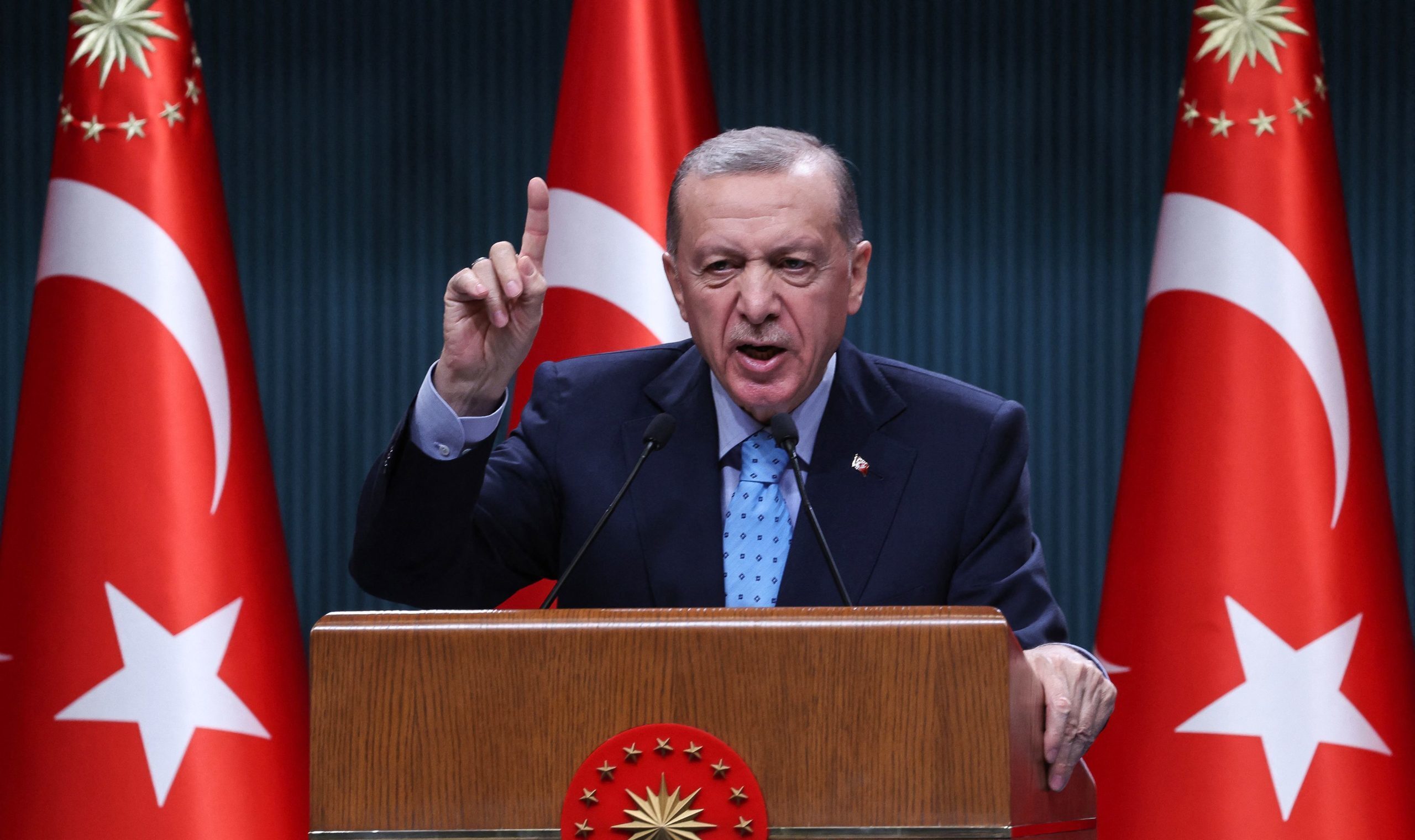
One of the stranger geopolitical developments in the Middle East of late (leaving aside the present war) has been the rupture between Israel and Turkey. A war of words has turned into something resembling a full diplomatic spat, with Israel’s Prime Minister Benjamin Netanyahu describing Turkey’s regional aspirations as “aggressive” and other high officials even advocating for the country’s removal from NATO.

Most worrying, considering the conflict in which the United States currently finds itself embroiled, are Israeli comparisons of Turkey to Iran. The former Israeli Prime Minister Naftali Bennett, for instance, has declared that “Turkey is the new Iran,” which seems to portend a confrontation with Ankara.

From a historical perspective, this is surprising. Turkey recognized Israel less than a year after the latter declared its independence, becoming the first major Muslim-majority country to do so. Turkey, along with Pahlavist Iran, played an important role in Israel’s “Alliance of the Periphery,” which sought close ties with non-Arab states on the outer reaches of the Middle East, such as Turkey and Iran, as a counterweight to the Arab states more geographically proximate and hostile to Israel. 

As a result, for decades Israel maintained strong linkages with Turkey. Israelis still have access to visa-free travel to Turkey. The two countries had significant military ties until the early 2010s, with Turkey even considering procuring Israeli air defense systems. Until 2024 (when Turkey cut off trade due to the Gaza War), they had a valuable trade relationship as well. The two countries also assisted each other with natural disaster relief, such as during Israel’s 2010 Mount Carmel fire, or after Turkey’s massive 2023 earthquakes.

Israeli-Turkish cooperation has historically extended to the lobbying efforts of both countries in Washington, with parts of the Israel lobby historically acting as “enthusiastic boosters” for Turkey.

Both Turkey and Israel tended to find themselves on the same side of geopolitical issues outside the Middle East. In the Caucasus, Israel cultivated close ties with Azerbaijan—a Turkish client, and the perennial antagonist of Turkey’s enemy Armenia—since the breakup of the USSR in 1991. In the Nagorno-Karabakh War of 2020 and in Azerbaijan’s 2023 offensive, both Turkish and Israeli weapons played a significant role in Azerbaijan’s military successes. In the weeks before the 2023 offensive, Azerbaijani military cargo planes flew to an Israeli airbase 13 times, presumably to carry arms back to Azerbaijan. While Azerbaijan’s President Ilhan Aliyev has complained about the deteriorating relations of his two benefactors, it is unlikely that such close ties between Israel and Azerbaijan would have been possible to be cultivated without Israel’s prior relationship with Turkey.

Israel’s collaboration with Turkey has even extended to Israel tending to take the Turkish side in contemporary debates about the Armenian genocide. Israel’s Knesset, including under Netanyahu, historically blocked bills recognizing the Armenian genocide. (Israel currently appears to be shifting its position on the Armenian genocide due to deteriorating relations with Turkey.)

This long-term cooperative relationship between Turkey and Israel was at the same time punctuated occasionally by mutual criticism, and Turkish rhetorical anti-Zionism, as well as more tangible disputes, such as Turkey’s suspension of military ties with Israel following an Israeli raid which killed nine Turkish civilians in 2011. But these did not prevent both countries from pursuing their common interests.

Given this long history of ties between the two countries, it comes as a surprise for Israeli politicians to declare that Turkey is the “New Iran” or to try to stop the U.S. from selling F-35s to Turkey. Yet, in many respects, Israel’s relationship with Turkey is following the pattern established by Israeli–Iranian relations.

Contrary to popular belief, the Iranian Revolution of 1979, and the replacement of Pahlavist Iran with the Islamic Republic, was not the main rupture point in Iranian–Israeli tensions. Despite Supreme Leader Ruhollah Khomeini’s rhetorical anti-Zionism, Iran maintained deep ties with Israel, with Israel being Iran’s main foreign supplier during the Iran–Iraq War and Iranian intelligence possibly enabling Israel’s successful bombing of the Osirak Reactor. Despite the ideological differences between Israel and Iran, both were brought closer together by common threats such as the Ba’athist Iraq and the USSR.

Israeli–Iranian tensions largely increased in the 1990s as these threats waned, even though Iran was going through significant ideological moderation. As Trita Parsi, whose book Treacherous Alliance covers this aspect of the Iran-Israel rivalry, told The American Conservative:

At the heart of it [the Iran–Israel rivalry] is Israel’s insistence that its only path to security is by dominating the region militarily. No country in the region, or combination of countries, can be allowed to outgun Israel. Israel needs to deter everyone in the region, while no one should be allowed to deter Israel. As such, it is Iran’s power that is the main challenge to Israel, not its ideology. Indeed, at a moment when Iran’s ideology was in decline in the mid-1990s, Israel suddenly started to depict Iran as the main threat in the region. It was a very sudden shift. The reason was that the two key factors that had brought Iran and Israel closer together in earlier decades, the common threat from the Soviet Union and from strong Arab nationalist countries, such as Iraq under Saddam Hussein, had both evaporated. And a new embryonic, bipolar geopolitical situation was emerging in which Iran and Israel were the two most powerful countries in the region with no buffers in between them. To make matters worse, the Israelis feared that if the U.S. reconciled with Iran, Israel’s strategic value to Washington would diminish while America’s support for Israel against Iran would be in jeopardy.

Similarly, the Turkish-Israeli relationship was kept alive for structural reasons inherent to the region’s geopolitical order, despite the differences between both Turkish and Israeli society and occasional mutual criticisms between the two countries. Both the Turks and Israelis shared common foes in the Soviet Union, Ba’athist Iraq, and (most recently) Iran. Indeed, the longstanding tensions and hostility between Iran and Azerbaijan play a major role in Israel’s support for Baku and is a major source of Turkish–Iranian tensions. 

When those structural conditions changed, the glue holding the relationship together dissolved. The shriveling of Iranian influence in the Levant following the fall of Syria’s Assad regime and the weakening of Hezbollah, together with the seemingly decisive victory of Azerbaijan over Armenia in the 2020 war, eliminated the commonality of interest that had brought the two powers together. As with Iran in the 1990s, Israel has increasingly turned on its former partner Turkey, seeing it as a potential rival to Israeli military supremacy. 

“What we are seeing now between Israel and Turkey is reminiscent of Israel’s shift on Iran,” Parsi told The American Conservative with regard to this historical comparison. “As Turkey rose in power because of its success in Syria, and Iran appeared to have weakened, the rhetoric in Israel started to turn against Turkey.” 

Parsi continued,

Suddenly, Erdogan was described as the most dangerous person in the Middle East. Turkey, who never has deployed the Islamic Republic’s rhetoric against Israel and has had long intelligence ties with Israel—back in the 1990s when Israel and Turkey were close, AIPAC was training a Turkish lobby in Washington—was now being treated as if it posed an even greater threat to Israel than Iran. Not much had changed in Turkey—except, of course, Turkey had grown more powerful and was seen as an obstacle to Israel’s designs for regional hegemony.

While it is unclear where Turkish–Israeli relations will go—though further deterioration is likelier than not—it is important to ensure that Israeli (or Turkish) interests, to the extent these diverge from our own, do not shape American policy-making. We have little reason to fear Turkey as a potential regional aggressor; our approach should be conditioned by a clear-eyed view rather than Israeli concerns and fears.

In the Middle East, the past two decades have been the story of the American people wanting one thing, withdrawal, and their government giving them another. Many of our recent entanglements are connected with the policies and interests of the Israeli government, particularly its views and fears concerning regional rivalries. If tensions should rise between Israel and Turkey, Washington should stay as far removed as possible.

The post Israel Runs the Iran Playbook on Turkey appeared first on The American Conservative.

Marco Rubio’s “Democratic Hemisphere” vs. the National Security Strategy

Marco Rubio’s “Democratic Hemisphere” vs. the National Security Strategy

In Latin America, the White House abandons its own strategic doctrine for democracy promotion.

Photo by YAMIL LAGE/AFP via Getty Images

Earlier this month, Daniel Ortega, the dictator of Nicaragua, announced that his country would no longer hold elections. In response, Secretary of State Marco Rubio issued a statement condemning Ortega and declaring that Nicaragua “cannot expect to maintain business as usual with other nations when it is thwarting the basic tenets of our democratic hemisphere.”

There is no doubt that Nicaragua has suffered under the rule of Ortega and his wife Rosario Murillo, who have run the country as their personal fiefdom for nearly two decades. But Rubio’s rhetoric on Latin America increasingly resembles the neoconservatism President Trump was ostensibly elected to displace.

In last year’s National Security Strategy (NSS), the Trump administration declared that it would “be realistic about what is possible and desirable to seek in its dealings with other nations.” The document also said the United States would pursue “good relations and peaceful commercial relations with the nations of the world without imposing on them democratic or other social change that differs widely from their traditions and histories.” 

Although a departure from the stated approach of the Biden White House, this is less revolutionary than many people would suppose: Ever since the United States stepped out onto the world stage, it has always and of necessity been connected to governments of varying moral and political character. During the Second World War, we famously saved Stalin’s USSR from collapse to win the war against Hitler; today, we work hand in glove with Saudi Arabia, an authoritarian dictatorship with a bad habit of dismembering journalists that also happens to be the keystone of our Middle East strategy.

The reasons for this are simple: foreign policy is about furthering American interests, which often requires working with countries that are very different from our own. As the NSS states, “We recognize and affirm that there is nothing inconsistent or hypocritical in acting according to such a realistic assessment or in maintaining good relations with countries whose governing systems and societies differ from ours even as we push like-minded friends to uphold our shared norms, furthering our interests as we do so.”

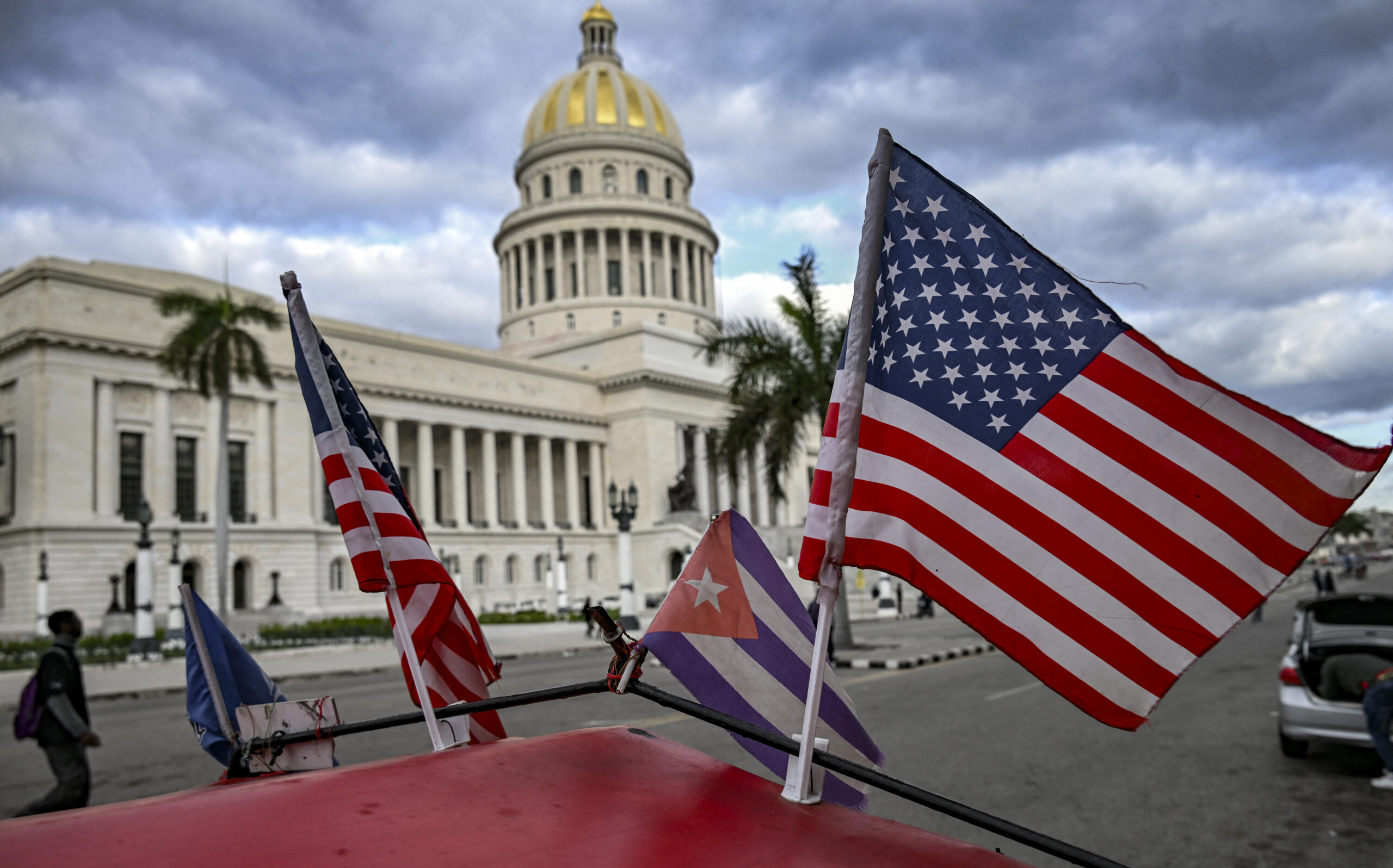
Unfortunately, the White House appears to have tossed this wisdom aside in the Western Hemisphere. Instead, we are being treated to reheated platitudes about battling communism and spreading democracy abroad. The State Department recently released a 100-page document entitled “Cuba: The Capital of 21st Century Communism,” which, despite its name, consists almost entirely of the rehashing of Cold War–era grievances.

The document is a transparent and clumsy effort to gin up support for intervention against Havana, which has not been a serious threat to American interests since the demise of the Soviet Union. Indeed, the biggest challenge Cuba presents to the U.S. is its potential collapse—which we seem to be doing our best to precipitate via a tightening oil embargo on the island—as that could trigger a massive migration crisis.

The White House has been alarmingly consistent in its assertions that it is preparing for aggressive action in Cuba. In February, still riding the high of his apparently clean decapitation of the Maduro regime in Venezuela, Trump touted the potential for a similar outcome in the Caribbean: “The Cuban government is talking with us,” he told reporters. “We could very well end up having a friendly takeover of Cuba.”

The talks don’t seem to have panned out, however, and U.S. rhetoric has escalated since then. “I think I can do anything I want with [Cuba],” Trump said on March 16. The next day, he laid out his timetable: “We’re talking to Cuba,” the president stated, “but we’re going to do Iran before Cuba.”

There is, at present, little prospect of a quick resolution to the war in Iran, but the Trump administration has continued to ramp up for intervention in Latin America. In late May, the Department of Justice indicted Raul Castro, the former president of Cuba and the brother of the late Fidel Castro, for his role in the 1996 shootdown of two planes flown by Cuban exiles. (It has been widely speculated that the indictment was drawn up to justify something similar to January’s Venezuela operation.)

More concerning still, CBS News reported earlier this month that the Pentagon is drawing up plans for military action in Cuba, including “an Army-led air assault involving thousands of U.S. soldiers to be carried out by the 101st Airborne Division.”

The second Trump administration’s renewed focus on the Western Hemisphere has been, in many ways, a long-overdue development. This is the region most intimately bound up with the real interests of the United States. Combating drug trafficking, illegal immigration, and possible adversary influence over our near abroad are important foreign policy goals. But crude reversion to a Cold War-era framing is the wrong way forward.

The administration would be better served by holding to its own National Security Strategy, which recommends the application of American economic power to secure concessions from uncooperative regimes, rather than the open pursuit of regime change—a tactic which has consistently failed to produce good results.

The post Marco Rubio’s “Democratic Hemisphere” vs. the National Security Strategy appeared first on The American Conservative.

Three GOP Senators Who Could Complicate a Vance/Rubio Coronation

Three GOP Senators Who Could Complicate a Vance/Rubio Coronation

Ted Cruz, Josh Hawley, and Rand Paul each have reasons to run in ’28.

Senate-hearing-on-Trump-assassination-attempt

Chances are good that the Republican nominee for president in 2028 will be named either J.D. Vance or Marco Rubio (as I write, the prediction markets put the odds at around 70 percent).

Yet we are still a long way from the first primary, and much could change. Republicans might get clobbered worse than expected in the midterms. Perhaps the AI bubble will burst and crash the economy—or maybe it won’t, and the robots will take our jobs ahead of schedule.

But whatever the situation, neither the vice president nor the secretary of state will cruise to victory completely unopposed. Other Republicans are sure to throw their hats in the ring, even if the prospect of victory is slim; some will run without expecting anything more than a boost to their profiles or a cabinet nod down the road.

Whence might such challengers come? Governorships are a good guess; it is a natural jump from running a state—particularly an important state (say, Florida)—to running the country. We could also see some candidates from less conventional backgrounds (broadcast journalism, anyone?).

One place, however, is almost guaranteed to supply a few contenders: the United States Senate. Our august upper chamber has served as the nursery of 17 presidents so far, and there is no reason to believe this role—which, given the body’s apparently incurable legislative sclerosis, may well be its most important modern function—has ended.

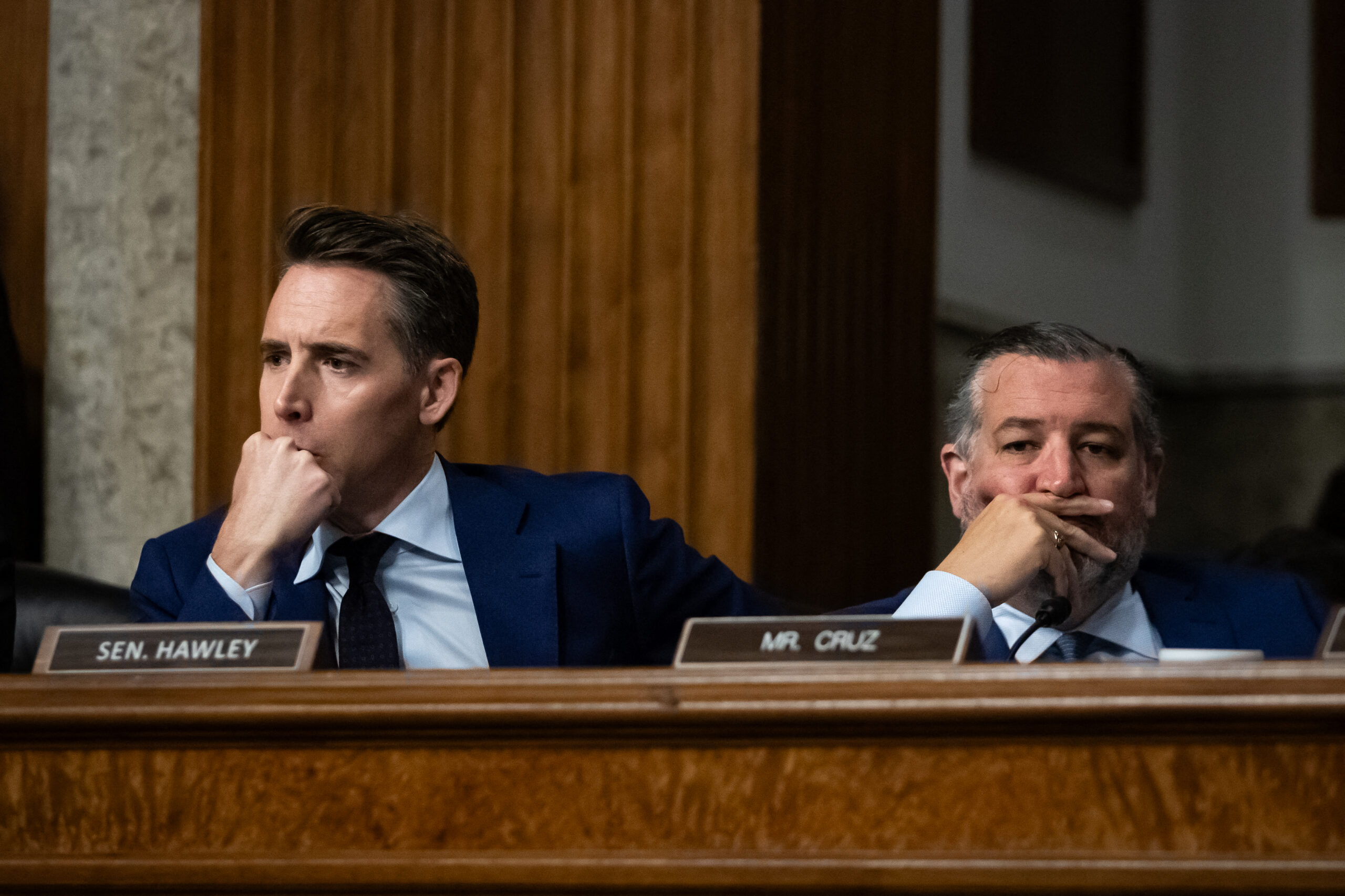
In the Senate today, there are three Republicans who are widely believed to be mulling 2028 bids. Senators Ted Cruz of Texas, Josh Hawley of Missouri, and Rand Paul of Kentucky each have the name recognition, command of the issues, and sheer chutzpah necessary for a credible go at the nomination. And each appeals to a distinct part of the conservative coalition.

Of the three, Cruz has done the most so far to further his presidential ambitions. He has maintained a big public profile and kept a fair amount of buzz going. While loudly backing the president on most issues, he has also broken from the White House in some key areas—notably tariffs and free speech—and gotten directly involved in a few Republican primaries (even endorsing opponents of Trump-supported candidates in Georgia and South Carolina). He has launched strident attacks on what you might call the “America First” wing of the party, picking public fights with Tucker Carlson and offering private criticism of his rival J.D. Vance. He has even been spotted in Iowa. It’s fair to conclude, as Texas’ other senator noted last month, that “Ted wants to be the next president.”

In both style and substance, a Cruz presidency would look like a restoration of the pre-Trump GOP. It would be the Bourbons reclaiming the throne after Napoleon, a turning back of the clock to those pre-lapsarian days when tariffs were unambiguously bad, Israel was unambiguously good, and the party hymned in unison before the smiling icon of St. Ronald Reagan. Cruz is the candidate of what used to be called fusionism: interventionism abroad and a blend of free-market economics and social conservatism at home. Although Trumpism (to the extent one can still speak of such a thing) represents a repudiation of one-and-a-half legs of this “three-legged stool” and the base appears to have mostly moved on, fusionism is still the creed of a large part of the GOP’s donor class. Particularly if Vance is the guy to beat, this creates a clear lane (Rubio, of course, would pose greater difficulties).

On a personal level, Cruz’s prospects would be helped by his clear intelligence, keen political instincts, and experience with a previous presidential run. But his likability needs work; House Speaker John Boehner’s memorable description of him as “Lucifer in the flesh” has been echoed over the years by other congressional confreres, and it is hard to shake the impression that retail politics may not be his strong suit.

Next, there is the senior senator from Missouri (full disclosure: I worked for Josh Hawley from April 2025 until last month). Hawley has been less obvious about 2028, and it is far from certain that he will run. Still, the speculation swirls. And Hawley has done a few things to fuel such conjectures, including setting up a new group to push pro-life causes, zeroing in on hot-button issues like AI that escape the attention of his less supple colleagues, and speaking at venues ranging from the Teamsters’ convention to the Southern Baptist Theological Seminary

While broadly supportive of the president, Hawley has worked hard to create an independent image and separate himself from the GOP mainstream (indeed, in the Senate he has a reputation as something of a lone wolf). His basic commitments are a hardcore social conservatism, a zealous economic populism—including an embrace of organized labor that makes him an outlier among Senate Republicans—and a broadly non-interventionist foreign policy. In an important sense, then, Hawley offers Trumpism without Trump—which seems like something the base could go for, at least abstractly. He also brings to the table (relative) youth and a talent for soaring oratory, along with a squeaky-clean evangelical background and serious intellectual chops. 

But he has liabilities of his own. Hawley would have a hard time gaining traction if Vance is the heir apparent, since the vice president occupies the same “articulate populist under the age of 50” lane. The emphasis Hawley lays on abortion—he is perhaps the most committed pro-lifer in the Senate—and his intense evangelical Christianity could turn off a post-Dobbs electorate. He has been basically absent from the Iran War debate, despite his otherwise strong realist credentials. And although the potency has obviously faded, his pseudo-cancellation after January 6 could come back to haunt him.

Finally, we have Rand Paul. Paul, who also vied for the 2016 nomination, has publicly mused about a bid, telling CBS earlier this year he was “50-50” on running. And if he ran, Paul emphasized to his interviewer, it would be because “we need to have a free market [and] free trade wing of the party, one that’s not eager for war.” Here, then, is the choice for the GOP’s individualist, small-government contingent; Paul offers a libertarianism more moderate and respectable than can be procured from the likes of Jo Jorgensen & co.

And unlike another Kentucky libertarian, Paul has recently made it a point to play nice with the White House. As chair of the Senate’s Homeland Security and Governmental Affairs Committee (HSGAC), he swallowed his fiscal hawkishness and dutifully shepherded the president’s second reconciliation request—which contained more than $70 billion in new government spending—through markup. He has also used his committee gavel to go after high-value targets like Anthony Fauci, who comes before HSGAC this week for a grilling on his Covid conduct. 

But Paul’s constituency, though passionate, is small. And his 2016 campaign fizzled out early after a fifth place finish in Iowa. It remains far from clear that he could improve upon that performance.

To return to the observation with which this column opened, by far the most likely scenario is Vance or Rubio at the head of the ticket. Yet it is more than idle speculation to contemplate other contenders.

In fusionism, populism, and libertarianism, we see three broad visions for American conservatism. Whether the senatorial champions of these tendencies run in ’28—and how well they perform—could tell us much about where the right will go after Trump makes his exit.

The post Three GOP Senators Who Could Complicate a Vance/Rubio Coronation appeared first on The American Conservative.

Funny Moment President Trump Passes Tic Tacs to Vance and Bessent at Lindsey Graham’s Funeral (VIDEO)

President Trump on Tuesday attended Senator Lindsey Graham’s funeral at Washington National Cathedral.

Ukrainian President Volodymyr Zelensky and Israeli Prime Minister Benjamin Netanyahu are in Washington DC for the funeral.

Lindsey Graham died earlier this month after a brief, sudden illness.

The South Carolina Senator just turned 71 on July 9.

“The preliminary examination findings were: Aortic Dissection due to Arteriosclerotic Cardiovascular Disease,” Graham’s office said, according to the medical examiner.

Toward the end of Lindsey Graham’s memorial service, President Trump handed Tic Tac mints to JD Vance and Treasury Secretary Scott Bessent.

WATCH:

Senator Darline Graham (R-SC) last Monday announced she is running for a full Senate term to replace her brother Lindsey Graham.

“I’ve made a decision,” Darline Graham told Fox New host Sean Hannity. “I’m in.”

“I have been praying a lot, talking to my family… I feel like I can do it. I feel an inner peace about it. Will it be difficult? Yes. Absolutely,” she said.

President Trump endorsed Darline Graham earlier this month:

It was my Honor to welcome now Senator Darline Graham Nordone (The sister of the Late, Great Lindsey Graham!), from the Wonderful State of South Carolina, into the Oval Office.

We have known each other for a long time — She is a spectacular person, and a true American Patriot. Lindsey was one of the greatest people and Senators I have ever known, and his sister shares his deep love of our Country, and the State of South Carolina.

During her visit, I asked Darline, for the Good of our Nation, to run for the U.S. Senate in the Special Republican Primary on Tuesday, August 11, 2026.

I hope Darline does this, in that there would be nobody better to honor the legacy of her beloved brother, Lindsey.

Darline, who comes from an absolutely incredible family, has been a WINNER all of her life and, should she accept, has my Complete and Total Endorsement in the Special Election for U.S. Senate in South Carolina — SHE WILL NEVER LET YOU DOWN. RUN, DARLINE, RUN! President DONALD J. TRUMP

The post Funny Moment President Trump Passes Tic Tacs to Vance and Bessent at Lindsey Graham’s Funeral (VIDEO) appeared first on The Gateway Pundit.