MUST READ: DOJ Weaponization Working Group Drops Explosive Report Exposing FBI’s Outrageous Spy Campaign Against Traditional Catholics Under Biden Regime

The Justice Department’s Weaponization Working Group released a bombshell report detailing how the Biden-era FBI expanded an investigation of one dangerous criminal suspect into a disturbing intelligence operation targeting Catholic priests, traditional Catholic churches and constitutionally protected religious beliefs.

The 231-page Richmond Domain Perspective Report concludes that personnel responsible for the disgraceful intelligence product have now been removed.

“The FBI personnel involved in the creation of the Richmond Catholic Memo have been terminated from their positions,” the report states.

The Justice Department did not publicly identify the terminated personnel.

The DOJ announced Thursday that investigators reviewed more than 1,800 pages of internal emails, intelligence assessments and investigative records concerning the FBI Richmond Field Office’s infamous January 2023 memorandum.

The report reveals that FBI personnel:

  • Opened investigative “Guardian” assessments on two Catholic priests.
  • Examined the priests’ travel and communications.
  • Pulled airline and credit-card information.
  • Searched one priest’s phone at Boston Logan International Airport.
  • Followed that priest from the airport to a private residence.
  • Conducted surveillance outside another residence associated with him.
  • Proposed cultivating Catholic clergy and church leaders as “tripwires” and sources.
  • Considered elevating the Richmond memo into a national intelligence product for senior FBI leadership.
  • Continued revising the project even after FBI headquarters ordered the original memo removed from bureau systems.

The FBI eventually closed both assessments after finding no national-security threat or evidence linking the priests to violent extremism.

“This Department of Justice will not tolerate a weaponized bureaucracy that chills First Amendment activity,” Attorney General Todd Blanche said.

“The individuals who developed the Richmond Domain Perspective are no longer with the Department, and our Working Group’s efforts to investigate weaponization under the previous Administration will continue.”

It Started With One Legitimate Criminal Investigation

The FBI’s original investigation involved an individual identified only as “Target 1.”

Unlike the Catholic priests who were later swept into the investigation, Target 1 presented legitimate and serious warning signs.

According to the report, Target 1 vandalized vehicles, assaulted police officers, threatened minorities and law enforcement, promoted mass violence online and attempted to acquire or construct weapons despite being a convicted felon.

Agents searching his home recovered ammunition, firearm components, a 3D printer, lock-picking equipment and more than six fully assembled Molotov cocktails.

Target 1 was ultimately sentenced in 2025 to more than eight years in federal prison for possessing destructive devices.

But the FBI’s focus began to shift after agents learned that Target 1 had briefly attended Our Lady of Fatima Chapel, a traditional Catholic church affiliated with the Society of St. Pius X.

The chapel’s priest told agents that Target 1 was not a church member, was not Catholic and had attended only three or four catechism classes.

The priest reportedly described Target 1 as a white supremacist with “crazy views about race” whose positions would have to change before he could join the church.

In other words, the church was not radicalizing the suspect. The priest was rejecting his extremist beliefs.

That did not stop the FBI.

FBI Opened Assessments on Two Priests

The Richmond Field Office interviewed the first priest twice in November 2022.

During the second conversation, the priest told agents, “I don’t want to be involved,” and raised concerns about violating his relationships with people at the church.

On January 5, 2023, the FBI opened a Guardian assessment on the priest to determine whether he was recruiting or radicalizing Target 1.

The FBI cited the priest’s position at the chapel and the religious activities of his uncle—another traditional Catholic priest—as grounds for further scrutiny.

Agents examined the first priest’s travel history and compared it with the travel of his uncle. The FBI found no evidence that the priests had traveled together or had been in the same foreign location simultaneously.

The bureau then opened a second Guardian assessment on the uncle on January 20, 2023.

The FBI claimed the second priest’s publicly available sermons and speeches reflected views comparable to Target 1’s—specifically citing alleged anti-establishment, anti-Semitic and anti-abortion positions.

Yes, the FBI included opposition to abortion in an assessment purportedly concerning violent extremism.

Agents also pulled the second priest’s flight and credit-card information after learning he planned to travel overseas.

When the priest returned through Boston Logan International Airport on January 31, 2023, Customs and Border Protection subjected him and a companion to secondary screening. His phone was searched to determine the extent of his contact with his nephew.

FBI personnel watched the priest leave the airport, followed his vehicle to a private residence and later conducted surveillance outside another residence associated with him.

The report specifically describes this as “surveillance not requiring a court order.”

But after the Richmond memo leaked, both Guardian assessments collapsed.

The FBI closed the assessment on the second priest on February 10, 2023. The first priest’s assessment was closed five days later because agents had identified no federal violation or national-security threat.

FBI Analysts Started With a Theory—Then Searched for Evidence

The report reveals that an FBI Richmond analyst first proposed a document examining the supposed “increasing intersection” between “rad-trad Catholics” and domestic violent extremists in September 2022.

The analyst admitted at the time that the proposal depended on “finding sufficient additional evidence beyond” Target 1.

Rather than evidence producing the theory, the theory came first.

Analysts then searched FBI databases for cases that could support it.

They located only two additional individuals—one in Portland and another in Milwaukee—whom they believed fit their proposed narrative.

The Portland individual was already dead. Information concerning him came partly from a dossier produced by the Anti-Defamation League.

The Milwaukee case involved another violent individual who reportedly attended a church associated with the Society of St. Pius X.

The new DOJ report concludes that investigators never found evidence connecting traditional Catholic organizations themselves to domestic extremism.

The analysts also used material obtained from a foreign law-enforcement agency concerning the SSPX Resistance. According to the Justice Department, the FBI relied on foreign intelligence and activist organizations without adequately assessing their credibility or possible bias.

Still, analysts pushed forward.

Before they had even located the Portland and Milwaukee cases, one analyst proposed transforming the document into a Strategic Perspective: Executive Analytic Report, or SPEAR, that could reach senior FBI executives because the subject allegedly had “national application.”

A draft SPEAR was eventually sent to a domestic-terrorism analyst at FBI headquarters.

The national project was abandoned only after the Richmond memo was leaked publicly on February 8, 2023.

Memo Suggested Turning Churches Into FBI “Tripwires”

The Richmond memo claimed with “high confidence” that racially motivated violent extremists displayed an increasing interest in “radical-traditionalist Catholic” beliefs.

However, the new report says its authors never established a baseline demonstrating that any such increase had occurred.

The memo identified supposed “catalyzing events” that could unite violent extremists and traditional Catholics, including political disputes over abortion, immigration, affirmative action and LGBT policies.

These are mainstream political and religious issues debated by millions of Americans.

The memo also listed the names, addresses and telephone numbers of Catholic chapels and a seminary near Richmond.

It recommended that agents engage church leaders and recruit congregations to act as “suspicious activity tripwires.”

Agents also proposed approaching the Diocese of Richmond to help “sensitize” parishes to alleged warning signs of radicalization.

The document relied on the far-left Southern Poverty Law Center’s designation of nine Catholic organizations as supposed “hate groups.” It did not independently explain why those groups qualified or adequately address the SPLC’s long record of controversial and retracted designations.

The FBI’s own Directorate of Intelligence later concluded that the memo treated the supposed connection between traditional Catholicism and violent extremism as fact “without substantiation.”

An internal tradecraft review determined the document virtually labeled the religious ideology itself violent and extremist without offering supporting evidence.

The Counterterrorism Division separately said its threat assessment did not align with the Richmond Field Office’s conclusion and that it saw no significant connection justifying additional FBI intelligence collection.

FBI Created Chilling Slide Deck Profiling Latin Mass Catholics and “Conservative Family Values”

The FBI did not stop at reviewing criminal evidence.

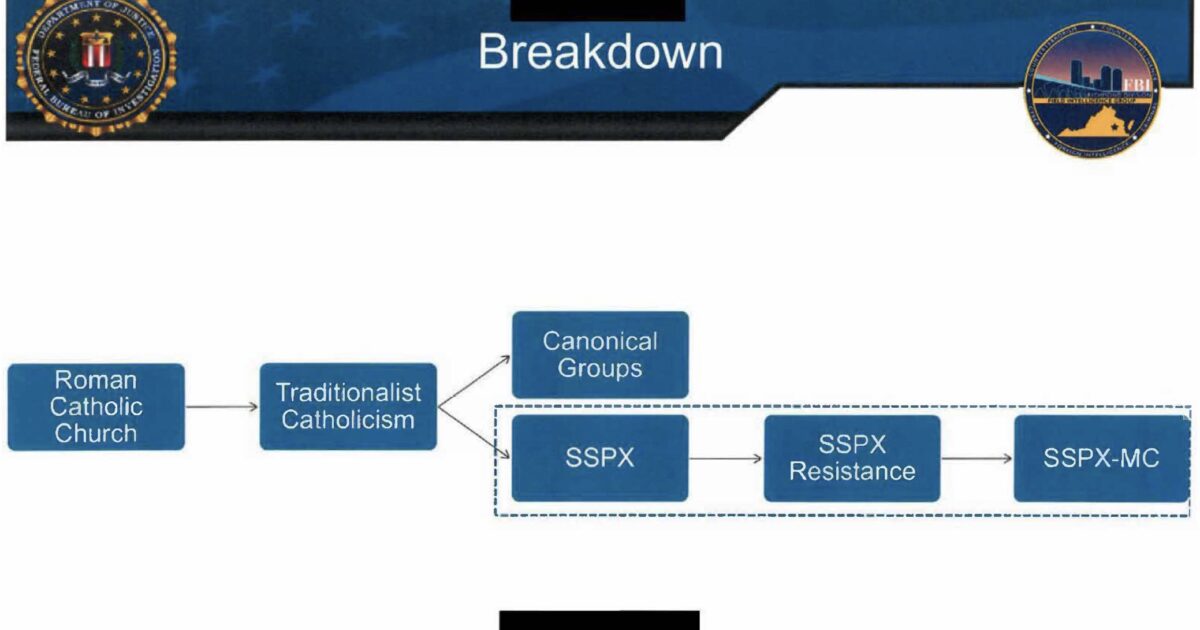
According to the Weaponization Working Group report, personnel in the Richmond Field Office devoted government resources to studying Catholic theology and constructing an internal presentation titled “Traditionalist Catholicism Overview.”

The slide deck was attached to a January 20, 2023, email from a Richmond intelligence analyst—just three days before the infamous Catholic memo was published.

The presentation provides a stunning look inside the ideological framework the FBI used while developing its theory about traditional Catholics.

One slide titled “Core Ideology and Beliefs” listed the following supposed “core concepts” of traditionalist Catholicism:

  • Traditional Latin Mass.
  • Conservative family values and roles.
  • Rejection of modernity.
  • “Discontinuity and Disruption.”
  • A “tendency toward isolationism.”

That’s right. The Biden FBI included attending the Traditional Latin Mass and believing in conservative family values in an intelligence presentation developed while the bureau was exploring connections between Catholics and violent extremism.

Credit: DOJ Weaponization Working Group

Another slide, titled “On Earth as it is in Heaven,” examined Catholic integralism and claimed it involved creating a “totalitarian, anti-pluralist Catholic nation,” rejecting religious neutrality and subordinating government to Catholic principles.

The FBI presentation then outrageously declared the ideology “comparable to Islamist ideology.”

Credit: DOJ Weaponization Working Group

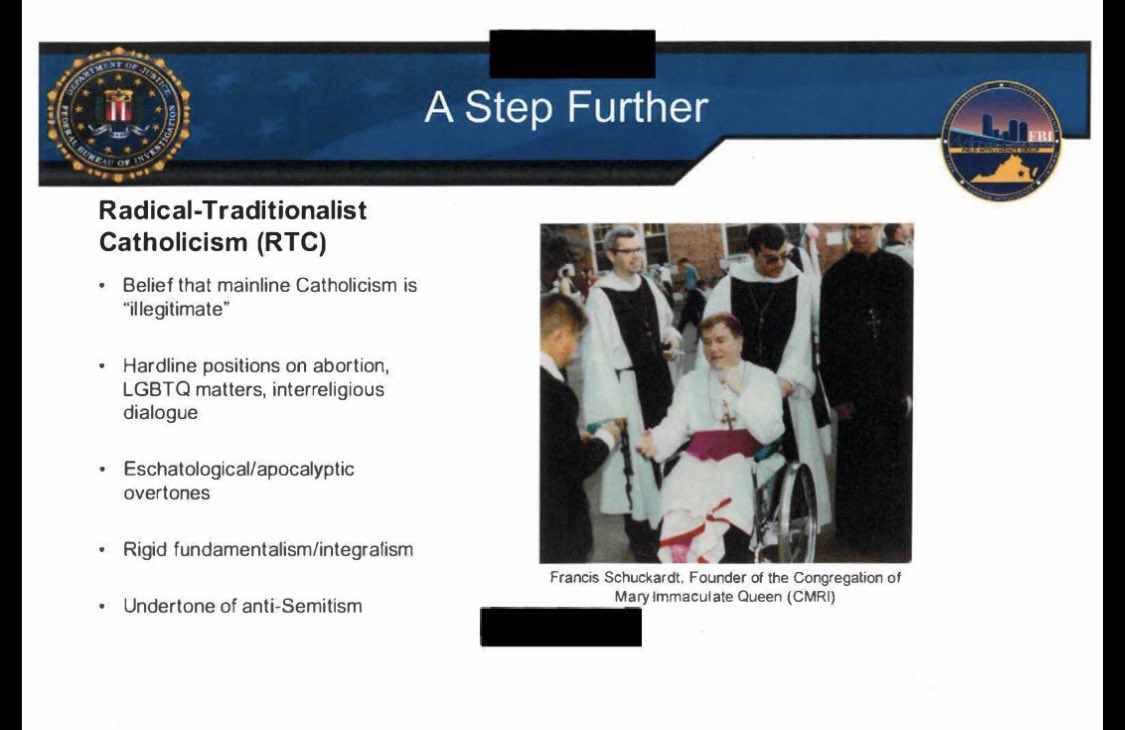
A third slide labeled “A Step Further” described what the FBI called “Radical-Traditionalist Catholicism.”

Among the identifying characteristics listed by the bureau were:

  • Belief that mainstream Catholicism is “illegitimate.”
  • “Hardline positions” on abortion and LGBT issues.
  • Opposition concerning interreligious dialogue.
  • Apocalyptic or eschatological language.
  • “Rigid fundamentalism” or integralism.
  • An alleged “undertone of anti-Semitism.”

Once again, the FBI placed constitutionally protected religious and political positions, including opposition to abortion and radical LGBT ideology, inside an intelligence presentation associated with domestic-extremism analysis.
Credit: DOJ Weaponization Working Group

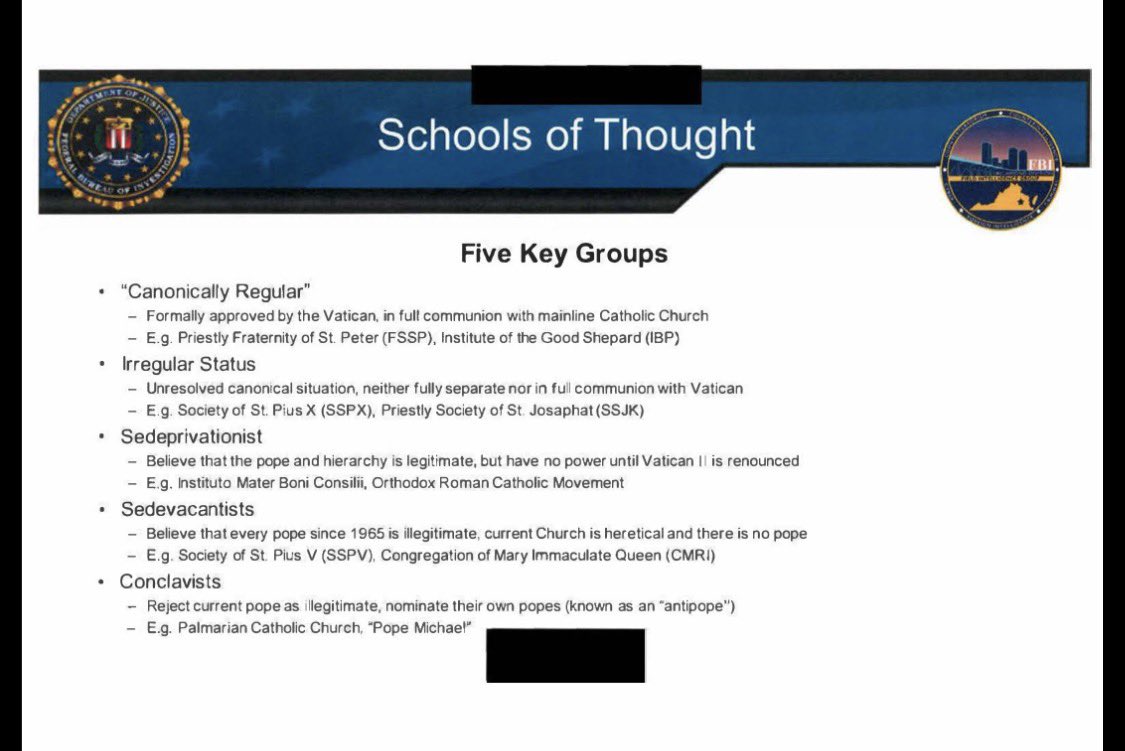
The FBI even constructed its own taxonomy of non-mainstream Catholic movements.

A slide titled “Schools of Thought” divided Catholics into five categories: “Canonically Regular,” “Irregular Status,” “Sedeprivationist,” “Sedevacantists” and “Conclavists.”

The bureau named organizations including the Priestly Fraternity of St. Peter, the Institute of the Good Shepherd, the Society of St. Pius X, the Priestly Society of St. Josaphat, the Society of St. Pius V and the Congregation of Mary Immaculate Queen.
Credit: DOJ Weaponization Working Group

The slide deck contained a boilerplate disclaimer claiming the FBI did not investigate or collect information on Americans solely for engaging in First Amendment-protected activity.

But the report states that none of the reviewers flagged substantive constitutional concerns.

The draft memo was even sent to an FBI employee described as a “former seminarian” for a review of “all things Catholic.”

Rather than objecting to the government scrutinizing Catholic doctrine, a supervisory analyst suggested adding Virginia’s proposed 15-week abortion restriction as a potential “catalyzing event” where traditional Catholics and violent extremists might supposedly find “common cause.”

These slides expose how far the Richmond Field Office had strayed from investigating criminal conduct.

Federal agents were no longer concentrating solely on threats, weapons or violence. They were constructing charts about the Latin Mass, conservative families, Vatican II, abortion and Catholic theology, and feeding those religious distinctions into a domestic-extremism intelligence project. This was religious profiling dressed up as national-security analysis.

FBI Headquarters Scrambled After the Leak

Following the public leak, FBI headquarters ordered the Richmond memo removed from internal systems.

Internal emails show how urgently senior leadership wanted it erased.

“The 7th Floor is breathing down my neck on this one,” one FBI lawyer wrote while pressing for its removal.

During the 15 days the memo remained accessible, it was opened by 19 intelligence analysts from 13 field offices, four agents and two task-force officers from two offices, three senior intelligence analysts from three offices and a chief division counsel from another field office.

But even after headquarters ordered the memo deleted, one of its original authors continued working on the project.

On March 17, 2023—more than a month after the leak—the analyst wrote, “I spent today tinkering with the DP,” and circulated suggested changes.

So much for shutting down the operation.

Minimal Discipline—Then Positive Performance Reviews

An April 2023 internal review concluded that the memo improperly equated traditional Catholic beliefs with violent-extremist ideology, failed to account for biased sources and created the appearance that the FBI investigated Americans based on religious affiliation.

The review found no evidence of malicious intent or an improper purpose, but concluded that the personnel involved showed poor professional judgment and failed to follow FBI standards.

The punishment was little more than a slap on the wrist.

Employees involved in drafting, reviewing and approving the memo were admonished, ordered to undergo additional training and told the matter would be reflected in their performance evaluations.

But the new report shows Richmond leadership continued defending them.

During a July 2023 staff meeting, the Richmond special agent in charge reportedly apologized to personnel involved in the memo.

When one analyst apologized for what others had endured because of the document, the special agent in charge responded that the scandal would make “a great chapter in your memoirs some day!”

The Richmond office later arranged access to employee-assistance counselors for staff members and their families following congressional hearings on the scandal.

At the end of the fiscal year, employees deeply involved in producing the memo received performance ratings ranging from “Consistent” to “Exemplary.”

Gateway Pundit Reported on the Scandal From the Beginning

The Gateway Pundit reported on the leaked Richmond memorandum in February 2023 after former FBI Special Agent Kyle Seraphin exposed it.

The Gateway Pundit later reported that the scandal extended beyond the Richmond Field Office and that bureau personnel had coordinated with employees in Portland, Milwaukee and at FBI headquarters while developing the intelligence product.

In December 2023, The Gateway Pundit reported that the FBI had interrogated a priest and a church choir director during the investigation.

The Gateway Pundit also reported in April 2025 that Richmond Special Agent in Charge Stanley Meador remained employed despite overseeing the field office during the memo’s approval.

The newly released report does not name the employees who have since been terminated.

A limited DOJ Inspector General review released in 2024 found no evidence that analysts were ordered to connect a specific religion with violent extremism or that they made discriminatory comments. That review, however, expressly acknowledged its limited scope.

The new Weaponization Working Group report examined a much larger record and concluded that the FBI conducted improper and unjustified intelligence and law-enforcement activity.

“History will rightly judge the Richmond Catholic Memo as a grave failure of the FBI Richmond Field Office” to protect Americans’ First Amendment rights, the report concludes.

FBI Director Kash Patel said the bureau would not tolerate weaponization and that publicly releasing the underlying information was a necessary part of holding those responsible accountable.

What began as a legitimate investigation of one genuinely dangerous individual became a sprawling intelligence exercise that scrutinized priests, churches, religious doctrine and conservative political beliefs.

Under the Biden administration, the FBI did not merely investigate a violent suspect.

It treated his brief contact with a Catholic chapel as an excuse to place faithful Americans and their priests under the federal microscope.

READ THE FULL REPORT HERE.

The post MUST READ: DOJ Weaponization Working Group Drops Explosive Report Exposing FBI’s Outrageous Spy Campaign Against Traditional Catholics Under Biden Regime appeared first on The Gateway Pundit.

Denmark Under Pressure Over Its Decades-Long Forced Contraception of Greenlandic Women – Now, Reports Investigate Whether this Constitutes Genocide

Grenlandic Inuit Woman – Wiki Commons

Around half of fertile women in the Arctic Island were fitted with IUDs or given hormone birth control shots.

From the 1960’s and into the early 1990’s, Denmark imposed an inhuman sterilization program on Greenlandic Inuit women, with the purpose of limiting population growth in the self-governing territory.

Now, against the background of Donald J. Trump’s decision to control the island, the Danish are under fire for their mistreatment of the indigenous populations.

Two separate reports investigating the forcible contraception of thousands of Indigenous women and girls are divided over a core question: does it constitute genocide?

Associated Press reported:

“The Greenlandic government, which commissioned the inquiry, released the reports Friday but, when pressed by journalists during a news conference, would not say whether its leaders concluded whether a genocide had occurred. The government told the authors to use the definition under the United Nations’ 1948 genocide convention, which includes ‘imposing measures intended to prevent births within the group’.

[…] Known as the ‘spiral case,’ the revelations have rocked both Denmark and Greenland. More than 350 Greenlandic Indigenous women and girls, including some 12 years old and younger, previously came forward to investigators and reported that they were forcibly given contraception by Danish health authorities. Denmark says more than 4,000 women and girls — reportedly half the fertile women in Greenland at the time — received IUDs between the 1960s and mid-1970s.

“The Inuit victims, many of them teenagers at the time, said they were either fitted with intrauterine contraceptive devices, known as IUDs or coils, or given a hormonal birth control injection. They were not told details about the procedure, or did not give their consent.”

“The Danish government on Thursday approved payouts of 300,000 Danish kroner (about $46,500) to each victim. Danish Prime Minister Mette Frederiksen officially apologized last year.”

Read more:

Denmark Summons US Ambassador Over Alleged ‘Covert Influence Operations’ in Greenland, as Copenhagen Apologizes for Decades of Forced Sterilization of Inuit Greenlander Women

The post Denmark Under Pressure Over Its Decades-Long Forced Contraception of Greenlandic Women – Now, Reports Investigate Whether this Constitutes Genocide appeared first on The Gateway Pundit.

Jesse Kelly Warns Texas of Radical Democrat US Senate Candidate James Talarico (VIDEO)

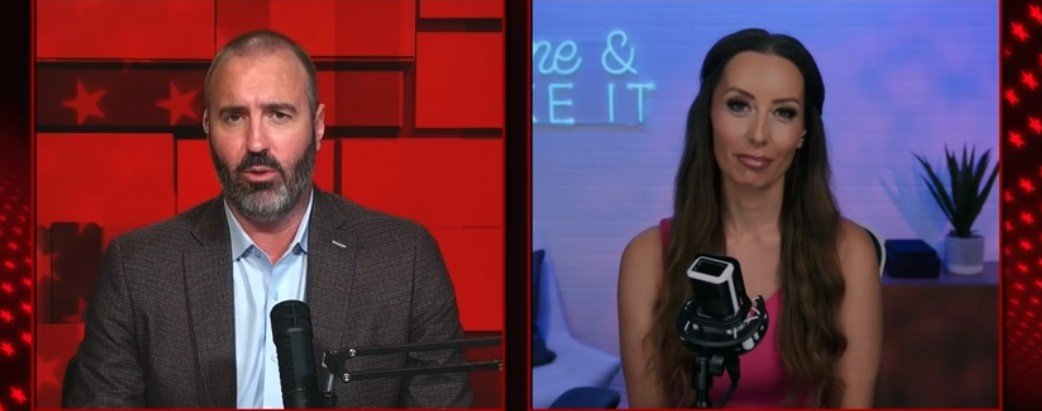
Jesse Kelly of “The First” talked with podcaster Sara Gonzales about the upcoming election in Texas between radical Democrat James Talarico and Republican Ken Paxton.

Kelly started the video showing clips of James Talarico’s radical, lunatic views, which included him embracing Islam and his support for transgender ideology targeting kids.

Kelly and Gonzales also talked about the danger of the rise of Islam in the US, not only as a religion, but also as a political system designed to take over.

“Hey Sara, that guy doesn’t have any chance, right?” Kelly asked.

“I wish that I could tell you no, this crazy, lunatic radical would stand no chance in the State of Texas because here in Texas, we are deep red, and we will never go blue,” Gonzales said.

“The problem Jesse is that Texas Republicans are lazy. And despite this guy being an extreme radical, and despite him having you know, an agenda that includes gun control and transing the kids, and all sorts of things that are very un-Texan, he does seem to have a shot right now, only because the Democrats are the ones with the enthusiasm,” Gonzales explained.

“We would be the laughingstock in the State of Texas if this guy went to the Senate,” Gonzales continued.

Kelly explained that he is continually seeing ads on television for Talarico but has not seen any for Ken Paxton.

“I have not seen one Ken Paxton ad, not one on Television,” Kelly commented.

“The problem is that James Talarico has outraised money, right? Like he has outspent, or sorry, outraised Ken Paxton with all the donations he is getting in from California, and New York and all of these other liberal places,” Gonzales explained.

“That’s the problem is that Ken Paxton is not getting the money. He’s not getting all of this outside money,” Gonzales said.

“So, he doesn’t have the money to spend on the ads yet. My sense is that he will kick it into high gear. He is kind of saving his funds and kicking into high gear before early voting happens,” Gonzales said.

“You see all these reports online about mosques being built in Texas, and you think to yourself, surely not, that doesn’t make sense. Then you find out the Dallas airport was planning on putting in a Muslim foot washing station and you wondering just how bad the problem is. How bad is the problem?” Kelly asked.

“The problem is so bad that everyone thought that the foot washing stations went away because Governor Greg Abbott put a stop to it. Well, unfortunately, there is already two of them that have been there since 2019, so the problem didn’t actually go away,” Gonzales said.

“They are trying to treat this as it is a freedom of religion case. The problem with that is that Islam is not just simply a religion, it is of course an ideology. It is a form of governance because that is what they want to do. They want to take control of the government, and they want of course to enact Sharia law,” Gonzales warned.

Please support Ken Paxton to silence this craziness in Texas.

Watch:

The post Jesse Kelly Warns Texas of Radical Democrat US Senate Candidate James Talarico (VIDEO) appeared first on The Gateway Pundit.

HORROR: Pack of Pitbulls That Terrorized Community For Years Fatally Mauls Elderly Illinois Man – Photo of Killer Dogs Caught on Google Street View Images!

An elderly man was fatally mauled by a pack of pitbulls that terrorized a Washington Park, Illinois, community for years.

On Thursday evening, 68-year-old James Gibson was attacked by at least five ‘mixed breed’ dogs and died at the scene.

According to reports, when police finally arrived to the scene, they found Gibson with his face torn off.

Washington Park police shot three of the dogs but the other ones ran away,

Fox 2 reported that neighbors were terrified of the wandering pack of dogs for years.

A photo of the killer dogs was caught on Google Street View Images a few months ago.

Fox 2 reported:

After a fatal dog attack on Thursday night, people living in a Washington Park neighborhood say they have dealt with a pack of wandering dogs for years and feared something like this would eventually happen.

The Washington Park Police Department tells FOX 2 the victim has been identified as 68-year-old James. L Gibson.

Gibson was mauled and killed by a pack of dogs around 10:45 p.m. Thursday in the 2100 block of N. 49th Street, according to Washington Park police.

Police investigators believe the dogs are strays, but people who live on 49th Street claim that’s not the case.

Aretha Harper, who lives nearby, said she had encountered the same dogs just hours earlier. Harper said the dogs are familiar to people who live in the area and that residents are usually able to shoo them away. But she said one of the dogs followed her up her front steps Thursday.

More on this story from KMOV:

The post HORROR: Pack of Pitbulls That Terrorized Community For Years Fatally Mauls Elderly Illinois Man – Photo of Killer Dogs Caught on Google Street View Images! appeared first on The Gateway Pundit.

Paper Audits Are Necessary When China-Made Parts Are Embedded in Election Machines 

Paper Audits Are Necessary When China-Made Parts Are Embedded in Election Machines 

China-made components, shared county voting systems, and an unresolved Riverside, California reconciliation question make independent paper audits a necessity—not an accusation.

By Christine Bish

Catherine Herridge’s report this week should not be dismissed as another abstract debate about election technology. The documents behind it are public, and they sharpen a question California officials have evaded for years: when election systems carry acknowledged supply-chain and cybersecurity risks, why is independent verification so often treated as a threat rather than a duty?

The responsible answer is not to assume that a machine changed a vote. It is also not to insist that certification makes further scrutiny illegitimate. The responsible answer is to examine the paper, reconcile the records, test the exact equipment, and publish the result.

THE ESSENTIAL DISTINCTION

Fraud is an allegation of intentional wrongdoing. Machines can malfunction, software can be misconfigured, records can be incomplete, and people can make mistakes without anyone intending to alter an election.

Three questions that must not be collapsed into one

Herridge’s disclosure raises three separate questions. Keeping them separate protects both election integrity and factual accuracy:

  1. Foreign manipulation. Did a foreign government successfully alter an American vote count? The released intelligence says there is no evidence that China did so.
  2. Supply-chain exposure. Did major vendors use components manufactured in China or other adversary countries? DHS says the vendor testimony establishes that risk.
  3. Ordinary failure. Could equipment, software, procedures or records fail without fraud? Yes. Mechanical, clerical and administrative errors require correction even when criminal intent is absent.

The 2020 congressional hearing cited by DHS made the same practical point. As one voting-system witness put it: “On rare occasions, machines falter, and humans make mistakes.” That statement does not establish that a particular county result was wrong. It explains why verification exists.2

Nothing in the records cited here establishes that a foreign actor altered a vote, that these systems miscounted an election, or that any county official acted fraudulently. The case for expanded auditing rests on risk and verifiability—not an accusation of crime.

The federal warning—precise, serious and limited

In an August 24 letter to the White House Government Transparency Task Force, Homeland Security Secretary Markwayne Mullin said voting machines containing components manufactured by foreign adversaries present “significant security risks.” Relying on 2020 congressional testimony, the letter identified Election Systems & Software, Hart InterCivic and Dominion as the three vendors then supplying more than 80 percent of U.S. voting machines, and said representatives of each had acknowledged that some parts were made in China.1

The underlying hearing record gives that statement needed scale and context. The parts discussed included items such as displays, glass, capacitors, resistors, and a programmable logic device. The vendors said some components had no practical domestic substitute; they also told Congress they knew of no foreign-government breach or tampering of their systems. The DHS disclosure establishes a supply-chain exposure. It does not establish that China altered an American vote count.2

That distinction is not a retreat. It is the dividing line between evidence and speculation. An administration official also told Herridge there was no intelligence that China had successfully manipulated an American vote count. The National Intelligence Council assessment released with the materials said election tabulation is highly secure, large-scale alteration would likely be detected, and it had no indication that foreign adversaries attempted such attacks in the prior two federal cycles.1

THE LIMIT OF THE EVIDENCE

The DHS disclosure documents a real supply-chain risk. It does not prove tampering, exploitation, or an altered Riverside vote.

DHS nevertheless announced a concrete grant condition. For fiscal-year 2026 Homeland Security Grant Program awards, the department says states seeking access to the full award must demonstrate a post-election manual audit of at least 5 percent of ballots after each federal election. The underlying grant notice holds back 20 percent from drawdown until specified election-security conditions are met.3

That rule is prospective, applies to federal elections, and is not a retroactive judgment about any California result. It is not an order for a full recount. But it is a federal acknowledgment of a basic principle: a paper record has value only when officials use it to test the machine-produced result.

California’s ordinary safeguard is narrower: state law generally requires a public manual tally of ballots from 1 percent of precincts, supplemented so every contest is included. That process can detect tabulation error in the sampled ballots, but it is not the same as reconciling every ballot category or conducting a broad performance audit. The federal 5 percent grant condition does not invalidate California’s certified elections; it does show that Washington now expects a more substantial paper check as a condition of full funding.15

Sacramento: a citizen inquiry carried San Mateo’s warning north

California did not need Washington to explain the value of testing. Sacramento’s 2019–2020 grand-jury inquiry began when a citizen asked whether recommendations from a San Mateo County grand-jury report should also apply in Sacramento. San Mateo had examined risks to election announcements after website hijacking and employee-email breaches. Sacramento’s grand jury sent that report to its Registrar of Voters and asked whether the recommendations were applicable and being implemented.4

The inquiry then produced its own local finding: Sacramento County’s Department of Technology was not regularly and consistently performing vulnerability scans and penetration testing. The grand jury also said it could not determine when the last external security audit of the county’s election systems occurred or who had performed the penetration testing.4

The report recommended third-party penetration tests at least twice each year, additional scans after system changes, multi-factor authentication before the November 2020 general election, and a report-back on reviews by CyberDefenses and DHS. This was a general county information-technology finding; the grand jury did not identify a China-made component, a Dominion defect, a compromised tabulator, or a changed vote.4

Sacramento’s response partially disagreed with the first finding. The county said vulnerability scans were consistent, but acknowledged that penetration testing was not regular or consistent. It projected semiannual testing by June 2021. Multi-factor authentication for nontechnical election staff was postponed until June 2021 because of operational conflicts with the November 2020 election. The county also declined to make technical DHS and CyberDefenses reports public, arguing that publication could expose defensive strategies.5

In a July 21, 2021 email in The Bish Report’s records, then-Registrar Courtney Bailey-Kanelos said the DHS assessment was still outstanding and listed remote and on-site testing for August 2021—after the 2020 general election. Sacramento’s record is not proof of a breached election. It is proof that officials knew independent security work remained unfinished while the public was being asked to trust the system.6

A limited case study published by Great American Rebirth supplies the contemporaneous visual record. On December 15, 2020, during a tour of Sacramento County’s election facility, IT consultant Mark Cook photographed warehouse racks containing rows of Dominion-branded cartons. A close-up clearly shows the Dominion Voting logo above the stencil “MADE IN CHINA”; the case study estimated approximately 100 labeled boxes. The original files credit Cook, and the county response posted with the report confirms that all photographs were taken December 15, after certification and the recount period.10

The evidentiary boundary is as important as the image. The photographs do not show what was inside the cartons, identify a model or serial number, establish that a complete voting machine was manufactured in China, connect any box to Riverside County, or prove compromise. But they do establish something local and concrete: Dominion-branded cartons bearing a China country-of-origin marking were present in Sacramento’s election warehouse by December 2020. The county’s posted response did not directly address Photo #1 or dispute the carton markings.10

Figure 1. Dominion Voting-branded shipping cartons bearing the printed words ‘Made in China,’ photographed during a December 15, 2020 visit to Sacramento County election facilities. Photo © 2020 Mark Cook.

Figure 2. Storage racks containing Dominion Voting-branded cartons and equipment cases during the same facility visit. Photo © 2020 Mark Cook.

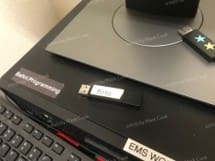
The county’s posted response supplied important context. It said the Dominion environment operated on two air-gapped networks; that all USB drives were labeled and recorded when used; and that only designated senior personnel had access to the server and ballot-counting room under a two-person rule. It also acknowledged that USB drives “should not have been left out” and said procedures were updated so they would be returned immediately to designated storage.10

Figure 3. A removable USB drive hand-labeled ‘BIOS’ resting on a workstation labeled ‘Ballot Programming.’ Photo © 2020 Mark Cook.

Were Sacramento, Riverside and Shasta using the same systems?

For the 2020 general election, the answer is yes in the material sense: California’s official inventory lists all three counties in the Dominion Democracy Suite 5.10A family. Sacramento and Riverside both used ImageCast Central 5.10A for central tabulation and ImageCast X 5.10A for accessible voting. Shasta used ImageCast Central 5.10A with ImageCast Evolution 5.10A devices. Similar system families do not prove identical hardware lots, component suppliers, configurations, maintenance histories or operating procedures.11

County System used in 2020 Procurement / acquisition Status in 2026
Sacramento Dominion ImageCast Central 5.10A; ImageCast X 5.10A Board approved Dominion component awards November 14, 2017 (Resolution 2017-0773); replacement system deployed for 2018 elections. Dominion Democracy Suite 5.19 components
Riverside Dominion ImageCast Central 5.10A; ImageCast X 5.10A Eight-year managed-services agreement approved June 18, 2019 (effective June 1); Dominion portion not to exceed $7,989,036. Riverside used Sacramento’s competed agreement for pricing. Dominion Democracy Suite 5.19 components
Shasta Dominion ImageCast Central 5.10A; ImageCast Evolution 5.10A $1,978,428 lease approved December 5, 2017, effective January 1, 2018. Dominion contract ended in 2023; Hart authorized April 2023. Hart InterCivic Verity 3.2 components

Sources: California Secretary of State county inventories (2020 and 2026); Sacramento County Resolution 2017-0773; Riverside County Board item 3.37 (2019); Shasta County Board agendas (2017 and 2023).

The procurement paths also overlap. Riverside’s 2019 board record says its Dominion agreement was based on—“piggybacking” from—Sacramento County’s competitively bid agreement, with Riverside negotiating a 30 percent discount from list price. Shasta entered its own Dominion lease earlier, effective January 1, 2018, and later terminated it. By 2026, Sacramento and Riverside had moved within the Dominion family to version 5.19, while Shasta was using Hart InterCivic Verity 3.2.12,13,14

Shasta shows why the vendor name is not the whole story

Shasta’s Board of Supervisors approved a $1,978,428 lease for Dominion Democracy Suite 5.2 on December 5, 2017, covering January 1, 2018 through December 31, 2025. The board voted to end that agreement in January 2023. In April 2023 it authorized acquisition of Hart InterCivic’s Verity system, which the Secretary of State’s 2026 inventory lists as Shasta’s current platform.13,14

The change matters to the comparison. A photograph from Sacramento cannot establish what was inside Riverside’s units, and a 2020 system inventory cannot establish what Shasta uses today. The correct question is not merely, “Which vendor?” It is: which exact devices, components, software versions and procedures were actually deployed in the election being reviewed?

Riverside: what triggered the grand-jury investigation?

Riverside’s investigation had a broader trigger than Sacramento’s. The 2024–2025 Civil Grand Jury says it acted “in response to public concerns about election integrity” and the “ongoing interest” of county residents. In its discussion, it identified two lawsuits involving Riverside County and a private election-oversight committee that had raised concerns for years. The report does not identify one complaint or one complainant as the sole trigger.7

After the November 5, 2024 general election, the community group tried to reproduce Riverside’s certified result from documentation supplied by the Registrar. The group reported that the certified result contained 33,888 more ballots than it could verify. The grand jury did not conclude that those were fraudulent, illegal or nonexistent ballots. It found that the group could not independently verify the certified result even with the Registrar’s cooperation—and separately found no evidence that the office was deliberately withholding information.7

That is a reconciliation problem, not a fraud finding. It could reflect incomplete records, different accounting categories, clerical omissions, illegible forms, timing differences or another explanation. The report did not determine which explanation applied, and it established neither fraud nor machine failure. Those possibilities must be tested, not guessed. Mechanical and administrative errors do not need criminal motive to matter.

The same report credited the Registrar with improvements, found evidence that the office followed federal and state law, noted that the statutory 1 percent manual tally required only nine ballots to be re-adjudicated, and reported that three requested recounts did not change results. Those facts argue against declaring the 33,888 figure proof of a wrong outcome. They do not eliminate the grand jury’s finding that an outsider could not independently reproduce the certified total.7

The grand jury also found that the office did not provide a comprehensive trail for all ballots issued, received, returned and challenged; that some handwritten chain-of-custody records were not legible; that temporary employees lacked emergency drills; and that ballot-processing livestream cameras did not record during two emergency evacuations. Riverside disputed or qualified several of those findings, including the audit-trail and camera findings.7,8

The grand jury’s central recommendation was straightforward: hire a third-party independent firm to conduct a performance audit of all aspects of the Registrar’s election processes by June 2, 2026. The county rejected that recommendation as “not warranted or reasonable,” citing consultant reviews, Auditor-Controller work and collaboration with DHS. It accepted or planned other improvements, including further study of electronic chain-of-custody records and expanded emergency training.8

Those responses matter. So does the line the county drew. A consultant’s procedural review can improve operations. Statutory compliance can establish that required steps occurred. Neither is identical to an independent performance audit designed to test whether the complete system produces a result that outsiders can reproduce from the underlying records.

NO MOTIVE REQUIRED

A discrepancy can arise from fraud, but it can also arise from equipment failure, software configuration, incomplete documentation, transcription, transfer, adjudication or simple human error. The audit determines which explanation fits the evidence.

The Dominion connection—and the missing answer

California’s official 2020 inventory lists Riverside County as using Dominion ImageCast Central 5.10A for central tabulation and ImageCast X 5.10A for accessibility support; the 2026 inventory lists version 5.19 components. The Mullin letter says Dominion, as a company, acknowledged using some China-made parts.11,14,1

That does not tell us which parts—if any—were inside Riverside’s specific units. The public records reviewed for this article do not provide a part-level bill of materials for Riverside’s deployed equipment, its component countries of origin, or the replacement history for individual devices. A vendor name is not a forensic finding. A model number is not a supply-chain audit.

California has also drawn an important technical distinction. In 2022 the Secretary of State said a CISA advisory involving Dominion ImageCast X version 5.5-A did not apply wholesale to California’s certified 5.10-A system. Seven of nine findings were not present, the state said, and two overlapping issues had already been mitigated. There was no evidence the vulnerabilities had been exploited. That memorandum is a reason to reject blanket claims about every Dominion device—but not a reason to conceal the exact provenance and configuration of the units used in Riverside.9

THE UNANSWERED EQUIPMENT QUESTION

Did Riverside’s deployed tabulation system contain any components covered by the DHS supply-chain warning? Only a verified bill of materials, procurement history, configuration record, and independent inspection can answer that.


What independent verification should look like

An independent review can be rigorous without becoming partisan theater. At minimum, it should include:

  1. Paper reconciliation. Account for ballots, return envelopes, voter-participation records, precinct and vote-center statements, cure records, duplication logs and adjudication records.
  2. A meaningful hand audit. Use a statistically sound risk-limiting audit or an expanded hand count sufficient to test the certified outcome; if the court finds a full count necessary, document every batch and variance.
  3. System examination. Review logs, removable media, access records, software and firmware hashes, configurations, technician activity and any authorized network connections.
  4. Supply-chain verification. Obtain the bill of materials, serial numbers, supplier records, countries of origin, maintenance history and component replacements for the equipment actually deployed.
  5. A public findings report. Publish the scope, method, totals, discrepancies and conclusions while sealing only the technical details necessary to protect voter privacy and system security.

Election officials sometimes argue that public release of technical security reports can reveal defensive weaknesses. That concern can be legitimate. It is not an excuse to avoid independent examination. Courts routinely protect sensitive details while permitting experts to test evidence and report conclusions the public can understand.

The answer is verification

Herridge’s disclosure changes the debate in one important respect: the supply-chain concern can no longer be dismissed as imaginary. The federal government has now said that dominant voting-system vendors acknowledged China-made components and has tied full grant access to paper-based post-election checks. Sacramento’s 2020 photographs add a local, contemporaneous fact: Dominion-branded cartons inside the county election warehouse carried a “MADE IN CHINA” mark.10

That leaves California with a choice. Officials can continue asking the public to accept assurance as proof. Or they can permit a protected, independent review capable of confirming the certified result—or identifying the exact point at which the records fail to reconcile.

If the records reconcile, an audit strengthens confidence and closes the door on unsupported claims. If they do not, the public learns precisely what failed and what must be corrected. Neither outcome requires investigators to begin with a fraud theory. Mechanical errors do not need motive, and public trust should not depend on pretending that only intentional wrongdoing can produce a meaningful discrepancy.

THE BISH REPORT

Fraud is a criminal allegation. Reconciliation is accounting. Verification is how the public learns the difference.


Source record

Primary records reviewed for this article. The photographs are used as documentary images and retain Mark Cook’s visible copyright watermark.

  1. White House Election Integrity page and Secretary Mullin letter and DHS assessments ZIP.
  2. S. House Administration Committee, 2020 Election Security hearing.
  3. DHS July 10, 2026 grant-condition release and FEMA FY 2026 HSGP Notice of Funding Opportunity.
  4. Sacramento County Grand Jury, Election Security in Sacramento County.
  5. Sacramento County response to the 2019–2020 Grand Jury.
  6. Email from Sacramento County Registrar Courtney Bailey-Kanelos, July 21, 2021 (on file with the author).
  7. Riverside County Civil Grand Jury, Riverside County Elections: A Pathway to Greater Voter Confidence.
  8. Riverside County response to the 2024–2025 Civil Grand Jury.
  9. California Secretary of State June 3, 2022 memorandum on Dominion Democracy Suite 5.10-A.
  10. Great American Rebirth, Sacramento Registrar of Voters: A Limited Case Study; Photo #1: Dominion Voting cartons marked ‘Made in China’; and Sacramento Registrar Courtney Bailey-Kanelos’s response posted with the case study. Photographs credited © 2020 Mark Cook.
  11. California Secretary of State, voting systems used by counties in the November 3, 2020 general election.
  12. Sacramento County Board of Supervisors, November 14, 2017, executed voting-system award materials (Resolution 2017-0773); and Riverside County Board of Supervisors, June 18, 2019, item 3.37 and Dominion managed-services agreement.
  13. Shasta County Board agenda, December 5, 2017, item C9; Shasta County voting-system staff report and Hart authorization, March–April 2023; and Shasta County notice of Dominion contract termination.
  14. California Secretary of State, voting technologies used by counties, 2026 inventory.
  15. California Secretary of State, one-percent manual tally requirements.


The post Paper Audits Are Necessary When China-Made Parts Are Embedded in Election Machines  appeared first on The Gateway Pundit.

GOP Members of Congress Demand State Department and DOJ Investigate Iranian Regime Sympathizer Max Blumenthal After He Attended the Ayatollah’s Funeral in Iran

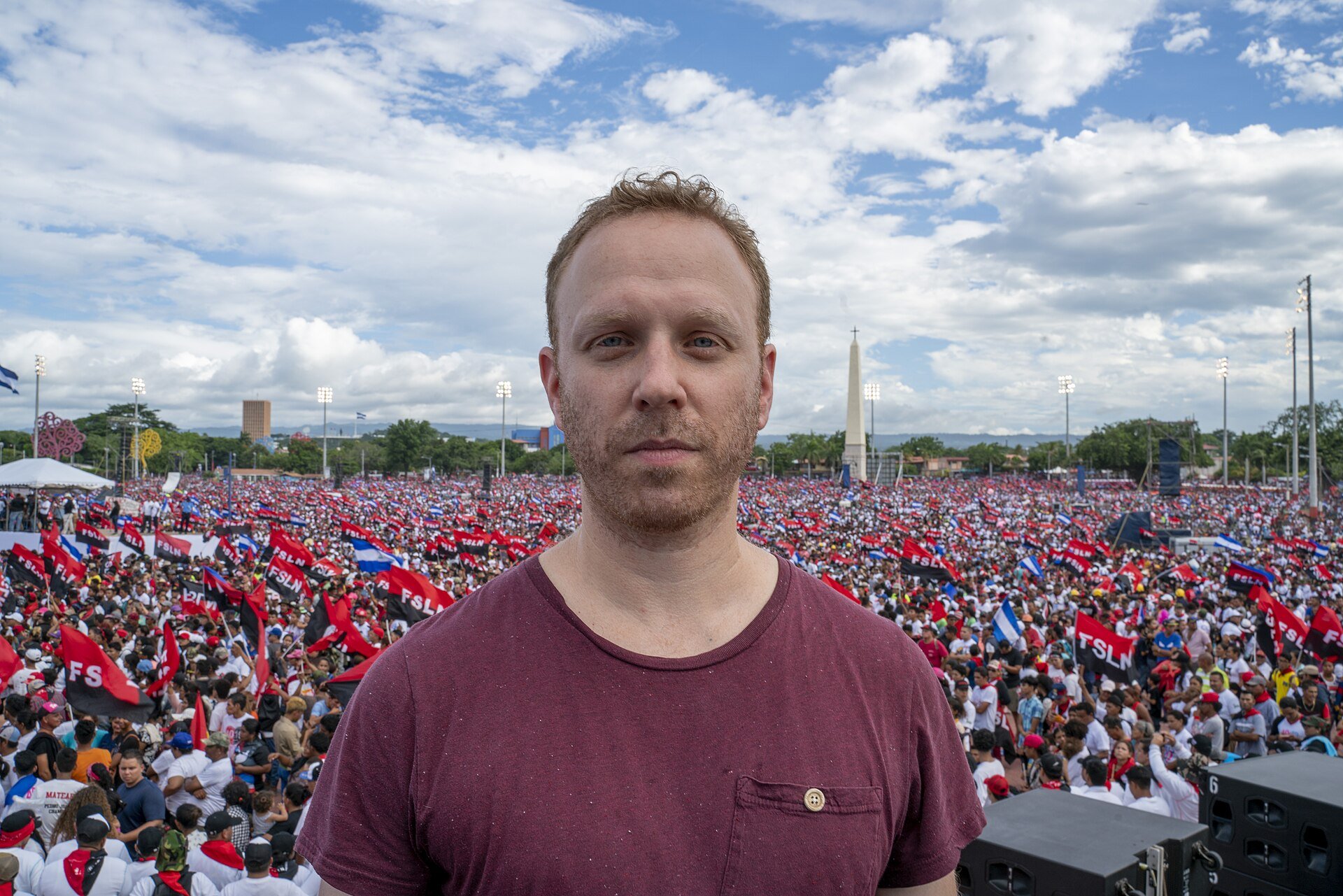
Max Blumenthal during the 40th anniversary celebration of the Sandinista Revolution, on July 19, 2019 in Managua, Nicaragua. (Credit: Ben Norton)

Florida Republican Rep. Randy Fine and two GOP colleagues are demanding the Trump administration investigate Grayzone editor Max Blumenthal after the radical left propagandist traveled to Iran to attend the funeral of Ayatollah Ali Khamenei, an event organized and orchestrated by the Iranian regime and the Islamic Revolutionary Guard Corps, a designated Foreign Terrorist Organization.

Fine sent the letter on Friday to Secretary of State Marco Rubio and Attorney General Todd Blanche. It was co-signed by Reps. Keith Self (R-TX) and Randy Weber (R-TX), according to investigative reporter Laura Loomer.

The request expands an earlier July 17 letter from Fine and other House Republicans asking Rubio and Blanche to examine whether Calla Walsh, Jackson Hinkle, and Christopher Helali provided material support to a Foreign Terrorist Organization by participating in the same IRGC-tied funeral spectacle.

The event, according to Fine, was “organized and orchestrated by Iranian authorities, including the Iranian Revolutionary Guard Corps,” which the United States has designated as a Foreign Terrorist Organization.

Fine wrote:

“I am writing today requesting that you add to your investigation an additional American, Max Blumenthal, for also participating in Ali Khamenei’s funeral in Iran.”

The Florida Republican described Blumenthal as “a radical leftist who hides under the veil of ‘journalism’ to relay propaganda and misinformation that benefits America’s enemies.”

Fine’s letter accused Blumenthal of denying or minimizing atrocities committed during the October 7 Hamas terrorist attack and of repeatedly making excuses for the Islamic Republic’s brutal oppression of the Iranian people.

The congressman also noted that this was not Blumenthal’s first trip to Iran.

According to the letter, Blumenthal traveled to the Islamic Republic in 2025, shortly before Operation Midnight Hammer, to produce what Fine described as a state-sponsored propaganda piece portraying Iran’s tiny remaining Jewish community as “safe.”

Fine continued:

“Blumenthal is no ordinary supporter of the world’s leading sponsor of state terrorism. He is also the son of Sidney Blumenthal, the former White House aide to President Bill Clinton and a confidante of former Secretary of State Hillary Clinton.”

Fine argued that federal law enforcement and counterintelligence officials should be deeply concerned that the son of a longtime Democrat operative may have been “cultivated as an agent of influence” by America’s adversaries.

The Republican lawmakers are also demanding answers about who finances Blumenthal’s activities and The Grayzone.

“The question of who finances Blumenthal’s activities and those of his Grayzone Project also remains,” the letter states. “This subject seems particularly relevant in light of the Trump administration’s worthwhile efforts to expose the nexus between hostile foreign states and subversive leftist activism on the American homeland.”

Upon returning from Iran in July, Blumenthal was questioned by Customs and Border Protection officers at Washington Dulles International Airport. Agents confiscated two of his phones after he declined to provide their passcodes.

Blumenthal subsequently claimed he was being targeted for his journalism and political views. His attorneys filed an emergency motion demanding the return of the devices, which the government later returned.

Fine, however, accused Blumenthal of attempting to turn the national-security screening into a media spectacle.

“Blumenthal has since attempted to make a media spectacle out of his devices being confiscated despite traveling to a sanctioned country where he willingly attended the funeral of a global funder of Islamic terrorism.”

The congressman concluded with a devastating assessment:

“Blumenthal’s lengthy track record of supporting enemy propaganda, and his recent participation in Ali Khamenei’s funeral, shows that he sympathizes with America’s enemies and is a threat to United States national security.”

“I urge you to use your offices to promptly investigate Max Blumenthal to ensure the American public is safe from this traitor.”

As The Gateway Pundit previously reported, Blumenthal joined Walsh, Hinkle, and Helali at Khamenei’s state funeral. The four have documented histories of supporting communist politics, appearing alongside Iranian or Russian state media, or promoting organizations hostile to American foreign policy.

Fine’s letter comes just two days after the State Department announced sanctions against violent far-left terrorist organizations and their leaders.

The sanctions were imposed under Executive Order 13224, which targets terrorists, terrorist organizations, their leaders, and individuals who provide material support for terrorism.

The State Department said the action was part of a broader effort to confront “the threat of transnational far-left terrorism.”

The radical left has spent years providing political cover for some of America’s most vicious enemies.

The post GOP Members of Congress Demand State Department and DOJ Investigate Iranian Regime Sympathizer Max Blumenthal After He Attended the Ayatollah’s Funeral in Iran appeared first on The Gateway Pundit.

Jelly Roll Breaks Down in Tears on Jimmy Kimmel and Delivers Borderless Immigration Sermon After Calling Trump a “Fat Pig”

Jelly Roll breaks down in tears on Jimmy Kimmel Live! days after calling President Trump a “fat pig.” (Screenshot/ABC)

Country music singer Jelly Roll broke down in tears Thursday while delivering an emotional immigration sermon during his final night guest-hosting ABC’s Jimmy Kimmel Live!

The tearful performance came just days after Jelly Roll used Jimmy Kimmel’s anti-Trump platform to mock President Donald Trump’s weight, call him a “fat pig,” and make a vulgar joke about the president’s anatomy.

After spending the week insulting Trump and telling angry fans they were free to stop listening to his music, Jelly Roll suddenly wrapped himself in the language of compassion, Christianity, and “human dignity” while promoting rhetoric that closely echoed the talking points of open-borders activists.

Jelly Roll recalled winning three Grammy Awards earlier this year and being asked about immigration enforcement operations in Minneapolis. At the time, the singer declined to offer a political opinion, a decision he now says he regrets.

The singer became emotional as he claimed he had failed to speak for people who were supposedly “scared” and “hurting.”

“Human dignity isn’t Republican or Democrat. Compassion isn’t left wing and mercy isn’t right wing… There are no boundaries or borders for broken families,” Jelly Roll declared while fighting back tears.

WATCH:

This is the same Jelly Roll who, just six months earlier at the 2026 Grammys, refused to criticize ICE. He called himself a “dumb redneck” who was “disconnected” from current events and said people shouldn’t care about his opinion. Other artists that night denounced immigration enforcement.

Jelly Roll stayed quiet, then promised he would speak “loud and clear.” This week he finally did. The message: compassion has no borders.

Jelly Roll is a convicted felon who has spoken openly about prison, drugs, and robbery charges from his youth. Tennessee Gov. Bill Lee later pardoned him. America gave him a second chance, a music career, Grammys, and restored voting rights in March 2026.

He shook President Trump’s hand at a UFC event and later insisted a handshake is not an endorsement. Fine. But crying on national television that there should be “no boundaries or borders for broken families” while sitting in for one of the most partisan anti-Trump hosts on television is not “down the middle.” It is the same open-borders sermon the left has been preaching for years.

He said he wants to represent “those without representation,” the recovering addict, the felon trying to change, the single mother. Those people exist in America.

Many of them are the ones paying the price when the border is treated as a suggestion. Illegal immigration does not just produce “broken families” on the other side of the Rio Grande. It produces American victims, overwhelmed towns, and children who never get a second chance because a cartel or a repeat offender got one first.

The post Jelly Roll Breaks Down in Tears on Jimmy Kimmel and Delivers Borderless Immigration Sermon After Calling Trump a “Fat Pig” appeared first on The Gateway Pundit.

Bill Melugin Delivers Verbal Beatdown to WaPo Hacks on ICE Arrests, “Crossing the Border Illegally Is a Federal Crime”

The far left Washington Post published an article today on ICE arrests.

The Democrat rag whines that illegals are being arrested without a criminal record.

Via the Washington Post: “ICE has arrested more than half a million people since President Trump returned to office, and nearly 40 percent do not have a criminal record. As of Aug. 6, ICE had detained more people without a criminal record this year than in all of 2025.”

Not a surprise. Some WaPo hack believes entering the US illegally is not a crime.

However, authors David Nakamura and Emmanuel Martinez for some reason forgot to mention that every single one of the ICE arrests involve criminal aliens.

According to Cornell Law, “Crossing the border illegally is a federal crime via 8 USC 1325. 5 year statute of limitation for first time offense.”

So, the WaPo published their article based entirely on fake news.

FOX News contributor Bill Melugin went after the WaPo for their ignorant claims.

Bill Melugin: Crossing the border illegally is a federal crime via 8 USC 1325. 5 year statute of limitation for first time offense.

Overstaying a visa is a civil offense.

Being unlawfully present in the U.S. is a civil offense.

But none of these semantics matter, because any of the above can result in ICE detention.

There is no requirement under US law that an alien must have a criminal record before being detained by ICE. There never has been.

ICE also does not need a judicial warrant to make arrests. (Unless they’re entering private property like a home).

All they need is reasonable suspicion that an alien is unlawfully present in the country.

Bottom line, all aliens who violate US immigration law are subject to ICE arrest and detention. This is how the law has been for decades.

Bill Melugin is a solid reporter.

Too bad WaPo does not have any reasonable people on staff like Bill.

The post Bill Melugin Delivers Verbal Beatdown to WaPo Hacks on ICE Arrests, “Crossing the Border Illegally Is a Federal Crime” appeared first on The Gateway Pundit.

President Trump Unveils U.S. Space Academy During Ceremony Honoring Artemis II Astronauts (VIDEO)

Screenshot

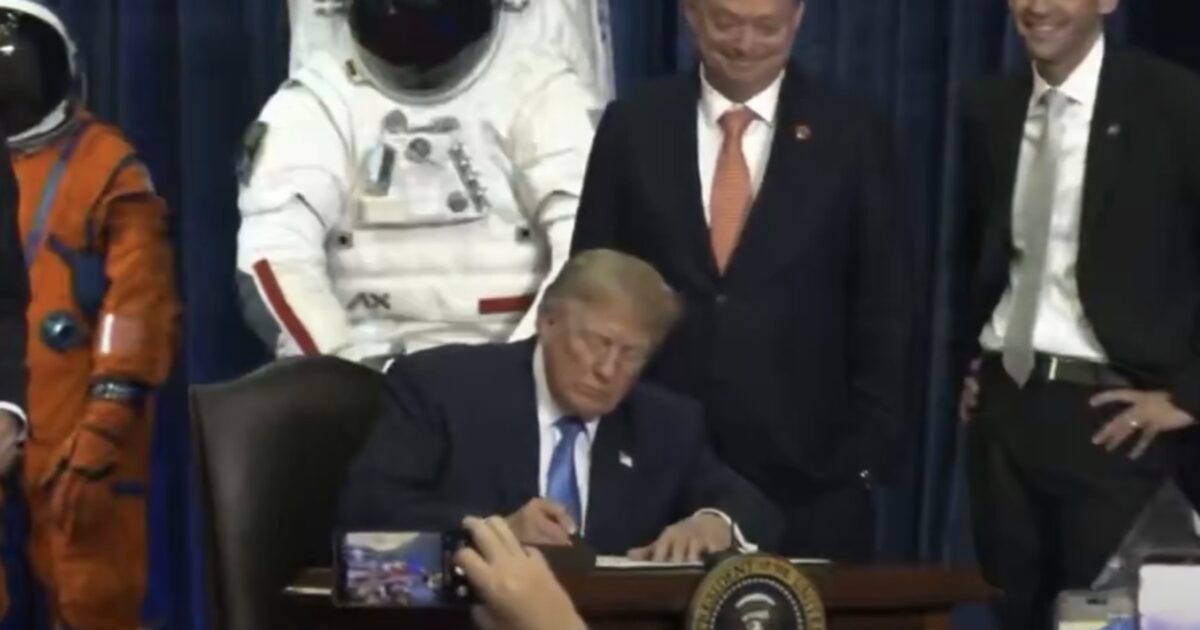
President Donald Trump has signed an executive order creating the U.S. Space Academy, a first-of-its-kind institution designed to train the next generation of Americans for careers in space.

Trump made the surprise announcement Friday at NASA’s Johnson Space Center in Houston.

The event was also honoring the four astronauts who completed the historic Artemis II mission around the moon earlier this year.

“I ⁠will sign an executive order ⁠to begin the process of creating a new national ‌academy. It’s called the US Space Academy,” Trump told the audience.

Trump said the academywould rank alongside America’s prestigious military academies, including West Point and the U.S. Naval Academy.

“They’re all great. But … we’re gonna have an academy for what the people in this room love the most,” Trump said. “That’s really exciting.”

The academy will recruit and train Americans for careers with the U.S. Space Force, NASA and the civilian space industry.

“It’ll attract, train and graduate the very best of our nation,” Trump said, describing the project as “a big deal” and promising it would be “top line.”

The executive order creates a presidential commission tasked with designing and establishing the academy.

NASA Administrator Jared Isaacman will lead the commission, which will include Defense Secretary Pete Hegseth, Air Force Secretary Troy Meink and White House Office of Management and Budget Director Russ Vought.

The announcement marks another expansion of Trump’s space agenda.

During his first term, Trump established the Space Force in 2019 as the first new branch of the U.S. military since the creation of the Air Force in 1947.

Present at the event were NASA astronauts Reid Wiseman, Victor Glover and Christina Koch, along with Canadian astronaut Jeremy Hansen.

The four made history in April when Artemis II carried them around the far side of the moon, sending humans farther into space than ever before.

The administration is seeking to return Americans to the lunar surface by 2028, while NASA is already preparing Artemis III for 2027.


The post President Trump Unveils U.S. Space Academy During Ceremony Honoring Artemis II Astronauts (VIDEO) appeared first on The Gateway Pundit.

Gun Laws Have Changed – Do You Have The Updated Reciprocity Map?

(Note: Thank you for supporting businesses like the one presenting a sponsored message below and working with them through the links below which benefits Gateway Pundit. We appreciate your support!)

Gun owners, does this sound familiar?

The car is FINALLY packed and you’re hitting the road.

But then “IT” hits you:

You’re armed… but you’re not sure about the gun laws where you’re going.

Vacation, road trips, and visiting family is supposed to be RELAXING.

You’re a law-abiding citizen. You just want to protect yourself and your loved ones.

But that doesn’t mean you have all the laws memorized.

And if you break one…

Local officials won’t have a problem slapping you with a fine or a set of handcuffs.

And maybe taking your gun.

That’s why you need this 100% FREE Gun Law map that has just been made available to every US gun owner.

Click here to discover the answers to the most important concealed carry questions for every state like…

  • Which states honor my concealed carry permit?

  • How do I legally carry a gun in my vehicle while traveling?

  • Which states REQUIRE me to reveal that I have a gun to a police officer during a traffic stop?

  • How many rounds can my magazine legally hold?

  • Can I legally carry in state and national parks and forests?

  • Can I legally carry in bars or restaurants that serve alcohol (even WITH my permit)?

  • Can I legally carry at roadside rest areas?

  • Can I legally have a gun in my hotel room?

  • Are “No Weapons Allowed” signs enforceable by law in my state?

And many more answers you need to be aware of…

If you ever cross state lines, you NEED to get this 100% FREE Gun Law map that’s now available to the public.

This interactive map allows you to quickly see the laws in your state or ANY state you plan to visit. It’s constantly updated to reflect changes in gun laws across the country.

You can save you from getting arrested for breaking a law you didn’t even KNOW about.

And more importantly, you’ll be able to actually ENJOY traveling like you were meant to.

Click here to get your 100% FREE Gun Law Map today.

The post Gun Laws Have Changed – Do You Have The Updated Reciprocity Map? appeared first on The Gateway Pundit.