REPORT: Antifa Networks Panicked After Trump Admin Designates Affiliated Group as Terrorists

Person in a black mask and green headscarf holding a red flag at an anti-fascist rally with banners in the background.

Person in a black mask and green headscarf holding a red flag at an anti-fascist rally with banners in the background.
Anarchist demonstrators on a May Day protest hold Antifa and Anarcho-synficalism flags.

The Trump State Department recently designated the group known as the ‘Autistici/Inventati (A/I Collective)’ as a terrorist group.

While they operate out of Italy, the Autistici/Inventati (A/I Collective) provides technical support for Antifa in the United States. Now that they have been targeted, panic is beginning to surge among various Antifa groups.

Apparently, some members of Antifa were surprised that the Trump administration made this move.

The Federalist reports:

While many on the online left have feigned indignation, for their part, the A/I Collective has long known that it was a legitimate target of law enforcement action. Following a series of Italian law enforcement actions in the early 2000s, the collective initiated what they called Plan R*, intended as a technical solution of decentralized servers meant to prevent physical intrusion and the collective’s clients from losing access in the event of law enforcement action. Following Plan R*, the collective published what it calls the “Orange Book,” a manual to allow individuals or groups to replicate their specific network methods.

This is in keeping with Anarchist/Autonomous methodology, which seeks to widely and deniably distribute responsibility. One can think of it as a kind of digital black bloc, where the more people participating and utilizing the techniques, the harder it is for law enforcement to address. While one site or group can be taken down, the material is quickly redistributed to other servers and other groups…

Indeed, U.S. persons are prohibited from either receiving or providing any services to or from A/I Collective at all. That means hundreds of violent far-left actors in the United States may be scrambling to find new digital homes, or else face potential criminal investigation and liability.

There seems to be some surprise within the Antifa/Anarchist networks that the Trump administration has been successful in landing a genuine blow. After decades of hiding behind the legal fiction that “Antifa doesn’t exist,” the idea that the government might successfully target not just a handful of individual anarchists but elements of the network apparatus upon which they rely seems to have come as something of a shock.

“WTF” commented one account, apparently dumbfounded.

The official State Department account on Twitter/X recently posted this:

If Democrats complain about this, the Trump administration should just remind them that Antifa doesn’t exist.

Isn’t that what they have been saying for years now?

The post REPORT: Antifa Networks Panicked After Trump Admin Designates Affiliated Group as Terrorists appeared first on The Gateway Pundit.

Leftist Defends Mass Mail In Ballots While Admitting The USPS Sucks


CNN legal so-called analyst Norm Eisen used an appearance on the network to slam President Donald Trump’s executive order restricting mail-in ballots while casting doubt on the U.S. Postal Service’s capacity to enforce it.

“No mail-in voting is currently being affected by this rule; it’s grossly unconstitutional, and we and others have gone to court to stop it—we will stop it—and voters should know that this idea that the Postal Service is going to screen every mail-in voter and mail-in ballot in the country is not going to happen,” Eisen said, according to a clips of the interview.

In the same discussion, Eisen quipped that “they can’t even deliver my utility bill on time” and argued that USPS therefore cannot “turn into a kind of super registrar for every voter in the land,” using his own mail delays to contradict his defense of mail in ballot voting to begin with.

His comments came after the Supreme Court, in a 6–3 unsigned order, allowed Trump to move forward with key portions of the March executive order that directs the Postal Service and the Department of Homeland Security to build voter-eligibility lists and limit mail-ballot delivery, while explicitly declining to decide the order’s legality leaving it open for further litigation amongst the states across the country.

The justices said the states that sued lacked standing because any harms were still “conjectural or hypothetical,” lifting a preliminary injunction issued by U.S. District Judge Indira Talwani in Massachusetts that had blocked the USPS provisions in 23 states and Washington, D.C.

Even after the Supreme Court’s intervention, Talwani and other lower-court judges have questioned the constitutionality of using USPS to “police” mail voting, with earlier rulings emphasizing that election rules belong to state legislatures and Congress.

Following publication of the Postal Service’s final rule requiring states to upload lists of mail-ballot recipients and use uniquely barcoded envelopes, Talwani lifted her own nationwide injunction in light of the Supreme Court decision, clearing the way for the administration to implement the rule while stressing that challengers could still seek new blocks.

Eisen and allied groups including Democracy Defenders Fund and the Campaign Legal Center quickly filed new lawsuits to stop the USPS rule, and he told followers on X and Bluesky that “the president has NO authority to make lists of voters & tell the Postal Service who gets a ballot,” urging supporters not to “overreact” to what he cast as a procedural Supreme Court ruling.

Multiple Democrat governors have publicly vowed to oppose Trump’s mail‑in ballot order and the related USPS rule, mostly through new lawsuits and formal letters strategically keeping the litigation alive to delay it before the upcoming midterms.

Sponsor | https://www.purgestore.com | Use promo code DREW for 20% off and support The Gateway Pundit today!

Follow Drew on X: https://x.com/DrewHLive
Follow Drew on Rumble: https://rumble.com/DrewHernandez

The post Leftist Defends Mass Mail In Ballots While Admitting The USPS Sucks appeared first on The Gateway Pundit.

ICYMI: TRUTH Social Post from President Donald J. Trump

ICYMI: TRUTH Social Post from President Donald J. Trump

The following is from the Trump team.

 @realDonaldTrump

At the request of the PGA Tour, and its Great new Commissioner, Brian Rolapp, it is my Honor to accept being the Honorary Chairman of the upcoming Presidents Cup, which will take place at the Medinah Country Club in Chicago. This will be a particularly exciting event. Both teams are “loaded” with Talent. I look forward to being there, and greeting all of these fantastic athletes, on both teams! Thank you for your attention to this matter.

See you in Chicago!

President DONALD J. TRUMP

Trump is a great golfer – He’s made 8 holes in one.

Here’s President Trump making a long put.

He’s the perfect President for the President’s Cup.

The post ICYMI: TRUTH Social Post from President Donald J. Trump appeared first on The Gateway Pundit.

When an Oil State Cannot Fill Its Cars

This article originally appeared on Iran So Far Away and was republished with permission.

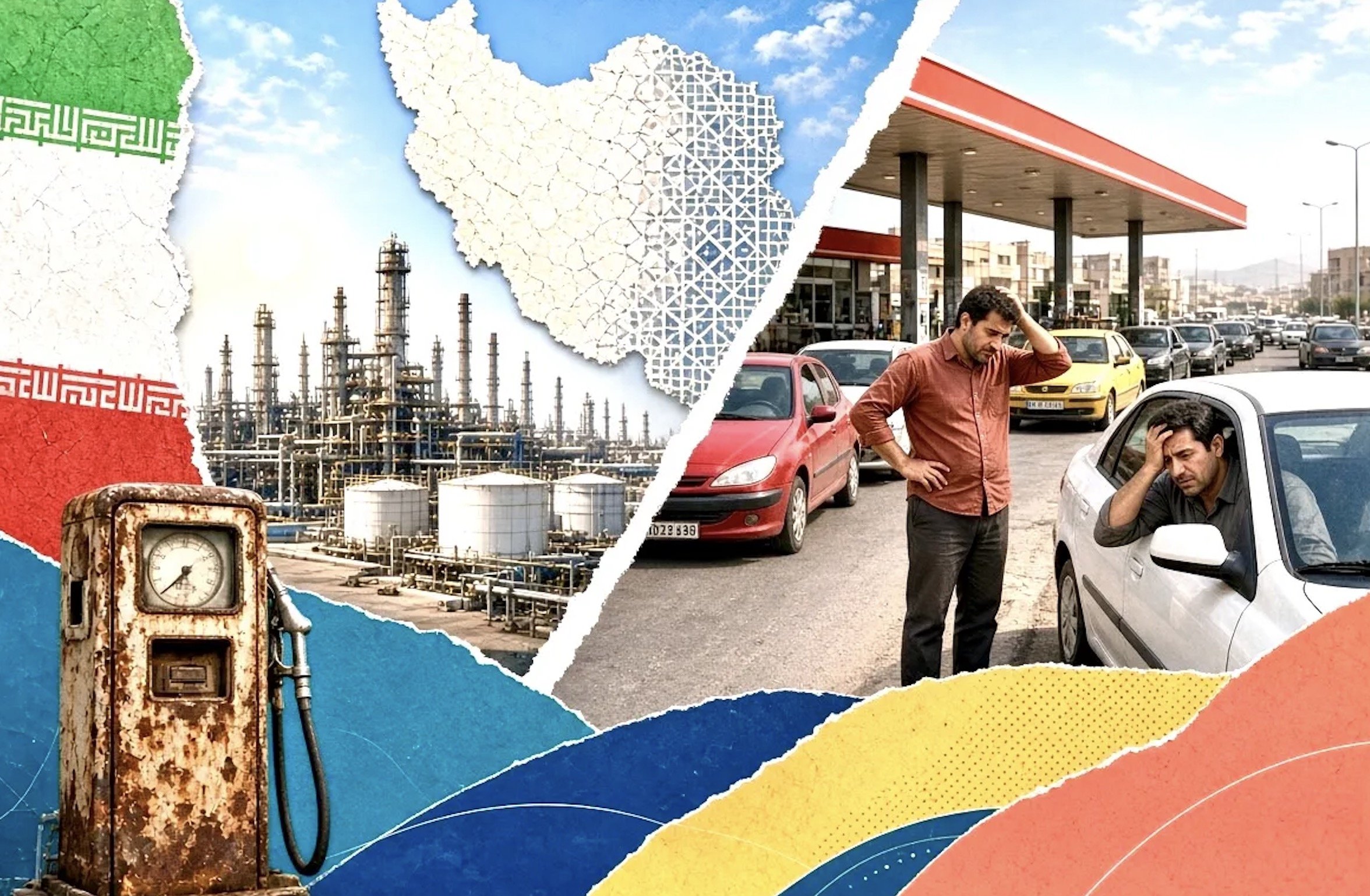
There are few images more politically embarrassing for an oil state than a line of cars waiting for gasoline.

Russia has them. Iran has them. And the spectacle is particularly striking because these are not countries poor in energy. They are among the most resource-rich states on earth, countries that have built foreign policy and political power around their ability to extract and export hydrocarbons.

Yet motorists are searching for functioning pumps, stations are running dry, and two regimes accustomed to discussing oil in millions of barrels are confronting the far more intimate question of whether an ordinary citizen can fill a tank.

Crude oil in the ground is not gasoline in a car. Between the two stands an entire civilization of infrastructure: refineries, pipelines, storage facilities, ports, tankers, spare parts, electrical grids, transportation networks, financing, foreign exchange and competent administration.

A country may possess extraordinary natural wealth and still be unable to convert that wealth efficiently into what its population needs.

Iran is becoming a particularly stark example.

The Islamic Republic controls a country with the world’s third-largest proven oil reserves and second-largest natural-gas reserves. Yet Iranian officials are now confronting a significant gap between domestic gasoline production and consumption. Estimates vary, but Iran is producing roughly 120 to 130 million liters of gasoline a day while consuming approximately 135 million or more.

The deficit did not suddenly appear because of the latest confrontation with the United States. War has made it more dangerous, but the underlying problem is older.

Iran had already returned to importing gasoline because domestic demand was exceeding the capacity of its refining system. Much of that infrastructure is aging.

Years of sanctions have complicated modernization, investment and access to technology. Consumption has meanwhile continued to grow, encouraged by extremely cheap subsidized fuel, inefficient vehicles and an economic system in which gasoline has long been treated not simply as a commodity but as a political entitlement.

Now the margin for managing that imbalance is shrinking.

The interruption of normal trade, restrictions on shipping, falling oil exports and the difficulties of importing refined products have transformed a chronic structural weakness into a much more immediate problem.

The roots of today’s gasoline shortage reach back to the Iran-Iraq War, when major refineries like Abadan were heavily damaged, and never fully restored to their former capacity or technological standard. In the decades that followed, the regime consistently prioritized other projects—its nuclear program, missiles, regional interventions— while underinvesting in refinery modernization. The result is a stark irony: a nation sitting atop some of the world’s largest oil and gas reserves, struggling to produce enough gasoline for its own people.

Russia, which might under different circumstances have helped compensate for shortages, is wrestling with its own fuel crisis after repeated Ukrainian attacks on Russian refining capacity.

Two energy powers are therefore confronting variations of the same irony: immense petroleum wealth coupled with an increasingly fragile ability to deliver fuel where it is actually needed.

In Iran, the implications go far beyond the inconvenience of finding gasoline.

Abdolnaser Hemmati, the governor of Iran’s Central Bank, recently made an extraordinary admission on Iranian television. Discussing the country’s deteriorating economic position, he said that Iran was no longer exporting oil.

The statement should not necessarily be interpreted as a precise accounting figure. Independent tanker tracking indicates that some Iranian crude has continued to move, although volumes have fallen dramatically.

Hemmati’s admission has its significance elsewhere. A senior official of the Islamic Republic was publicly acknowledging something the state has spent decades trying to prevent: the strangulation of the economic mechanism upon which the regime itself depends.

Iran does not merely sell oil. Oil revenue provides foreign exchange. Foreign exchange helps pay for imports. Imports compensate for weaknesses in domestic production.

When exports collapse while gasoline production fails to meet domestic demand, the country becomes trapped in a vicious circle. It needs the income generated by one part of its petroleum economy partly to repair the failures of another.

For a normal government, this would constitute a serious economic problem.

For the Islamic Republic, gasoline is also a political memory.

Iran has been here before.

In 2007, the government of Mahmoud Ahmadinejad introduced gasoline rationing. The response was immediate. Petrol stations were attacked and set ablaze in Tehran. The anger was not difficult to understand. Ordinary Iranians living above one of the greatest petroleum reserves on earth were being told that their government could not provide enough gasoline.

The underlying problem then was remarkably similar to the one Iran confronts today: vast crude reserves combined with insufficient refining capacity and dependence on imported fuel.

Twelve years later, gasoline became explosive again.

In November 2019, the government abruptly raised fuel prices. The demonstrations that followed quickly ceased to be protests about gasoline alone. They became protests against the political order. The authorities shut down much of the country’s internet access and responded with extraordinary violence. Hundreds of Iranians were killed.

No Iranian government can now alter gasoline prices without remembering November 2019.

The current leadership plainly understands this.

President Masoud Pezeshkian has announced plans to raise the price of gasoline purchased in the highest pricing tier, while leaving heavily subsidized allocations in place for the moment.

Economically, the logic is obvious. Iran cannot indefinitely sell fuel at prices radically disconnected from its production and replacement costs. Politically, however, gasoline prices occupy dangerous territory.

The subsidy itself has created many of the distortions now haunting the country.

Artificially cheap gasoline encourages consumption. It discourages efficiency. It supports an aging fleet of vehicles with notoriously high fuel use. Most perversely, it has made smuggling enormously profitable.

When the price of gasoline inside Iran is dramatically lower than in neighboring countries, moving subsidized Iranian fuel across the border becomes an industry of its own.

The Iranian state therefore subsidizes fuel at immense cost, loses part of that fuel to illegal export, struggles to produce enough gasoline to satisfy domestic consumption, and must sometimes import gasoline into a country sitting on some of the largest oil and gas deposits on the planet.

It would be difficult to design a more concise illustration of economic dysfunction.

Sanctions are part of this story and should not be treated as an incidental detail. They have restricted investment, financing, technology transfers, infrastructure development and access to global markets. The present military conflict has intensified those pressures enormously.

But sanctions alone cannot explain a problem that has recurred across different phases of the Islamic Republic’s history.

Iran’s gasoline predicament is also the cumulative product of political choices: decades of economic isolation, corruption, distorted subsidies, underinvestment, institutional incompetence, prioritization of ideological and regional projects, and the deterioration of an economy that should, given the country’s natural endowments and educated population, be vastly more productive than it is.

That distinction matters because there is always a temptation outside Iran to interpret shortages as proof that external pressure is “working.”

Working toward what?

Economic pressure does not descend neatly upon governments while sparing populations. It travels through societies. A gasoline shortage means that a taxi driver spends part of his working day searching for fuel. A delivery business loses hours. Transportation costs rise. Food becomes more expensive.

Families already living under severe inflation lose another portion of their purchasing power. People who had no role in deciding the policies that produced international confrontation absorb the consequences of those policies from both directions.

The Islamic Republic possesses mechanisms for protecting itself that ordinary Iranians do not.

Security institutions will receive fuel. Politically indispensable agencies will receive fuel. Resources can be diverted toward the organizations upon which the regime depends. A state accustomed to rationing scarcity can determine who receives what remains.

The man waiting at the petrol station cannot.

This is why fuel shortages should not automatically be mistaken for imminent regime collapse. Authoritarian governments have demonstrated repeatedly that they can survive extraordinary levels of economic dysfunction, particularly when they are willing to transfer the cost of that dysfunction to their populations and suppress those who object.

Yet survival and stability are not the same thing.

There is something unusually dangerous about shortages that can be seen and experienced directly.

A government can dispute inflation statistics. It can manipulate exchange rates. It can claim that oil exports are higher than foreign analysts suggest. It can insist that sanctions have failed, that production targets have been met, that another economic plan is succeeding and that tomorrow will be better.

An empty gasoline pump is less accommodating.

A driver does not need an economist to explain a closed petrol station. He does not need an opposition television network to tell him that the queue in front of him exists. He does not require foreign propaganda to calculate how many hours of his day have disappeared while he searches for fuel.

Material failure has a language of its own.

That may ultimately be the most important aspect of what is now happening in Iran.

For nearly half a century, the Khomeinist regime has presented resistance as a governing philosophy. Economic pain could be described as sacrifice, isolation as independence, sanctions as proof of revolutionary virtue and deteriorating living standards as the price of refusing submission to foreign powers.

But political rhetoric encounters limits when ideological abstraction enters everyday life.

Iran is not a poor country in the conventional meaning of the word. It possesses energy, minerals, industry, agriculture, coastlines, strategic geography, an ancient commercial culture and a remarkably educated population. Its predicament has never been a simple absence of resources.

The tragedy lies precisely in the abundance.

A government sitting atop such wealth must explain why scarcity has become ordinary.

Why should one of the great oil-producing civilizations of the world worry about gasoline? Why should an Iranian motorist stand in line for fuel? Why should a country that once possessed the resources, expertise and international relationships necessary to imagine itself among the world’s major industrial powers repeatedly find itself improvising around shortages?

The answer cannot forever be reduced to foreigners.

Foreign pressure is real. War is real. Sanctions are real. Damage to infrastructure is real.

So too are forty-seven years of decisions made in Tehran.

Russia’s current experience provides an illuminating comparison. Ukrainian strikes have damaged refineries and reduced gasoline production even though Russia possesses enormous crude resources. It is a reminder that energy power depends not merely upon what lies beneath the soil but upon the functioning systems that turn natural resources into usable prosperity.

For Iran, however, the lesson is harsher because the fragility preceded the current emergency.

The gasoline queues are therefore more than another wartime inconvenience. They expose the distance between resource wealth and national wealth, between possessing oil and possessing a functioning petroleum economy, between controlling a country and governing it successfully.

The Islamic Republic has spent decades describing Iran as a great power under siege.

The far more uncomfortable question is what Iran might have become had so much of its wealth, talent and national energy not been consumed by the siege mentality itself.

A country with some of the greatest petroleum reserves on earth should not force its citizens to live with gasoline scarcity.

Yet once again, Iranians are being asked to adapt.

And once again, the people paying the price are standing in line.

The post When an Oil State Cannot Fill Its Cars appeared first on The Gateway Pundit.

DHS Confirms Minnesota Flag-Dragging Vandal Is a Somali Citizen Who Entered as a ‘Refugee’ (VIDEO)

The man charged with stealing an American flag from a Minnesota medical office, dragging it behind his car, and coming back to shred it is a Somali citizen who was born in Uganda and came to the United States as a refugee, the Department of Homeland Security confirmed to Libs of TikTok.

The suspect is 24-year-old Mahamud Hassan Mahamed, who has been booked on a misdemeanor tab charge of fourth-degree damage to property after the Wednesday incidents.

As The Gateway Pundit previously reported, Mahamed ripped the flag down in the morning, attached it to his vehicle, and dragged it until bystanders chased him off and recovered it.

Mahamed returned that afternoon and shredded it.

Crime Watch Minneapolis obtained videos of the incident and posted them on X.

WATCH:

Jail records showed he was held on $2,000 cash bail or $200 conditional release.

It appears Mahamed has since been released and is due back in court in December.

Mahamed already had a live felony file for threats of violence from an April incident at his apartment building. A hearing in that case was scheduled for the same Wednesday as the flag attack.

Minnesota records list at least five prior traffic convictions.

Earlier this month, he was booked into Hennepin County Jail on a probable-cause DWI and released pending a formal complaint.

The flag case itself was charged only as a misdemeanor despite the second trip to destroy the flag after witnesses had already stopped him.

The post DHS Confirms Minnesota Flag-Dragging Vandal Is a Somali Citizen Who Entered as a ‘Refugee’ (VIDEO) appeared first on The Gateway Pundit.

Canadian Nat’l Broadcaster Caves to Outrage, Will Refer to 9/11 as ‘Terrorist Attacks’ After Insane Internal Memo Leaked

Earlier this week, the Canadian taxpayer found out that they were supporting, with their hard-earned money, an organization that wouldn’t call the deadliest terror attack in human history “terrorism.”

Americans found out about it, too, and they were pretty unhappy — especially since we’re approaching the 25th anniversary of the attacks and our neighbors to the north were telling reporters with their national broadcaster that 9/11 was a situation where “hijackings led to passenger jet crashes.”

Now, the Canadian Broadcasting Corporation is reversing course and calling terror attacks “terrorism.” All it took was international outrage and the United States ambassador to Canada saying the language “significantly endangers our efforts to establish and harmonize a shared national and economic security partnership.”

The whole to-do began when a memo from Basem Boshra, the “Senior Director of Journalistic Standards and Public Trust” was reported by a columnist in the Toronto Sun.

(I will to put quotation marks around Boshra’s title because it’s about as true as my self-appointed title as “Starting Quarterback for the Philadelphia Eagles,” except Boshra apparently takes it seriously and receives money for it.)

In it, he described the CBC’s standards regarding 9/11 reporting.

“Do not refer to the Sept. 11 attacks as terrorist attacks,” he wrote, apparently in bold italics. Instead, reporters were supposed to say that “[t]he hijackings led to passenger jet crashes.”

“CBC’s longstanding language guidance regarding the terms ‘terrorist’ and ‘terrorism’ is a preference for the use of these words with attribution, a practice shared by many of the world’s top journalistic organizations,” said CBC News spokeswoman Kerry Kelly.

“Our general manager and editor in chief has written publicly in the past on the subject.”

Indeed they had — after the Oct. 7, 2023 Hamas terrorist attacks against Israel, again not a good sign:

Attribution of the word “terrorist” has been our policy for decades — mirrored by other news organizations such as the BBC, AP, AFP and Reuters, among many others. Our focus is to report the facts of such atrocities with accuracy, clarity and detail; to convey the scale and scope of violent acts wherever they occur; to quote the people affected, and to convey the views of officials and experts on these events. We bear witness. But CBC News does not itself designate specific groups as terrorists, or specific acts as terrorism, regardless of the region or the events, because these words are so loaded with meaning, politics and emotion that they can end up being impediments to our journalism. 

The problem is that this policy isn’t really “mirrored” by those organizations, since it took me all of three minutes to find The Associated Press, the BBC, and The New York Times — three of the organizations mentioned either in the 2023 post or in response to the 9/11 memo controversy — using the word “terrorist attacks” in the first paragraph of a 9/11-related story. So that’s clearly bogus.

And at this point, even U.S. ambassador to Canada Pete Hoekstra was outraged, as was FBI Director Kash Patel:

So, on Friday, Boshra backtracked, insisting that the memo — which explicitly said in bold italics to not refer to the 9/11 terror attacks as terror attacks — was “published and amplified by a number of outlets without full context or explanation” and “has caused significant concern, anger and hurt for many people who believe CBC News seeks to minimize or obscure the horror of that day and who was behind it.”

“CBC’s reporting on terrorism, wherever it occurs, has always been guided by the principle of attribution, and like other major news organizations, it has been our practice for decades. The reason for the extreme care around the use of the words ‘terrorist’ and ‘terrorism’ was detailed in this earlier editor’s blog,” he said, linking to the 2023 Israel-Hamas piece.

But to be clear, CBC News has never said what happened on Sept. 11, 2001, was not terrorism, as some commentators have stated in recent days. We have reported fully and accurately on the reasons and motivations for those attacks as determined by police, governments and an independent commission. We’ve just made sure to do it with attribution.

Clarity and understanding are at the heart of our journalism. The leaked excerpt without context or explanation has raised more questions for the public that we must now answer.

After reviewing our current language guidance, we have decided to adjust it to clarify that direct attribution is not required for describing the historic events of 9/11 as terrorism.

So, there was never any guidance to not refer to the 9/11 attacks as terrorism, but CBC wants to engender “clarity and understanding,” so it has adjusted the guidance that specifically said to not call the 9/11 attacks terrorism except in attributions.

Oh, and just to confuse matters more, Boshra said in closing that “we will continue to follow the journalistically sound practice of attributing causes and motivations to officials and experts.” Translation: He’s covering his posterior this time, but don’t expect him to do so in the future.

Many, many years ago, the CBC’s last truly great show, “The Kids in the Hall,” ran a hilarious (if ribald) sketch called “Screw You, Taxpayer,” in which they started out with a deliberately offensive premise and then broke the fourth wall, with cast member Mark McKinney saying that they were just wasting your money.

This included one of the other cast members, Scott Thompson, stating that he would “like to take a little bit of our national network airtime to advocate” that he be allowed to perform lewd acts “in public buildings.”

“Whoa! What a viewpoint!” McKinney responded. “And you know what? I bet it’s not yours — but you just paid to hear it!”

That’s only funny when it’s a sketch comedy show.

When it’s a terrorist attack that left nearly 3,000 innocent people dead being referred to as a situation where “hijackings led to passenger jet crashes,” not so much. And Boshra made it clear that you’ll be hearing this propagandized language again, once the storm blows over and the outrage is milder. Canadians who care about truth — whether they’re conservatives or liberals — need to defund this outrage to journalism before the CBC is allowed to resume this nonsense.

This article appeared originally on The Western Journal.

The post Canadian Nat’l Broadcaster Caves to Outrage, Will Refer to 9/11 as ‘Terrorist Attacks’ After Insane Internal Memo Leaked appeared first on The Gateway Pundit.

CALIFORNIA DOUBLE STANDARD: Democrats Advance Bill Recognizing Two Muslim Holidays and Authorizing Eid Lessons in Public Schools — No Matching Provision for Christmas, Easter or Good Friday

Credit: Levi Clancy

California Democrats are advancing legislation that would formally recognize two Muslim holy days as state holidays and create special authorization for public schools to teach about their history.

Meanwhile, nearly 12 million Catholics live in California, yet the state’s education code contains no comparable holiday-specific provision inviting officials to develop model curriculum exercises addressing the religious significance of Christmas, Easter or Good Friday.

Assembly Bill 2017, introduced by San Francisco Democrat Assemblyman Matt Haney, would add Eid al-Fitr and Eid al-Adha to California’s list of official state holidays.

The legislation passed the State Assembly in May by a lopsided 64-1 vote. Republican Assemblyman Carl DeMaio was the lone “no” vote.

The official legislative record shows AB 2017 was amended in the Senate on August 27 and ordered to a third reading on August 28.

It must still pass the Senate and return to the Assembly for concurrence before it can be delivered to Newsom.

If enacted, AB 2017 would:

  • Designate Eid al-Fitr and Eid al-Adha as California state holidays.
  • Permit K-12 public schools and community colleges to close for the holidays if local governing boards and employee unions agree.
  • Allow state employees to use existing vacation, annual leave or compensatory time to observe the holidays.
  • Allow public schools to conduct exercises “exploring the history” of Eid al-Fitr and Eid al-Adha.
  • Authorize the State Board of Education to develop a model curriculum guide related specifically to the two Muslim holidays.

The bill would not automatically close schools, courts, government offices or private businesses.

Earlier versions contained even more controversial language permitting schools to conduct exercises “acknowledging and celebrating the meaning and importance” of the two Islamic holidays.

After critics questioned why California public schools would be explicitly encouraged to “celebrate” religious holidays, lawmakers quietly softened the language. The latest version now describes the exercises as “exploring the history” of Eid.

But the special statutory authorization and invitation for a state-created model curriculum remain.

California Family Council Vice President Greg Burt previously challenged the original language, asking, “What happened to neutrality? It doesn’t make any sense.”

Burt noted that California school policies typically allow objective teaching about religion but prohibit schools from sponsoring religious celebrations. Many school districts have also erased the words “Christmas” and “Easter” from their calendars, replacing them with the sanitized labels “winter break” and “spring break.” Fox News previously reported on the controversy.

Christmas Day is already recognized as a state holiday, and the education code references Christmas and Easter recesses. But there is no parallel provision in Section 37220.7 authorizing special classroom exercises or a state model curriculum about the Christian meaning of Christmas, the Crucifixion on Good Friday, or the Resurrection celebrated on Easter Sunday.

According to the California Catholic Conference, nearly 12 million Catholics, approximately 30 percent of the state’s population, live in California.

Haney and the bill’s sponsors, including the California chapter of the Council on American-Islamic Relations, argue that the legislation will prevent Muslim students and employees from being penalized for observing their faith.

“No student should have to choose between celebrating one of the holiest days of their faith and showing up to school,” Haney said when announcing the legislation.

When Muslims request recognition, Sacramento Democrats draft a state holiday, authorize specialized classroom exercises and invite the State Board of Education to develop a curriculum guide.

When Christian parents ask schools to acknowledge the religious foundation of Christmas or Easter, they are frequently lectured about “separation of church and state.”

The Gateway Pundit previously reported on AB 2017 in July, when the measure cleared the Assembly and began moving through the Democrat-controlled Senate.

California Democrats apparently believe religious accommodation is essential, but only when the religion being accommodated fits their political agenda.

If Sacramento lawmakers truly support religious equality, they should apply the same rules to every faith instead of constructing another politically favored carveout.

The post CALIFORNIA DOUBLE STANDARD: Democrats Advance Bill Recognizing Two Muslim Holidays and Authorizing Eid Lessons in Public Schools — No Matching Provision for Christmas, Easter or Good Friday appeared first on The Gateway Pundit.
D.C. Circuit DENIES Peter Navarro’s Bid for Full-Court Rehearing — Trump Adviser Says “Deep Blue” Court Just Cleared Runway to SCOTUS

The Washington legal establishment has dealt President Trump’s senior adviser Peter Navarro another blow, but Navarro says the constitutional battle is far from over.

The full U.S. Court of Appeals for the District of Columbia Circuit on Friday denied Navarro’s petition for rehearing en banc, leaving intact a three-judge panel’s decision upholding his criminal contempt-of-Congress conviction.

The court’s terse, one-page order revealed that not a single judge requested a vote on whether the full court should reconsider the case. The court denied Navarro’s petition without further explanation while granting motions to file supporting amicus briefs.

The ruling now clears the way for Navarro to petition the United States Supreme Court.

Navarro issued a blistering response following the decision:

“This case was always headed to the Supreme Court. Deep Blue D.C. Circuit’s denial simply clears the runway. The issue is bigger than me: whether a White House adviser — Republican or Democrat — can be prosecuted and imprisoned for acting on a good-faith belief that a President invoked executive privilege, while being forbidden from presenting that belief to the jury. That is a separation-of-powers question the Supreme Court will now have a chance to answer.”

Navarro’s attorneys have argued that the government should have been required to prove that he knew his refusal to comply was unlawful, or that he acted with an improper purpose, not merely that his noncompliance was intentional.

They also maintain that Navarro’s good-faith understanding of President Trump’s executive-privilege instruction should have been presented to the jury. The court rejected Navarro’s request for full-court review on August 28.

Navarro was convicted in September 2023 on two counts of criminal contempt after refusing to produce documents and appear for testimony before Nancy Pelosi and Liz Cheney’s partisan January 6 Committee.

Navarro maintained that President Trump had directed him to protect executive privilege. Yet Obama-appointed District Judge Amit Mehta barred Navarro from presenting his good-faith executive-privilege belief as a defense to the jury.

As The Gateway Pundit previously reported, Mehta sentenced Navarro to four months in federal prison and ordered him to pay a $9,500 fine.

Before sentencing, Navarro explained the impossible position in which he had been placed:

“When I received that congressional subpoena, the second, I had an honest belief that the privilege had been invoked, and I was torn. Nobody in my position should be put in conflict between the legislative branch and the executive branch.”

Navarro also condemned a process in which the government was permitted to prosecute him while preventing him from explaining his central defense to the jury.

The D.C. Circuit nevertheless affirmed his conviction in July. The three-judge panel concluded that only the president or an authorized representative can invoke executive privilege and upheld Mehta’s finding that no sufficiently formal invocation had been established for the specific January 6 Committee subpoena.

The panel further ruled that even a proper privilege claim would not have justified Navarro’s complete refusal to appear or produce materials, particularly information involving his public statements and writings.

The case took an extraordinary turn after President Trump returned to office.

Trump’s Justice Department informed the appeals court that it was no longer taking the Biden administration’s position in the case and withdrew its brief defending Navarro’s conviction. The DOJ, however, did not file a new brief or formally move to dismiss the appeal.

The D.C. Circuit then declared that the government had withdrawn from further participation and proceeded to hear Navarro’s appeal with Navarro standing alone.

Despite the federal government no longer defending the Biden-era prosecution, the court upheld the conviction anyway.

The Gateway Pundit has extensively documented the campaign against Navarro. In 2025, the Justice Department dropped a separate Biden-era lawsuit accusing him of improperly retaining presidential records.

That case was tainted by internal communications showing anti-Trump FBI officials discussing, and apparently celebrating, Navarro’s indictment.

Navarro has already served every day of his four-month sentence. But the constitutional danger created by his prosecution remains.

If presidential advisers can be imprisoned for honoring what they sincerely understand to be an executive-privilege instruction—and then be forbidden from explaining that understanding to a jury—future advisers from either political party could face the same trap.

The prison sentence has been served. The constitutional battle is only beginning.

Navarro is now taking that battle to the Supreme Court.

The post D.C. Circuit DENIES Peter Navarro’s Bid for Full-Court Rehearing — Trump Adviser Says “Deep Blue” Court Just Cleared Runway to SCOTUS appeared first on The Gateway Pundit.

Trump Says Hochul ‘Doesn’t Care About New York’ and is ‘For Canada’ After She Declares New York Will Not Recognize Lake America Rename

Governor Kathy Hochul has announced that New York will not recognize President Donald Trump’s order renaming Lake Ontario as Lake America, calling the move “absurd” and a “deflection” from grocery bills and energy costs.

Trump responded by declaring that Hochul is “for Canada” and “doesn’t care about New York.”

On Thursday afternoon, Trump signed an executive order directing the Interior Department and the U.S. Board on Geographic Names to update the Geographic Names Information System so federal maps and documents use “Lake America,” effective immediately.

The change applies only to federal usage. This means that the order does not bind Canada, New York state agencies, or international mapmakers to using the new name.

The move comes amid a trade fight with Canada after talks broke down and the Trump administration imposed heavy new tariffs.

Hochul responded to the news in a post on X, writing that “New York won’t be calling it that.”

In an NY1 interview, she went further, saying, “I’m speechless. It is so patently absurd. Shame on them for deflecting from the real needs that Americans are feeling that we have here in New York. The high cost of energy, prescription drugs, utility bills, groceries. And this is what the president spends his time on? Renaming a lake that was named after our Indigenous peoples. Shame on you.”

Trump responded on Truth Social, writing that, “Governor Kathy Hochul is for Canada, a Country that has been ripping off New York State for years, especially under her Administration, instead of the good ‘ol U.S.A. Can you imagine her saying that she won’t respect or acknowledge LAKE AMERICA. That’s why the Dumocrats are so bad for our Country. Vote for Bruce Blakeman for Governor of New York. He has my Complete and Total Endorsement, and will never let you down! President DJT”

About half the lake’s surface sits in Canada and the rest along New York’s northern shore.

Other governors, including Wisconsin’s Tony Evers and Vermont’s Phil Scott, have also criticized the order.

Canadian officials also said they would not use the new name.

The post Trump Says Hochul ‘Doesn’t Care About New York’ and is ‘For Canada’ After She Declares New York Will Not Recognize Lake America Rename appeared first on The Gateway Pundit.

Same Democrats Who Cry Over Renaming of Lake Ontario to Lake America – Renamed Over 650 Geographic or Military Locations During Biden Years

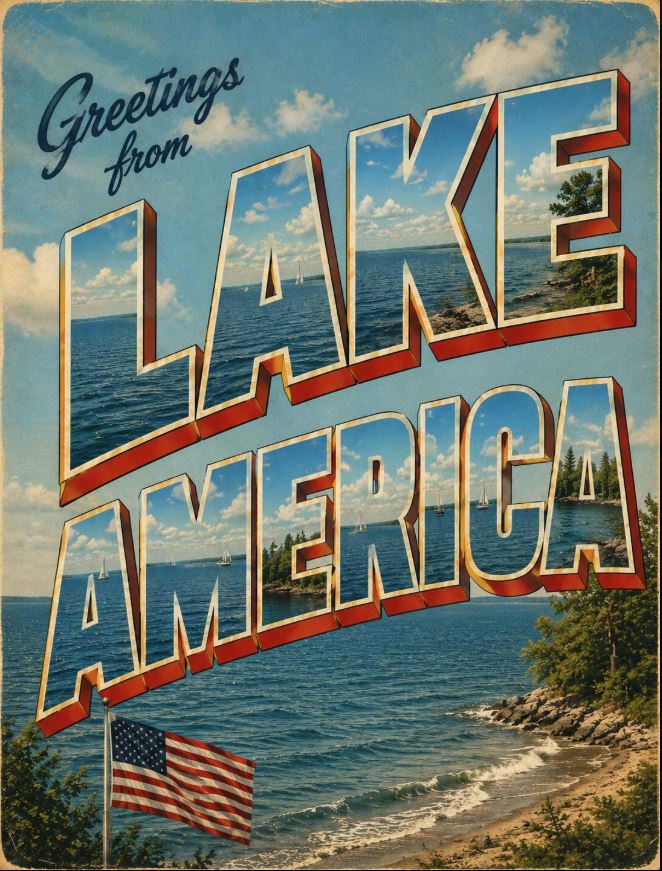
A ‘Lake America’ postcard, via the GOP.

Democrats howled this week when President Trump renamed Lake Ontario to Lake America after Canada walked out on trade talks with US representatives.

For decades, Canada has been taking advantage of US markets while taxing US products heading north. Trump decided to put a stop to this. But, the globalist Carney government walked out of talks last week in hopes to damage President Trump in the midterm elections.

In reality, Carney’s actions may permanently damage Canada’s important oil business with the US.

Alberta Canada Premier Danielle Smith Speaks Out – Explains Why PM Carney’s Threats Against US is Suicide for Canadian Economy (Video)

That’s when President Trump renamed Lake Ontario to Lake America this week.

And, of course, Democrats lost it. They hate that we have a president who puts America First and works day-in and day-out to reverse the dangerous decline of the United States.

Democrats are angry that Trump changed the name of a Great Lake. They forgot about every landmark they changed due to political correctness during the failed Biden and Obama regimes.

In fact, Democrats renamed 650 specific landmarks or locations during the Biden years.

In November 2021, Interior Secretary Deb Haaland issued Secretarial Order 3404 declaring “squaw” a derogatory term (described by the department as an ethnic, racial, and sexist slur, particularly for Indigenous women). The U.S. Board on Geographic Names then approved replacement names for nearly 650 geographic features on federal land—peaks, lakes, streams, canyons, islands, and similar features. The changes took effect in September 2022 after consultation with nearly 70 tribes and more than 1,000 public recommendations. A handful of additional unincorporated populated places were renamed in January 2023.

And, don’t forget that Democrats renamed woman to “birthing person” and forced you to call any male who described himself as a woman as she or they!

Riss Alesi named off the liberal word games.

The post Same Democrats Who Cry Over Renaming of Lake Ontario to Lake America – Renamed Over 650 Geographic or Military Locations During Biden Years appeared first on The Gateway Pundit.