
The Right-Wing Tide Reaches Brazil
A President Flavio Bolsonaro would be friendly to Trump, but not a game-changer for American interests.
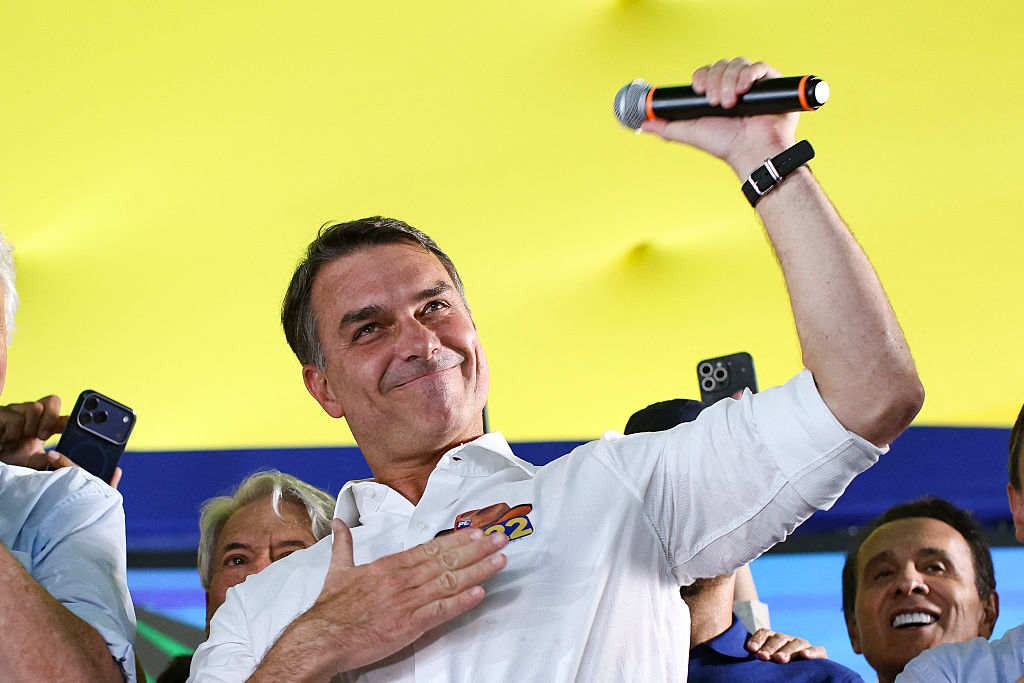
Brazil is heading to a runoff election to determine the fate of the country for the next four years, and the right-wing tide sweeping Latin America appears to be about to overtake Brazil as well.
On October 4, Brazilians went to the polls for a bitterly disputed presidential election that pitted the left-wing incumbent, Luiz Inácio Lula da Silva, against Flavio Bolsonaro, the son and political heir of the former president Jair Bolsonaro. The results of the first round look promising for the Brazilian right, which outperformed the polls. Flavio Bolsonaro secured first place in the presidential contest with a hair over 47 percent, with Lula taking 45 percent. The right was even more successful in the legislative elections.
As neither candidate secured an absolute majority, the election will proceed to a runoff on October 25, which Flavio is heavily favored to win. He will probably pick up most of the 2 percent of the vote that went to the right-wing candidate Ronaldo Caiado, and a plurality of the 3 percent for the right-wing candidate Renan Santos. Lula, on the other hand, has no similar reserve of votes to draw upon; he will need a major groundswell of new voters turning out for the second round to secure a victory. The polling is bleak for Lula: AtlasIntel’s latest poll, released on Friday, puts Bolsonaro ahead 51 percent to 46 percent.
For the Bolsonaros, the election is existential. Jair Bolsonaro has been incarcerated or under house arrest since 2025, when he was convicted by the Brazilian Supreme Court for attempting to engineer a coup d’etat after losing to Lula in the 2022 presidential election. His sentence carried a penalty of 27 years and 3 months imprisonment and prohibits him from running for office.
The Bolsonaros claim that the election was fraudulent and that Jair was attempting to preserve the constitutional order. Right-wing Brazilian activists, convinced that Lula had robbed Bolsonaro of the 2022 election, organized a major riot on January 8, 2023, when Bolsonaristas attacked the seat of government in the capital of Brasilia in an attempt to precipitate intervention by the military and prevent Lula from taking office. Over 2,000 were arrested, and hundreds have been convicted of crimes ranging from destruction of property to insurrection.
The incident is a notable parallel to the events of January 6, 2021 in the U.S., and the Bolsonaros hope to extend the parallel still further. Flavio has pledged that, if elected, he will pardon his father—whose declining health occasioned his release from prison to house arrest—along with anyone convicted of crimes connected with the January 8 riots.
The right retaking control of the Brazilian government would have major repercussions throughout the region and beyond. Under Lula, Brazil has been one of the firmest opponents of the Trump administration’s foreign policy, and the country is powerful and independent enough to have made both Trump and Elon Musk, the richest man in the world, blink.
Musk was the first to tussle with the Brazilian Supreme Court Justice Alexandre de Moraes and the Brazilian left: In 2024, Moraes ordered X, Musk’s social media company, to censor Brazilian accounts posting inflammatory political content. Musk defied the court, arguing that the demand violated the principle of free speech, and shuttered the company’s office in Brazil, but Moraes doubled down and blocked the social network from the country entirely. After a little over a month, Musk knuckled under, suspending the accounts as requested and paying a hefty fine for his intransigence.
Trump has significantly more leverage to work with, but Brazil proved a tougher nut to crack than the president anticipated. In July 2025, the Trump administration increased tariffs on Brazilian goods to 50 percent and sanctioned Moraes to protest the treatment of Jair Bolsonaro. Lula didn’t flinch, and before the end of the year the U.S. had lifted many of the tariffs and ended sanctions on Moraes. The reversal was a hard one for the Trump administration, and unexpected; few countries have managed to make the president back down in comparable fashion.
Lula was also a major supporter of efforts to counterbalance U.S. hegemony—including serving as a major ally for Nicolas Maduro’s regime in Venezuela. Lula’s government has cultivated ties with Russia and China, expanding economic integration with China in particular and providing the Chinese with an important base for increasing their influence in the Western Hemisphere.
While a President Flavio Bolsonaro won’t cut China out of the Brazilian markets—it is Brazil’s largest trade partner, to the tune of over $170 billion of commerce in 2023—Brazil will certainly be much more amenable to the priorities and policies of the Trump administration, with which the family has cultivated close ties. With Lula out of office and Brazil pivoting to a pro-U.S. orientation, the Chinese will find it significantly more difficult to expand non-economic partnerships in the region, a major priority for the Trump administration.
Flavio Bolsonaro has also pledged to sign Brazil onto the Shield of the Americas, Trump’s regional anti-narcotics alliance, allowing for further regional coordination on fighting drugs and organized crime. The northwestern portion of the country, an isolated region of the Amazon rainforest bordering on Colombia, Venezuela, and Peru, is a major conduit for drug trafficking, and organized crime groups exploit the border to avoid crackdowns by crossing from one country to the other. Effective coordination via Shield of the Americas could produce real progress in the area.
The administration shouldn’t get too enthused, though. The Brazilians will still need to placate the Chinese, and much of a Bolsonaro administration’s term is likely to be consumed by bitter disputes with the Brazilian Supreme Court, an immensely powerful entity with sweeping legal authority. The incoming government may be friendlier to the Trump administration, but that is no guarantee it will significantly improve American interests, at least in the short term.
The post The Right-Wing Tide Reaches Brazil appeared first on The American Conservative.