
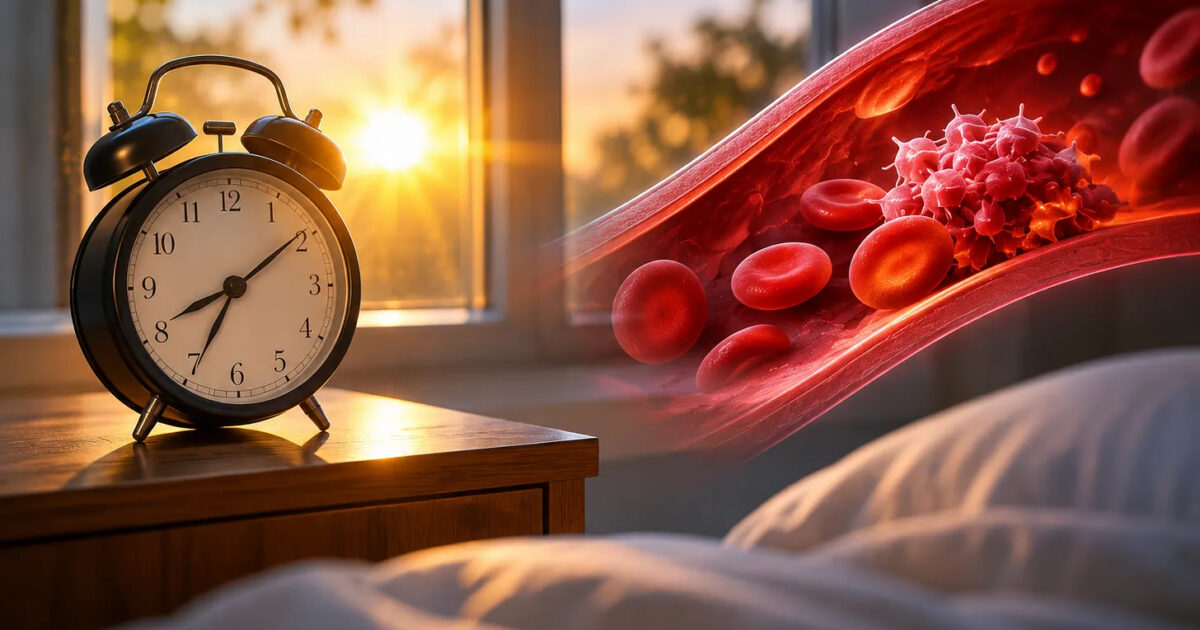
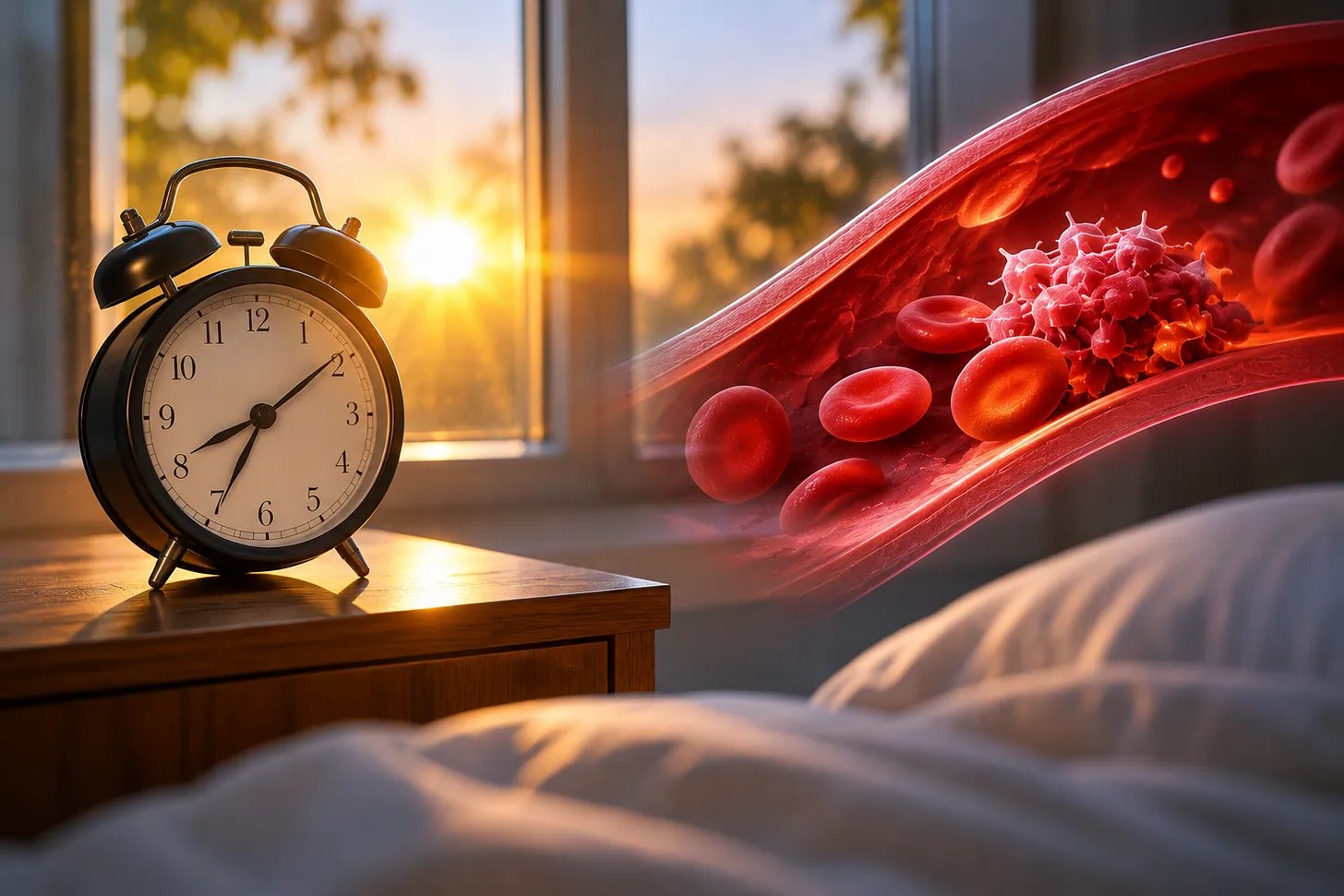
Most people know that sleep is important for heart health. But few realize that when you sleep, when you wake up, and when you expose yourself to sunlight may influence the biological systems responsible for forming and dissolving blood clots.
For decades, doctors have observed that heart attacks and ischemic strokes (those caused by blocked blood vessels) are especially common between 6 a.m. and noon.
Part of the explanation is the morning rise in cortisol, adrenaline, and blood pressure. But researchers have discovered something more intriguing: Your blood vessels and platelets, the tiny blood components that help stop bleeding, operate according to internal biological clocks. These clocks influence when blood is more likely to clot and when the body is better equipped to dissolve clots.
And because light and sleep help regulate biological timing, maintaining a consistent daily schedule may be another way to support cardiovascular health.
Your blood vessels have their own clocks
Most people associate circadian rhythms with sleep. But nearly every organ system follows a roughly 24-hour biological cycle.
The brain’s master clock, located in the hypothalamus, coordinates these rhythms. Yet blood vessels have their own molecular clocks, controlled by genes and proteins that regulate cellular activity throughout the day. These clocks influence how vessels dilate and constrict, respond to injury, and regulate clotting. Even platelets have mechanisms that influence their activity according to biological time.
Your risk of developing a clot, then, depends not only on what you’re doing, but also on what time your body thinks it is.
Why the morning is particularly vulnerable
In a 2011 study, researchers investigated whether platelet activity followed the internal biological clock or simply reflected the activities associated with waking.
They used a technique called forced desynchrony, deliberately shifting participants’ sleep and activity schedules out of alignment with their internal clocks. This allowed them to separate biological timing from the effects of sleeping, waking, and moving around.
They measured three proteins involved in platelet activation:
- GPIIb/IIIa: A receptor that allows activated platelets to bind together through fibrinogen, a blood protein involved in clot formation.
- GPIb: A receptor that helps platelets attach to injured blood vessel walls.
- P-selectin: A protein displayed on activated platelets that helps them interact with white blood cells and vessel walls.
All three followed circadian rhythms, peaking at a biological time corresponding to approximately 8–9 a.m. The internal clock influenced these markers more than mental stress, changes in posture, or mild exercise.
Meanwhile, another biological process was moving in the opposite direction.
The body balances coagulation, which forms clots, with fibrinolysis, which dissolves them. Fibrinolysis relies on plasmin, an enzyme that breaks apart fibrin, the protein mesh holding clots together. Plasmin generation is partly controlled by plasminogen activator inhibitor-1 (PAI-1), a protein that suppresses the enzymes responsible for producing plasmin.
Researchers found that PAI-1 peaked at a biological time corresponding to approximately 6:30 a.m. Its circadian variation was eight times greater than changes induced by posture or exercise. This means that during the same morning hours when platelets become more reactive, the body’s ability to dissolve clots is relatively suppressed.
Other biorhythms also contribute. The endothelium, the thin layer of cells lining blood vessels, produces nitric oxide, which relaxes vessels and discourages platelet aggregation. iNitric oxide availability is often reduced in the morning.
Factor VII, a protein involved in initiating coagulation, also fluctuates throughout the day.
Experiments show that disrupting BMAL1, a gene regulating vascular cellular clocks, changes susceptibility to thrombosis, the formation of clots inside blood vessels.
How sunlight helps synchronize your cardiovascular system
Light is the strongest environmental signal controlling the brain’s master clock. Specialized cells in the retina detect light and transmit timing information to the hypothalamus. The brain then helps synchronize peripheral clocks through hormonal, nervous-system, and behavioral signals.
Morning sunlight tells your biological clock that the day has begun. Consistent exposure helps stabilize the timing of daily rhythms, including those influencing cardiovascular function.
Bright light late in the evening can have the opposite effect, delaying the internal clock and disrupting synchronization with sleep and other bodily processes. Irregular sleep schedules and night-shift work can also produce circadian misalignment, in which the body’s biological rhythms become poorly coordinated.
This doesn’t mean morning sunlight has been proven to prevent blood clots. Rather, it helps maintain the biological timing system that regulates several processes involved in clotting.
Sleep and blood sugar also influence clotting
Sunlight helps set your body’s internal clock, but your sleep schedule helps keep it on time. Going to bed and waking up at roughly the same time each day reinforces the biological rhythms that regulate blood pressure, blood vessel function, and clotting.
Blood sugar plays a role, too. Insulin resistance, high blood glucose, and chronic inflammation can raise levels of PAI-1, the protein that slows the breakdown of blood clots. The higher its activity, the harder it can be for your body to dissolve a clot once it forms.
Regular exercise and limiting sugar and carbohydrates can help counter these effects by improving insulin sensitivity and supporting the body’s natural clot-dissolving system.
So while sunlight and regular sleep help keep your biological clocks synchronized, exercise and metabolic health help maintain the clotting balance those clocks regulate.
But your body’s internal clocks aren’t the only systems quietly regulating your health. Trillions of bacteria in your gut are also sending chemical signals that influence everything from inflammation to brain function.
Next week, we’ll look at three remarkable molecules these bacteria produce, and how they help regulate your immune system, protect your gut, and even communicate with your brain.
Have a question for the GoldCare HealthDesk?
The post How Do Better Sleep and Morning Sunlight Help Prevent Blood Clots? appeared first on The Gateway Pundit.