Attorney General Todd Blanche will host a White House press briefing this afternoon in the Rose Garden, rather than the typical briefing room.
White House Press Secretary Karoline Leavitt announced last month that she would end her year-and-a-half tenure with the White House after welcoming her second child into the world. President Trump said she would continue to serve as one of his “top outside advisors.”
President Trump has not said who will replace Leavitt as press secretary, but signaled to reporters over the weekend that he has someone in mind. Until he makes a decision, though, Trump says that members of his administration will continue to fill in as press secretary and field questions from reporters.
“We have a lot of people that want it, many people want it, many people have been written about, as you know, but many people want it,” Trump said, noting that he “may have” developed a short list over the weekend.
“You know what we’re going to do for a little while? We’re going to use the secretaries, you know, Marco, and maybe JD just did it. He did a great job, but we’re going to use Scott [Bessent], we’re going to use Howard [Lutnik]. We’re going to use a lot of our secretaries. Linda McMahon is so great. And we’ll do it for a little while, but ultimately, I’ll pick somebody.”
WATCH:
Blanche’s press briefing in the Rose Garden comes as subpoenaes fly in the Russiagate probe in South Florida, involving former FBI Director James Comey and Former CIA Director John Brennan.
Lead prosecutor in the case, Joe DiGenova, resigned last week after five months at the Justice Department, but the case is still moving forward. As The Gateway Pundit reported on Monday, John Brennan has been subpoenaed to testify next month before a grand jury in the probe.
Also, yesterday, the Supreme Court ruled against the Trump Administration’s new US Postal Service rule that would allow the Postal Service to refuse to deliver ballots to ineligible voters.
Blanche reportedly said on Monday that the federal government is still looking at “multiple states” in its ongoing review of election practices, and “hundreds of open investigations” are underway into illegal voting.
The press briefing is scheduled to begin at 2 pm ET.
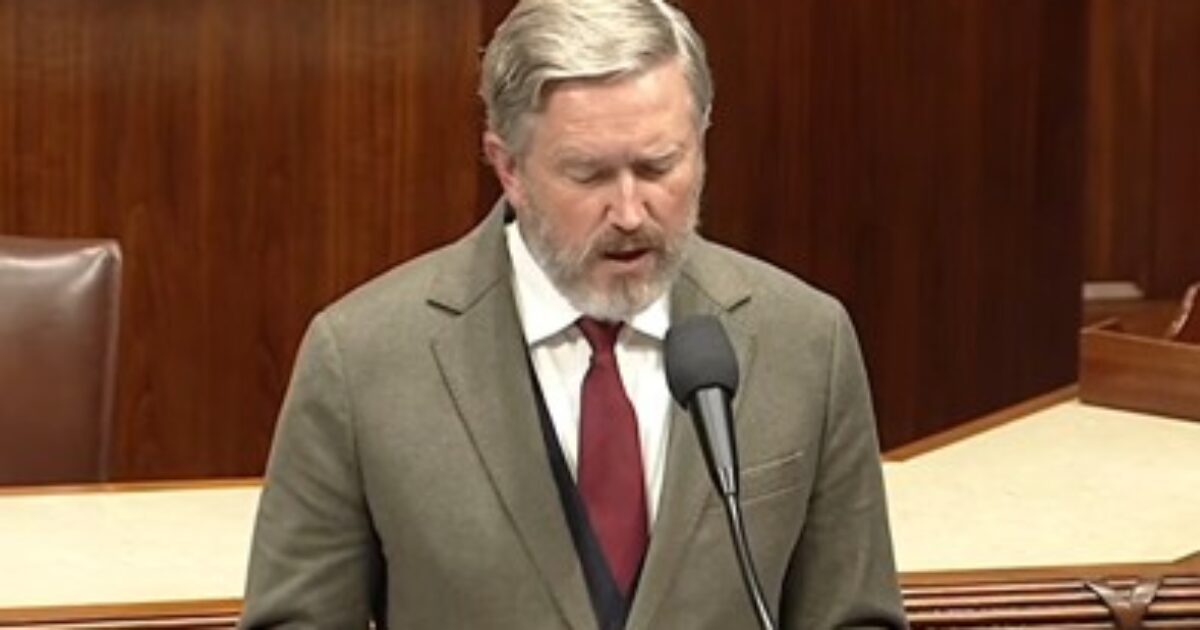
Rep. Thomas Massie (RINO-KY) announces articles of impeachment against War Secretary Pete Hegseth. Credit: C-SPAN screenshot
Disgraced Rep. Thomas Massie (RINO-KY) has determined that his one last grandstanding move will be an attempt to impeach War Secretary Pete Hegseth on bogus charges and perhaps force a vote on the matter.
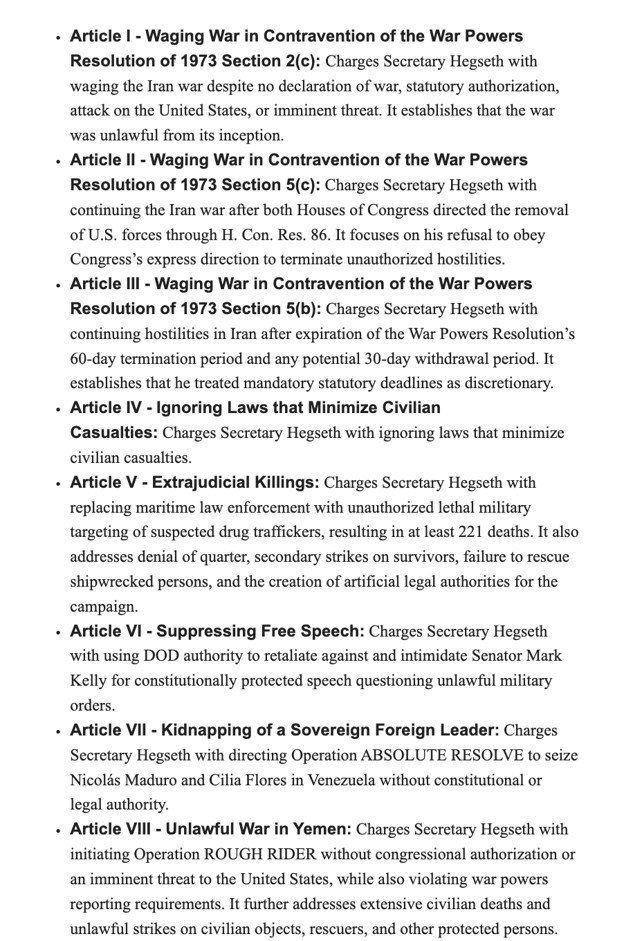
On Tuesday, Massie announced a whopping EIGHT articles of impeachment against Hegseth. The War Secretary stands accused of violating the War Powers Act of 1973 on three occasions, ignoring civilian casualties, extrajudicial killings, suppressing free speech, kidnapping a sovereign foreign leader, and waging “an unlawful war in Yemen.”
These charges focus specifically on the ongoing war in Iran, the bombing of drug trafficking boats in the Caribbean, Hegseth “retaliating” against disgraced Senator Mark Kelly (D-AZ), the successful capture of former Venezuelan tyrant Nicholas Maduro, and the aforementioned Yemen War.
Here is the list:
Credit: Andrew Solender X
Watch Massie’s announcement on the House floor:
BREAKING: Rep. Thomas Massie has just moved to impeach Secretary of War Pete Hegseth for “high crimes and misdemeanors.”
Axios reports that the vote will have to happen by Thursday unless House GOP leadership cancels the week early.
Massie, who lost his House primary to Trump-endorsed Ed Gallrein back in May, has shown signs that he is not done with the political scene.
As The Gateway Pundit reported, Massie has already filed with the FEC to run for political office in 2028. He claims the filing keeps his political operation alive while he decides what comes next.
This includes a presidential run. Massie notably refused to rule one out during an interview on “Meet The Press” a week following his primary loss.
One would think he would seek the Libertarian Party’s nomination, since he has zero chance in a GOP primary.
This is not the first attempt to impeach Hegseth.
As Newsweek notes, Rep. Yassamin Ansari (D-AZ) introduced articles of impeachment back in April against Hegseth over the U.S. war in Iran. A dozen Democrats signed on as cosponsors of the six articles.
Rep. Shri Thanedar (D-MI) attempted to impeach Hegseth in December 2025 on charges of “Murder and Conspiracy to Murder” and “Reckless and Unlawful Mishandling of Classified Information.”
While making the announcement, he stumbled over English in an embarrassing scene.
Local law enforcement took photos of Thomas Matthew Crooks before he attempted to murder President Trump at the Butler, PA rally. (Source: Preliminary findings/Ron Johnson)
The family couldn’t pay. Someone else did. And two years later, nobody will say who.
An anonymous donor paid to cremate Thomas Matthew Crooks, the 20-year-old who climbed a rooftop in Butler, Pennsylvania, and tried to murder Donald Trump, just ten days after the July 13, 2024 assassination attempt.
The New York Post reviewed documents turned over to Senate Judiciary Committee Chairman Chuck Grassley (R-Iowa) as part of his ongoing probe into the Butler attack. Buried at the end of an FBI interview summary with the gunman’s father, Matthew Crooks, is a short, stunning note:
“Anonymous donor paid for cremation.”
The information, according to the records, came from a lawyer for the Crooks family.
There is currently no public evidence that the anonymous donor had any connection to Crooks’ attack, and the identity of the individual or organization reportedly footing the bill remains unknown.
But the revelation is especially striking because the rapid disposal of Crooks’ remains was already the subject of controversy on Capitol Hill.
As The Gateway Pundit previously reported in August 2024, Rep. Clay Higgins (R-LA), who served on the House task force investigating the assassination attempt, revealed that Crooks’ body had been cremated only ten days after the shooting.
Higgins wrote:
“My effort to examine Crooks’ body on Monday, August 5, caused quite a stir and revealed a disturbing fact… the FBI released the body for cremation 10 days after J13. On J23, Crooks was gone. Nobody knew this until Monday, August 5, including the County Coroner, law enforcement, Sheriff, etc.”
The coroner, Higgins said, would never have released that body without specific FBI permission.
Higgins called it what it looked like: obstruction.
“This action by the FBI can only be described by any reasonable man as an obstruction to any following investigative effort.”
The Gateway Pundit also reported the FBI released the Butler crime scene after just three days and cleaned biological evidence off the AGR rooftop, something veterans of actual homicide scenes said they had never seen done that fast.
Now we learn the family didn’t even write the check.
Thomas Matthew Crooks in a school photo. (@itscarterhughes / X)
Stunning new details have emerged regarding Thomas Crooks, President Trump’s would-be assassin in Butler, Pennsylvania, two years ago.
On Tuesday, Fox News reviewed federal records turned over to the Senate, which will raise questions about why such information regarding Crooks has not come out before.
For instance, Thomas Crooks’s father, Matthew Crooks, then took an early retirement shortly after the shooting, while his mother, Mary Crooks, went on leave from work to “process the situation.”
This did not seem to be a family with significant financial means, especially since they could not afford a funeral for their son. So, something appears to be missing.
The New York Post also reviewed records which show Crooks adopted the pseudonym “Bob Dole” while ordering large numbers of Amazon packages, including “parts, tools, and items to increase the capacity of his rifle.”
He started doing this due to paranoia he picked up after his father’s Citizens Bank checking account was hacked and multiple fraudulent BetMGM charges were made on his account. It’s unclear why Thomas Crooks chose “Bob Dole” as his go-to online disguise.
Thomas Crooks also ignored his dad’s warning that simply using a pseudonym would not necessarily protect the buyer from being hacked. The charge, after all, is still being made to a bank account under his name.
Thomas dismissed his dad’s logic and continued using pseudonyms to make his online purchases, believing he was shielding his accounts from being compromised.
He also coached Matthew how to use identity-obscuring software like CyberGhost VPN and the Bravenet Browser — which Thomas would argue made them “less likely to be compromised by outside actors.”
Matthew further recalled Thomas using multiple different, privacy-focused encrypted email providers, including GMX and Mailfence.
Documents also show that Thomas Crooks’s father told interviewers that his son was a loner with no friends, never showed interest in girls, and frequently talked to himself. He also gained an obsession with guns during his teenage years.
He was also emotionless since birth.
Still, none of this raised red flags with family members.
While these documents certainly shine new light on Thomas Crooks, we still do not have a motive for why he tried to take out Trump.
Until this is revealed, pertinent questions and allegations of a cover-up will remain.
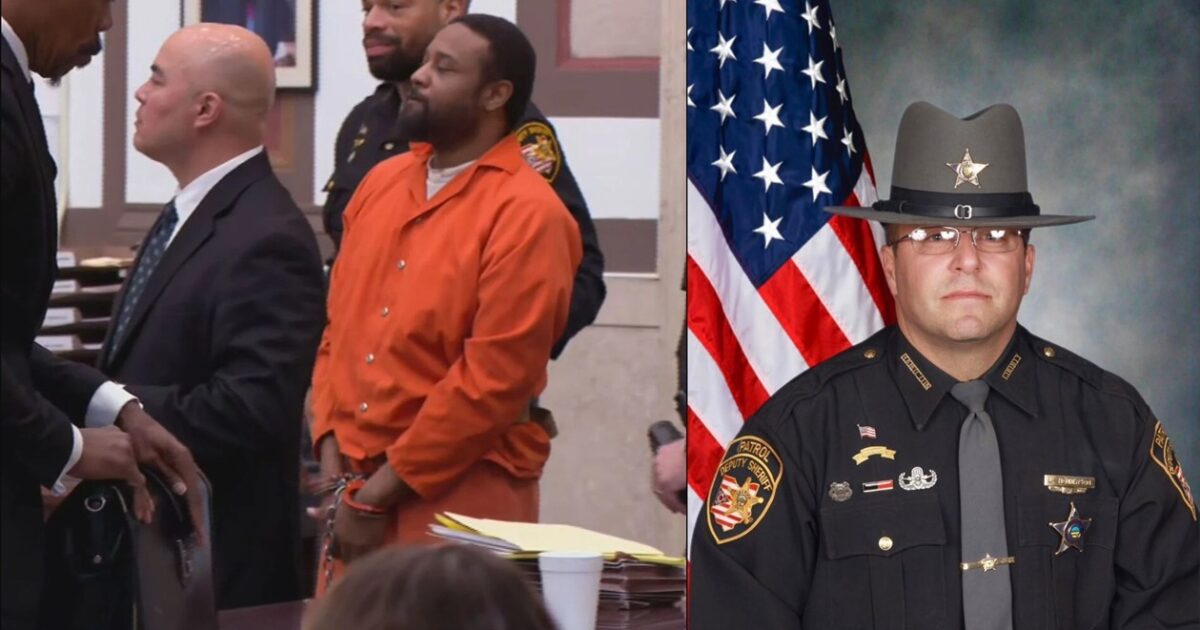
After his son was shot during an armed encounter with police, social media users called Rodney Hinton Jr. a hero for killing a police officer who was unrelated to the case.
The murder trial of Rodney Hinton Jr., the Cincinnati father accused of killing a sheriff’s deputy the day after his own son was fatally shot by police, is set to begin October 5, 2026.
The case has revived a debate that has simmered since the fentanyl overdose death of George Floyd in 2020: Media coverage of high-profile police shootings has consistently misrepresented the underlying data, exacerbating public outrage and distorting Americans’ understanding of whom police shoot and why.
The Cincinnati case now heading to trial shows how quickly a single shooting can generate a false narrative of its own. On May 1, 2025, Cincinnati police located a stolen Kia Telluride at an East Price Hill apartment complex with four occupants inside, including 18-year-old Ryan Hinton.
As officers approached, all four fled on foot. Hinton was carrying a handgun with an extended magazine, and the officer who shot him said Hinton pointed it at him. From the time officers reached the car until shots were fired, only six seconds elapsed. The Hamilton County prosecutor later ruled the shooting legally justified and declined to charge the officer.
The next day, Hinton’s father, Rodney Hinton Jr., watched police body-camera footage of the shooting and then deliberately drove his car into Hamilton County Sheriff’s Deputy Larry Henderson, killing him. Henderson had no connection to the shooting. He worked for a different agency than the officer who shot Ryan Hinton and was assigned to an unrelated traffic detail for a University of Cincinnati graduation ceremony.
Social media posts nonetheless circulated false claims that Rodney Hinton Jr. had killed the same officer who shot his son. The social media framing was that a black man had been pushed beyond his limit by police repeatedly shooting innocent black people and had taken revenge on his son’s killer. Some posts went so far as to call him a hero.
The reality is that his son was armed and involved in a crime when he was shot. Hinton then planned and carried out the murder of an innocent man.
Prosecutors initially sought the death penalty; that was dropped in January 2026 after evaluators found Hinton has a qualifying serious mental illness. Hinton has pleaded not guilty by reason of insanity and faces trial on murder and felonious assault charges, with a maximum sentence of life without parole if convicted.
Today’s media and social media distortions are an extension of what happened during the unrest following Floyd’s fentanyl overdose death. Many Americans came to believe that police killed hundreds of unarmed black men each week. Mainstream media coverage often reinforced that impression by framing individual shootings as evidence of a systemic pattern without providing the base-rate data needed to evaluate the claim.
The Washington Post’s Fatal Force database, the source most commonly cited by researchers, tells a different story from the one that has taken hold in the public consciousness. On average, police fatally shoot fewer than 60 unarmed people per year, the majority of whom are white.
Unarmed” is meant to indicate that the person had no weapon of any kind. However, audits of the database have found that some people coded as “unarmed” were confronting officers with vehicles, rocks, or other improvised weapons. A City Journal audit found that of 118 black people listed as “unarmed” and fatally shot between 2016 and 2022, 51 were attacking police or civilians at the time, while several others were making threatening movements.
Therefore, the label has not reliably reflected its own definition, much less indicated that a shooting was unjustified.
Each shooting is investigated separately to determine whether the officer’s use of deadly force was legally justified.
Recent incidents involving anti-ICE protesters allegedly attempting to run down federal law-enforcement agents illustrate the distinction. A person using a vehicle as a weapon may not be carrying a gun or knife but can still pose a deadly threat.
Police fatally shoot roughly 1,000 civilians a year in the United States. As of the June 2019 update, the Washington Post database recorded 14 unarmed black suspects and 25 unarmed white suspects for that year. The database excludes deaths not caused by shooting, such as Floyd’s.
In 2024, police fatally shot 1,173 people, the highest annual total since the Post began tracking the data in 2015. By the Post’s own accounting, about half of those shot and killed by police were white.
Therefore, it is clearly untrue that police shoot hundreds of unarmed black people each week. The data show that police fatally shot an average of about 23 people per week in 2024, only about 2% of whom were unarmed. Most of the unarmed people shot were white.
Mainstream media outlets and anti-police activists point out that Black Americans account for about 23% of people shot by police, compared with roughly 14% of the population. This is then framed as evidence that black Americans are killed at more than twice the rate of white Americans.
They cite this disparity as evidence of police bias, systemic racism, and police specifically targeting and killing black people. However, this ignores the fact that black Americans commit a disproportionate share of violent crimes and have more police encounters, increasing the likelihood that they will be involved in police shootings.
According to FBI Uniform Crime Reporting data, white individuals accounted for 69.4% of all arrests in 2019, while black individuals accounted for 26.6%. For violent crime specifically, white arrestees made up 59.1% of the total, putting black arrestees at roughly 39%, nearly three times their share of the population. For murder specifically, 51.3% of adults arrested were black and 45.7% were white.
Having said all of this, the other point that the liberals and anti-police activists miss is that each case must be adjudicated on its own merits and evidence, not based on a general impression of policing or broad opinions about racism in the United States.
In this case, a suspect armed with a gun was shot by police, and his father murdered an innocent man. No data analysis or framing is needed. Under U.S. law, the case should be adjudicated based on the evidence.
Image: Wikimedia Commons (DoD photo by Lisa Ferdinando)
On the heels of The Gateway Pundit’s reporting on the five-year anniversary of Dr. Terry Adirim’s signing of the interchangeability memorandum on September 14, which stated that the Pfizer-BioNTech Emergency Use Authorization (EUA) COVID-19 shot and the FDA-approved Comirnaty vaccine could be used interchangeably, a congressman from Maryland is urging his fellow lawmakers to “put her under oath.”
Yesterday, Rep. Andy Harris (R-MD), who is a physician and a former Naval Reserve medical officer, called upon Rep. James Comer (R-KY), the Chairman of the House Committee on Oversight and Accountability; Sen. Rand Paul (R-KY), the Chairman of the Senate Committee on Homeland Security and Governmental Affairs; and Sen. Ron Johnson (R-WI), the Chairman of the Permanent Subcommittee on Investigations, to summon Adirim to testify under oath.
For Davis Younts, a retired Air Force Lieutenant Colonel and military defense attorney, “putting her under oath is an absolutely critical step towards accountability for the unlawful mandate issued by Biden’s Department of Defense.”
He suggested several questions need to be raised, such as:
Who requested Adirim to draft the memo?
Which JAGs and attorneys from the General Counsel’s office examined it?
Who gave the final approval for the draft?
“Because the memo was obviously factually and legally wrong,” Younts proposed, “the ultimate question: Who was involved in creating the fabrication (emphasis mine)?”
“Thousands of military members had their careers ended because of this memo, so we need to know how it happened and who was complicit,” he remarked.
The military’s tyrannical enforcement of the COVID-19 shot mandate in 2021 resulted in the destruction of tens of thousands of service members’ careers. As noted in Rep. Harris’ press release, “About 8,600 service members were ejected. Tens of thousands left early. Another 20,000 retired early. Nearly a million ordered to take it.”
“Every commander who relied on this memo should want to know how this happened, [because] they enforced an unlawful order based in part on this fabrication,” said Younts.
This kind of inquiry into the misuse of authority takes on additional weight in light of recent revelations. In a statement that surely caught the interest of Sen. Paul, who investigated Fauci’s intentional cover-up, the press release stated, “Anthony Fauci got an autopen scribble pardon. Dr. Adirim has no pardon.”
Rep. Harris admitted, “I changed what I was willing to say about the vaccines as the facts changed. That is what a physician does. Our Warriors deserve the truth. Put her under oath. Let her look those service members whose careers were ruined and family members of the deceased that were decimated by her memo in the eye.”
Yesterday’s press release clearly reiterated his request. “Put Adirim on the record about that destructive and unlawful memo and its human cost.”
In the midst of this unfolding situation, Lt. Col. (ret.) Ivan Raiklin, a constitutional attorney, former Army Green Beret, and previous instructor at the Defense Intelligence Agency (DIA), quickly took to social media to share the news. He raised a very important question that countless service members are eager to have answered:
“Will this new call for transparency and accountability….lead to criminal referrals on Dr. Adirim?”
BREAKING!!! Reign of Terry Day.
On the 5th Year Anniversary of the Unlawful DOD COVID-19 “Vaccine” Mandate, Rep. Andy Harris, Chairman of the House @freedomcaucus calls on @RepJamesComer @SenRandPaul and @SenRonJohnson to call Dr. Terry Adirim to testify about her unlawful vaccine mandate implementation memo of Sep 14, 2021.
“I changed what I was willing to say about the vaccines as the facts changed. That is what a physician does,” Harris said. “Our Warriors deserve the truth. Put her under oath. Let her look those service members whose careers were ruined and family-members of the deceased that were decimated by her memo in the eye.”
With this new call for transparency and accountability by one of the most influential members of the Republican conference, who is also a doctor motivate @PeteHegseth and @RobertKennedyJr to speed up the investigative timeline into the COVID injection harms? Will they lead to criminal referrals on Dr. Adirim?
The pressing need for transparency not only resonates with those affected by the Adirim memo but also reflects a broader demand for integrity within the military and governmental institutions. The ramifications of the COVID-19 shot mandate continue to ripple through the lives of countless service members and their families, calling into question the decisions made at the highest levels.
Whether this inquiry leads to criminal referrals or not, it is clear that the pursuit of truth remains paramount, as the nation grapples with the consequences of policies that have irrevocably altered the lives of so many.
Romania’s countryside brought its fury to the EU-backed, globalist government’s doorstep Tuesday as farmers and livestock breeders poured into the capital, demanding answers from a corrupt political establishment they say has watched domestic agriculture suffer under rising costs, rigid bureaucracy, import pressure, and years of broken promises.
According to reports from the Romanian press, citing organizers, as many as 200,000 agricultural producers and citizens joined the protest, traveling from counties across Romania. The demonstration hadn’t completed the required authorization procedure, yet farmers said fines wouldn’t frighten them away.
The protest wasn’t another dispute over agricultural subsidies. Sheep breeders, crop farmers, vegetable growers and beekeepers were joined by expressions of support from miners and teachers, widening a revolt rooted in the belief that the people who grow the food, teach the children, and keep the country working are carrying burdens decided elsewhere.
Farmers say they’re being squeezed on all sides. Agricultural diesel, taxation, unpaid subsidies, losses from natural disasters, and competition from imports all feature on a list of grievances that has grown far beyond a single dispute with Bucharest.
The breaking point, for livestock breeders, involves the authorities’ handling of disease outbreaks. Farmers object to the slaughter of entire herds following outbreaks of peste des petits ruminants or sheep and goat pox, particularly when breeders say compensation either arrives late or doesn’t arrive at all.
Then there’s the export blockade. Sheep farmers want live-animal exports reopened, arguing that restrictions have cut them off from crucial markets and left Romanian producers paying the economic price for decisions made by regulators.
Their demands strike directly at ANSVSA, whose leadership protesters want dismissed. Farmers are calling for an end to livestock slaughter in the form currently contested by breeders, compensation for affected producers, outstanding subsidies and measures addressing agricultural fuel costs and taxation.
But the revolt also reaches beyond Bucharest. The EU-Mercosur agreement and agricultural imports appear among the protesters’ concerns, putting the demonstration squarely inside a larger European argument over whether governments are sacrificing their own farmers in pursuit of cheaper imports and international trade deals.
That fight, for Romania’s sovereigntist right, cuts to the bone. Its argument is that food production isn’t another line on some economic spreadsheet: a country that can’t protect its farmers, villages and capacity to feed itself steadily gives away part of its national independence.
Farmer representative Ionică Sterp made clear that producers weren’t planning another ceremonial march followed by a quiet journey home. Unlike July’s protest, organizers said they were prepared to remain in Bucharest for three or four days — or until authorities finally produced a concrete response.
“We won’t leave after a day” was the message. With the milking season finished, Sterp said livestock farmers now have more room to dig in, transforming the demonstration from a one-day warning into a potentially sustained confrontation with the authorities.
And they’ve been here before. Sheep breeders protested in Bucharest on July 30, first outside ANSVSA and later at the government, only to return more than a month later saying the fundamental problems remained unresolved.
Huge protest by Romanian patriots in Bucharest against the EU’s insane laws.
Romanian patriots took to the streets today to stand against the dictatorship from Brussels.
That failure to settle the dispute feeds a broader feeling that Romania’s productive economy sits near the bottom of the political pecking order. Farmers say they produce, invest and take the risks while officials respond with paperwork, restrictions, taxation and promises that too often lead nowhere.
The political backdrop makes the confrontation even more explosive. Romania is still living with the fallout from the annulled 2024 presidential election, an extraordinary episode that badly damaged institutional trust among citizens who believed their votes had been cast only to see the contest overturned.
Călin Georgescu became the central figure in that rupture. His supporters regard the annulment and subsequent political turmoil as confirmation of his argument that Romanian sovereignty and popular consent have been subordinated to an entrenched political system; his opponents and state institutions strongly dispute that interpretation.
Either way, the anger didn’t vanish when the election did. For citizens already struggling with austerity, jobs, pensions and public services, the political crisis landed on top of an economic one, reinforcing the sense that ordinary Romanians are repeatedly handed the bill for decisions over which they have little control.
AUR moved quickly into that political space Tuesday. Deputies Florin-Bogdan Velcescu, Gianina Șerban and Doru-Lucian Mușat appeared at the farmers’ demonstration, while party representatives broadcast events from Piața Victoriei directly through social media.
Some AUR politicians accused the Gendarmerie of obstructing their access to demonstrators. The authorities rejected those allegations, insisting that the designated area remained open to anyone wishing to protest peacefully.
AUR leader George Simion backed the farmers while explicitly calling for calm. “I ask farmers and all protesters to demonstrate peacefully, calmly and responsibly,” he said, while urging law enforcement to show “restraint and professionalism” and declaring that AUR stood “alongside farmers.”
The party’s involvement wasn’t improvised at the last minute. AUR held an open-house event near Piața Victoriei, more than 50 people subsequently left its headquarters for the protest, and some branches had previously announced transportation to Bucharest.
By Tuesday, tempers were boiling. The Gendarmerie said some demonstrators pushed beyond their designated area, blocked Kiseleff Road and threw bottles and other objects at officers, leading police to deploy irritant substances and remove several people from the crowd.
The illegitimate government has been dismissed since May 2026, but they refuse to leave and the disgraceful asshole-in-chief @NicusorDanRO is refusing to name a new prime minister.
Protesters saw the confrontation differently. Angry at the barriers surrounding them, demonstrators accused authorities of trying to squeeze the crowd into an inadequate space and fired back with a slogan tailor-made for a farmers’ rebellion: “Pens are for animals.”
Memories of July only sharpened the distrust. Sterp had warned police not to repeat the tear-gas intervention from that demonstration, claiming some farmers were still suffering from burns sustained during the earlier confrontation.
Strip away the party maneuvering and Romania is left with a harder question. How long can a country afford to watch farmers struggle with costs, disease restrictions, imports, taxes and blocked markets before the erosion of domestic agriculture becomes a matter of national resilience rather than merely agricultural policy?
That question explains why the language of sovereignty resonates with large parts of the protest movement. For those protesters and political movements, sovereignty means more than flags and speeches: it means Romanian farms producing Romanian food, Romanian workers being able to build lives at home, and elected institutions remaining answerable to Romanian voters.
The government now faces an increasingly large group of Romanians that says their patience has reached its limit.
The Food and Drug Administration is buying up young baboons with taxpayer dollars so researchers can infect and kill them for research in Maryland.
White Coat Waste Project has released a new report detailing how the agency issued a $368,626 purchase order on August 31 to buy 20 baboons for pertussis experiments at its Maryland primate laboratory.
An active protocol allows the lab to use up to 48 animals.
Some of the baboons will receive experimental vaccines or antibodies. Others will get no protection at all. Then researchers will pump the bacteria that cause whooping cough into their windpipes and noses.
The primates will be subjected to violent coughing, vomiting, breathing problems, fever, weight loss, nasal discharge, and weeks of illness.
Staff will draw blood and swab noses and throats again and again.
Some of the animals will be killed and dissected so researchers can examine their lungs, windpipes, and lymph nodes.
That is a lot of suffering for a disease America already vaccinates against, and taxpayers are being forced to spend more than a third of a million dollars on it.
The news of the purchase order comes as the Trump administration has made significant moves to shift away from animal testing.
The Department of Veterans Affairs eliminated its primate laboratories. The CDC moved to shut monkey labs and send survivors to sanctuaries. NIH closed the last beagle experiments on its own campus. EPA revived a plan to end mammal use in chemical testing by 2035. Congress even barred painful Department of Defense research on cats and dogs.
The public message has been clear: stop the cruelty and waste and use modern methods.
The labs and researchers apparently did not get the message.
Last week, Gateway Pundit reported that White Coat Waste documented more than $225 million in new NIH funding for dog and cat experiments awarded, supplemented, renewed, or extended since February 2025.
The total climbed from about $150 million in June.
Nearly $98 million went to pharmaceutical companies running dog tests.
An earlier WCW review found more than $30 million in new fiscal 2026 NIH money for primate projects, including work that infects monkeys with dangerous pathogens and force-feeds experimental drugs.
The public is being told that there is a phase-out, but many of these agencies seem to be doing a restock instead.
The WCW policy victory has saved tax dollars and animals’ lives. Last year, the FDA retired several baboons from its Maryland lab to a sanctuary.
The new purchase order shows why pressure still matters.
If the government is serious about replacing animal tests with modern tools, why is it buying another shipment of young baboons to cough, vomit, and, in some cases, die on a dissection table?
SHANNON BREAM: Dario Amodei worries about the takeover of the internet by these AI agents. But he talks about China: “If we greatly restrain our AI capabilities in the belief China will do the same, and then China defects, A.I. could be so powerful that such a defection could lead to their geopolitical dominance.” How do you measure these imbalances?
MOLLIE HEMINGWAY: First of all, Dario Amodei runs an AI company, but if he really believes these things, he has complete control.
SHANNON BREAM: That is what David Sacks, Just do it, you run the company, do it.
MOLLIE HEMINGWAY: It is an issue of our common Washington, D.C. People seek regulatory capture. You’ve made it to the top of the heap, and you want to keep everybody else out by regulating so the smaller competition companies cannot rise.
So this is particularly concerning for this particular issue because these six or seven top AI oligarchs are all massively aligned with the Democratic Party, the left. They want to make sure they have control for a post-Trump environment, so they can engage in ongoing censorship and control, and keep anybody else out for decades to come.
So it is totally legitimate to be concerned about AI. I myself am as well. But when you see a massive op like this going on, you have to wonder about precisely the motivation.
Watch the video below:
Mollie Hemingway: Democrat-aligned AI oligarchs want to maintain control in a post-Trump environment.
“It is totally legitimate to be concerned about AI …, but when you see a massive op like this going on, you also have to wonder about precisely the motivations of these… pic.twitter.com/lCSTS9lo2K
Saudi Arabia has temporarily suspended operations on its East-West oil pipeline, also known as Petroline, following multiple drone attacks this past Thursday, in the Riyadh and Medina regions. The decision was described as a precautionary measure while emergency and specialized technical teams assess the safety of the infrastructure, secure the affected facilities, and address any damage. The attacks reportedly caused several injuries, with medical assistance provided to those affected.
The Saudi Ministry of Foreign Affairs condemned the attacks, stating that several drones had originated from Iraqi territory and caused both human injuries and material damage. Riyadh indicated that it would not retaliate against Iraq at this stage, allowing Baghdad time to take appropriate measures. However, Saudi Arabia reserved the right to defend its territory and protect its critical infrastructure if necessary.
#Statement | The Foreign Ministry expresses the Kingdom of Saudi Arabia’s strongest condemnation of targetting the East-West Pipeline in the Riyadh and Madinah regions by several drones launched from Iraq, which resulted in injuries and some damage that is currently being… pic.twitter.com/QFqSiMWQWr
The East-West pipeline is approximately 1,200 kilometers long and transports crude oil from Saudi Arabia’s eastern production areas, near Abqaiq and the Persian Gulf, across the Arabian Peninsula to Yanbu on the Red Sea. The system has an estimated maximum capacity of approximately 7 million barrels per day. In recent months, it had reportedly been carrying between 4 million and 5 million barrels per day, making it a crucial alternative export route during disruptions affecting traditional Gulf shipping channels.
Petroline’s strategic importance has increased substantially amid regional tensions and disruptions involving the Strait of Hormuz. By transporting crude to the Red Sea, the pipeline allows Saudi Arabia to bypass the strait and reduce its dependence on this critical maritime chokepoint. However, the effectiveness of this alternative depends on the security and availability of Red Sea shipping routes, which have also faced risks associated with regional conflict and Houthi attacks.
Satellite imagery reportedly showed smoke and fire damage near pumping stations or related infrastructure south of Medina. Such damage highlights the vulnerability of energy infrastructure that depends on interconnected pumping stations, control systems, and transportation facilities. Even if the main pipeline remains structurally intact, damage to supporting equipment can interrupt the movement of crude and require extensive safety inspections before operations resume.
CNN reports that Saudi Arabia’s East-West oil pipeline system was struck by projectiles Thursday, with U.S. officials saying pumping stations alongside the pipeline were hit and fires broke out. Satellite imagery appears to show significant fire damage at one pumping station,… pic.twitter.com/cqn4DcHIcw
Saudi and Iraqi officials indicated that the drones were launched from Iraqi territory, with the attacks reportedly linked to Maysan province, which borders Iran. Iraq’s prime minister’s office condemned the incident, ordered an investigation, and dismissed the operations commander for the province. Nevertheless, no group had publicly claimed responsibility for the attacks, leaving the precise identity of the perpetrators unresolved.
The question of Iranian involvement adds a further geopolitical dimension. U.S. President Donald Trump later stated that Iran was “probably” behind the assault. The possibility of involvement by Iran-aligned armed groups operating in Iraq remains part of the broader regional security context, but attribution should be distinguished from confirmed evidence.
US President Donald Trump said on Saturday that Iran was probably responsible for the aerial attack that shut Saudi Arabia’s East-West oil pipeline, while predicting that the war with Tehran would end “very soon.”
The temporary shutdown creates additional pressure on Saudi Arabia’s remaining export infrastructure. The kingdom can continue producing and exporting oil through other channels, but the loss of Petroline reduces its ability to redirect crude away from vulnerable maritime routes. If the closure is prolonged, Saudi Arabia may face difficult decisions involving storage capacity, alternative transportation routes, production management, and the allocation of available export infrastructure.
The market impact is likely to extend beyond Saudi Arabia. The disruption adds to existing concerns about global oil supply reliability, particularly at a time when restrictions around the Strait of Hormuz and risks in the Red Sea have already complicated energy transportation. Even if the physical loss of supply remains limited, the attack can increase the geopolitical risk premium in oil prices because traders must account for the possibility of further attacks or prolonged infrastructure outages.
The economic consequences for Saudi Arabia will depend on the duration of the shutdown and the kingdom’s ability to maintain export volumes through alternative routes. Higher oil prices could partially offset reduced sales volumes, but sustained transportation disruptions could still undermine revenue stability and complicate production planning. The incident therefore poses both a logistical challenge and a strategic threat to the kingdom’s energy-export resilience.
This incident demonstrates that infrastructure security, maritime access, and regional diplomatic stability are closely interconnected. While the current suspension is temporary and does not represent a complete halt to Saudi oil exports, a prolonged outage could have wider consequences for regional security, global energy markets, and the stability of international oil supplies.







 (@KSAmofaEN)
  Follow our live coverage: