Republican House Majority Whip Tom Emmer on Tuesday criticized his fellow Minnesotan, Democratic Rep. Ilhan Omar, about her updated financial filing with the Ethics Committee.
“Ilhan Omar is even more clueless than I thought if she thinks this financial disclosure revision clears her of suspicion,” Emmer told Fox News.
Omar submitted new financial documents to the committee in hopes of avoiding a scandal. Emmer said that in doing so, however, she only raised further concerns among lawmakers.
“She can backtrack, obfuscate, and distract all she wants, but she’s made clear who she is: A fraud-enabling, racist antisemite who espouses anti-American rhetoric every chance she gets,” Emmer proclaimed.
“She should be held accountable to the fullest extent,” he continued. “My colleagues on the House Ethics Committee have my full backing for any and all investigations into Ilhan and her potential misdealings.”
An amended filing reviewed by The Wall Street Journal showed Omar and her husband’s assets between $18,004 and $95,000 — much less than her earlier disclosure, which estimated their assets to be valued between $6 million and $30 million.
“The amended disclosure confirms what we’ve said all along: The congresswoman is not a millionaire,” Omar spokesperson Jacklyn Rogers told the outlet.
She also said the filing was corrected “as soon as the discrepancy was identified,” with the amended filing showing Omar reporting between $102,503 and $1,005,200 in income from 2024 assets that she and her husband own.
Further documents showed $213,200 in money going to her husband from his venture capital management firm and $3,000 from a winery.
A 2025 email between the Minnesota Democrat’s husband and his accountant estimated the value of the venture capital firm to be $7.9 million, and the winery clocked in at $1.5 million, though he is reported by The Wall Street Journal to own around one-third of both businesses.
House Oversight Committee Chairman Rep. James Comer of Kentucky went after Omar Sunday during an interview with “Fox & Friends Weekend.”
“We’re not supposed to do that [investigate it] on the Oversight Committee, but because she’s a person of interest in the Somali fraud, I’ve been trying to get that,” he said, referencing Omar’s link to people who’ve been associated with the recent fraud in Minnesota.
Omar has been the target of heavy backlash for how quickly her net worth jumped after she joined Congress.
Vice President J.D. Vance, who was put in charge of tracking down nationwide fraud, has promised to investigate her.
“So we actually think that Ilhan Omar definitely committed immigration fraud against the United States of America,” Vance said in March. “And I talked to [White House deputy chief of staff] Stephen Miller about this actually recently. We’re trying to look at what the remedies are.”
He added, “That’s the thing that we’re trying to figure out is what are the legal remedies now that we know that she’s committed immigration fraud? How do you go after her? How do you investigate her? How do you actually do the thing? How do you build the case necessary to get some justice for the American people?”
The May 17 Agreement’s Failure Is a Warning About Lebanon
The current peace process could well fall into the traps of 1983.
(Photo by Fadel Itani/NurPhoto via Getty Images)
“War is the continuation of politics by other means” is Clausewitz’s most famous dictum.
Lebanon has suffered far too much from the serial failures of diplomacy and the shortcomings of politics, necessitating the use of “other means.” Now yet again, diplomats and statesmen are trying to induce the country and its powerful antagonists to reach a political accommodation that checks the worst instincts of warring factions more powerful than the state itself.
Last week in Washington, Israeli and Lebanese diplomats met under American auspices during an American-engineered ceasefire. Efforts are under way to establish direct talks between Israel and the government of Lebanon.
Yet the sorry record of diplomacy to resolve Lebanon’s travails is a cautionary tale for those who today are trying yet again to establish rules of the game compelling enough to convince all contesting parties that war is the least favorable option.
For aspiring peacemakers, there is no better cautionary example than the abortive May 17 Agreement—the U.S.-brokered accord signed on May 17, 1983 between Israel and Lebanon in the aftermath of the 1982 Lebanon War.
The agreement’s central provision was that Israel would withdraw its forces from Lebanon contingent upon the withdrawal of Syrian forces (which had been in Lebanon since 1976) and the reestablishment of Lebanon’s sovereign authority in the South, where Palestinian guerilla forces had effectively ruled since the Cairo Agreement (1969).
This conditionality created a built-in dependency: Israel’s retreat was tied to (1) Syrian compliance, which only materialized in 2005, and (2) the (abortive) consolidation of state authority in the South, a task that remains unrealized. The 1983 agreement effectively justified the continued Israeli military presence in the South, all but guaranteeing its failure.
The most consequential—and controversial—terms of the agreement concerned postwar security in the South:
A security zone in southern Lebanon was implicitly authorized.
Israel was permitted to maintain security coordination mechanisms inside Lebanese territory.
These arrangements included cooperation with local militias, especially the South Lebanon Army, a proxy force established and funded by Israel after 1976.
Although the agreement avoided explicitly calling for permanent Israeli occupation, it institutionalized a framework that recognized Israel’s right to retain influence and operational freedom in the South even after formal withdrawal (realized only in 2000, when Israel withdrew unilaterally).
While not a peace treaty, the agreement included:
Commitments to end the state of war
Restrictions on hostile activities across the border
Movement toward normalization under U.S. auspices
These terms were then and remain today politically explosive in Lebanon, where normalization with Israel, while no longer taboo, remains widely opposed.
Syrian-backed factions in particular argued that the May 17 Agreement limited Lebanon’s freedom to host foreign forces (implicitly targeting Syria and Palestinian groups). Like today’s efforts, the agreement allowed Israeli security demands to shape Lebanese internal arrangements.
As a consequence, Israel’s withdrawal from Lebanon was tied not only to narrow, if significant security conditions, but also to a wide-ranging restructuring of Lebanon’s sovereignty in ways favorable to Israel.
The assassination of Bachir Gemayel in September 1982 had a profound—arguably decisive—impact on the fate of the May 17 Agreement. Even though it was signed months later, his death removed the one Lebanese leader who was most capable (and willing) to implement it.
Gemayel, as president-elect and leader of the Lebanese Forces, was central to the strategy behind the agreement. He had close ties with Israel dating back to the civil war, and was expected to negotiate and legitimize a postwar order that recognized and accommodated extraterritorial Israeli security demands in southern Lebanon. More than any other personality, he commanded the coercive capacity to impose compliance upon Lebanon’s powerful and influential politico-military factions.
Gemayel’s assassination didn’t just delay the May 17 Agreement—it undermined its entire domestic political foundation. His death transformed the agreement from a potentially enforceable (if controversial) political settlement into a fatally compromised paper framework with no viable path to implementation.
Without Gemayel, the Agreement lacked a domestic champion committed to its enforcement. It became instead dependent on fragile external diplomacy, which ultimately collapsed under internal opposition, Syrian resistance, and continuing Israeli occupation.
Syria refused to withdraw, and the domestic Lebanese opposition (both militias and political factions) rejected normalization in the aftermath of Gemayel’s assassination. Without him, the Lebanese central government lacked the capacity to enforce the deal. The agreement was never implemented and was formally abrogated by Lebanon in 1984.
When the framework collapsed, Israel concluded that no reliable Lebanese or regional partner could deliver. In 1985, it implemented a partial, unilateral withdrawal from most of Lebanon, establishing a security zone along the border. The line is the basis for Israel’s current deployment.
Today’s diplomats be advised: Rather than ending Israel’s military role in Lebanon, the May 17 Agreement attempted to transform it from overt occupation to consensually regulated, semi-permanent security control—a shift that proved untenable for Lebanon’s political class.
After Bachir’s death, his brother Amin became president. Amin lacked Bachir’s authority over militias, and also his decisiveness. He pursued a more cautious, balancing approach between Israel, Syria, and Lebanon’s contesting and fragmented internal factions.
As a result, the May 17 Agreement, when eventually signed by Amin, reflected more an imposed, externally driven (especially by the U.S.) agreement that compromised Lebanese sovereignty and less one internally anchored in a tenuous Lebanese political consensus.
Today’s aspiring peacemakers beware: This critical weakness at the heart of the diplomatic process made the agreement’s central mechanism—conditional Israeli withdrawal—effectively unworkable. Without a Lebanese champion with the power and intent to implement its controversial provisions, the agreement’s framework for a managed Israeli withdrawal with guarantees was stillborn. Instead, Israel shifted toward a more unilateral approach, eventually establishing its security zone in southern Lebanon (from 1985–2000) without a functioning bilateral agreement.
As the latest generation of Lebanon’s peace (and war)makers confront Lebanon’s predicament, the May 17 Agreement stands as an object lesson in the fraught nature of diplomatic efforts to empower a sovereign Lebanese government capable and committed both to keeping domestic peace and to containing the interests of erstwhile foreign friends and enemies.
The May 17 Agreement established both the parameters of potential agreement and a cautionary reminder of the agreement’s inherent limitations. Its failure stands as a warning for those who seek to reaffirm the value of diplomacy in an era all too often plagued by war.
On Mass Surveillance, Will the Deep State Win Again?
Tucker Carlson and Glenn Greenwald worry Congress will reauthorize a controversial intelligence tool.
For nearly two decades, Congress has obediently renewed one of the federal government’s most expansive and unconstitutional domestic surveillance authorities, typically with total bipartisan enthusiasm, little floor debate, and even less public attention. Last Thursday morning, at 2 a.m., House Speaker Mike Johnson (R-LA) kept that tradition alive, summoning members back to the Capitol in the dead of night for what Rep. Ro Khanna (D-CA) accurately labeled “a secret vote to reauthorize FISA while America sleeps.”
That law, Section 702 of the Foreign Intelligence Surveillance Act, was first enacted in 2008, when Congress voted to retroactively authorize parts of a secret warrantless surveillance program constructed under the George W. Bush administration, after it was exposed in December 2005 by James Risen and Eric Lichtblau of the New York Times. They revealed how under a presidential order signed in 2002, the NSA had been monitoring the international calls and emails of people inside the United States without warrants, targeting hundreds of Americans. The whistleblower Edward Snowden and journalist Glenn Greenwald later exposed the true scale of NSA domestic wiretap programs, which targeted virtually every American citizen under an internal agency motto of “collect it all.”
Ever since that law was enacted, there has been a gradual expansion of the executive branch’s surveillance authorities and shredding of Americans’ Fourth Amendment protections, which this outlet has covered in depth. Under the pretext of targeting foreigners abroad, Section 702 has become a vehicle for warrantless backdoor searches of Americans’ private communications, with the FBI conducting up to 3.4 million such queries in 2021 alone. Those abuses triggered a reform battle in April 2024 that ultimately failed, when Johnson, a Constitutional lawyer, abandoned his longheld opposition to mass domestic spying and cast the deciding vote to reject a warrant requirement amendment, extending the program to April 20, 2026.
Last Friday, three days before the sunset date, a vote in the House for a clean renewal of Section 702 failed, despite a full court press from the White House and to the surprise of most people who have followed the battle for surveillance reform.
Patrick Eddington of the Cato Institute was one of the few who predicted that outcome, telling The American Conservative two days before the vote that he expected “at least a double digit group of GOP House members” to vote against a renewal, which is exactly what happened on Friday, when 20 Republicans joined most Democrats to block Section 702 reauthorization. Eddington correctly identified three in particular—Reps. Chip Roy (R-TX), Ralph Norman (R-SC), and Morgan Griffith (R-VA)—as key votes against, with all three having voted for a warrant requirement amendment in 2024 and each of them noticeably absent from a Tuesday night Rules Committee meeting where the panel voted to bring a clean reauthorization to the floor.
Eddington sees the vote as representing something much larger than a mere procedural defeat for Johnson. “I think what this speaks to is probably the beginning of the end for Trump,” he told The American Conservative. “So many more voters who went for him, even those who went for him three times, are walking away from him. There are members of the House who now feel they can take some more distance from this guy with less political risk.”
He also attributed the outcome to outside pressure from the Senate, pointing to a letter released by Senator Ron Wyden (D-OR) to colleagues referencing a secret FISA court opinion from last month which he said “found major compliance problems” with how Section 702 surveillance was being used by three-letter agencies and revealing that multiple administrations have now relied on a “secret legal interpretation” of the law. Wyden posted on X that he sent a “classified letter” about that “secret legal interpretation” of FISA section 702, warning that “every American should be concerned” but declining to give Americans any additional information on it by, for instance, using his constitutional rights under the Speech or Debate clause to read classified materials into the congressional record as others have done in the past.
For now, Section 702 survives on a 15-day temporary extension, and the prospects for blocking a clean renewal of the government’s surveillance authorities remain uncertain. Greenwald, whose reporting alongside Snowden’s disclosures first revealed the true scope of NSA mass surveillance, frequently says that “the deep state always gets what it wants,” though he told The American Conservative that he “has been through about four of these and got [his] hopes up every time.” During a livestream last Friday, Greenwald sustained that pattern, holding up some hope that there were enough votes in Congress to stop reauthorization.
Tucker Carlson, who has covered surveillance overreach extensively on his show, seemed even more skeptical. “I doubt it,” he told The American Conservative when asked whether Trump’s push for a clean renewal could still be stopped. “He’s determined. It’s very dark.”
As Carlson explained in a monologue last week, Trump’s reversal on FISA, and his insistence on a clean renewal, may ultimately serve Israeli interests, providing that government with tools to monitor, manipulate, and neutralize perceived threats to its survival. “All of a sudden the President is advocating for this new law,” Carlson said. “Why could that possibly possibly be?”
“Well there are a couple of clues,” he continued, pointing to the raw intelligence sharing agreement between the NSA and Israeli intelligence, first revealed by Snowden and reported by Greenwald, under which Americans’ signals intelligence data is handed over “to be used, God knows how.” He also pointed to a 2024 presentation by Rep. Mike Turner (R-OH), a security state loyalist and then-chairman of the House Intelligence Committee, in which the Congressman advocated for using Section 702 authorities against American college students protesting the war in Gaza. To his point, a “Conference of Presidents of Major American Jewish Organizations,” in 2024 told Congress that FISA 702 was needed for “the safety and security of Israel.”
Carlson has more than a passing interest in FISA Section 702, having been the subject of domestic surveillance himself. “They admitted spying on me,” he told The American Conservative.
When the NSA responded to Carlson’s 2021 allegation that the agency had been monitoring his communications, it said only that he had never been an intelligence “target,” a carefully lawyered denial that conspicuously avoided saying his communications had never been queried under programs like FISA Section 702. The NSA’s response was also unusual since three-letter agencies typically neither confirm nor deny whether any specific individual’s communications have been collected.
On how Trump, another documented victim of FISA abuse, and Johnson, who built his political identity around opposition to FBI overreach, both ended up as the leading advocates for a clean renewal of those spying powers, Carlson pointed to institutional capture and coercion. “I think it’s a combination of carrot and stick,” he said.
“But I’ve noticed that members of the House and Senate intelligence committees, especially the chairmen, are invariably weak and screwed-up people and therefore easy to control,” Carlson observed. “Alcoholics, compulsive philanderers, etc,” he added, noting that disgraced Rep. Eric Swalwell, who is currently dealing with a sex scandal that seems likely to end his political career, was a member of the House Intelligence Committee.
(Photo by Jonathan Ernst / POOL / AFP via Getty Images)
Vice President J.D. Vance should have touched down in Islamabad today for round two of peace talks with Iran, but at the time of writing, negotiations have been put on ice. The last-minute cancellation undermines the Official Media Narrative™, which liberal outlets like the New York Times have been suspiciously eager to propound: Vance opposed the war in cabinet meetings, and now he has a golden opportunity to end it, saving his political fortunes in the process.
Vance tends to inspire wishful thinking, and attracting positive projection isn’t a bad quality in a politician. Mark Halperin, a veteran journalist with a knack for horserace election coverage, wrote last week in the Daily Mail that Vance’s team exudes “zero panic” about 2028, believing their man remains a frontrunner for the GOP nomination. Halperin seems to think they’re not optimistic enough: “If the election were held today, Vance would still be the most likely next occupant of the Oval Office. Not by a whisker, but by a margin.”
All of the above—from the Iran war hopes to the 2028 dreams—sounds, to me, utterly fanciful. Round one in Islamabad seemed to make the two-week ceasefire even more fragile, with President Donald Trump announcing a blockade of the Hormuz Strait right afterwards. (This Tuesday, Trump extended the ceasefire hours before it was set to expire, but for all we know he’s just setting up another sneak attack.) As for the next presidential elections, here’s a fact Halperin didn’t mention: Vance is the least popular vice president ever, having plummeted 21 points in public approval since taking office.
Still, 2028 is a long way away, and if Vance can secure some kind of diplomatic understanding with Iran that averts the resumption of war, he’ll lay the groundwork for a political comeback. But to win the presidency, Vance will need to answer a question that more and more people are asking: Who is he?
First, he’s a man of contradictions:
Vance presents himself as a “hillbilly” populist from Appalachia. Yet he’s a graduate of Yale Law School, a political ally of right-wing tech tycoons, and chief fundraiser for the Republican Party.
Echoing the kind of conservatives who lament “Third-World migration,” Vance says that America is a “particular people,” not an idea or economic zone. At the Republican National Convention in 2024, Vance waxed poetic about his many ancestors buried in a cemetery plot in eastern Kentucky. Yet Vance’s wife, and so also his kids, are of Indian heritage.
Vance is the preferred candidate of conservative “restrainers,” who favor a less militaristic foreign policy. He’s said that his opposition to forever wars stems from the disillusionment he experienced as a Marine fighting in them. Yet Vance has become an apologist for the military adventures of the second Trump administration, including the war with Iran.
I could go on, but you get the idea (and in journalism, “three makes a trend,” so it’s my right to stop there). The story that Vance tells about himself seems increasingly detached from the Ding an sich, the thing itself—the man as he appears to truly be.
This widening gulf threatens to worsen a reputational issue that has bedeviled Vance for years: the perception that he doesn’t really believe anything and merely strives for power. The conservative political columnist Gerard Baker recently wrote that when you search for “Vance’s defining identity, the soul of his true self, there is nothing there, only a pile of receipts from a succession of useful transactions.”
Acquaintances of Vance insist that such charges are unfair, that he holds convictions and adheres to principles even if he, like all politicians, must sometimes make compromises. Regardless, the perception poses a serious problem. Americans prefer political candidates who seem authentically relatable and candid about their private views, as academic studies have shown (political “scientists” have a penchant for proving the obvious).
And as Jude Russo, the managing editor of The American Conservative, noted on a recent episode of TAC Right Now, Vance “has no political profile that preexists the Trump moment.” By contrast, Secretary of State Marco Rubio, Vance’s chief rival in the looming battle to succeed Trump, built a political career from the ground up, establishing an essential identity distinct from the president he currently serves.
For Vance, riding shotgun in the Trump wagon has been perilous (though not as physically dangerous as for Mike Pence, on whom Trump sicced a rabid mob during the January 6 Capitol riot). Vance doesn’t steer Trump’s decision-making, though he’s compelled to defend the crashing results—and to square them with his own political persona.
So when Trump launched a war with Iran, the collateral damage was Vance’s restrainer bona fides. And when Trump instigated a spat with Pope Leo, who has criticized the U.S. war with Iran, the Catholic convert Vance found himself pitted against the Vicar of Christ. “I think it’s very, very important for the pope to be careful when he talks about matters of theology,” Vance said last week.
Good Lord, that’s bad.
Vance gave those remarks during an event hosted by Turning Point USA, an organization for young conservatives. His appearance highlighted the bind in which Vance finds himself on religion, foreign policy, and everything in between. “Jesus Christ does not support genocide!” yelled one heckler as Vance criticized the pope’s views on war and peace. “You’re bombing children!” Vance handled the awkward moment reasonably well, but he seemed hot under the collar.
A less contentious moment was equally telling. Asked which “influencer” he would recommend for young conservatives, Vance listed the TPUSA moderator sitting to his right, the comedian podcaster Theo Von, and himself. It was not just a tacky answer, but an evasive one.
Unmentioned by Vance was America’s most prominent conservative commentator, who happens to be a friend of the vice president: Tucker Carlson. In recent weeks, Trump and Carlson have been attacking one another in escalatingly heated terms. Vance, by not recommending the latter, sided, in effect, with the former. Days later, news broke that Tucker Carlson’s son Buckley, who had served as deputy press secretary for Vance, was leaving the post.
The younger Carlson says he’s starting a political consulting firm, but the move followed pressure from pro-Israel activists looking for a scalp. I wrote last November that Vance can strike a balance in the right’s “civil war” over Israel. But that seems more difficult now, thanks to an actual war with Iran. The Zionists want the U.S. to “finish the job” and destroy Israel’s main adversary, and they demand obeisance from Vance, whom they don’t trust. Meanwhile, conservatives who prefer Vance over Rubio believe the U.S. launched the war on Israel’s behalf and want him to secure the peace. Neither side is looking to compromise.
Now’s a time for choosing: Which side is Vance on? He’s been courting billionaire megadonors, including pro-Israel extremists like Miriam Adelson. Perhaps he’s their man. And yet, behind the scenes Vance has opposed the war with Iran, assuming America’s top newspapers have got the story right. So perhaps he’s ours. Instead of recommending we listen to Theo Von, Vance should tell us, and prove to us, where he really stands—so that we can find another candidate if needed.
Bruce Springsteen in concert at Manchester, England, screen image via Instagram, May 14, 2025.
Bruce Springsteen’s anti-Trump tour is not impressing anyone. He is even getting trashed by his own hometown newspaper over the high ticket prices and expensive ‘No Kings’ merchandise for sale in the lobby.
Like so many other people in the entertainment industry, Springsteen was ruined by his Trump Derangement Syndrome.
His image as someone who writes songs for the working man is forever tarnished and without that, his act is as good as dead.
Bruce Springsteen Shredded By Hometown Paper for Anti-Trump Concert: ‘Hypocritical Crap. Profiteering over Legitimate Protest’
Bobby Olivier, a food and culture Editor and a music reporter for NJ Advance Media, took Bruce Springsteen to task this week calling the rocker’s Prudential Center concert in Newark on Monday “all hypocritical crap. Profiteering over legitimate protest.”
“Springsteen’s artistic identity, as a bleeding-heart populist who sings for the destitute and downtrodden, has never been more disconnected from his economic behavior as a touring act or businessman. The blue-collar troubadour now charges exorbitant amounts for his tickets — up to $2,900 retail for the best seats in Newark Monday; prices he agreed to despite fan backlash,” Olivier writes at NJ.com.
“He’s selling ‘No Kings’ branded flags for $90 in the arena concourse,” Olivier says of Springsteen. “And last week, his merchandise distributor got an injunction passed to ban bootleg T-shirt sales outside the venue, even as crews of independent sellers — fine examples of working-class people he’s romanticized for 50 years — hawk merch at nearly every other Prudential Center show without issue.”
Springsteen brought his anti-Trump tirades to new heights in February when he announced his “Land of Hope and Dreams’ American tour,” which has seen the New Jersey native go on the attack against President Trump from Minneapolis, Minnesota, to Los Angeles, California, to Newark, New Jersey.
Springsteen probably should have just retired years ago instead of trying to become a liberal political activist.
At least then, his musical legacy would still be intact.
Trump’s Fed Chair Nominee Kevin Warsh had to appear before the Senate today and was grilled by Senator Elizabeth Warren. This is what she lives for. She loves nothing more than to grandstand before these people and try to create a viral moment for herself. After all, it’s all about her.
She tried to corner him by asking for one thing on which he disagrees with Trump, as if that even matters.
Rather than taking her seriously, he just played games with her mind. She was not amused.
Although it was an official hearing, there may not be a vote anytime soon because Sen. Thom Tillis (R-NC) is vowing to block one until the Department of Justice concludes its investigation into whether Powell made false statements about the $2.5 Fed construction project.
You would think a hearing about the Reserve, interest rates, and economics would be dry, but Massachusetts Democrat Sen. Elizabeth Warren brought some unintentional humor to the proceedings by breaking out her cranky, hen-pecking attitude when it was her turn to ask questions.
She kept badgering Warsh to disagree with Trump on something — anything. He did finally come up with an answer, but it certainly wasn’t what she was fishing for. Well-played, Kevin…
Senator John Kennedy of Louisiana swooped in for the win. Watch:
.@SenJohnKennedy calls out Pocahontas: Warren suggested you might use your power to bail out your friends if they get in trouble, kind of like Biden did with Silicon Valley Bank and Signature Bank…are you gonna do that?
Prayer has been a feature of the U.S. government since the birth of the republic.
Since early 2025, the Trump administration has faced a series of legal challenges and public controversies over prayer and religious observance in federal agencies. Those opposed to worship in the White House, Pentagon, and Congress invoke the Establishment Clause of the First Amendment, which states that “Congress shall make no law respecting an establishment of religion.”
The opposition often uses the phrase “separation of church and state.” However, that phrase appears nowhere in the Declaration of Independence, the Constitution, or the Federalist Papers. It derives from a private letter Thomas Jefferson wrote to the Danbury Baptist Association in 1802.
The clause’s original meaning was specific: it prohibited Congress from designating an official national church, compelling participation, or funding a denomination through taxation, the model the Framers knew firsthand from the Church of England. The Trump administration has done none of those things. No denomination has been named a state church, no citizen has been compelled to worship, and no taxpayer funds have been directed to a religious institution as such.
The Pentagon prayer services began in May 2025, when Defense Secretary Pete Hegseth organized the first “Secretary’s Christian Prayer and Worship Service” during a workday at the Pentagon auditorium, broadcast live on the Department of War’s internal television network, with all department employees invited to attend.
At a monthly Christian service on March 25, 2026, Hegseth asked God to “let every round find its mark against the enemies of righteousness and our great nation.” Similar services were established at the Department of Labor, where Secretary Chavez-DeRemer spoke of her Catholic faith at the inaugural service on December 10th, and the gatherings have continued monthly.
The legal response has been led primarily by Americans United for Separation of Church and State. The suits, filed March 23, 2026, in U.S. District Court in Washington, D.C., are procedural in nature and do not directly challenge the constitutionality of the prayer services, representing the fourth and fifth FOIA lawsuits the group has filed against the Trump administration, following earlier suits against the Departments of Health and Human Services, State, and Veterans Affairs over the president’s February 2025 executive order aimed at eradicating anti-Christian bias in the federal government.
Separately, Trump signed an executive order on May 1, 2025, creating a Religious Liberty Commission whose members include Pastor Paula White-Cain, Cardinal Timothy Dolan, Rabbi Meir Soloveichik, and Franklin Graham. Americans United and Democracy Forward filed a lawsuit against the commission in February 2026, challenging its composition and seeking to block publication of its report on behalf of interfaith, Muslim, Sikh, and Hindu organizations.
At the commission’s final hearing, Texas Lt. Gov. Dan Patrick, the commission’s chair, called church-state separation “the biggest lie that’s been told in America since our founding.”
The term separation of church and state is one that liberals believe has special powers attached to it, like when they kept saying during his trial that Kyle Rittenhouse had “crossed state lines,” which he probably had, but that had nothing to do with the case.
In 1644, Roger Williams, founder of Rhode Island and the First Baptist Church in America, was the first public official to call for a “wall or hedge of separation” between “the wilderness of the world” and “the garden of the church,” not to restrict religion, but to protect the church from government corruption.
The phrase as used today derives from Thomas Jefferson’s 1802 letter to the Danbury Baptist Association, a private letter written to reassure a Baptist minority that the federal government would not interfere with their worship, not a legal document, legislative act, or founding text.
Notably, both Jefferson and Madison, the men most associated with church-state separation, mixed religion and government in practice: Madison issued proclamations of religious fasting and thanksgiving, and Jefferson signed treaties sending religious ministers to Native Americans.
In Zorach v. Clauson, 343 U.S. 306 (1952), the Supreme Court ruled 6-3 that a New York City policy permitting public school students to leave campus for religious instruction did not violate the Establishment Clause. Justice William O. Douglas wrote: “We are a religious people whose institutions presuppose a Supreme Being…”
“When the state encourages religious instruction or cooperates with religious authorities by adjusting the schedule of public events to sectarian needs, it follows the best of our traditions. To hold that it may not would be to find in the Constitution a requirement that the government shows a callous indifference to religious groups.”
There have been 151 national calls to prayer, humiliation, fasting, and thanksgiving by U.S. presidents from 1789 to 2022, with 35 of the 46 presidents signing proclamations for national prayer, and every president since Eisenhower participating in the National Prayer Breakfast. Reagan proclaimed 1983 the “Year of the Bible” and stated: “I believe the First Amendment was written not to protect the people and their laws from religious values, but to protect those values from government tyranny.”
Newsweek described the George W. Bush White House, where prayer meetings ran day and night, and Bible study was encouraged, as “the most resolutely faith-based” presidency in modern times. Jimmy Carter ordered a half-hour interfaith prayer service at the Lincoln Memorial on the morning of his 1977 inauguration.
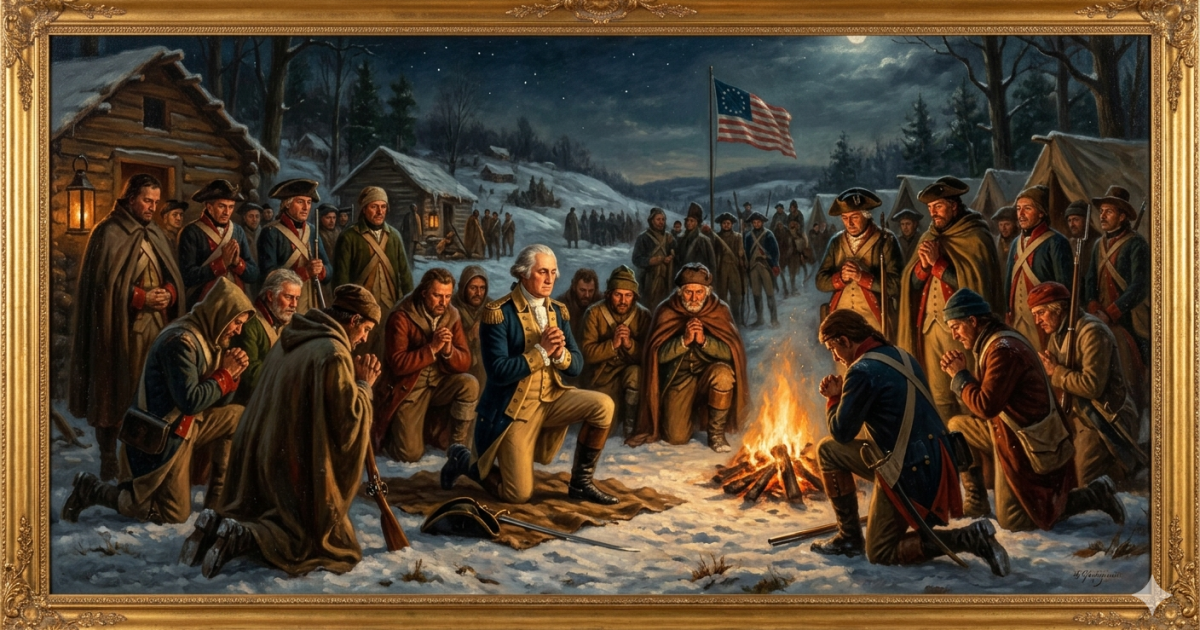
Not only has religion been a feature of government since before World War II, but the tradition is older than the Constitution itself. The Continental Congress established the military Chaplain Corps on July 29, 1775, at the request of George Washington, authorizing one ordained chaplain at the rank of captain for each regiment, 218 of whom served through the Revolutionary War.
That same Congress called the colonies to prayer in 1775, predating the Constitution entirely. When the Senate first convened in New York City on April 6, 1789, appointing a chaplain was among its first orders of business, electing the Right Reverend Samuel Provoost, Episcopal Bishop of New York, on April 25.
The House followed on May 1, electing the Rev. William Linn, continuing the tradition established by the Continental Congresses of opening each day’s proceedings with prayer. From its first session, the Supreme Court has opened each sitting with the cry “God save the United States and this honorable Court.” Congressional prayer, military chaplains, and government-called days of fasting and thanksgiving were the baseline from which the republic began.
Washington himself left no ambiguity. In his Circular Letter to the thirteen state governors on June 8, 1783, he closed with these words:
“I now make it my earnest prayer, that God would have you, and the State over which you preside, in his holy protection, that he would incline the hearts of the Citizens to cultivate a spirit of subordination and obedience to Government, to entertain a brotherly affection and love for one another… and finally, that he would most graciously be pleased to dispose us all, to do Justice, to love mercy, and to demean ourselves with that Charity, humility and pacific temper of mind, which were the Characteristicks of the Divine Author of our blessed Religion, and without an humble imitation of whose example in these things, we can never hope to be a happy Nation.”
An adult illegal alien who was charged and found guilty for groping minor teen girls at a high school in Virginia was sentenced to only 360 days in jail – but, with time served, he only has 135 days left in prison.
As reported last month, parents were outraged after an 18-year-old illegal alien groped over a dozen girls “in between their legs” at a high school in Fairfax County, Virginia.
The alien, identified as Israel Flores Ortiz, is turning 19 soon and is only in the 11th grade.
Why did authorities allow a 19-year-old man – who is in this country illegally – to sexually assault minor teen girls in the hallways at school for several months??
“There’s a group of about 12 individuals that have reported this assault,” one mother told 7News.
“It was all perpetrated by a single individual who is a stranger to the girls. He just sneakily walked up behind them and put his hand in between their legs,” she said.
“It was not just a butt smack or a butt grab. It was a groping of a private area. It had been occurring for several months,” she added.
Why are grown adult illegal aliens allowed to attend American public schools?
Forget the cost burden it places on the taxpayer, what about the obvious danger it presents to school children?
Democrats need to get out of the way and let our laws be enforced. Protect the children and have an ounce of common sense.
New York City continues its tragic decline under the failed stewardship of buffoonish Mayor Zohran Mamdani, as spotlighted by a disturbing video showing three out-of-shape NYPD officers failing to restrain a subway thug.
The incident, which occurred on a subway platform in the Bronx, underscores how Mamdani‘s embrace of anti-meritocratic DEI hiring practices has eroded public safety and emboldened criminals.
The video, which was originally posted on Instagram, was reposted on X on Monday.
“Three NYPD officers are unable to take down one thug at the Tremont Avenue subway stop in NYC,” an X user observed.
“The thug falls or jumps down to the tracks, gets up on the other side, and walks away.”
Before walking off, the suspect berates and curses at the officers, repeatedly screaming, “Get the f*** off me!”
While casually walking away, the suspect derisively taunted an obese female officer as a “fat b****.”
WARNING: The following videos contain vulgar language that some viewers may find offensive.
Three NYPD officers are unable to take down one thug at the Tremont Avenue subway stop in NYC. The thug falls or jumps down to the tracks, gets up on the other side, and walks away.
This after the suspect repeatedly saying, “Get the f*** off me!”
The viral clip spotlights several disturbing themes underscoring the disastrous impact of left-wing social re-engineering agendas.
First, criminals no longer fear or respect law enforcement, which means there’s no deterrent to crime.
Second, many New York City officers are physically unfit to do their jobs.
Those of us who live in New York are used to seeing obese, lethargic officers who look as if they’re one doughnut away from a heart attack.
It’s inconceivable to imagine them chasing a suspect on foot or being able to physically restrain a criminal.
This is especially true of female cops, who’ve been hired en masse due to the Democrats’ DEI fetish, which has slashed standards amid leftist complaints that the fitness tests prevented women from being hired.
This dangerous trend has metastasized nationwide and around the world, making a laughingstock of the police.
Guy wearing nothing but speedos outruns two female police officers like it’s nothing…until they finally hit him with the taser.
Mamdani is escalating the harebrained diversity agenda by steering millions of tax dollars into expanding “racial equity” hiring practices.
There’s a dwindling supply of qualified NYPD officers, because many have taken early retirement or quit the force during the past few years — a catastrophic fallout of the Black Lives Matter riots, which demonized the police and handcuffed their ability to do their jobs.
Adding to the erosion of law and order in NYC and other Democrat-controlled big cities is the left-wing promulgation of “bail reform” laws that put criminals back on the streets shortly after they’re arrested.
This is a recipe for disaster that incentivizes more crime and jeopardizes public safety.
Virginia voters have passed the redistricting referendum that will benefit Democrats and disenfranchise millions of Virginia independents and Republicans.
Abigail Spanberger lied to the people of Virginia on the campaign trail, saying that she would not back this and it was almost the fist thing she did once in office.
This has massive potential to backfire on Democrats, much like the passage of Obamacare.
Virginia voters pass redistricting referendum, setting stage for new congressional maps
Democrats scored a major victory on Tuesday as a congressional redistricting referendum that could give Democrats a significant boost in the battle for the U.S. House of Representatives majority in this year’s midterm elections was passed by Virginia voters, the Associated Press reported at 8:49 p.m. ET.
The ballot measure gives the Democrat-controlled Virginia legislature — rather than the state’s current nonpartisan commission — temporary redistricting power through the 2030 election. It could result in a 10-1 advantage for Democrats in Virginia’s congressional delegation, up from their current 6-5 edge.
That would give the Democrats four additional left-leaning U.S. House seats ahead of the midterms as the party tries to win back control of the chamber from the GOP, which currently holds a razor-thin majority.
The standalone spring referendum capped months of political crossfire and court battles, sky-high early voting turnout, and tons of national attention and money poured into the ballot box showdown.
Even though a majority of voters gave the ballot initiative a thumbs up, it still faces legal challenges.
Obama is already celebrating, and lying about this.
Congratulations, Virginia! Republicans are trying to tilt the midterm elections in their favor, but they haven’t done it yet. Thanks for showing us what it looks like to stand up for our democracy and fight back.


 OMG. Trump Fed Chair Nominee Kevin Warsh is TOYING with Elizabeth Warren





 (@Bubblebathgirl)
