(Note: Thank you for supporting businesses like the one presenting a sponsored message below and working with them through the links below which benefits Gateway Pundit. We appreciate your support!)
That old pillow on your bed is already flat. Your neck is stiff, and you are up again at 3 a.m. flipping it over like that will fix it.
“Years ago, like you, I found myself extremely frustrated with my pillow going flat,” says Mike Lindell. “I would wake up in the morning with a sore arm, my neck would hurt, my fingers would be numb, and I would toss and turn all night not knowing why. So finally, I decided to do something about it.”
He created MyPillow, with its patented interlocking fill. It moves with you, holds the loft you fluff it to, and does not go flat or clump, so you sleep through instead of flipping the pillow at 3 a.m.
People who got the Premium MyPillow talk about waking up rested, and a pillow that still has its shape in the morning. A stomach sleeper said it was the first one that worked. Another bought three more for the family after it came out of the washer like new.
You fluff it to the height you want and it stays there, whether you sleep on your side, your back, or your stomach. The cover is 100% cotton, you can wash it and dry it, and it carries a 10-year warranty.
Mike’s guarantee is blunt. “I guarantee that your MyPillow will be the most comfortable pillow you’ll own or YOUR MONEY BACK.” If you send it back within 60 days of receipt, for any reason, you get 100% of the purchase price back, less shipping, and you pay the return shipping.
The prime minister highlighted real problems with elder care but ignored deeper crises.
UK Special Coverage
(Andrew Aitchison / In pictures via Getty Images)
Britain has a new prime minister who can, at least, deliver a speech. Andy Burnham, the former Blairite who has reinvented himself as an old-school socialist, electrified British politics at the end of September with a speech that promised to take Britain back to the 1970s.
Not since John Smith, the Labour leader whose early death paved the way for the Blairite centrist revolution in the early 1990s, has there been a Labour leader, and PM, who is so unapologetically Labour, and he lovingly caressed every party prejudice about why Britain isn’t working as it should. And in further proof that most of British politics remains an argument with the legacy of Margaret Thatcher, he got his biggest cheer for a promise to undo the former Conservative leader’s privatization of the water industry.
The speech was left-populist, tribal, emotionally manipulative, ideologically blinkered, and wrong about most of Britain’s biggest problems. But it also had one useful and original idea at its heart: paying for reform of the underfunded system of elder care by ending the expensive so-called “triple lock” on the public pension system, which guarantees that the state pension rises in line with earnings, inflation, or 2.5 percent, whichever is highest.
Burnham’s lackluster predecessor, Keir Starmer, would not have had the courage or imagination to come up with such an idea. But neither would he have been so naively ideological to suppose that Britain has a built-in center-left majority waiting to govern in perpetuity once the old first-past-the-post voting system is replaced with a new, more proportional system, another of Burnham’s promised reforms. Nor would Starmer have been apparently so unconcerned with Britain’s constipated state machine and spluttering economic engine as to make a whole speech without, as one commentator noticed, using the words “entrepreneur,” “biotech,” “Oxford,” “Cambridge,” “London,” “financial services,” or many of the other right-coded things that Britain is actually quite good at.
Nonetheless, the speech has had its desired short-term effect and provided a Burnham bounce in the opinion polls, allowing Labour to narrowly lead the insurgent right-populists of Nigel Farage’s Reform party, mainly by winning back some of the disillusioned younger graduate voters in the big cities and university towns who had deserted the party for the leftist Greens.
Does Burnham really believe in all that back-to-the-1970s and public-ownership stuff? It is one thing to take back control of failed organizations like Thames Water, but all of energy and water? Burnham’s leftist ambitions will certainly be constrained by the fact that he can’t increase public spending and Britain is already paying more for its debt pile—which reaches nearly 100 percent of GDP—than comparable European countries. But the left-inclined voters cannot be fed on rhetoric alone.
The run-up to the next general election in 2029 is more likely to confirm the view that the great tragedy of British politics is the failure of the Boris Johnson–led realignment after the big Conservative election victory in 2019. In the light of the Brexit vote to leave the European Union, there was an opening for the main party of the right to lock in a new swathe of socially conservative lower-income voters who were impatient with the left’s social liberalism but also wanted protection from the harsh winds of the market economy.
Johnson—the joker anti-politics politician—should have been the perfect figurehead for such a realignment, but the combination of his capricious personality, Covid, and the fact that the Conservatives were constantly divided between their conservative and liberal wings put paid to the realignment and ushered in a badly timed Labour Government in 2024. Labour entered with a huge majority—thanks to the divide on the right between Reform and the Conservatives—but with no idea what to do with it.
The new government was certainly in no position, temperamentally or ideologically, to respond to the accumulated failures and unintended consequences of the Blair/Cameron era. One reason I am no longer a member or supporter of the Labour party (I was a member from my student days until 2017) is that I believe we need a government that can address those problems. What are they?
The problem of overregulation, state incapacity, and too much dispersal of power to the courts and regulators; the absence of “tough love” in health and social services, including the over-diagnosis problem and the inability to control welfare spending; the economy-throttling high energy costs, which are the result, in part, of the chaotic and over-rapid path to “net zero” in the name of global leadership; the indifference to both high levels of immigration and deindustrialization (from both Labour and Conservatives), the combination of which has been a main driver of populism; the neglect of technical/vocational education in favour of university over-expansion; the creation of a new progressive establishment—Oxbridge, the British Medical Association and all health institutions, the Senior Civil Service, most of the legal profession—with views some way to the left of the average voter on both social and economic issues.
It is very hard for the party that ushered in most of these changes, admittedly with some help from the Conservatives, to perform a volte-face. And Burnham’s speech underlines just how little he wants to. He expatiated on public ownership, though with the wriggle room provided by the phrase “public control,” and said nothing at all about the overregulation/state incapacity problem, or the welfare incontinence, or the self-inflicted energy cost wound, or even how to stimulate economic growth.
Moreover, while Burnham has proved adept at appealing to the economic nostalgia of less-well educated, more locally connected people, often in post-industrial places—the people I call the Somewheres (as opposed to highly-educated, more mobile Anywheres)—as the leader of a party dominated by liberal graduate Anywheres he has had nothing to say about their social and cultural anxieties.
In his speech, Burnham made cursory reference to stopping the wave of refugees illegally entering Britain on small boats. He also talked about the common belief that “the powers that be are pulling against the people, not with them.” He clearly did not include himself or the progressive-establishment-dominated Labour party in the “powers that be.”
But many former Labour voters believe that free speech, promotion on merit, and common sense itself have been abandoned by the Labour “powers that be,” who are also indifferent to the dramatic demographic change in many towns and cities. The white British population of the UK was still around 90 percent in 2000 and it is now shy of three-quarters: London, Birmingham, Manchester, and several smaller towns and cities are all now majority-minority or close to it, and the school population of England is now barely 60 percent white British. Burnham has nothing to say about this, because social liberals do not think there is an issue.
The centerpiece of Burnham’s speech, and the most powerful political punch, was the elder care reform/triple lock combination. Almost everyone agrees the care status quo is unsatisfactory in many ways. I do too. I even wrote a book partly about how to reform it (The Care Dilemma: Freedom, Family, Fertility).
Yet is there really a care crisis? What about the defense crisis, or the energy cost crisis, or the overregulation crisis, or the economic growth crisis? Are there not more important places to start sorting out the country?
Elder-care reform is in many ways a surprising place for Burnham to invest so much passion and political capital, and is perhaps further testimony to the importance of personal experience in setting political priorities. (His father was in a care home with dementia for several years and died just before the conference.) The failure to reform has become, in the political class, an emblem of the inability to think beyond the short-term. But there are good reasons why the issue has not been tackled by preceding governments.
For a start, the public does not prioritize it. Only 3 to 4 percent of people mention it as one of the top three issues facing the country, compared with more than 30 percent for the National Health Service (NHS). Moreover, many more people are already getting heavily subsidized care than is generally realized, despite the ungenerous means-test; meanwhile local and central government combined are already spending about £35 billion a year on care.
There are about 300,000 younger people in the care system with long-term, often severe, disabilities, like cerebral palsy. The number is rising because of modern medicine’s ability to keep more people with severe conditions alive for longer, and most if not all of their care is paid by the state.
Another 600,000 people are in the elder care system—roughly 350,000 in care homes and 250,000 receiving visits from carers in their own homes. Over half of care home residents are getting much of their care, and accommodation, paid by the state, and nearly three-quarters of people receiving care at home are substantially covered by the taxpayer.
But most elderly people do not use the formal system at all and any support they have comes from their family. There are roughly 6 million people over the age of 75 in England, and around 5 million people who provide some degree of informal care for the younger disabled or elderly relatives.
The means-test for those in residential homes includes the value of someone’s house, but the house is excluded from the calculation if a spouse or a child, or even a friend in some circumstances, is living in it. The King’s Fund, a health think tank, reckons that at any given time only about 220,000 people are fully self-funding for elderly social care.
Politicians have quietly accepted that it is perfectly fair to claw back some of the unearned property value increase that some people have enjoyed in recent decades, especially in more affluent places. Polls suggest public opinion is on their side. It is true that a few people are exposed to very high costs, which is why there has been interest in some kind of cap on overall costs even for those blessed with expensive property.
So the irony is that the main beneficiaries of making care free would be affluent home owners, mainly in the south of England, and the main losers, assuming that ending the triple lock would mean less generous pensions, would be poor pensioners concentrated in the north of England, Burnham’s territory.
But Burnham is nevertheless right—there may not be an imminent crisis of elder care, but we do need a much better organized and better funded system. The current system is unfair in that cancer treatment is free, covered by the NHS’s general tax-based insurance, while dementia might in rare cases cost you hundreds of thousands of pounds.
Moreover, there are plenty of unmet care needs in the current system and there are those 5 million informal carers, mainly family members, who might be able to contribute more to the GDP if their relatives could lean more on the formal care system. And by 2047 there will be 3.3 million people over the age of 85, many of whom will need some kind of support in an era when families are smaller, if they exist at all, and more dispersed.
Although Burnham ventilated hyperbolically about his National Care Service reform, planned for 2030, being equivalent to the founding of the NHS, he is glamorizing what should actually be a few relatively prosaic decisions about structure and funding.
The NHS analogy is, in fact, completely inappropriate for elder care reform, and we have to hope that Burnham was using it as a kind of metaphor. The NHS is an increasingly unpopular and struggling institution based around giant, publicly owned, hospitals. Elder and social care is delivered by about 18,000, mainly small, private institutions, hand-in-hand with local authorities.
It does make sense to raise the visibility of the system and give it a name, a logo, and a clearer identity. I argued in my Care Dilemma book that it should be called the National Preventative Service (NPS). The job of the NHS is to deal with your problem and get you out the backdoor as quickly as possible; the job of the NPS should be to stop so many old people going through the front door in the first place.
The 1.6 million people who work in care need to be better paid and trained. Their pay should be pegged to that of an NHS care assistant with a greater possibility of career progression. There is a case for more care staff to have some limited medical skills—minor wound care, injections, taking vital signs—and to review some of the archaic demarcation lines that prevent a care worker cutting someone’s toe-nails. Better links between family carers and the care system could also keep more elderly people self-sufficient for longer.
There needs to be much more emphasis in care packages on taking exercise—old people falling over costs the NHS £2 billion a year—and much better use of technology especially in the smaller homes which tend to resist innovation. More volunteering and gap years should be encouraged in care homes, with perhaps an equivalent of Now Teach (the organization that encourages professional people near retirement to spend a few years teaching) for care managers.
Burnham talked, again hyperbolically, about how the failures of the care system are causing the NHS to collapse. True, the chronic illnesses of the elderly in an aging society inevitably take up more of the NHS’s resources, but a better organised and funded care system will only be able to relieve those pressures to a limited extent. Moreover, some of the problems of bed-blocking by the elderly are due to the NHS’s organizational inefficiencies and the length of time it takes to organise a care package, and these are problems that could in principle be sorted out right now.
Providing the entire care service free to a decent standard for everyone who needs it plus improving pay and training for care staff would be both prohibitively expensive—costing maybe around £25 billion—and regressive. When Burnham talks about free care for all, in fact he seems to mean the state covering the care element of a weekly care home charge, now about £1,400 in total, with the accommodation costs left to be paid by users, at least by better-off ones. When people discover that they may actually be paying more for Burnham’s supposedly free service he will have a bit of explaining to do.
But by then, Andy’s premiership is likely to have been engulfed by all those other, bigger, potential crises that he didn’t talk about at all in his speech.
Sandy Hook, Parkland, the attempted assassination of Donald Trump, the killing of Charlie Kirk. Americans know the names and the devastation. But how much can they actually verify about the explanations offered afterward? AbleChild.org has repeatedly examined these events and others, demanding evidence, transparency, and answers beyond the official narratives.
In the Thomas Crooks investigation, records did not simply arrive through routine public disclosure. Judicial Watch filed a Freedom of Information Act lawsuit against the Justice Department in July 2025. In September 2026, the organization announced that the litigation had obtained 180 pages of heavily redacted FBI records. In October, it announced another 249-page release. More than two years after the attack, the public is still receiving pieces of the investigative record.
Who inside the FBI is responsible for turning that evidence into a behavioral analysis, and how well has that system served the American people?
The answer is the FBI’s Behavioral Analysis Units, or BAUs. The units examine criminal behavior, assess threats, and advise investigators. Understanding criminal behavior is the core mission, not an optional task.
The framework’s history deserves scrutiny, not automatic praise. In 1972, the FBI established the Behavioral Science Unit at Quantico. Howard Teten and Patrick Mullany helped develop the approach under unit leader Jack Kirsch. Even this largely glowing accountreveals the divide: longtime FBI director J. Edgar Hoover called early profiling “hokum,” while Teten and Mullany pursued methods the author describes as grounded in scant scientific data, police experience, intuition, and guesswork. Looking back, was Hoover’s skepticism justified and did the FBI take the wrong direction?
One could easily see how this might have ushered in the billion-dollar behavioral health industry and Hollywood connections, and weakened our national security.
The work helped shape today’s BAUs and the broader framework of the National Center for the Analysis of Violent Crime. Expansion, however, is not proof of accuracy. A 2008 scholarly critiqueargued that criminal profiling lacked strong scientific support.
It is time to consider an audit and propose some key benchmarks for accountability. Federal law authorizes FBI audits. Where is the independent review of BAU methods, accuracy, and errors?
The government’s catalog summary of the center’s 1991 annual report describes offender profiles, personality assessments, interviewing techniques, investigative strategies, expert testimony, and prosecution assistance. Its programs included psychological services, crime-linkage support, research, training, and media relations. This description comes from the catalog summary, not a review of the complete report. The mission widened. Where is the matching public accounting of results?
On CSI, Criminal Minds, and Mindhunter, investigators turn disturbing behavior into answers. The FBI’s real-world research reveals a less reassuring picture: missing medical records and incomplete treatment histories.
John Douglas, Robert Ressler, and Ann Burgess helped build a profiling framework whose scientific foundation has faced serious challenges. Anindependent study found no support for the distinct “organized” and “disorganized” crime categories central to that framework.
Yet profiling became a commercial product, complete with a Netflix series based on Douglas’s Mindhunter and neatly packaged explanations. Where is the evidence of accuracy? Where are the records needed to examine mind-altering drug exposure?
The FBI’s own Law Enforcement Bulletin warned that television and film made profiling appear almost psychic. It also acknowledged disputes over methods, reliability, and effectiveness, with longstanding controversies receiving “little systematic assessment.” Has the public image of FBI profiling received more attention than the evidence needed to test its conclusions?
The Bureau’s November 2019 lone-offender terrorism studyexamined 52 offenders responsible for attacks between 1972 and 2015. On page 22, the FBI’s report acknowledges missing medical records and inconclusive treatment and medication data. Did mind-altering drugs contribute to the violence? Why were the records missing, and what steps did the FBI take to obtain and analyze them? Without complete histories, a critical question remains unresolved, not ruled out.
Congress imposed a specific reporting obligation in 1998. Section 703 of the Protection of Children From Sexual Predators Act established the Morgan P. Hardiman Child Abduction and Serial Murder Investigative Resources Center, known as CASMIRC, under NCAVC management. The law required the Attorney General to report to Congress one year after the center’s establishment, describing its activities, personnel qualifications, equipment, support, and projected needs. It did not create the BAU itself.
Where is that report?
It has not been located in the public sources reviewed for this article. That does not establish that it was never submitted. Congress should determine whether it was submitted and make it accessible. The 1991 annual report cannot satisfy a requirement enacted seven years later.
The reporting provision required neither annual follow-up reports nor independent performance audits. It specified no penalty for failing to submit the report. A one-time reporting requirement is not a durable oversight system.
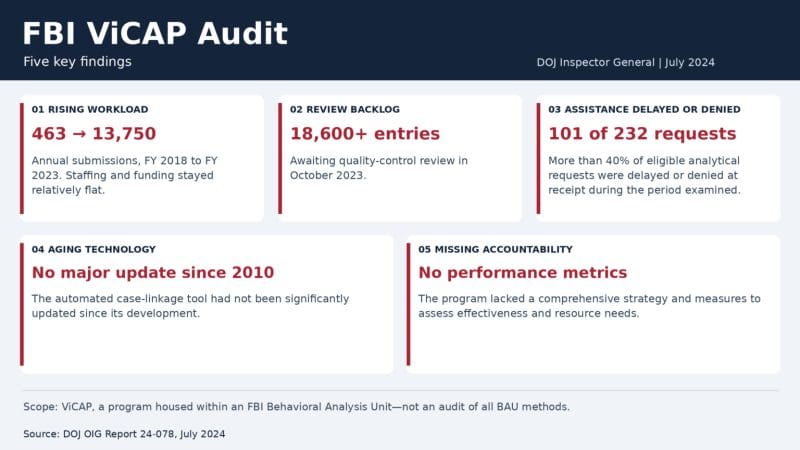
Outside scrutiny has identified real operational problems. A July 2024 DOJ Inspector General audit examined the Violent Criminal Apprehension Program, or ViCAP—a national database that helps police connect violent crimes, supported by analysts who assist investigations. The program is housed within a BAU. Its audit findings expose the gap between an expanding workload and the systems needed to handle it.
As the world remembers the horrific anniversary of the October 7 terrorist attacks on civilians in Israel, radical Muslim New York City Mayor Zohran Mamdani can’t hide his Jew-hate for even one day.
On the third anniversary of the deadliest attack on Jews since World War II and the Holocaust, Mamdani could not spare a single message for the victims without attacking Israel.
Hamas intentionally plotted to attack and murder innocent teens and young adults at a dance party in the desert.
They stormed neighborhoods and murdered entire families.
Ariel Bibas, left, and his baby brother Kfir died after they were abducted in the Hamas terrorist attack on Israel on Oct. 7, 2023. (@NikkiHaley / X screen shot)
The New York Times published a lengthy report after a two-month-long investigation into the sexual violence and brutality Israeli women faced at the hands of Hamas terrorists.
Yet in his post, all the evil Hamas committed gets three short sentences.
His propaganda about Gaza, by contrast, fills the majority of the post.
Mamdani wrote:
This day is profoundly painful for so many New Yorkers. It marks three years since the horrific war crimes of October 7. On that day, Hamas killed more than 1,100 Israelis and abducted 251 others. We grieve alongside our many friends and neighbors who still carry that unthinkable loss.
The suffering did not begin nor end that day. It instead continued through the Israeli government’s devastating, ongoing genocide in Gaza, in which it has killed more than 74,000 Palestinians—including more than 21,000 children. Even since the so-called ceasefire, more than 1,400 Palestinians have been killed. That suffering has intensified with every Israeli bomb dropped on ambulances waiting outside hospitals, every drone strike targeting a residential building or journalist, and every shipment of food aid turned away at a border crossing. Many New Yorkers are reckoning with this unbearable grief, and we mourn alongside them – all while knowing that our tax dollars fund these war crimes.
Three years later, we must refuse to accept a world in which occupation and apartheid continue, where war crimes are met with impunity, and our federal government continues its complicity with every arms shipment.
To honor the dead, we must fight for a world in which every person can live with freedom, safety, and dignity.
The Mayor’s wife, Rama Duwaji, publicly liked Instagram posts just hours after the murderous attacks that celebrated the attacks and expressed anti-Israel rhetoric.
BREAKING: Jewish Insider reveals that Zohran Mamdani’s wife was mass-liking Instagram posts on October 7th, celebrating the massacre in real time.
The FBI arrested a 30-year-old Bellingham, Washington resident on Tuesday and charged him with conspiracy to murder persons in a foreign country for allegedly coaching, funding, and agreeing to broadcast the February 10 slaughter at Tumbler Ridge Secondary School in British Columbia, the attack that left 8 people dead, including 5 children.
James Cody Bryant was taken into custody in Bellingham and appeared in federal court in Seattle.
The charge carries a maximum sentence of life in federal prison.
Both Bryant and Van Rootselaar were born male and identified as transgender women, according to police and federal officials.
The Royal Canadian Mounted Police said in February that Van Rootselaar was “born a biological male” who began identifying as female about six years earlier.
On Tuesday, U.S. officials said they understood Bryant was also born male and identified as female.
Van Rootselaar first murdered her mother and stepbrother at the family home before driving to Tumbler Ridge Secondary School, federal investigators said.
Inside the school, Van Rootselaar killed five children between the ages of 12 and 13 and an educational assistant, seriously wounded other students, detonated an improvised explosive device, and fired through locked classroom doors before exchanging gunfire with police and ultimately dying from a self-inflicted gunshot wound.
Eight victims were murdered in total, six at the school and two at the family residence. Department of Justice
And according to federal officials, Van Rootselaar was not operating in an online vacuum.
FBI: Bryant Allegedly Helped Plan and Promote the Bloodbath
The FBI complaint alleges that Bryant and Van Rootselaar communicated repeatedly on Discord about weapons, potential targets, livestreaming the murders, hiding their communications, and maximizing the attack’s impact.
During one discussion about possible locations, Bryant allegedly offered chilling tactical advice, writing: “Wide open spaces means numbers.”
Investigators say Bryant also helped Van Rootselaar test the livestream setup ahead of the massacre and agreed to record and redistribute the video online.
Federal prosecutors further allege that Bryant sent money that ultimately funded items connected to the attack.
The complaint says Bryant purchased the shoes Van Rootselaar later wore during the massacre and sent money for a lighter intended for an explosive device.
Screenshot: DOJ
Investigators also documented discussions about money for stickers placed on firearms.
One photograph included in the federal complaint shows a shotgun posed directly in front of a transgender pride flag with a transgender-themed sticker attached to the firearm.
Screenshot: DOJ
After Van Rootselaar sent Bryant the image, Bryant allegedly replied: “love the stickers.”
Other photographs and reporting on the complaint show weapons and accessories decorated in the blue, pink, and white colors associated with the transgender pride flag.
Screenshot: DOJ
Perhaps most disturbing are the allegations that Bryant understood there was an opportunity to warn authorities, and repeatedly promised not to do it.
According to the FBI complaint, Bryant acknowledged potentially being able to “save lives I guess,” but repeatedly assured Van Rootselaar that law enforcement would not be contacted.
In another exchange cited by investigators, Bryant allegedly wrote: “I still won’t snitch.”
The DOJ says Bryant did occasionally urge Van Rootselaar not to carry out the attack. But prosecutors allege Bryant nevertheless continued assisting with preparations and never alerted authorities.
Even after Van Rootselaar had allegedly murdered two family members, investigators say Bryant provided advice that helped the killer start the family vehicle and drive to the school.
Moments before the school massacre began, Van Rootselaar initiated the livestream.
Bryant responded: “Watching now.”
According to the FBI, the Twitch livestream lasted approximately 20 seconds and was viewed by only one Twitch account, an account investigators say was registered using Bryant’s identifying information.
The Gateway Pundit extensively reported on Van Rootselaar following the February massacre.
As The Gateway Pundit previously reported, Canadian authorities drew controversy after announcing they would honor Van Rootselaar’s preferred gender identity and pronouns even while detailing the murders.
Credit: The Presidential Press and Information Office
The mystery surrounding a possible deadly laboratory accident in Siberia is deepening.
Russian media reports now claim a second person has died amid fears of a possible pneumonic plague outbreak in the Irkutsk region, just days after a 28-year-old researcher at one of Russia’s anti-plague laboratories died under highly suspicious circumstances.
Meanwhile, countries across Central Asia are ramping up health controls as the Kremlin continues to insist there is no confirmed plague outbreak.
News.com.au reported that Russian media claimed a second individual died at an Irkutsk-area hospital after allegedly contracting the same disease that killed laboratory technician Darya Shipilova.
That second death has not been independently confirmed, and Russian authorities have not acknowledged that another person died from plague.
Shipilova, 28, worked at the Irkutsk Anti-Plague Research Institute of Siberia and the Far East, a facility that handles extremely dangerous pathogens, including Yersinia pestis, the bacterium responsible for plague.
Regional reports claimed Shipilova told medical personnel she had accidentally broken a test tube containing live bacteria while working at the institute days earlier.
Russian authorities deny that account.
Russia’s health watchdog, Rospotrebnadzor, claims there was no laboratory accident involving dangerous microorganisms and says Shipilova died from “pneumonia of unknown etiology.”
But the government’s reassurances have done little to stop alarm.
Nearly 200 people who came into contact with Shipilova were initially placed under medical observation, while dozens of employees at the anti-plague facility were isolated and hospitals in the region imposed quarantine restrictions.
Reuters reported that Russian officials said testing found no plague pathogen among Shipilova’s contacts and that approximately 60 percent of those initially quarantined had subsequently been released.
Now comes the reported second death.
According to reports circulating Tuesday, an unidentified person allegedly died at an Irkutsk district hospital with a suspected plague infection.
Again, Russian officials have not confirmed the second death as a plague fatality, and no publicly available laboratory evidence has established that the person was infected with Yersinia pestis.
The lack of answers has only fueled suspicion.
The Insider reported that Russian media outlets have been deleting reports discussing a suspected plague outbreak as Kremlin spokesman Dmitry Peskov instructed the public to rely on information from Russia’s government health agency rather than what he called “rumors and speculation.”
At the same time, governments outside Russia are not simply ignoring the situation.
CNN specifically reported that Kazakhstan, Kyrgyzstan, Uzbekistan and Tajikistan implemented quarantine controls at state border crossing points, with Uzbekistan also increasing readiness for highly infectious diseases.
“Maybe there’s nothing there. Maybe it’s bigger than we thought. We don’t know,” Rubio said at a news conference in Iceland, AP News reported.
“We encourage Russia to be more transparent and share more information with the world,” Rubio said, adding this has so far been “quite limited, but hopefully that will change in the next few hours and days.”
President Trump has also addressed the situation, calling the Russian laboratory worker’s death a serious concern and offering American assistance.
Credit: r U.S. Senate Committee on Health, Education, Labor and Pensions
Far-left Michigan Democrat Abdul El-Sayed, the Bernie Sanders– and AOC-backed nominee for U.S. Senate, is on video telling a Detroit audience he carries dual citizenship in the United States and Egypt, the second time he has been documented claiming Egyptian citizenship, even as his campaign insists he never held it.
The Washington Free Beacon published the previously unreported footage on Monday. El-Sayed made the remarks onstage at a 2016 GlobeMed conference in Detroit, while he was the city’s health director.
“I carry dual citizenship, and I grew up spending most of my summers in another country where I understood what it meant not to have the right to self-govern,” El-Sayed told the crowd, according to the Free Beacon.
His parents emigrated from Egypt to the Detroit area in 1978. El-Sayed was born in Michigan. In the same speech he retold a story he still uses on the campaign trail: Egyptian police questioned him during a summer visit after he publicly cursed then-President Hosni Mubarak.
WATCH:
A newly unearthed video shows El-Sayed explicitly telling an audience that he carried dual citizenship while discussing his ties to Egypt.
There is just one problem.
His campaign has previously insisted that he has never been a dual citizen. https://t.co/4gA2QW8ujx
In January, the Free Beacon reported that a résumé El-Sayed posted while he was an assistant professor at Columbia University’s Mailman School of Public Health listed his citizenships as “USA, Egypt.” The résumé disappeared from the academic site Academia after the outlet sent it to the campaign.
Campaign spokeswoman Roxie Richner told the Free Beacon then: “Abdul is not a dual citizen by any verifiable metric and never has been.”
Her explanation: El-Sayed was “told as a child that his grandfather had pursued Egyptian citizenship on his behalf, for which he was eligible due to his parents being born in Egypt.” She called it “an error based on what he was told by family members secondhand,” and said that when he later tried to check, “he and his family were unable to find any documentation to verify this claim.”
The Free Beacon reported that the campaign did not answer questions about the separate 2016 video. The campaign has also declined to say when, exactly, El-Sayed decided the childhood story was wrong, even though he was still describing himself as a dual citizen on a public stage in 2016, two years after the résumé.
Michigan voters are now being asked to send this man to the United States Senate.
El-Sayed narrowly beat Rep. Haley Stevens in the August Democratic primary after a race he and his allies framed as a fight against AIPAC and “foreign” money.
He launched with an endorsement from Sen. Bernie Sanders and has been backed by Rep. Alexandria Ocasio-Cortez and Rep. Rashida Tlaib. He is the Democratic nominee to replace retiring Sen. Gary Peters and faces Trump-endorsed Republican former Rep. Mike Rogers in November. Control of the Senate is on the line.
In 2020, Andy Hodge was leading a happy life. The 38-year-old licensed plumber, a single father of three, lived in Kentucky with his sister, Ellie Hodge Hayse, and her family — a life Ellie described as “perfection.”
That changed in August 2020, when Andy broke his left leg in a work-related accident. The accident, subsequent surgeries and hospitalizations, and a positive COVID-19 PCR test set off a cascade of events that led to his death on March 2, 2021.
In an interview with The Defender, Ellie detailed Andy’s hospital treatment, including COVID-19 hospital protocols, which she believes caused his death. She shared extensive documentation with The Defender to corroborate her story.
Ellie discussed the aftermath of Andy’s death, including finding inconsistencies in hospital documents that raise questions about the treatment he received.
After lawyers refused to take her case, she co-launched Dead Serious…Kinda Not, an advocacy group for families of COVID-19 hospital protocol victims.
“We can’t have a chapter where I can set it down and say, ‘This is what happened to my brother,’” Ellie said. “We don’t get that. We get nothing, and it makes me sad.”
Admitted for leg injury complications — but treated for respiratory issues
According to Ellie, Andy’s orthopedist, Dr. David Seligson, described Andy’s injury, which included a “crushed” ankle, as “one of the worst cases” he’d ever seen, and suggested the surgery to repair it would be complicated and high-risk.
Two months later, Andy began experiencing a “different” kind of leg pain. It turned out the screws were protruding from his ankle.
After running into delays — which UofL hospital attributed to being “short-staffed due to COVID” — Andy was scheduled for a second surgery.
The second surgery was also unsuccessful, and Andy continued to experience “horrible” pain. Yet, on Jan. 18, 2021, a nurse practitioner at UoL Orthopedics cleared him to return to work.
But there, the staff didn’t focus on Andy’s leg. In a text message, Andy told Ellie that a nurse at Twin Lakes said, “We’re not worried about your leg right now. We’re worried about saving your life.”
Andy was admitted, placed on oxygen and prescribed a new round of antibiotics. Four days in, he said he was “feeling better,” but staff were ignoring complaints about his leg, which was still sore.
Andy told Ellie that if the hospital put him on a ventilator, to “please don’t let them shut it off.”
The next day, Twin Lakes doctors transferred Andy to Owensboro Health Regional Hospital (part of the same hospital system) for a bronchoscopy. Andy and Ellie asked that instead, he be transferred to Norton Hospital in Louisville. But Andy changed his mind because, as he told Ellie, his doctors told him he would die if he did not accept the transfer to Owensboro.
Little food or water — but five doses of remdesivir under the COVID protocol
Andy was admitted to Owensboro on Feb. 17, 2021, in stable condition. Though doctors initially told them Andy was being transferred for a bronchoscopy, hospital records listed it as an “emergency transfer” for respiratory issues.
“What I can say isn’t in the notes anywhere is his leg. They didn’t check it. They didn’t even acknowledge it,” Ellie said.
Ellie later learned that Andy was tested twice for COVID-19 on Feb. 17, 2021. While his nasal swab test was negative, PCR testing by physician and Owensboro board member Dr. Jason Mills was positive — so the hospital initiated its COVID-19 protocol.
The next day, Owensboro gave Andy the first of five remdesivir doses. According to Ellie, hospital staff also didn’t offer Andy much food or drink and didn’t administer “maintenance medications that he needed every day” for his leg.
Hospital staff told Ellie that the COVID-19 protocol didn’t allow other treatments to be administered, as doctors would be unable to “scientifically say” whether it was the protocol medications or other medications that succeeded in treating him.
They also told Ellie that Andy couldn’t receive visitors due to a 14-day “isolation protocol.” She later learned that she had the right to visit Andy twice a day, despite the protocols.
Placed on a ventilator after a stroke was left unaddressed for hours
On Feb. 20, 2021, Andy told Ellie he was “doing better” and was being relocated to a room on the COVID-19 floor.
However, while Andy appeared in good spirits during a video call, he complained of a headache and said hospital staff kept telling him that “everything is COVID.”
By the next morning, Ellie awoke to the news that Andy had had a stroke — and to a message Andy sent the previous evening, shortly after the call ended, that included a photo that showed his lip sagging.
Andy insisted he hadn’t had a stroke, but Ellie learned that he was diagnosed with a stroke at 1:20 a.m., nearly two hours after Andy’s text message, and wasn’t treated until 4:38 a.m., outside the three-hour window for administering a tissue plasminogen activator, a time-sensitive treatment for ischemic strokes.
According to hospital documents, physicians wrote that the decision not to provide a tissue plasminogen activator was “also complicated by the fact that patient just received prophylactic Lovenox,” a blood thinner, shortly before his stroke.
Ellie and other relatives remained on a video call with Andy throughout that day — not knowing that it would be the last time they would speak with him.
Late that evening, without his family’s knowledge or approval, Owensboro staff placed Andy on a ventilator. The news caught Ellie by surprise — and was accompanied by evidence that Andy had resisted being ventilated.
“I wake up, and he’s vented. They didn’t ask permission. He was restrained to the bed. They said he was fighting the vent … I can imagine that maybe he was trying to tell them he didn’t want the vent, and they forced it,” Ellie said.
Ellie said she implored the nurse, and several other doctors in the days that followed, to examine Andy’s leg, but to no avail.
Instead, doctors and hospital staff repeatedly told her that Andy “wouldn’t make it” and that she was being “inhumane” for keeping him on a ventilator.
On Feb. 23, 2021, Andy received his final dose of remdesivir.
It wasn’t until Feb. 24, 2021, that a physician at the hospital told Ellie that a blood clot had been found in Andy’s right leg. However, Ellie later learned physicians had previously observed a clot. The same physician claimed he tried calling her — but he had been calling Andy’s phone instead.
Rather than address Andy’s leg troubles, doctors instead tracked Andy’s condition through what Ellie later found out were “window visits” — visually observing Andy through the window of his hospital room, “due to COVID.”
Hospital claimed Andy was brain-dead, but family saw signs of consciousness
By Feb. 26, 2021, doctors at Owensboro declared Andy brain-dead, based on a test performed a day earlier. Ellie said the test was questionable.
“If you look at the records, it says, ‘This test cannot be used to deem brain death due to patient is on a paralytic.’” Ellie learned that a medical student had given Andy a paralytic, typically used only during surgery to block muscle movement, on the same day as the test that was used to determine his brain death.
On Feb. 27, 2021, Ellie made a video call to Andy’s phone with a nurse present in his room. Elli and other family members decided to “talk to him and stimulate his brain and tell him we’re there, we love him, to keep fighting.”
“Every time I would speak to him, his blood pressure would go up, way up. You could see life,” Ellie said.
The nurse in the room with Andy, “Angela,” agreed with Ellie — or seemed to. Later that day, with the video call still in progress, another nurse, “Rachel,” entered Andy’s room to siphon fluids out of his mouth, causing him to gag — another sign he wasn’t brain-dead.
But instead of pursuing this, the nurse disconnected Andy’s phone when the call ended. The next day, Ellie learned that the nurse had shut Andy’s phone because she felt it was a “liability” to be recorded on the job.
Ellie and her husband finally visited Andy on Feb. 28, 2021. Once more, Andy showed signs of life when he heard Ellie’s voice.
“When I start talking, his blood pressure starts going up. Those doctors saw that. They were right behind me,” Ellie said. By the next day, Ellie said hospital staff were giving her “all kinds of promises” and were claiming they were “sorry for the misunderstanding.” Yet, “they still weren’t acknowledging his leg.”
It was at this time that Seligson, who had originally treated Andy’s leg, contacted Ellie. She said he sounded “traumatized, terrified” at the news of Andy’s condition and his treatment at Owensboro. He told her he would visit Andy the next day and to tell the hospital to simply “keep him on the ventilator.”
But when Ellie informed the hospital about Seligson’s planned visit, the hospital ethics committee said it had already met that afternoon, without her knowledge, and had changed Andy’s status to “DNR.”
The committee also decided to place a sign at the door to Andy’s room, prohibiting anyone from treating him.
Ellie said that when she and other family members questioned hospital staff about changing Andy’s status and threatened legal action, they were told — in a message they recorded — that the decision of the ethics committee “trumps” any court order.
Did the hospital intend to harvest Andy’s organs?
On March 2, 2021, Andy was declared dead. Ellie’s mother learned of Andy’s death in a rushed phone call from Dr. Brad Brasher, one of the physicians treating Andy.
“He told my mom that Andy passed away, his heart stopped, that he hopes that this gives some closure, and he’s very sorry,” Ellie said.
The aftermath of Andy’s death led to a series of eye-opening revelations for Ellie, through her examination of the documents, interactions with entities involved in Andy’s care and his funeral, and discussions with outside physicians and experts.
Ellie learned that the Kentucky Organ Donor Affiliates — later known as Network for Hope — was at Andy’s bedside on at least three and as many as six occasions while he was on a ventilator. During this period, Ellie recalled that an Owensboro physician asked if Andy was an organ donor.
Earlier this year, the U.S. Department of Health and Human Services (HHS) shut down Network for Hope after a whistleblower reported incidents of the organization attempting to harvest organs from living patients.
Ellie said she can’t be certain whether Andy’s organs were left intact or if any were harvested. “I can’t say that they did, but I can’t say that they didn’t. I’m going to leave it at that. But they better hope they didn’t.”
Owensboro did not perform an autopsy on Andy after his death. The funeral home, which collected Andy’s body directly from the hospital, subsequently embalmed him.
Ellie’s review of Andy’s hospital documents after his death revealed further inconsistencies or details that she was previously unaware of. These included:
The use of “multiple” lethal cocktails of sedatives and paralytics, including morphine, fentanyl, ketamine and Precedex. Ellie suggested this was done to put Andy “in a coma with medication” to support the claim he was brain-dead.
Andy’s ventilator failed three times in one day and stopped providing Andy with nitric oxide. Ellie learned that the U.S. Food and Drug Administration recalled the model used in the hospital later that year due to malfunctions.
Andy’s charts showed that he lost 41 pounds in 21 days at Owensboro. Ellie said this is a sign he was not fed properly.
Andy’s records showed no evidence at any time that he had developed COVID-19 antibodies, casting doubt on the accuracy of the positive PCR test.
An independent physician who analyzed Andy’s records on behalf of his family determined that Andy’s bronchoscopy was performed to “pull a positive” PCR test result. He also determined, through analysis of Andy’s hospital photos, that Andy’s injured leg lacked blood flow and was discolored.
Despite COVID-19 being listed as Andy’s cause of death, the “died of communicable disease” check box on his post-death toe tag was unchecked.
Andy’s records also include the names of personnel “that don’t even exist,” including a registered nurse purportedly by the name of “Paula Brasher.”
In the aftermath of Andy’s death, possible conflicts of interest came to light
Despite what Ellie believes is compelling evidence of hospital wrongdoing, she said she has faced difficulty pursuing legal action.
“I have called probably every lawyer in this state. I have probably called every lawyer that has a license to practice law outside of their states. Every single time, I get the same exact answer: ‘Oh, you’ve got a case, but unfortunately, we’re not going to be able to handle it,’” Ellie said.
Ellie said the Public Readiness and Emergency Preparedness Act of 2005 (PREP Act) poses a significant barrier. The law provides the manufacturers of emergency countermeasures used during public health emergencies, including the COVID-19 pandemic, and those who administer the products, with a legal liability shield.
Ellie filed a work-related workers’ compensation claim, partly to bypass the PREP Act. The claim was successful. She later learned the company that paid the claim was Sedgwick, which also served as Owensboro’s third-party administrator — a potential conflict of interest.
Ellie also learned that in January 2021, weeks before Twin Lakes insisted that Andy transfer to Owensboro Health Regional Hospital, Owensboro had acquired Twin Lakes.
“If you dig deeper, you’ll see that Owensboro also had already planned to take Twin Lakes COVID medical patients, and the very day Andy was transferred is the day that Owensboro became the big COVID spot in Kentucky,” Ellie said.
‘We can get accountability. We can protect our kids’
Ellie said she has taken matters into her own hands by launching Dead Serious…Kinda Not, an informal group that “welcomes anybody who has lost a hospital protocol patient.” The group is active in about 30 states.
“We can use our voices and our stories,” Ellie said. “We connect dots and get the medical records,” using a tool her group developed that analyzes medical records, puts them in chronological order and “can point the red flags out.”
Dead Serious…Kinda Not co-organized a remembrance event in Washington, D.C., for COVID-19 hospital protocol victims on Sept. 27-28, with family members as speakers.
“We’re going to get names read … and they’re going to be remembered. We’re going to do slideshows and we’re going to do photos,” Ellie said before the event.
“Will we ever get justice? No. It’s never there to be had. But we can get accountability. We can protect our kids, children that are going to have these same issues if we don’t change them now.”
California is the most dramatic illustration of the problem. It is the most populous state in the Union, with roughly 39 million people. A handful of coastal metropolitan regions — Los Angeles, the San Francisco Bay Area, and Sacramento — dominate its politics, culture, and policy. The result has been a generation of governance that many inland, northern, and rural Californians experience as tyranny.
High taxes and a hostile business climate have driven companies and families out. Open-border policies and sanctuary rules have strained public services and public safety. Destructive wildfires have been worsened by forest mismanagement. Homelessness remains a visible crisis on city streets even when official counts claim improvement. Elections have repeatedly returned the same leadership despite widespread dissatisfaction outside the urban cores. Rural counties find themselves governed by a legislature and executive whose priorities and values are alien to their communities.
The fundamental issue is structural. When one or two urban centers can permanently outvote the rest of a vast state, democratic accountability collapses for everyone outside those centers. The people who produce the food, the energy, the timber, and much of the practical work of the state are reduced to permanent political minorities in their own homes.
This is not a temporary policy disagreement. It is a constitutional and cultural mismatch that cannot be fixed by ordinary elections inside the existing state boundaries. The only peaceful, lawful, and American remedy is division.
The West Virginia Model: How a New State Was Actually Formed
Article IV, Section 3 of the United States Constitution provides the path: “New States may be admitted by the Congress into this Union; but no new State shall be formed or erected within the Jurisdiction of any other State; nor any State be formed by the Junction of two or more States, or Parts of States, without the Consent of the Legislatures of the States concerned as well as of the Congress.”[1]
The critical historical question is what happens when the existing state government refuses consent — or has itself rejected the authority of the United States. West Virginia answers that question.
When Virginia seceded and joined the Confederacy, the people of the northwestern counties refused to go along. Those counties wanted to remain loyal to the Union and free of slavery. Because the Confederate government of Virginia would never consent to their departure, the people of those counties did not wait for permission. They organized themselves.
Delegates from the loyal counties met, formed their own constitutional conventions, and created their own government. They established a new legislature (a Senate and a House of Delegates) based on the counties that wished to separate. They chose their own executive and began building the judicial institutions of a functioning state. In short, they did not rely on the existing Virginia government to “okay” their exit. They created a complete constitutional body themselves — a new legislature, executive, and framework of laws — resting on the consent of the people of those counties.
Congress then recognized that new government. In 1863 West Virginia was admitted to the Union as a new state. The United States accepted the legitimacy of the government the people of the region had formed. The hostile, seceded Virginia government was not allowed to veto the process. The people of the separating region, acting through their own representative institutions, and the Congress of the United States were sufficient.[2]
There is a precedent and a need. Join the courageous people of New California.
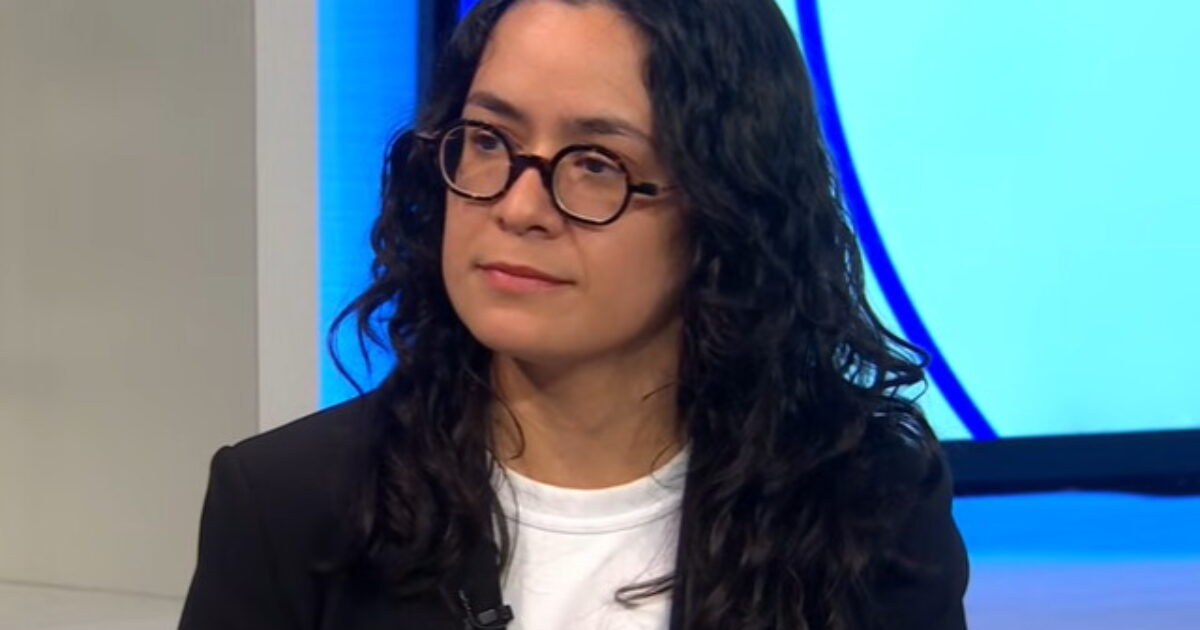
Claire Valdez is a DSA type Democrat running in New York’s 7th Congressional District.
During a recent podcast appearance, Valdez describes meeting with House Minority Leader Hakeem Jeffries and says that she brought up several issues that are important to her, including a ‘trans bill of rights’ which she wants Democrats to pass if they win the midterms.
Democrats have made it clear that they will not let go of the trans issue, no matter what the public thinks. There is simply too much money in the LGBT activist community and the Democrats need it to run campaigns.
Socialist Democrat Nominee Claire Valdez Says She Pitched ‘Trans Bill of Rights’ to Hakeem Jeffries
Socialist Claire Valdez affirmed that a “trans bill of rights” is among the top issues that she wants Democrats to deliver on if they take back control of the U.S. House of Representatives.
Valdez and Avila Chevalier were also asked if they had spoken to House Minority Leader Rep. Hakeem Jeffries (D-NY) about issues like whether ending the war with Iran is a “condition” for “supporting him as speaker” if Democrats take control of the U.S. House.
“We saw the reporting that Hakeem Jeffries has reached out to you guys, and that you’ve talked with him,” cohost Holly Pretsky said. “Is this something you talked to him about as a condition for, maybe, supporting him as Speaker should Democrats take the House back?”
“We haven’t talked about — we haven’t had that kind of conversation, but I, you know, in my conversation recently I wanted to emphasize how important certain issues were in my district and that were defining parts of my race, and that includes the war,” Valdez responded. “It includes the genocide, Medicare for all, Trans Bill of Rights, like, there are a lot of things that I ran on that I want to deliver for my district, and I think it’s our responsibility to do exactly that.”
Watch the video:
DSA candidate Claire Valdez, flanked by Darializa Avila Chevalier, says she told Hakeem Jeffries that a “trans bill of rights” is one of her top issues that she wants a Democratic Congress to deliver on https://t.co/Ue3mLPjUzl