Far left Senate candidate Abdul El-Sayed of Michigan is not connecting with black voters. It was really first noticed during the Democrat primary race when El-Sayed did horribly in black areas of Detroit and other locations.
Several Black voters in Michigan have a message for Senate candidate Abdul El-Sayed (D): Just because we’re Democrats doesn’t mean you automatically have our vote.
The group of Black Michiganders told MS NOW on Tuesday morning they are iffy on El-Sayed, even though he has the D next to his name that they normally look for.
“I think he’s taking advantage [of] we as Black people are Democratic, and he think we gonna vote for him anyway,” one middle-aged woman vented. “And I’m like, ‘No sir, I’m gonna put uncommitted down on that little circle and move on.’ If you’re going to Congress to represent me, I need you to talk about what’s going on in this community.”
The gentleman to her left shrugged and agreed as the woman went off, echoing that El-Sayed assumes they’re “gonna vote for him anyway.”
And another woman made a similar gripe a moment before, saying there have been “missed opportunities” for El-Sayed to “help us understand him.”
Watch a clip below:
Black Michiganders feel abandoned by Abdul El-Sayed:
“He’s taking advantage that we, as black people, are Democratic – and he thinks we’re gonna vote for him anyway, and I’m like, NO!” https://t.co/IZ9zwkZKfb
Secretary of War Pete Hegseth recommended the jihadist killer be executed by the US Army firing squad – and President Trump approved.
President Trump approved Fort Hood Jihadist Nidal Malik Hasan to be executed by firing squad.
“Secretary of War Pete Hegseth has recommended — and President Donald J. Trump has approved — death by U.S. Army firing squad for convicted terrorist Nidal Malik Hasan, the jihadist who opened fire on unarmed American soldiers at Fort Hood in 2009. He killed 13 people and wounded 32 others while shouting “Allahu Akbar” during the attack,” Pentagon spokesman Sean Parnell said on Monday.
US Army policy dictates that the execution must take place within 150 days of the president’s approval.
Nidal Hasan will be executed by US Army firing squad at Fort Hood, Texas, on Thursday, December 3rd, 2026 at 1 pm Central Time.
“The execution officer will be the Commandant United States Disciplinary Barracks,” the Secretary of the Army’s memo read.
The execution of Nidal Hasan by firing squad will take place at Fort Hood, Texas on Thursday, December 3rd, 2026, at 1 p.m. CT. https://t.co/re7BpqkSN4
Dennis Haskins, best known for his role as Principal Richard Belding on the popular early 90s show “Saved by the Bell” passed away from Parkinson’s, TMZ reported.
Dennis Haskins died from Parkinson’s disease … TMZ has learned.
TMZ obtained the “Saved by the Bell” actor’s death certificate from the Los Angeles County Department of Public Health, which lists Parkinson’s disease as the immediate cause of death.
The certificate shows Dennis died September 27 at Providence Saint Joseph Medical Center in Burbank.
The document also lists irritable bowel syndrome, depression, hypertension, and benign prostatic hyperplasia as other significant conditions.
No one knew Dennis was battling Parkinson’s before he died … with his ex-wife, Sarah Quinones, telling us he had even cut off communication with close confidants to hide his diagnosis in recent years.
Dustin Diamond, who played “Screech” on Saved by the Bell passed away in 2021 at the age of 44.
New York State will not increase its minimum wage in January 2027, marking the first time the state has frozen wages since a 2023 law tied future annual adjustments to the rate of inflation and job losses.
Democratic Gov. Kathy Hochul, who is running for reelection in November, is seeking approval for the change from the Democrat-led state legislature, the Times Union reported last week.
New York officials said the state has lost thousands of private sector jobs this year, which triggered the law forcing the minimum wage freeze.
Consumer costs have also increased while confidence has floundered.
Hochul blamed the state’s woes on the “misguided policies” of President Donald Trump, citing his tariff actions and the Iran War.
“This change is good for workers and businesses as it will ensure that those hardest hit by Trump’s affordability crisis keep pace with the cost of living, maintain their purchasing power, contribute to the state economy, and support our small business community,” she said in a statement.
This news comes as other blue states are set to hike their minimum wages for 2027, including neighboring New Jersey.
California, Connecticut, Michigan, and Washington state will also be raising minimum wages beginning on Jan. 1, according to a Fox News report published on Tuesday.
Washington will have the highest wage at $17.73 an hour, up 60 cents from its current $17.13 rate. Connecticut’s minimum wage will rise from $16.94 to $17.48, while California’s will climb from $16.90 to $17.40.
New Jersey will increase the minimum wage by 56 cents to $16.48 an hour for most of its workers, while Michigan’s rate will climb from $13.73 to $15 an hour.
California was recently cited in a report by CNN about how high labor costs are causing businesses to close and hurting the local economy.
CNN senior national correspondent Kyung Lah interviewed Los Angeles business owner Tom Sopit, whose restaurant survived the COVID lockdowns but is now closing due to regulations, taxes, and high labor costs.
“The cost of goods, the cost of labor is much higher than everyone else in the country,” he noted.
“I think you can’t just keep taxing businesses and people,” Sopit added. “How are we just keep paying more taxes, but somehow the state just keeps going downhill? That doesn’t make sense.”
Lah was later interviewed by CNN’s Dana Bash about her sit-down with Sopit and said this type of governance is “going to chase Gov. Newsom as he seeks higher office.”
President Trump speaks to reporters while departing the White House – October 6, 2026
President Trump on Tuesday gave an update on the reflecting pool, which has been undergoing repairs after vandals tore out the blue sealant lining the bottom.
Crazed left-wingers were caught red-handed and witnessed ripping out the lining over the summer. However, US Attorney Jeanine Pirro refused to prosecute multiple individuals despite video evidence of the alleged vandalism.
Surveillance footage, previously shared by Trump, shows suspects reaching their hands into the pool and allegedly ripping out the sealant.
WATCH:
Because of this, the pool was drained to make necessary repairs, which Trump said are now “almost complete.” Interior Secretary Doug Burgum shared a video on X showing the pool being refilled on Sunday.
Emily Miller, an independent journalist who reported on the Reflecting Pool vandals back in June, even catching former Olympian David Hearn’s arrest on camera, asked the President on Tuesday about the ongoing refilling of the pool.
She previously shared a clip of Hearn’s arrest on X, saying he was vandalizing the pool and tried to impede workers cleaning the pool by “grabb[ing] the hose that female National Park Service workers were using to clear the algae.” Miller further said in June that a man was arrested after jumping into the pool and cutting out a “huge piece” of the sealant, among other posts exposing the vandalism.
She did more journalism than anybody in the left-wing media.
Trump on Sunday thanked Miller in a Truth Social post, calling her “absolutely fantastic” and crediting her with catching vandals “REDHANDED.”
“We are proud of the Emily Millers of the World. You keep the Artificial News on their toes. They’ll probably never be honest again, like in the old days, but at least they know we’re watching!” Trump said.
When asked by Miller on Tuesday whether he’s worried about future vandalism once the pool is refilled, Trump said, “we have it about as vandal-proof as you can get, but only sick people do that.”
“And we have their pictures… But sick people do that,” Trump continued.
“Yeah, it’s starting. I think they’re going to fill it up this week. The reflecting pool is totally complete, and we changed the old pipes. We wanted to get it open for July 4th, and now we went and got rid of all of the old pipes, which we were going to do later during the winter. We did it, and I think it’s almost complete from what I understand.”
Trump further confirmed that he plans to visit the pool once it’s completed.
He also told Miller that the grass on the National Mall, which had been vandalized by radical leftists with giant “8647” inscriptions calling for Trump’s assassination, has been replaced with new grass.
Two planes collided on the tarmac at Los Angeles International Airport on Tuesday.
A Delta Air Lines plane and an Air Canada plane were involved in a minor ground collision at around 10:30 am.
It is unclear what led to the collision.
The Air Canada plane was reportedly ‘clipped’ by the Delta Airbus.
No injuries were reported.
“Nothing is more important than the safety of our customers and people, and we apologize to our customers for the experience and delay in their travels,” Delta said in a statement.
A departing Delta Air Lines jet “clipped” an Air Canada plane that arrived from Toronto at Los Angeles International Airport on Tuesday.
The U.S. Federal Aviation Administration (FAA) said in a statement that it was investigating the incident that occurred at 10:30 a.m. local time.
Delta Air Line Flight 7, an Airbus A350, was taxiing for departure when, according to the FAA, its left wingtip “clipped” the horizontal stabilizer of Air Canada AC 785, a Boeing 777.
The FAA added that the Air Canada plane was being towed when it stopped short of its gate.
In separate statements, both airlines confirmed the two planes “made contact” and no injuries were reported.
The Mexican Cartel is threatening to kidnap federal agents at the Texas-Mexico border according to an internal alert obtained by NewsNation.
According to NewsNation, a known ‘alien smuggler’ was planning on bringing illegals from Colombia and Venezuela to the US with the intent to kidnap border patrol officials in the El Paso region.
“CBP maintains proactive intelligence on all foreign actors that are a threat to the homeland. All relevant information is diligently vetted with appropriate partners to determine validity,” the CBP said in a statement to NewsNation.
“The specific tactics, procedures, and methods CBP uses to mitigate these threats and ensure the safety of CBP personnel and equities is robust. CBP does not comment on these methods to ensure the continued safety of our interests and the American Homeland,” the CBP said.
#EXCLUSIVE: The cartel is threatening to kidnap federal agents and officers at the Texas southern border according to an internal alert obtained through DHS sources.
The alert says a known “alien smuggler” is planning to smuggle multiple illegal immigrants from Colombia and Venezuela into the United States— “Initial reporting indicates that the purpose of this operation may include attempts to target and kidnap CBP law enforcement personnel within the Presidio and El Paso areas of operation.”
Via @CBP, “CBP maintains proactive intelligence on all foreign actors that are a threat to the homeland. All relevant information is diligently vetted with appropriate partners to determine validity. The specific tactics, procedures, and methods CBP uses to mitigate these threats and ensure the safety of CBP personnel and equities is robust. CBP does not comment on these methods to ensure the continued safety of our interests and the American Homeland.”
In January 2025, the Trump Administration designated the cartels and other organizations as Foreign Terrorist Organizations (FTO).
Late last month, Trump’s State Department sanctioned Sinaloa Cartel leaders and other individuals tied to the cartel.
“The United States is today sanctioning 21 individuals and 25 entities tied to the Sinaloa Cartel, including cartel leader Ismael Zambada Sicairos (“Mayito Flaco”) and the network of Tijuana- and Mexicali-based cell leaders, financial facilitators, and corrupt Mexican officials who enable the cartel to operate with impunity along the U.S.-Mexico border,” the State Department said.
“This action underscores the Trump Administration’s commitment to dismantling the Sinaloa Cartel’s operational and political infrastructure in Mexico, disrupting the networks that fuel fentanyl trafficking, violence, and corruption, and threaten communities on both sides of the border. Today’s designations reflect the whole-of-government approach the United States is taking to combat transnational criminal organizations and the Foreign Terrorist Organizations with which they intersect,” the State Department said.
“Today’s designations highlight the corrosive reach of cartel influence into Mexican governance, particularly in Baja California, where associates of the governor’s ex-husband, a former Mexicali public security director, and other political operators allegedly accepted bribes to shield Sinaloa Cartel operations from law enforcement,” they said.
While there is no official count, the Trump Administration’s border and financial crackdowns have cost the Mexican Cartels well over $1 billion in losses per year.
President Donald Trump closed out a major Navy shipbuilding announcement in Maryland the way only he can, by breaking into his signature dance to the Village People’s “Y.M.C.A.” while midshipmen and sailors roared, laughed, and filmed him on their phones.
The scene was captured Tuesday at Tradepoint Atlantic in Sparrows Point, the old Bethlehem Steel yard outside Baltimore, where Trump addressed Naval Academy midshipmen and sailors after Anduril Industries unveiled plans for a new “software-defined” shipyard.
The Baltimore Sun reported that “Y.M.C.A.” started as Trump wrapped his remarks and left the stage. Before he did, he told the crowd, “We will build the future of America’s Navy right here in Baltimore.”
WATCH:
LOL Trump hits the dance for midshipmen and sailors and they break out laughing and cheering https://t.co/IqoXt0NzWY
The announcement behind the music is real money and real steel. Anduril said it will put $3.7 billion of its own capital into Arsenal-2 at Sparrows Point, a facility meant to manufacture components for Virginia-class attack submarines, including torpedo tubes.
The Navy awarded a contract worth up to $2.9 billion tied to production outcomes.
Together the package is valued at up to $6.6 billion. The company says the yard should create more than 3,100 permanent jobs and support roughly 11,000 more, with operations expected in 2030.
Secretary of War Pete Hegseth was also on the program. The site once built Liberty ships. It has been idle as a major yard for years.
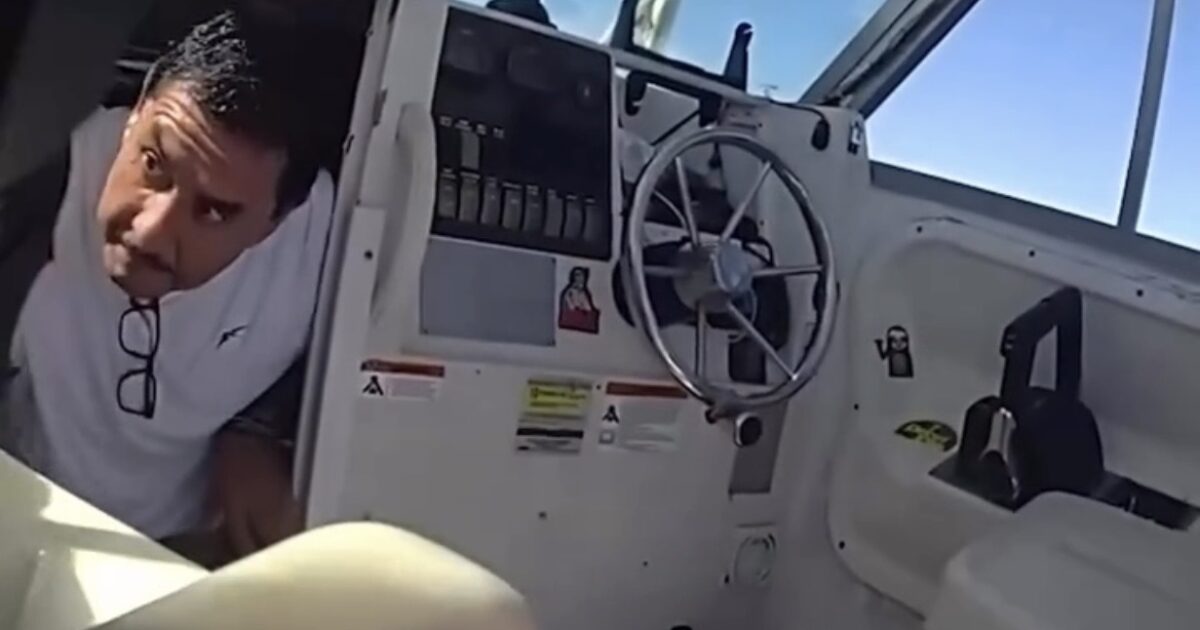
A Marine unit intercepted a smuggling vessel with 14 illegal aliens near Newport Beach, California, over the weekend.
Newport Beach is a wealthy, conservative enclave in Orange County about 95 miles from the Mexican border.
Several smuggling vessels have made it to Newport Beach’s Balboa docks over the last few months.
This time, CBP intercepted the smuggling boat before it reached land and arrested the illegals at gunpoint.
“On October 3, the Long Beach Marine Unit intercepted a vessel south of Newport Beach, California, carrying 14 illegal aliens,” CBPAMO said.
“The crew safely transported all 14 individuals to the US Coast Guard dock in Newport Beach, where one individual was evaluated and cleared by EMS. US Border Patrol assumed custody for processing, and the vessel was seized,” CBPAMO said.
The vessel was carrying 11 military aged males, two women and one minor male, Fox News reported.
Video courtesy of Customs and Border Protection Air and Marine Operations:
Last month, a boat full of illegals docked in Newport Beach, and the occupants of the vessel ran into the coastal neighborhood and disappeared.
According to Fox News, federal court records revealed a Mexican national previously convicted of human smuggling was waiting near the Balboa Fun Zone over the weekend waiting to pick up the illegal aliens arriving by boat.
A Newport Beach councilmember wants to install security camera’s at the harbor’s entrance.
A Kyiv school damaged by a Russian drone strike on October 1, 2026. Students and staff were sheltering inside; no injuries were reported. Photo courtesy of the State Emergency Service of Ukraine/DSNS Kyiv.
Russian drones struck Kyiv throughout October 1, hitting a school, a residential high-rise, a warehouse and, for the first time since the full-scale invasion, one of the capital’s bridges. The Kyiv Independent reported that overnight attacks nationwide killed at least six people and injured 38. Regional reports below cover separate reporting periods, including September 30 and October 1.
That morning, a drone hit a Solomianskyi district school, damaging the facade at the third-floor level and starting a fire. More than 100 students and about 60 staff were in the shelter, and police reported no injuries. A 16-story residential building in the same district caught fire, and drones hit a non-residential complex in the Pechersk district. A warehouse fire in the Obolonskyi district left one person needing medical care.
Around 11:30 a.m., two drones struck near the supports of the Pivdennyi (Southern) Bridge, which carries road and metro traffic across the Dnipro, as a metro train was crossing. The blast wave pushed dust into the cars through ventilation, but no passengers were hurt.
In Kyiv Oblast, the regional administration reported 42 damaged sites across six districts and six people injured. In the Obukhiv district, 20 private houses, a power line, a store and two vehicles were hit, and one person was injured. Four people were injured in the Brovary district and one in Boryspil, while homes, vehicles, industrial buildings and a school were damaged in the Bucha, Fastiv and Bila Tserkva districts.
In Rivne Oblast, an overnight drone strike damaged a house and left a woman hospitalized with shoulder and face injuries, regional administration head Oleksandr Koval said.
Over 24 hours, Russian forces carried out 80 strikes on 23 settlements in 12 communities of Sumy Oblast using artillery, mortars, drones and guided aerial bombs. Two men, ages 40 and 64, were killed and 15 people were injured, many elderly.
In Kharkiv Oblast, regional administration head Oleh Syniehubov said Russian forces attacked Kharkiv and 14 settlements with six missiles, six guided bombs and 32 drones over 24 hours, injuring eight people. The General Staff said Ukrainian forces repelled 13 attacks in the South-Slobozhansky direction near Hrafske, Symynivka, Mala Vovcha, Kozacha Lopan, Ternove and Izbytske, and two more near Novoplatonivka and Kupiansk.
In Donetsk Oblast, Russian strikes on September 30 injured five people, three in Kramatorsk and two in Sloviansk, according to regional police. Eleven private houses were damaged in Yakovlivka, and an administrative building was hit in Stepanivka.
In Dnipropetrovsk Oblast, Russian forces struck four districts more than 30 times with drones, artillery and guided bombs on October 1, injuring four people. Three were hospitalized after a strike on an administrative building in Pavlohrad. An enterprise, a hotel, private homes and vehicles were damaged in the Nikopol district.
In Kherson Oblast, Russian forces attacked 22 settlements, including Kherson city, killing one person and injuring four, regional administration head Oleksandr Prokudin said. In Odesa, an overnight drone attack damaged the roofs and facades of two business center buildings and started a fire, injuring one person.
The General Staff reported about 1,900 Russian personnel losses over 24 hours and 107 Shahed-type drones launched overnight. Ukrainian losses were not disclosed. Energy strikes left some consumers in the Kirovohrad, Rivne, Sumy, Kharkiv and Chernihiv regions temporarily without power. Attacks on Sumy and Kharkiv continue a pattern covered in a recent field report.
During the same overnight attack, Russian drones entered Moldovan airspace, and one exploded near Hîrbovăț in the Anenii Noi district, according to Moldova’s Ministry of Defense. Romania tracked an aerial target near its border but detected no breach of its airspace.
Estonia banned the transit of Russian and Belarusian grain through its territory. Foreign Minister Margus Tsahkna said, “Russia attacks Ukrainian ports, blocks Ukraine’s grain exports, and then looks for new routes for its own grain. Estonia will not provide one.” Russia and Belarus had not used Estonian routes for grain, making the ban preventive.
The United Kingdom announced 31 new sanctions against Russia, targeting individuals tied to the torture of Ukrainian civilians, Novatek Gas and Power Asia and eight shadow fleet vessels. London also extended licenses allowing Japan and South Korea to keep importing Russian liquefied natural gas from Sakhalin-2.
Last week, Russian state news agency RIA Novosti published and deleted a column calling for a “very short” special military operation against Lithuania using nuclear-armed missiles. The piece responded to Lithuania’s parliamentary vote to lift restrictions on stationing nuclear weapons there.








 (@ConradsonJordan)