Pope Leo XIV, the first American-born pontiff in the history of the Catholic Church, used his opening address in Uruguay on November 6, 2026, to issue a sweeping call for universal healthcare “in every society.”
Speaking at a welcome ceremony in Montevideo’s Independence Square alongside President Yamandú Orsi and other dignitaries, the Chicago-born former Cardinal Robert Francis Prevost declared that “ensuring that health care is accessible to everyone, regardless of their resources, is a duty that confronts every society.”
The remarks came less than a month after Leo underwent surgery at Rome’s Gemelli Hospital to remove a malignant tumor from his right lung. He explicitly linked his own experience to the broader demand:
“Recently I experienced firsthand the limitations imposed by illness and I received care for which I am deeply grateful. That experience makes me think of the many men and women who lack the means to obtain a timely diagnosis or receive the treatments they need.”
He added that those who are ill “do not cease to be full members of society, nor do their lives lose any of their value,” and that “caring for those who suffer is a responsibility incumbent upon the entire human family.”
This is not Leo’s first such statement. In March 2026, addressing a conference organized by the World Health Organization and European bishops, he called universal health coverage “a moral imperative for societies that wish to call themselves just” and insisted “health cannot be a luxury for the few.”
Critics of government-run universal systems point to real-world results. Canada’s median wait from general-practitioner referral to treatment has reached 28.6 weeks—more than double the figure from three decades ago—with high rates of patients waiting months for specialists or elective surgery despite high spending.
The UK’s NHS has faced multi-million-person waiting lists and corridor care. Single-payer and heavily socialized models frequently produce rationing by queue rather than price, longer delays, and fewer resources per capita relative to spending in peer nations.
The United States, without a full government monopoly, leads in medical innovation, advanced treatments, and rapid access for those who can navigate the system, even as costs and insurance distortions remain problems.
Approximately 40 masked students at Middle Tennessee State University marched across campus Thursday evening demanding the school disband its Turning Point USA chapter and permanently ban conservative podcaster Joshua Haymes from ever speaking there again.
Organized by the far-left Southern Youth Solidarity Network, the protesters carried signs and repeatedly chanted “fascists off our campus” and “Turning Point, turn away, we don’t want you here today” as they marched past the Student Union and library.
The protest was in response to an October 19 “Pick Up the Mic” debate-style event the TPUSA chapter held outside the Student Union featuring Haymes, a Christian podcaster known for discussing immigration, faith, and culture.
SYSN organizers claim the event brought “white nationalist rhetoric,” racist attacks, and attacks on LGBTQ+ students.
One masked protester told WSMV it was important to resist because such statements “give reasoning for harassment,” linking it to “ICE terror against immigrants,” the “brutalization of black people,” and rights being stripped from women.
WATCH:
SYSN organizer Max Johnson said Haymes “causes commotion amongst the students here whenever he has his debate tent set up, and he also has an online presence where he says very vile things.”
On October 23, the group launched a petition and sent an open letter to MTSU President Sidney A. McPhee demanding the chapter be shut down, and Haymes banned.
As of early Monday morning, it has collected 575 signatures.
MTSU’s Young Democratic Socialists of America is listed as supporting the petition.
The MTSU Turning Point USA chapter rejected the demands in a statement posted to Instagram last month.
“Our chapter’s official opinion is that we will not apologize, conform or regret hosting Mr. Haymes, Mr. Hodges or any speaker that we bring on campus,” the chapter said.
The group added that its official policy is to “uphold the First Amendment of the Constitution of the United States, and promote free speech in our country, our state, our city and our campus.”
If students do not want to hear the speakers, the chapter noted, “they have the freedom to leave the event.”
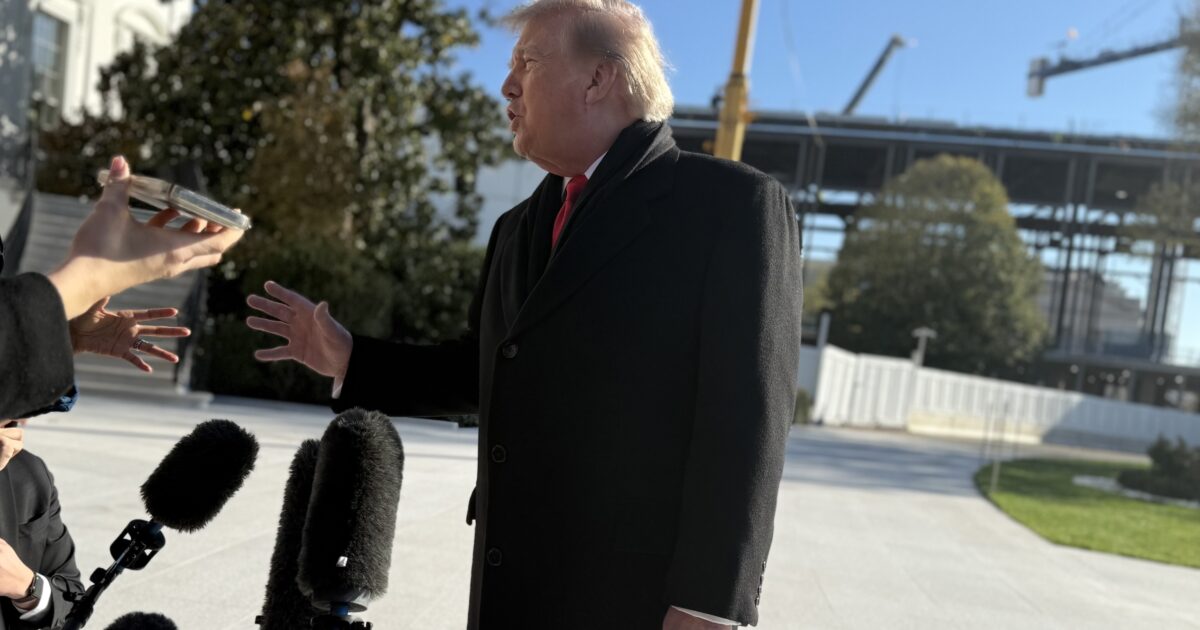
President Trump speaks to reporters on the South Lawn of the White House
President Trump responded on Monday to the situation surrounding Jensen Huang, ex-CEO of the chipmaking giant Nvidia, who is accused of sleeping with a Chinese spy and providing advanced AI chips to China.
Trump spoke to reporters while departing the White House to attend the ASEAN summit in Manila, Philippines, before heading to China for the APEC summit.
Huang came under fire last week after he admitted to an extramarital affair with a woman accused by U.S. intelligence officials of spying for the Chinese government.
He later resigned as CEO of Nvidia amid reports that his mistress was working for China’s Ministry of State Security and gathering information about Nvidia’s advanced chips.
“I don’t know that she’s a Chinese spy, and I’ve said that,” Trump told reporters. He further denied reports that Secretary of State Marco Rubio had alerted him to the potential espionage threat. “I haven’t heard that, no. I don’t know that she is a spy. Usually, what happens with that is that any woman coming to the country that’s a beautiful woman that comes from China, they say she’s a spy. I don’t know that she was a spy at all,” he said.
Trump added that national security “was not put at risk, and our country is now stronger than ever before,” noting that “China plays games with us, and we play games with China.”
Trump fielded multiple questions about the controversy, including whether he supports efforts by thousands of employees, Nvidia shareholders, and tech leaders to reinstate Jensen Huang as CEO.
SpaceX CEO Elon Musk chimed in over the weekend, saying that he is backing a petition to reinstate Huang.
@yunta_tsai A petition is underway to reinstate Jensen and I’m signing it too
Asked about Huang’s reinstatement as head of the chipmaker, Trump said, “I would not mind that.”
“You know, I threw out the name of Tim Cook, but I would say that Jensen’s reinstatement— I think he learned a big lesson. I guess maybe one lesson is more important than another. But I would certainly not mind seeing that,” Trump added.
Trump also responded to reported divisions between Treasury Secretary Scott Bessent and Commerce Secretary Howard Lutnick after Bessent blamed the Commerce Department for export-control failures involving companies suspected of helping China obtain advanced chips. Commerce reportedly delayed placing China-linked Singaporean firm Megaspeed on the Commerce Department’s entity list, a list of companies that may pose a national security risk.
“There are two different views: One view is you don’t want to insult China. We have a very good relationship with China, and you don’t want to insult them,” he said, seeming to agree with the first view. “And the other view is just go, you know, down and dirty and do what you have to do. Both— can’t say either is wrong or right. We’ll let you know.”
“But Jensen, as you know, wanted to sell to China, and the only thing he was able to sell to China were chips that were sort of obsolete, a little bit like our avionics, our aviation equipment. He wasn’t allowed to sell the Blackwell or any of that. But no, it’s a different approach, just a different approach. You know, we’re heading to China, and I don’t think you want to insult China just before you get there,” Trump added.
Lutnick, however, faces scrutiny from within the administration and from Congress, with Senator Jim Banks (R-IN) now calling for Lutnick’s testimony in an investigation into whether he defied export controls and allowed the high-powered chips to be sold to China.
Trump, however, stood by Lutnick, saying he does not plan to replace the Commerce Secretary and arguing that Lutnick may have prevented “a blowup with China” by delaying Megaspeed’s designation as a threat and cutting off the sale of Nvidia chips.
Trump said he “may” discuss the situation with President Xi Jinping when he meets with him in China this week.
The Iranian regime’s embassy in South Africa has publicly identified two American naval officers by name and photo and issued an explicit threat against them on the very day their warship returned to San Diego after the longest destroyer deployment since World War II.
On November 13, the Iranian Embassy in South Africa (@IraninSA) posted images of Commander Leigh R. Tate, commanding officer of the guided-missile destroyer USS Spruance (DDG-111), and Lieutenant Commander Jeffrey E. York, the ship’s executive officer. The post declared: “We will find you.”
This follows a March 28 post from the same account that labeled the officers “two criminals,” claimed they ordered three Tomahawk launches that allegedly killed 168 children at a school in Minab, and asked: “Don’t they have children of their own?” The embassy has continued to circulate the officers’ official Navy portraits while accusing them of war crimes.
The threat landed as the Arleigh Burke-class destroyer pulled into Naval Base San Diego on November 13 after 357 days at sea. The ship departed on November 21, 2025, with the USS Abraham Lincoln Carrier Strike Group.
Its deployment was extended to support Operation Epic Fury, the U.S.-Israeli campaign against Iran that began February 28, 2026.
According to Navy statements, Spruance fired dozens of Tomahawk land-attack cruise missiles at Iranian military targets between February and August, destroyed 12 drones and four anti-ship cruise missiles, served as Surface Action Group Commander near the Strait of Hormuz, and enforced the maritime blockade that included disabling the Iranian-flagged cargo vessel M/V Touska in April after its crew ignored repeated warnings.
Iran’s targeting of these officers centers on the February 28 strike in Minab. Iranian state media and officials claim Tomahawks hit the Shajareh Tayyebeh elementary school, killing roughly 168 people, mostly children.
Preliminary U.S. military findings indicate the strike relied on outdated Defense Intelligence Agency data that still labeled the site as part of an adjacent Islamic Revolutionary Guard Corps (IRGC) naval facility.
The school had previously been within the same compound and is affiliated with an IRGC-linked educational network; its listed address was “behind Asef Brigade.”
Satellite imagery and analyses showed the school and base were separated by a wall years earlier, but Iranian forces had long embedded military assets next to civilian sites. The regime has used the tragedy for sustained propaganda while its own forces operated under the protection of civilian proximity.
Multiple embassies have amplified the officers’ names and faces. Experts note the pattern: Behnam Ben Taleblu of the Foundation for Defense of Democracies told Fox News the public identification of American personnel and talk of retribution “should be setting off alarm bells in Washington, in the White House, the Pentagon, and even within CENTCOM,” given Iran’s history of plots against U.S. officials.
President Trump has previously warned Tehran against targeting American officials, stating that any such action would mean the regime “will not exist very long.” Senior administration figures have adjusted security postures amid persistent threats.
A U.S. Air Force veteran diagnosed with stage 4 ovarian cancer says Canada’s publicly funded health system offered her Medical Assistance in Dying (MAID) before she had even seen an oncologist, prompting her and her husband to repeatedly leave the country for treatment and ultimately move back to the United States, Fox News reported.
Kristin Logan, then 43, and her husband Donovan James, a Canadian citizen who later obtained a U.S. green card, had moved to Canada with their child expecting the financial protection of universal healthcare.
Instead, Logan described being “stymied at just about every turn” by long waits and limited resources.
She was diagnosed in September 2023 and left Canada that same month for initial treatment. After a bowel obstruction in March 2024 she left again, returned in April, and faced a cancer recurrence in December 2024.
According to the couple, Canadian providers presented MAID as the primary early option. Logan told Fox News she received information about ways to end her life “before I’d even gotten an oncology appointment.”
She called it “the most heartbreaking experience, to basically be set up to die,” adding that if she wanted to live she had to “take my life into my own hands and leave the country.”
James described the system as having “slowly sliding into an entire dystopian situation,” calling the expanded MAID program “frightening” and “evil” because it is offered “so easily and so upfront when a person gets sick.”
He said providers focused on death as a “kind offer” while assuming patients would die rather than concentrating on treatment.
During one crisis involving a second bowel obstruction, the couple said Canadian facilities had “no plan to operate,” a helicopter was unavailable for transfer to Vancouver, and a doctor advised them to leave the country if they had the means.
They removed Logan from hospital machines, drove down Vancouver Island, took a ferry, and crossed into Seattle for emergency surgery.
The U.S. surgeon later told them that another day of waiting would have led to sepsis and death in Canada. The family made three separate trips to the United States for care amid Canada’s delays before deciding in January 2025 to leave permanently; they officially relocated by May 2025.
Health Canada describes MAID as “a health service that allows eligible people to receive help from a medical practitioner in ending their life.”
Reporting has noted that MAID now accounts for roughly one in 20 deaths in Canada—about 5%—surpassing rates in some countries where assisted dying has been legal longer.
Median wait times for gynecology from referral to specialist have been reported around 25 weeks, followed by additional weeks to treatment.
The Gateway Pundit has extensively documented similar cases under Canada’s expanding MAID regime.
President Trump speaks to reporters on the South Lawn of the White House
President Trump previewed his trip to Asia this week while departing the White House on Monday and revealed that he “may” meet with North Korean dictator Kim Jong Un.
Trump further confirmed his plans to meet with Russian President Vladimir Putin and Chinese President Xi Jinping on the sidelines of the APEC summit in Shenzhen, China. It will be the first time the three leaders have ever met face-to-face together.
They are expected to discuss the US’s war with Iran, “the reduction of nuclear weapons in the world,” and potentially Russia’s war with Ukraine, according to a White House spokesperson.
The President will first attend the ASEAN summit in Manila, Philippines, where he said he will deliver a “major speech” on economics, before heading to China.
“We’ll be with President Xi,” Trump told reporters on the White House South Lawn this morning.
“We’re also going to meet with President Putin. And we may meet with Kim Jong Un also.”
“We have a chance to accomplish a lot,” Trump added.
WATCH:
“We might have Kim Jong Un. He may come. I don’t know,” Trump later told reporters. “That’s up to President Xi.”
Previously, Trump met with former NBA superstar and personal friend of Kim Jong Un, Dennis Rodman, at a campaign rally in Denton, Texas, last month, which was believed to be a precursor to meeting with Kim Jong Un.
Trump also commended Rodman on stage at his rally, telling the crowd, “When I wanted to get to know Kim Jong Un when we’re having a problem — Kim Jong Un and I get along — but the one who knew him best was Dennis Rodman.”
A source close to Rodman had said, “After the midterms, Trump wants to refocus again on North Korea and start talking about Kim Jong Un.”
Twice-failed presidential candidate Hillary Clinton is already looking ahead to 2029.
During a televised conversation with Rachel Maddow on MS NOW, Clinton laid out several potential avenues for Democrats to pursue legal action if President Trump’s Justice Department refuses to prosecute individuals targeted by congressional investigations.
Her proposed alternatives? Turn to state attorneys general and district attorneys, monitor statutes of limitations, and potentially wait until 2029, when Democrats hope to regain control of the White House.
Clinton expressed frustration over the incoming Democrat-controlled Congress’s potential inability to enforce congressional subpoenas through the Trump Justice Department.
Maddow suggested congressional investigations could expose alleged misconduct, resulting in public pressure, resignations, disbarments, and possible indictments.
But Hillary wanted to go further.
Clinton told Maddow:
“I think exposure is important. But I also think accountability is important. And so once we have the exposure about, you know, what the evidence shows, then how do we hold people accountable?
“Now, in some cases, there may be connected corresponding state criminal actions, and those can be pursued then by state attorneys general and district attorneys.”
Clinton then cited the New York legal cases against President Trump as a blueprint, referencing Manhattan District Attorney Alvin Bragg’s prosecution that resulted in 34 felony convictions and New York Attorney General Letitia James’s separate civil fraud lawsuit.
And then came the most revealing admission of the interview.
Clinton said Democrats should closely monitor statutes of limitations to ensure potential criminal charges remain viable if a new administration takes power in January 2029.
“So I think that we also will pay close attention to statutes of limitation. Because if there is a, you know, change in the Justice Department in 2029, for example, some of those cases could still be pursued.”
The 2028 presidential election is two years away, and Hillary Clinton is already discussing potential prosecutions under a future administration.
Clinton concluded:
“If we’re stymied by the Justice Department to actually bring cases and hold people accountable, then do we bide our time? Do we go to the states? We’ve got to have a bunch of potential options.”
WATCH:
During a televised discussion with Rachel Maddow on MS NOW, twice-failed presidential candidate Hillary Clinton openly discussed how Democrats could pursue criminal cases against Trump administration officials without the cooperation of President Trump’s Department of Justice.
Her proposed strategy? Turn to state prosecutors or preserve potential criminal cases until Democrats regain control of the federal government. https://t.co/pcwtvylOeB
Election officials in Bannock County, Idaho, discovered a sealed box containing 333 uncounted midterm ballots from Pocatello Precinct 2 inside a poll worker’s pickup truck.
The ballots, which had been in the truck for a week, were found during a search for missing election supplies.
County Clerk Jason Dixon claimed the box had slid forward from the tailgate toward the cab of the truck, where it went unnoticed when volunteers unloaded materials in the dark.
According to the Idaho State Journal, this year’s ballot was two pages long for the first time since 2018. This caused issues with machine roller tension and folds that landed on the timing marks along the edge of each ballot “kicked thousands of absentee ballots out of the machines and onto a resolution table,” where unpaid volunteers worked through the night.
Workers began counting ballots on two of the county’s three machines around 2 a.m., while a third continued processing absentee ballots.
“Otherwise, we were going to be there forever,” Dixon told the Journal.
Volunteers transported the ballots from polling places to the election office in their own vehicles.
Dixon said in a joint statement with the Idaho Secretary of State’s Office:
“Needless to say, this should not have happened. We take pride in Bannock County in the work that goes into running our elections. We are working closely with the Secretary of State’s office to ensure full transparency and to determine if additional steps can be taken to ensure this does not happen. I want Bannock County voters to know your votes will count.”
Officials said the box’s seals remained intact and matched the precinct’s records.
After the ballots were counted, no race outcomes changed.
“Ultimately, in clear eyes, fresh sleep, the ballot box was found. The ballot box was counted and it aligned with all of the numbers that we received on Election Day,” Bannock County Public Information Officer Emma Iannacone told the Idaho State Journal. “It didn’t change any results, and all the processes that needed to be followed, after the box was found, have been followed.”
Bannock County commissioners later recanvassed the results, including the additional ballots, and declared them official.
Separately, Latah County in northern Idaho identified a larger reporting issue involving more than 2,300 early ballots.
During a routine review, County Clerk Julie Fry’s office found that tabulation machines had counted 2,343 early voting ballots, but they were not fully transferred to the statewide election-night results reporting system.
The ballots represented roughly 13 percent of the 18,104 total ballots cast in the county.
A recount overseen by the Secretary of State’s Office found that no race or ballot measure outcomes changed.
Fry stated, “We take our responsibility to accurately report election results seriously, and this error should not have happened.”
On Friday, the Idaho Board of Canvassers, consisting of Secretary of State Phil McGrane, Controller Brandon Woolf, and Treasurer Julie Ellsworth, conducted a random drawing at the state Capitol to select counties for required post-election hand-count audits.
Both Bannock County and Latah County were among the eight counties drawn.
The audits involve hand-counting selected ballots and comparing the results to each county’s official canvass.
Bannock County’s audit is scheduled for Tuesday, November 17, at 9:30 a.m. at the elections office in Pocatello.
Latah County’s is set for Monday, November 16.
McGrane said of the audits, “Confidence in our elections comes from being able to show our work. These audits give us a chance to check the count by hand and let Idahoans see for themselves how we verify the results.”
Idaho law requires such audits after even-year primary and general elections.
Election results statewide remain unofficial until the Board of Canvassers certifies them later this month.
Christians from churches across South Florida gathered outside an abortion clinic Saturday for Love Life’s year-end prayer walk with a simple message: the prayers are working.
“This year, church, by the grace of God, 91 babies have been rescued,” the opening speaker told the crowd. He said that brings the local total to “over 400 babies” since the ministry began there, and “almost 8,000” nationally.
One of them was in the arms of Ezra Deane, who leads Love Life in Broward County. “This is baby Saul,” Deane told The Gateway Pundit. “He’s alive.” He said Saul’s mother, who came to the ministry’s office, is now pregnant again “because of our support and help.”
Ezra Deane of Love Life holds baby Saul at the Nov. 14 prayer walk. (Barry Ramey)
From Abortion Center to ‘The Plan for Parenthood’
Deane said Love Life brings the church to abortion centers for “a prayerful, peaceful presence” and prays outside “in the hopes that the abortion centers will close down.”
Men carry a wooden cross along the prayer-walk route on Nov. 14. (Barry Ramey)
The first target, Deane said, was a clinic in Plantation that had operated as an abortion center for 23 years. “We took the church there for four years,” he said. “And after four years, it shut down, and we took it over.”
According to Love Life’s website, that building, the former Aastra Women’s Center, “has been renamed The Plan for Parenthood and now serves as the Love Life Broward County office.”
And the women keep coming.
“Because it was ingrained in our society for so long, for 23 years, women are still coming every single day, and we’re there to tell them that there’s hope and his name is Jesus,” Deane said. “They’re expecting to come for an abortion, but they’re met with the hope of the gospel.”
Deane said the group did the same at Fort Lauderdale Women’s Center, “the second abortion center that closed down,” and took over that building as well. Love Life reports that the center closed in 2025. Deane said the clinic where Saturday’s walk was held is “going to be our next office.”
Love Life organizer Ezra Deane speaks with The Gateway Pundit on Nov. 14. (Barry Ramey)
“When a mother chooses life, that’s just the beginning,” Deane said.
He said the ministry offers “full practical support,” including transitional housing. “Every mother gets a Thanksgiving. Every mother gets a Christmas. Every mother gets a baby shower.”
A little one smiles from her stroller at the Love Life prayer walk. (Barry Ramey)
Mothers are connected to a mentor program with “over 150 partners in churches locally.” “We walk with that mother from the womb to the tomb,” Deane said, covering everything from “diapers, essentials, formula” to rent and bills.
Lily, who works with Love Life’s mentors and moms, put it plainly: “We pay phone bills, we pay car notes, we pay rent. We help them with car repair. We help them with food.”
The best part, she said, is seeing mothers go “from not wanting the baby to loving the baby.”
A mother who chooses life shouldn’t face it alone. Donate to Love Life South Florida, the ministry Deane says stands with these moms for years.
Open-Heart Surgery — Inside the Womb
Dr. Bill Lyle of ProLifeDoc.org, a board-certified OB-GYN introduced as having delivered over 5,000 babies, told the crowd about open-heart surgery performed at the Cleveland Clinic on a baby who was still inside his mother’s womb.
Dr. Bill Lyle of ProLifeDoc.org addresses the prayer walk on Nov. 14. (Barry Ramey)
An ultrasound had found a heart tumor, a cardiac teratoma, that Lyle said “was going to kill that baby by squeezing against that baby’s heart.” Rather than deliver him early, the parents chose surgery before birth.
Lyle described a team of 36 and two anesthesiologists: one for the mother, who stayed awake under an epidural, and one for the baby, who got an IV in his tiny hand. Surgeons opened his chest and spent three hours removing the tumor “from the beating heart of the baby,” then left him in the womb to recover.
He was delivered by C-section 10 weeks later, at 37 weeks.
“He is doing wonderfully, and his name is Rylen,” Lyle said.
“If we can perform open-heart surgery for a baby on the inside of the womb, is that a patient? Absolutely,” he said. “All patients have rights, and a patient is a person, no matter how small.”
Turning Point USA Shows Up
Turning Point USA volunteers representing TPUSA Families staffed a table offering help starting community groups, grants, and pro-life posters.
“We’re big fans of everything they do,” one volunteer said.
Pointing to a favorite poster, the volunteer read it aloud: “It’s okay to like babies being born. It sounds crazy in this day and age, but that’s what we believe.”
Their turnout comes just over a year after TPUSA founder Charlie Kirk was assassinated in September 2025.
Turning Point USA volunteers at their table, with a poster reading “It’s okay to like babies being born.” (Barry Ramey)
‘Everybody Can Do Something’
The closing speaker said three abortion centers have already closed in the South Florida area and urged the crowd to make this one “number four,” asking everyone to pray for one minute every morning at 9:29.
“When we say choose life,” the opening speaker said, “we must also be ready to say we will walk with you. You are not alone.”
Attendees kneel in prayer after the walk. (Barry Ramey)
Obama-appointed U.S. District Judge Tanya S. Chutkan has granted the Association of American Universities (AAU) a preliminary injunction blocking the Department of Education from publishing the names or any identifying information of foreign donors to major U.S. universities.
Chutkan, born in Kingston, Jamaica, and the same judge who previously handled the federal election-interference case against President Trump, ruled on November 13, 2026, that the AAU is likely to prevail on its claims.
She claimed that the Department of Education had repeatedly assured universities for years, through 2020 and 2023 information collection requests, that identities of foreign donors reported under Section 117 of the Higher Education Act would remain confidential, then abruptly reversed course without a reasoned explanation.
The judge also held that universities would suffer irreparable harm from disclosure (damage to donor relationships, potential safety risks to donors in repressive countries, loss of future funding, and First Amendment associational interests) and that the balance of equities plus the public interest favored blocking publication.
This is the extension of the temporary restraining order Chutkan issued on October 1, 2026, just as the department prepared to release the names.
As The Gateway Pundit previously reported, that earlier order halted publication of donor details tied to as much as $5.2 billion in reportable foreign gifts and contracts since 2020 (with universities reporting more than 8,300 transactions in 2025 alone and a cumulative $67.6 billion since Section 117 was enacted in 1986).
Section 117 requires institutions receiving federal funds to report foreign gifts and contracts of $250,000 or more. The statute primarily mandates aggregate amounts by country for most sources; identities are required mainly in ownership or control cases.
The department began collecting names in 2020 (during President Trump’s first term) while promising confidentiality under FOIA exemptions to protect donor privacy and safety.
In June 2026 the Trump administration reversed that policy as part of broader scrutiny of foreign influence on campuses. The department had already published 92 “counterparties of concern.” The rest of the list was set for release until Chutkan stepped in.
Department officials have previously described the money as coming from foreign governments, militaries, businesses, or entities tied to Chinese intelligence or the People’s Liberation Army.
One official told the New York Post the secrecy push is “a pretext to prevent public transparency” about enterprises funneling billions to top universities “mainly to do two things”: steal intellectual property and, in the case of Arab-country gifts, “change what’s taught on US campuses” by funding anti-Zionist and anti-Western ideology.
Education Department spokeswoman Ellen Keast has said the litigation protects schools “cashing multi-million-dollar checks from malign foreign actors that fund centers and faculty who promote anti-Western ideologies and support partnerships that are designed to export sensitive technology to geopolitical adversaries.”
In February, the Department of Education revealed that American universities reported more than $5.2 billion in foreign gifts and contracts for 2025 alone.
The largest foreign sources included:
Qatar: More than $1.1 billion
United Kingdom: More than $633 million
China: More than $528 million
Switzerland: More than $451 million
Japan: More than $374 million
Germany: More than $292 million
Saudi Arabia: More than $285 million
Harvard University alone reported receiving more than $610 million cumulatively from counterparties located in countries designated as countries of concern under federal law.
Since the federal disclosure requirements were enacted in 1986, American universities have reported a staggering $67.6 billion in foreign funding.
The Education Department also identified more than $2 billion in foreign gifts and contracts that were reported late in 2025.


 (@tpusa_mtsu)